
MHRA on Passing the Baton from GPvP to GMP

I love the MHRA Inspectorate blog. They don’t write often, but when they do, good stuff. Here are some of my thoughts on the post on moving patient safety data from determination as part of the pharmacovigilance efforts to labeling to distribution.

Starting in the Good Pharmacovigilance Practice (GPvP) realm, triggers for updates may be identified by pharmacovigilance staff and the corresponding variations submitted by regulatory affairs staff, who will also receive notification of variation approval. At this stage Good Manufacturing Practice (GMP) processes come into play with arrangements for printing the updated leaflets and incorporating these into the supply chain.

MHRA Inspectporate Blog “Passing the baton from GPvP to GMP: Three top tips for protecting patients and staying compliant ” 17 Dec 2019

“Unless otherwise stated, updates to patient information leaflets should be introduced within 3 to 6 months of approval” – this is the critical point stressed in this post. The recommendations given in the blog post are solid.

Blog RecommendationThoughts
Check that the end to end process facilitates the timely implementation of updates and that there is seamless transition from written procedures covering GPvP, regulatory affairs and GMP processes. Labeling is often a separate change control process. Integration and simplification in change management is critical and companies should look seriously at balkanization of systems.
Define what is meant by ‘implementation’ of an updated leaflet and make sure this is in advance of regulatory deadlines to prevent the need for batches being re-worked should there be any unexpected delays Effective dates on changes need to take into account deadlines.

Appropriate linkages to ERP and supply chain systems.
Ensure the QP has access to up to date information on the correct leaflet version that should be used at batch certification. Communication, and the use of integrated change management

I also read this morning Teresa Gorecki’s post “Dedicated, Integrated Quality Assurance Systems Critical to Successful Clinical Trials.” All of her points are highly relevant here.
Teaching Quality People to Listen

Been thinking a lot on what a training program around teaching people to listen and not to talk might look like and how it fits into a development program for quality professionals.

People in quality think a lot on how to make a reasoned argument, a good decision, to provide guidance, get their point across in meetings, persuade or coerce people to follow standards. This is understandable, but it has a cost. There is a fair amount of research out there that indicates that all too often when others are talking, we are getting ready to speak instead of listening.

I think we fail to listen because we are anxious about our own performance, concerned about being viewed as an expert, convinced that our ideas are better than others, comfortable in our expertise, or probably all of the above. As a result we get into conflicts that could be avoided, miss opportunities to advance the conversation, alienate people and diminish our teams’ effectiveness.

When we really listen we create the spaces to make quality decisions. Listening can be improved by these practices:

Ask expansive questions. Stay curious, build on other’s ideas are mantras I think most of us are familiar with. Suppress the urge to interrupt or dominate a conversation and concentrate on the implications of other people’s words. It is very easy for a quality professional to instantly leap to solving the problem, and we need to be able to give space. Focus on open-ended “what” and “how” questions, which encourage people to provide more information, reflect on the situation and feel more heard. Avoid yes-and-no questions which can kill dialogue.

Engage in “self-checks”. Be aware of one’s own tendencies and prepare with ways to identify they are happening and head them off. Doing this will surprisingly allow you to focus on the listener and not yourself moving beyond the words that are being said and being able to take in the speaker’s tone, body language, emotions and perspective, and the energy in the conversation.

Become comfortable with silence. This means communicating attentiveness and respect while you are silent.

Listening needs to be part of our core competencies, and unless we work on it, we don’t get better.

System failures are rarely due to the employee

Between January 2016 and May 2019, you recorded approximately 397 customer complaints related to container closure issues (e.g., approximately 60%), product separation, lack of effect and adverse events. Your quality unit failed to adequately review these complaints, identify trends, and implement effective CAPAs. During the inspection you explained that these lapses in quality system performance were due to underperforming staff, who had since been dismissed. In your response, you attributed these and other quality related issues to under staffing of the quality unit as your business expanded.

Your response is inadequate because you failed to appropriately address your quality unit not performing their required duties. Your firm must provide the quality unit with the appropriate authority, sufficient resources, and staff to carry out its responsibilities to consistently ensure drug quality.

FDA Warning Letter to Teligent Pharma, Inc. dated 26-November-2019

Continuing the trend of making me petrified about generics, this warning letter is a roller-coaster read. One big set of failures is to actually investigate and apply appropriate resources to the quality unit. And then the management had the gall to blame the employees.

80+ years of quality principles ignored. I personally thought the FDA was being overly nice.

There are basically three questions to answer:

  • Do you have a properly established, staffed, and managed Quality Unit?
  • Does your Quality Unit have appropriate responsibilities and authority?
  • Does your Quality Unit have access to the data it needs to make informed decisions?

Decision Quality helps overcome bad outcomes

We gather for a meeting, usually around a table, place our collective attention on the problem, and let, most likely let our automatic processes take over. But, all too often, this turns out to be a mistake. From this stems poor meetings, bad decisions, and a general feeling of malaise that we are wasting time.

Problem-solving has stages, it is a process, and in order for groups to collaborate effectively and avoid talking past one another, members must all be in the same problem-solving stage. In order to make this happen our meetings must be methodical.

In a methodical meeting, for each issue that needs to be discussed, members deliberately and explicitly choose just one problem-solving stage to complete.

To convert an intuitive meeting into a methodical one take your meeting agenda, and to the right of each agenda item, write down a problem-solving stage that will help move you closer to a solution, as well as the corresponding measurable outcome for that stage. Then, during that part of the meeting, focus only on achieving that outcome. Once you do, move on.

A Template for Conducting a Methodical Meeting

Pair each agenda item with a problem solving stage and a measurable outcome.

Agenda ItemProblem Solving StageMeasurable Outcome
Select a venue for the offsiteDevelop alternativesList of potential venues
Discuss ERP usage problemsFrameProblem statement
Implement new batch record strategyPlan for ImplementationList of actions / owners / due dates
Review proposed projectsEvaluate AlternativesList of strengths and weaknesses
Choose a vendorMake DecisionWritten decision

If you don’t know which problem-solving stage to choose, consider the following:

Do you genuinely understand the problem you’re trying to solve? If you can’t clearly articulate the problem to someone else, chances are you don’t understand it as well as you might think. If that’s the case, before you start generating solutions, consider dedicating this part of the meeting to framing and ending it with a succinctly written problem statement.

Do you have an ample list of potential solutions? If the group understands the problem, but hasn’t yet produced a set of potential solutions, that’s the next order of business. Concentrate on generating as many quality options as possible (set the alternatives).

Do you know the strengths and weaknesses of the various alternatives? Suppose you have already generated potential solutions. If so, this time will be best spent letting the group evaluate them. Free attendees from the obligation of reaching a final decision—for which they may not yet be ready—and let them focus exclusively on developing a list of pros and cons for the various alternatives.

Has the group already spent time debating various alternatives? If the answer is yes, use this part of the meeting to do the often difficult work of choosing. Make sure, of course, that the final choice is in writing.

Has a decision been made? Then focus on developing an implementation plan. If you’re able to leave the conversation with a comprehensive list of actions, assigned owners, and due dates, you can celebrate a remarkably profitable outcome.

New Report Exposes MBTA’s “Questionable” Approach to Safety

A “debilitated” safety department and too-thin maintenance crews are just two of the revelations surfaced by a new report on the MBTA’s safety culture.

Read on www.bostonmagazine.com/news/2019/12/09/mbta-safety-report/

Let’s cut right to the heart of the report’s recommendations:

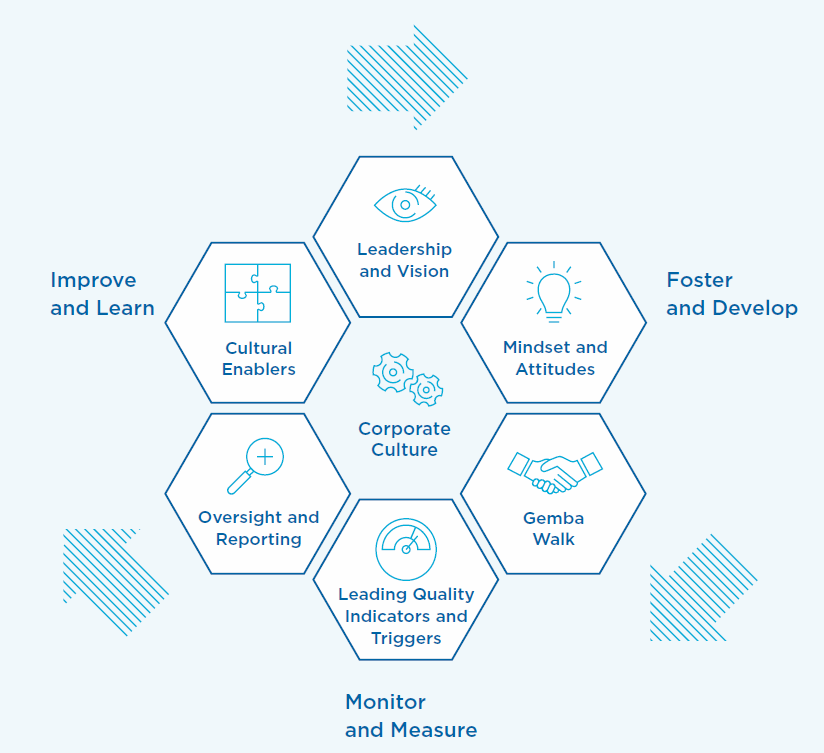
“The panel makes six policy recommendations that are intended “to move the organization to a place where safety is a priority and is culturally integrated into every aspect of their mission.” They include establishing better safety performance indicators, identifying the areas where maintenance is being deferred, implementing stronger data collection, and strengthening the MBTA’s leadership team with “more seasoned” transit professionals.“

Where does that seem familiar?