
Every change is a project, every project is a change

Project Management, the structured approach for managing tasks, resources, and budget to achieve a defined deliverable, is an important part of the quality management toolbox, and an important aspect to build into your change management program.

There are a lot of project management methodologies, but they all boil down to having an understanding of the tradeoffs between time, cost, and scope of a change; and then motivating a team towards delivering the change.
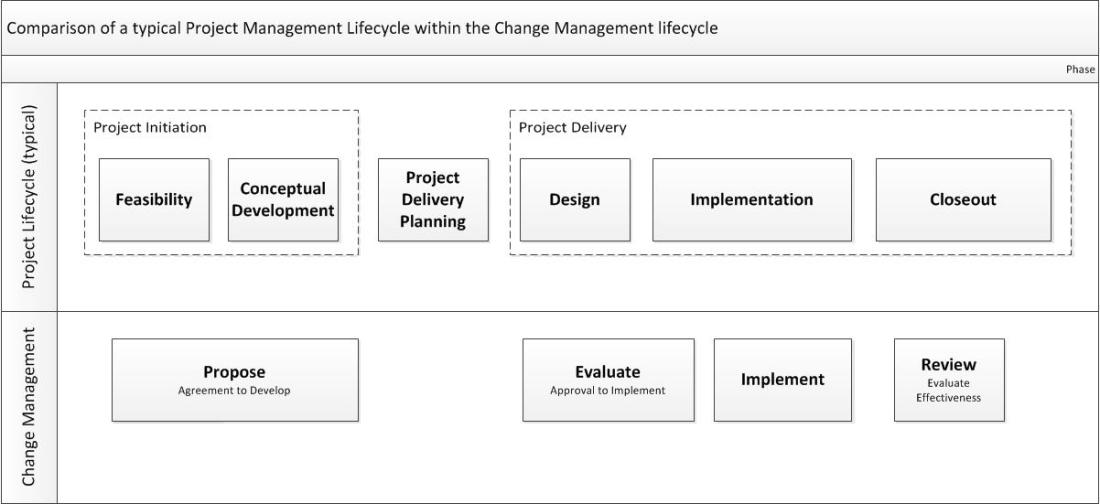
project and change comparison

Evaluate is best seen as a gate at the end of the project’s design (or a phase of design). A well-designed project, with appropriate stakeholders and team members ideally, will flow nicely into an evaluate change control (or set of change controls). Having this as part of your gate to develop will ensure that the right subject-matter-experts have been involved, that all potential risks and impacts are understood, and will ensure the site is ready to implement.

Small projects and the change management lifecycle are usually one and the same.

For projects with a large impact, it is often important to create more than one change control, to ensure appropriate implementations. In these cases it is often useful to create a change strategy (or incorporate in a project deliverable, such as a gate document) which can include:

Scope Describe the project, indicating the current and future state.
Roles/ Responsibilities Indicate what functions/departments will serve what role in the change controls

Indicate the role and responsibilities of project management.

Methodology/ Strategy What activities are included and how they will be organized.

How many change controls will be created as part of this strategy.

How change controls will be organized and linked together (e.g. dependencies).

Provide a methodology for managing changes and ensuring all change control activities happen according to the provided timetable.

Things to Consider:

Are there other changes that affect the same room/area or equipment?

How are affected rooms/areas/equipment being taken out of and placed back into service as to not to interfere with the provided timetable?

Will these change controls affect daily operations/sampling?

How will changes be organized? For example, will changes be organized along install, validate and implement?

If multiple areas are to be affected, will there be changes in Material and Personnel Flow that will need to be modified to execute the multiple changes?

Effectiveness Review If the project will have one effectiveness review (e.g. a process validation, comparability protocol, stability study) indicate, provide the effectiveness review criteria and justify. Provide a timeline for completion of the effectiveness review.
Regulatory Strategy Regulatory strategy for filing the project (e.g. will the changes be filed independently or together, at what point, which changes will require regulatory assessment)
Planned Timetable Timelines for writing, approving, implementing and closing change controls.

Take the dependencies written in the Methodology/Strategy into consideration when developing the timetable

Closure Plan How will the strategy be closed? What are the criteria for a successful project closure?

For larger projects, the change evaluation will start in the project design phase but can continue through implementation as individual changes are put in place.

The advantage of writing this strategy allows the project to consolidate deliverables and ensure the right level of effort is put into the changes across the project.
The Quality Toolbox

The Quality Toolbox by Nancy Tague is such a useful book that it belongs on everyone’s bookshelf.   Tools are included for generating and organizing ideas, evaluating ideas, analyzing processes, determining root causes, planning, and basic data-handling and statistics. From the seven basic quality tools to a wide variety of more sophisticated tools, this my first go-to when I am trying to figure out the best tool for a task, each  getting a solid write-up that can propel you into use.

The core spine of the book is a matrix that helps find the right tool base don three questions:

  1. What do you want to do with the tool (project planning, idea creation, process analysis, data collection and analysis, cause analysis and decision making)
  2. Where you are in process improvement methodology
  3. Whether you need to expand or focus thinking

Each tool gets a solid treatment, with examples and templates so it can be put into use.

Quality professionals tend to acquire a resources on specific tools. This book serves to easily consolidate tools, help you identify the right tool to use, and will probably also introduce you to a bunch of new tools.

Regulatory Impact of Changes

In a regulated industry, such as pharmaceuticals or medical devices, knowing your changes impact your regulatory partners is a critical aspect of change management. For example, the MHRA in their yearly summarizations of GMP inspection deficiencies consistently cites failure to perform adequate review of need of regulatory notification (for example, see 2016 trends). And to be frank, we in the industry are often looking for more guidance, which drives responses like ICHQ12 and the FDA’s March 2018 draft guidance CMC Changes to an Approved Application: Certain Biological Products and all the other similar guidances out there.

These all follow a similar risk-based approach, and this approach should be built into your change management system (and applicable change control process).

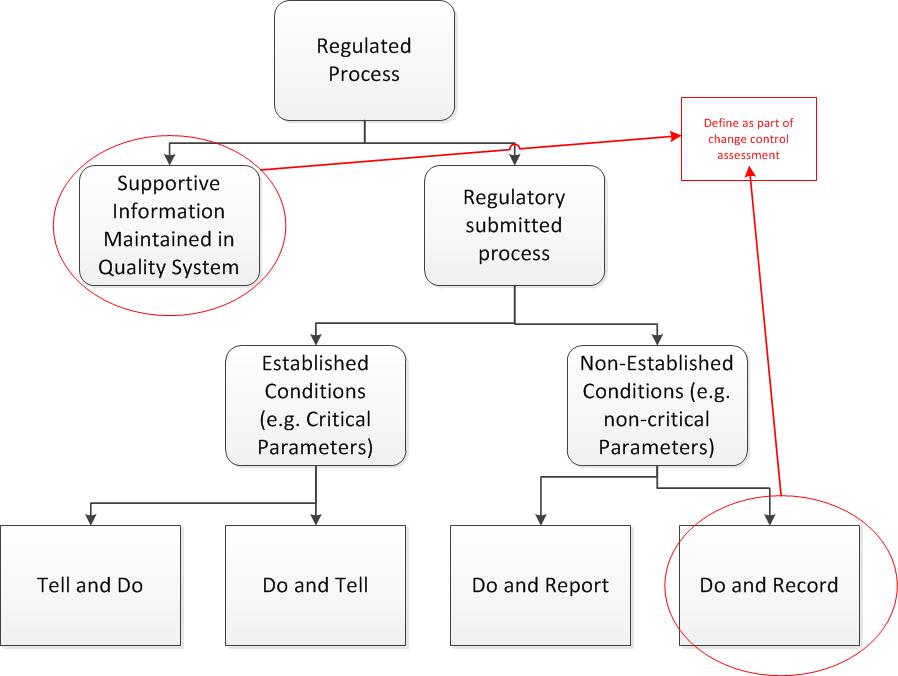
regulatory structure2

The major difference between Supportive Information and Do-and-Record is usually what goes in your product quality report (APR/PQR). Fro example, I often see qualification of facility fit into the Do-and-Record area. These changes may not be fillable, but you certainly want to review and account for.

Many companies manage this through their regulatory affairs organization, but that can be time consuming. It is better to take the time to identify the supportive and do-and-record categories out front, thus removing the need for an extra assessment. The PQR review process is a great tool for ensuring consistent execution.

This risk based approach should look at the dossiers, taking into account any special market considerations, as well as current best practices in the regulations. For those companies lucky enough to be more towards the QbD model, established conditions will greatly help here.

Then build a matrix to help guide your changes. An example could include items like these:

Facility, Equipment, Manufacturing Systems, Utilities & Automation Equipment/instrument maintenance
Decommissioning of equipment not classified as critical equipment
Computer programming that affects non-production equipment
Alarms (i.e., notification system for out of tolerances)
Cleaning and Sanitization of Manufacturing facilities and non-product Contact equipment
Upgrade of Application Software or operating system
Alarm setpoint changes
Creating user groups and modifying user group privileges
Tuning parameter, adjustment to the gain, reset and rate of a PID controller
Manufacturing Processes In-process labeling
Changes to Process Control and Operating Parameters (tightening/shifting) within current non-established conditions
Change in equipment sterilization times
The addition of in-process or final product samples
Changes to sample volume for in-process or finished product samples
Addition of new ancillary equipment (e.g. no product contact, does not control process steps) to the process

You can then further delineate between Supportive Information and Do-and-Record on a few other criteria, such as qualification/validation impact.

Like many areas of good system management, this is an area where a forethought and design can reap dividends in making your changes more nimble while preventing a compliance mishap. Tapping into the PQR makes all this part of your knowledge management system, and allows you to grow as your needs grow. This is definitely not a once-and-done process.


Quality Metrics – Not Dead yet

Pink Sheet has an update this week on the FDA’s Quality Metrics initiative – US FDA Quality Metrics Initiative Continues Moving Forward … Quietly.

This is behind a firewall so may not be viewable by all.

The major takeaways were:

  1. The initiative is still happening
  2. the FDA wants to remind companies why they are doing this in the first place
  3. They are starting a pilot real “soon” now

These metrics have been a hard sell within Pharma. I’ll be curious what steps the FDA will be taking to rebrand the effort.

ASQ – Pharmaceutical GMP Professional Certification

The ASQ’s CPGP certification is a very broad body of knowledge that covers regulatory agencies, to facilities and utilities, to testing, to release. In short, about every aspect of a GMP facility.

I am maybe the only person I know in the field who has this certification. I don’t know the details, but uptake does not seem as high as other certifications I am aware of. Yesterday at lunch I ended up discussing this with a few colleagues. We discussed a few options:

  1. The certification is not well known. Most of my colleagues were not aware of it.
  2. Many pharmaceutical GMP professionals are more directed at the PDA and ISPE. The ASQ is well known, but perhaps not as important when considering options.
  3. This certification is a generalist. There was a general opinion that many quality professionals tend to be specialized and might not feel comfortable stretching their wings.

Is there value in this BoK? Definitely. I found this certification much harder than the CMQ/OE, and as a result, I’m prouder of having it. The major question is how can we make this more valuable to the field. This is certainly a question I’ll be asking next week in Seattle.