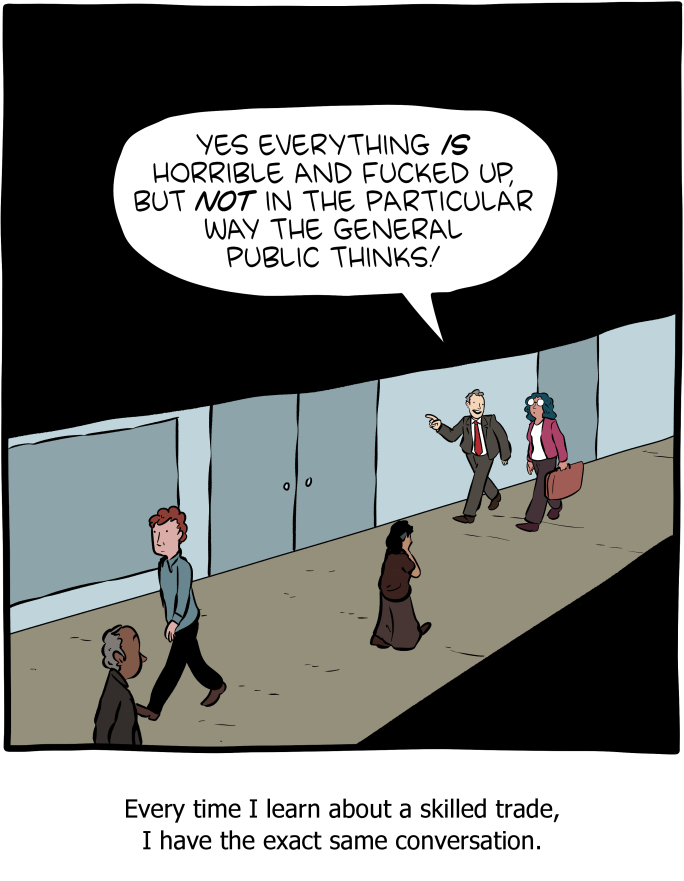
Automation has been a truism throughout my career. Organizations that leveraged that automation to create value were superior to the ones which used that automation as an excuse to cut jobs.
As we move oh so quickly to dealing with the impact of hyper-automation on our organizations it is important to have a vision and a strategy. Apply quality principles, and remember to drive out fear through the strategic execution.
The word quality is a loaded word in organizations, and I’m sure most of my readers have been in a least one major discussion that has felt like an Abbott and Costello routine.
The difference between “quality” and the “Quality department” is that “quality” refers to the overall level of excellence or excellence in a product, service, or process, while the “Quality department” is part of an organization that is responsible for ensuring that the organization’s products, services, or processes meet certain quality standards.
In other words, “quality” is a general concept that refers to the level of excellence or excellence in something, while the “Quality department” is a specific part of an organization that is responsible for managing and improving the quality of that organization’s products, services, or processes.
The Quality department typically plays a key role in ensuring that an organization’s products, services, or processes meet the required quality standards. This might involve activities such as conducting quality assurance audits, implementing quality control measures, or providing training and support to help employees understand and comply with quality standards.
Overall, the difference between “quality” and the “Quality department” is that “quality” is a broad concept that refers to the overall level of excellence or excellence in something, while the “Quality department” is the specific part of an organization that is responsible for managing and improving the quality of that organization’s products, services, or processes.
In FDA-regulated industries, this continues to be a stressful point. We have some regulations that specifically call out the Quality Unit or Quality Control (a different point of fun), while others provide quality expectations that may or may not be the responsibility of the Quality Unit, depending on the way your organization is built.
Add to this that quality is a culturally sensitive term. It gets to the heart of what people consider integral to themselves. That they have quality in their work. And there can be gaps between people’s perceptions and the reality of the organization. The whole concept of what quality is in an organization gets to three central aspects:
Role Conception: what people think their jobs are and how they have been trained to perform them
Role Expectation: what others in the organization think another person’s job is and how it should be carried out
Role Behavior: what people actually do in carrying out their job
So we have quality as a set of habits and practices and Quality as a concept of a role within an organization. And the boundaries between the two can be contentious. Add in the quality control layer (and how quality control does not require a department called quality control) and we can have a whole fun set of arguments.
This post was brought to you by me being in a meeting where someone referenced a version of the golden triangle and I instantly wondered what work someone else was trying to foist off onto me.
I am looking forward to speaking at the GxP Cloud Compliance Summit in Boston in September on Implementing a Lifecycle Risk Management Approach to the Cloud. I’ll be discussing some of my favorite topics:
Best practices to harness a life cycle risk management approach to protect product quality and patient data
What does a living risk assessment look like when key parts of your IT infrastructure is maintained by cloud service providers
How does Q9 R1 impact functional and usage assessments around cloud applications
I am looking forward to meeting and discussing some of the critical questions in our heady embrace of the cloud.
Cloud based GxP systems have shifted in the last few years from “Something I guess we should figure out” to “Well guess we have it now” to “Well that is all I seem to have now.” And where 5 years ago it seemed we were obsessed about the fine details of Open vs Closed systems and what cloud-based applications are, we are now looking at much more mature questions around a risk based strategy that evaluates and ensures appropriate controls around Data Integrity, Privacy, and Security. Through a risk-based approach, we drive activities such as auditing, change control, qualification/validation, and oversight.
I am looking forward to having this discussion with my peers and sharing best practices and experiences. It is only though this type of event that we can grow as a professional.
Engaging with knowledge and Knowledge Management are critical parts of development. The ability to navigate the flood of available data to find accurate information is tied directly to individuals’ existing knowledge and their skills at distinguishing credible information from misleading content.
There is ample evidence that many individuals lack the ability to accurately judge their understanding or the quality and accuracy of their performance (i.e., calibration). To truly develop our knowledge, we need to be engaged in deliberative practice. But to truly calibrate requires feedback, guidance, and coaching that you may not have access to within our organizations. This requires effort and deliberate building of a system and processes.
Information can be found with little mental effort but without critical analysis of its legitimacy or validity, the ease of information can actually work against the development of deeper-processing strategies. It is really easy to go-online and get an answer, but unless learners put themselves in positions to struggle cognitively with an issue, and unless they have occasions to transform or reframe problems, their likelihood of progressing into competence is jeopardized.
The more learners forge principled knowledge in a professional domain, the greater their reported interest in and identity with that field. Therefore, without the active pursuit of knowledge, these individuals’ interest in professional development may wane and their progress toward expertise may stall. This is why I find professional societies so critical, and why I am always pushing people to step up.
My constant goal as a mentor is to help people do the following:
Refuse to be lulled into accepting a role as passive consumers of information, striving instead to be active producers of knowledge
Probe and critically analyze the information they encounter, rather than accepting quick, simple answers
Forge a meaningful interest in the profession and personal connections to members of professional communities, instead of relying on moment-by-moment stimulation and superficial relationships
If we are going to step up to the challenges ahead of us, to address the skill gaps we are seeing, we each need to be deliberate in how we develop and deliberate in how we build our organizations to support development.
Risk management is a crucial aspect of any organization or project. However, it is often subject to human errors in subjective risk judgments. This is because most risk assessment methods rely on subjective inputs from experts. Without certain precautions, experts can make consistent errors in judgment about uncertainty and risk.
There are methods that can correct the systemic errors that people make, but very few organizations implement them. As a result, there is often an almost universal understatement of risk. We need to keep in mind a few rules about experience and expertise.
Experience is a nonrandom, nonscientific sample of events throughout our lifetime.
Experience is memory-based and we are very selective regarding what we choose to remember,
What we conclude from our experience can be full of logical errors
Unless we get reliable feedback on past decisions, there is no reason to believe our experience will tell us much.
No matter how much experience we accumulate, we seem to be very inconsistent in its application.
Experts have unconscious heuristics and biases that impact their judgment, some important ones include:
Misconceptions of chance: If you flip a coin six times, which result is more likely (H= heads, T= tails): HHHTTT or HTHTTH? They are both equal, but many people assume that because the first series looks “less random” than the second, it must be less likely. This is an example of representativeness bias. We appear to judge odds based on what we assume to be representative scenarios. Human beings easily confuse patterns and randomness.
The conjunction fallacy: We often see specific events as more likely than broader categories of events.
Irrational belief in small samples
Disregarding variance in small samples. Small samples have more random variance that large samples is considered less than it should be.
Insensitivity to prior probabilities: People tend to ignore the past and focus on new information when making subjective estimates.
This is all about overconfidence as an expert, which will consistently underestimate risks.
What are some ways to overcome this? I recommend the following be built into your risk management system.
Pretend you are in the future looking back at failure. Start with the assumption that a major disaster did happen and describe how it happened.
Look to risks from others. Gather a list of related failures, for example, regulatory agency observations, and think of risks in relation to those.
Include Everyone. Your organization has numerous experts on all sorts of specific risks. Make the effort to survey representatives of just about every job level.
Do peer reviews. Check assumptions by showing them to peers who are not immersed in the assessment.
Implement metrics for performance. The Brier score is a way to evaluate the result of predictions both by how often the team was right and by the probability the estimated for getting a correct answer.
Further Reading
Here are some sources that discuss the topic of human errors and subjective judgments in risk management: