Competence is the set of demonstrable characteristics and skills that enable, and improve the efficiency of, performance of a job. There are a ton of different models out there, but I like to think in terms of three or four different kinds of competences: professional and methodological skills; social competence; and self-competence which includes personal and activity- and implementation-oriented skills. Another great way to look at these are competencies for inter-personal (maps to social competence), intrapersonal (maps to self-competence), and cognitive (maps to professional and methodological skills).
The ongoing digital transformation (Industry 4.0) leads to changing competence requirements which means new ways of life-long teaching and learning are necessary in order to keep up.
We can look at the 4 competencies across three different categories: Human, Organization and Technology:
Professional & methodological expertise (Cognitive)
System thinking Process thinking Results oriented work Complexity management Business thinking Problem solving Sensitization ergonomics Structured, analytical thinking Change management
Soft/hardware understanding Cyber-physical system understanding Usability Human-machine interfaces
Social Competence (Inter-personal)
Inter-disciplinary thinking Managerial competence Ability to work as a team Conflict management Communication Empathy
Employee satisfaction Human centering
Social networking
Self-Competence (Intrapersonal)
Lifelong learning Personal initiative Innovativeness Independent work Sense of responsibility Readiness for change
Process orientation
When it comes to the professional competencies there is a large spread depending on what our industries requires. As a pharmaceutical quality professional I have different professional expertise than a colleague in the construction industry. What we do have in common is the methodological expertise I listed above.
Understanding competencies is important, it allows us to determine what skills are critical, to mentor and develop our people. It also helps when you are thinking in terms of body of knowledge, and just want communities of practice should be focusing on.
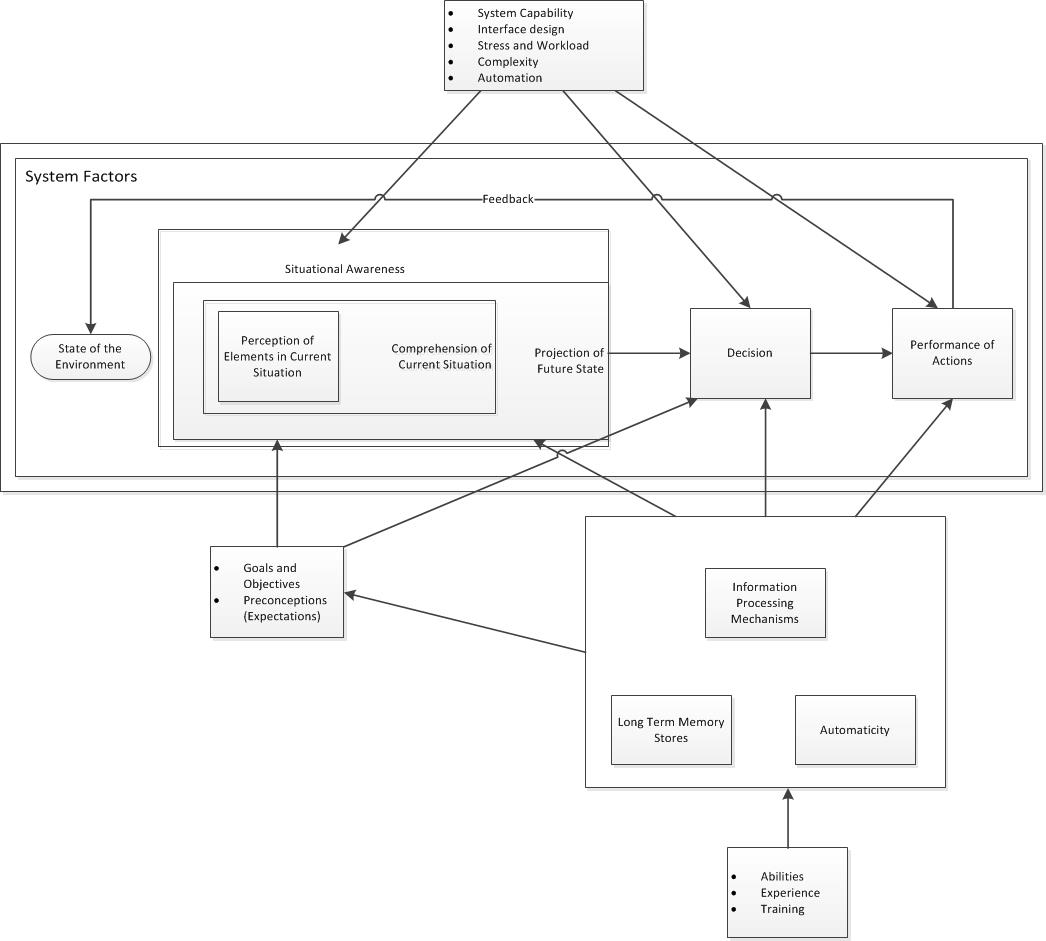
One of the key aspects of being an expert is the capacity to apply situational awareness: the perception of relevant information, comprehension of their meaning and the projection to future events.
Developing this situational awareness is a critical part of problem-solving and we can map the 4Cs of trouble-shooting onto these three elements.
Perception
The ability to perceive important information is a critical first step to being able to problem-solve, and one that takes time to develop especially in the highly complex and demanding environments most of us operate in. Knowing which information is important and have an understanding of the many subtle cues to evaluate is one of the hallmarks of an expert. But even for experts it can be difficult, which is why building perceptual cues in our checklists, procedures and such is important.
Comprehension
From perception we can draw meaning and significance, allowing the expert to combine, interpret, store and retain information. Integrating multiple pieces of information to arrive at a determination of relevance.
Projection
Experts are able to project from current events to anticipate future events and their implications.
Model of situation awareness in dynamic decision making (Endsley, 1995)
Many of us have had, or given, a talk about how we can learn from children in how to communicate, whether it is being thoughtful in our relationships or learning to adapt and be resilient, or some other point.
What we are really talking about how communicating empathetically is essential, including to building a quality culture and it is a key part of change management. People need to feel respected and have a sense of self-worth in order to be motivated, confident, innovative, and committed to their work and to appropriately engage in quality culture.
I am not going to pretend to be an expert on empathy. I think it is fair to say that is still (always) one of my key development areas. That said, I think a core skill of any quality leader is that of giving feedback.
People
need to feel respected and have a sense of self-worth in order to be motivated,
confident, innovative, and committed to their work.
To
provide good feedback focus on doing the following:
Focus on facts.
Respect and support others. Even when people aren’t performing their best, they need to feel your support and to know that they’re valued.
Clarify motives. Don’t jump to conclusions. Keep others’ self-esteem in mind, and you’ll be more likely to ask, “What can you tell me about this error?” instead of, “Don’t you care about quality?”
When
someone has done a good job, succeeded at a task, or made a contribution, you
want to enhance that person’s self-esteem. Some ways to do that are to:
Acknowledge good thinking and ideas. Demonstrations of appreciation encourage people to think and contribute, and they support innovation and intellectual risk taking.
Recognize accomplishments. People need to hear specifically what they’ve done to contribute to the team’s or organization’s success. This encourages them to sustain or exceed expectations.
Express and show confidence. Voicing your trust and then calling on people to show what they can do boosts their confidence and their feelings of self-worth.
Be specific and sincere. When you describe in detail what people do well and why it’s effective, they know exactly what you’re recognizing.
Nothing
can deflate people’s confidence faster than telling them they’re responsible
for something, and then doing it yourself. Conversely, when you provide support
without removing responsibility, you build people’s sense of ownership of the
task or assignment as well as the confidence that they can accomplish it. When
you use this Key Principle, remember to:
Help others think and do. Provide your support in two ways: Help others think of ideas, alternatives, and solutions, then support them so that they can execute the plan.
Be realistic about what you can do and keep your commitments. Remember that you don’t have to do it all, but be sure to do whatever you agree to.
Resist the temptation to take over—keep responsibility where it belongs.
Many
quality individuals tend to be action oriented and task driven, so keeping
responsibility where it belongs can take resolve, even courage. You might have
to overcome the protests of a team member who is reluctant to stretch into new
areas or even brave objections from a key manager about your decision to
support others rather than take over.
Feedback Conversation Structure
Open
In the OPEN
step you ensure that the discussion has a clear purpose and that everyone understands
the importance of accomplishing it.
Always state purpose and importance clearly in the discussion opening.
If you initiate the discussion, explain what you would like to accomplish and why.
If someone else is leading the discussion, ask questions if necessary to pinpoint the purpose and importance.
Cite how accomplishing the purpose would benefit others in the discussion.
Ask if there are any related topics to discuss.
Clarify
There are two
types of information to seek and share in this step: facts and figures and
issues and concerns. Both are essential to building a complete picture of the
situation.
Facts and figures are the basic data and background information that people need to understand the situation and make informed decisions.
Exploring issues and concerns provides insight into potential barriers to achieving your purpose. It also helps reveal people’s feelings about the situation, which is valid, important information to gather.
Develop
When
developing ideas, it’s important to ask questions and include others in the
process. Most likely, you’ll have ideas about what to do, and you should share
them. However, you should put equal emphasis on seeking others’ ideas.
Involving people in thinking about alternative approaches can:
Spark their creative energy.
Result in more and better ideas than you alone could generate.
Build commitment to turning ideas into action.
Agree
It’s important that you and the people involved agree on a plan for
following through on the ideas that were developed and for supporting those who
will take action. During this step:
Specify
what will be done, who will do it, and by when.
Agree
on any follow-up actions needed to track progress in carrying out the plan.
Be
sure to agree on needed resources or support.
Close
This is the final chance to make sure that everyone is clear on
agreements and next steps and committed to following through. Closing
discussions involves a summary of actions and agreements as well as a check on
the person’s or team’s commitment to carrying them out.
ICH Q10 states , “Leadership is essential to establish and maintain a company-wide commitment to quality and for the performance of the pharmaceutical quality system.” One of the central roles of the Quality reviewer/approver is to provide leadership, driving each event/record/etc, and the system as a whole, to continually improve. Quality does this in three ways:
Ensuring the process is followed
Validating the decisions made
Creating a good history
Ensuring the process is followed
The quality review provides a coaching/mentoring opportunity
to build and/or enhance capabilities and behaviors and recognize and reinforce
desired behaviors.
Questions to Ask
1. What is the
process? What process and steps apply?
2. What is
expected? Look for: Standard work, expected state, variation to the expected
state
3. What is
working well? Look for: process being followed, ideas being generated, lessons
shared
4. What is not
being followed? Look for: variation to procedural requirements, poor technical
writing
Validating the decisions made
Quality is ultimately responsible for the decisions made. For
each decision we do the following:
Identify alternatives. Once you have a clear understanding of the record from ensuring the process was followed, it’s time to identify the various options for each decision.
Weigh the evidence. In this step, you’ll need to “evaluate for feasibility, acceptability and desirability” to know which alternative is best. It may be helpful to seek out a trusted second opinion to gain a new perspective on the issue at hand.
Choose among alternatives. When it’s time to make your decision, be sure that you understand the risks involved with your chosen route. You may also choose a combination of alternatives now that you fully grasp all relevant information and potential risks.
Take action. Ensure the quality system/process reflects the action.
Review your decision. An often-overlooked but important step in the decision making process is evaluating your decision for effectiveness. Ask yourself what you did well and what can be improved next time.
Creating a good history
If it Isn’t Written Down, then it Didn’t Happen” is a
guiding principle of the quality profession.
There are four major types of writing in quality: instructional, informational, persuasive and transactional. A well written event is both instructional and transactional.
Our quality systems record what happened, finalize recommendations and action plans, and to act as an archive. A well written report allows the reader to easily grasp the content and, if applicable, make informed decision. Report writing is a cornerstone of an Event/CAPA system (from incident identification to root cause through CAPA completion and effectiveness review), validation, risk management and so much more.
In short, reports are our stories, they form the narrative.
And how we tell that narrative determines how we think of an issue, and how we
will continue to think of it in the future.
Conference proposals are a different writing beast than articles or columns or papers. Don’t be coy. Don’t give us a promise. Tell us the problems and what we will learn.
Good advice from Johanna Rothman on conference proposal writing.
Giving back to the profession, sharing best practices and lessons is an important part of being an ethical practioner, and also a great way to build your career. Preparing and speaking at a conference is also a great way to build connections with the material and to stretch in order to build expertise.

.png)
 Investigations of a Dog