Our research suggests that the bystander effect can be real and strong in organizations, especially when problems linger out in the open to everyone’s knowledge.
The bystander effect occurs when the presence of others discourages an individual from intervening in an emergency situation. When individuals relinquish responsibility for addressing a problem, the potential negative outcomes are wide-ranging. While a great deal of the research focuses on helping victims, the overcoming the bystander effect is very relevant to building a quality culture.
The literature on this often follows after social psychologists John M. Darley and Bibb Latané who identified the concept in the late ’60s. They defined five characteristics bystanders go through:
Notice that something is going on
Interpret the situation as being an emergency
Degree of responsibility felt
Form of assistance
Implement the action choice
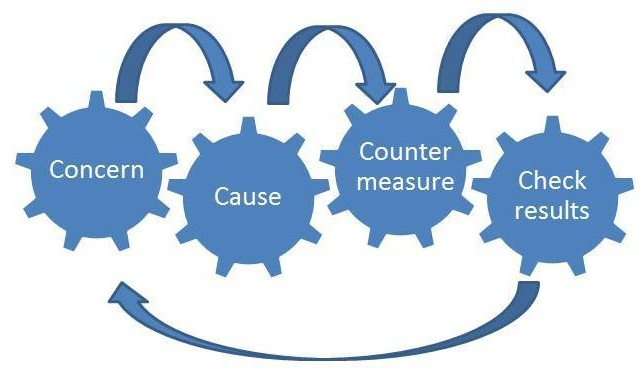
This is very similar to the 5 Cs of trouble-shooting: Concern (Notice), Cause (Interpret), Countermeasure (Form of Assistance and Implement), Check results.
What is critical here is that degree of responsibility felt. Without it we see people looking at a problem and shrugging, and then the problem goes on and on. It is also possible for people to just be so busy that the degree of responsibility is felt to the wrong aspect, such as “get the task done” or “do not slow down operations” and it leads to the wrong form of assistance – the wrong troubleshooting.
When building a quality culture, and making sure troubleshooting is an ingrained activity, it is important to work with employees so they understand that their voices are not redundant and that they need to share their opinions even if others have the same information. As the HBR article says: “If you see something, say something (even if others see the same thing).”
Building a quality culture is all about building norms which encourage detection of potential threats or problems and norms which encouraged improvements and innovation.
I recently had a discussion with one of the best root cause investigators and problem solvers I know, Thor McRockhammer. Thor had concerns about a case where the expected conditions were not met and there were indications that individuals engaged in troubleshooting and as a result not only made the problem worse but led to a set of issues that seem rather systematic.
Our conversation (which I do not want to go into too much detail on) was a great example of troubleshooting going wrong.
Troubleshooting is defined as “Reactive problem solving based upon quick responses to immediate symptoms. Provides relief and immediate problem mitigation. But may fail to get at the real cause, which can lead to prolonged cycles of firefighting.” Troubleshooting usually goes wrong one of a few ways:
Not knowing when troubleshooting shouldn’t be executed
Using troubleshooting exclusively
Not knowing when to go to other problem solving tools (usually “Gap from standard”) or to trigger other quality systems, such as change management.
Troubleshooting is a reactive process of fixing problems by rapid response and short-term corrective actions. It covers noticing the problem, stopping the damage and preventing spread of the problem.
So if our departure from expected conditions was a leaky gasket, then troubleshooting is to try to stop the leak. If our departure is a missing cart then troubleshooting usually involves finding the cart.
Troubleshooting puts things back into the expected condition without changing anything. It addresses the symptom and not the fundamental problems and their underlying causes. They are carried out directly by the people who experience the symptoms, relying upon thorough training, expertise and procedures designed explicitly for troubleshooting.
With out leaky gasket example, our operators are trained and have procedural guidance to tighten or even replace a gasket. They also know what not to do (for example don’t weld the pipe, don’t use a different gasket, etc). There is also a process for documenting the troubleshooting happened (work order, comment, etc).
To avoid the problems listed above troubleshooting needs a process that people can be thoroughly trained in. This process needs to cover what to do, how to communicate it, and where the boundaries are.
·What do we known about the exact nature of the problem?
·What do your
standards say about how this concern should be documented?
oFor example,
can be addressed as a comment or does it require a deviation or similar non-conformance
·If the concern stems
from a requirement it must be documented.
Cause
·What do you
know about the apparent (or root) cause of the problem?
·Troubleshooting
is really good at dealing with superficial cause-and-effect relationships. As
the cause deepens, fixing it requires deeper problem-solving.
·The cause can
be a deficiency or departure from a standard
Countermeasure
·What immediate
or temporary countermeasures can be taken to reduce or eliminate the problem?
·Are follow-up
or more permanent countermeasures required to prevent recurrence?
oIf so, do you
need to investigate more deeply?
·Countermeasures
need to be evaluated against change management
·Countermeasures
cannot ignore, replace or go around standards
·Apply good
knowledge management
Check results
·Did the results
of the action have any immediate effect on eliminating the concern or
problem?
·Does the
problem repeat?
oIf so, do you
need to investigate more deeply?
·Recurrence
should trigger deeper problem-solving and be recorded in the quality system.
·Beware troubleshooting
countermeasures becoming tribal knowledge and the new way of working
Trouble shooting is in a box
Think of your standards as a box. This box defines what should happen per our qualified/validated state, our procedures, and the like. We can troubleshoot as much as we want within the box. We cannot change the box in any way, nor can we leave the box without triggering our deviation/nonconformance system (reactive) or entering change management (proactive).
Communication is critical for troubleshooting
Troubleshooting processes need a mechanism for letting supervisors happen. Troubleshooting that happens in the dark is going to cause a disaster.
Operators need to be trained how to document troubleshooting. Sometimes this is as simple as a notation or comment, other-times you trigger a corrective action process.
Engaging in troubleshooting, and not documenting it starts to look a like fraud and is a data integrity concern.
Change Management
The change management process should be triggered as a result of troubleshooting. Operators should be trained to interpret it. This is often were concept of exact replacements and like-for-like come in.
It is trouble shooting to replace a part with an exact part. Anything else (including functional equivalency) is a higher order change management activity. It is important that everyone involved knows the difference.
Covers
Is it troubleshooting?
Like-for- Like
Spare parts that are identical replacements (has the same the same manufacturer, part number, material of construction, version)
Existing contingency procedures (documented, verified, ideally part of qualification/validation)
Yes
This should be built into procedures like corrective maintenance, spare parts, operations and even contingency procedures.
Functionally equivalent
Equivalent, for example, performance, specifications, physical characteristics, usability, maintainability, cleanability, safety
No
Need to understand root cause. Need to undergo appropriate level of change management
New
Anything else
No
Need to understand root cause. Need to undergo appropriate level of change management
This applies to both administrative and technical controls.
ITIL Incident Management
ITIL Incident Management (or similar models) is just troubleshooting and has all the same hallmarks and concerns.
Conclusion
Trouble shooting is an integral process. And like all processes it should have a standard, be trained on, and go through continuous improvement.
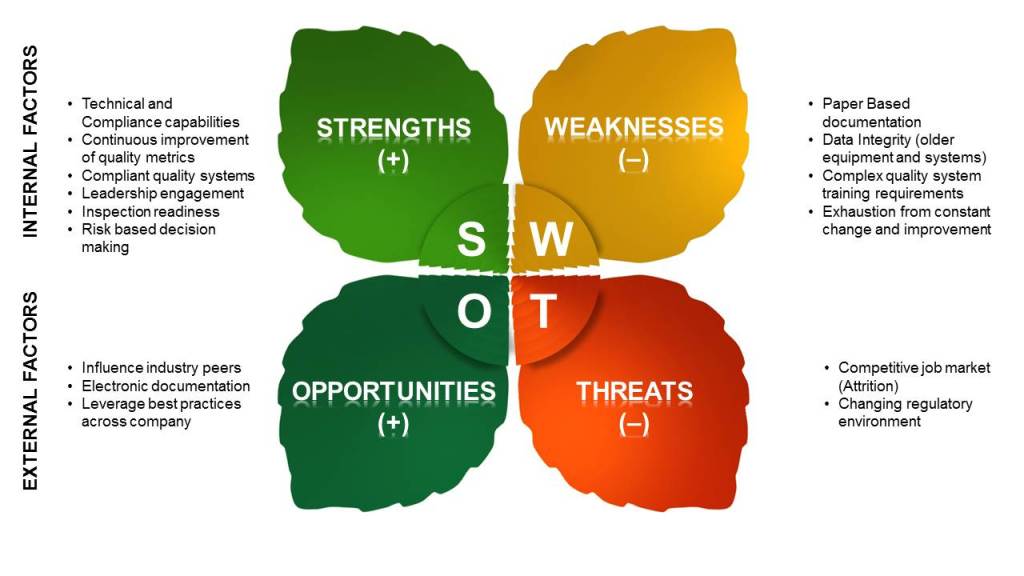
Looking back at my SWOT, I can see that it was a very useful tool for charting where this blog would take me. Change, risk, data, quality culture, knowledge management. All the items I spent time thinking about are there. I hope folks go as much use out of my thinking aloud as I did.
In the next few weeks I’ll be trying to utilize a few quality tools to lay out my goals for both this blog and my other professional endeavors in 2019.
As you wrap up 2018 and look forward to 2019, what quality matters are important to you?
ISO 26000: Guidance on social responsibility defines social responsibility as:
The responsibility of an organization for the impacts of its decisions and activities on society and the environment, through transparent and ethical behavior that:
Contributes to sustainable development, including health and the welfare of society
Takes into account the expectations of stakeholders
Is in compliance with applicable laws and consistent with international norms of behavior
Is integrated throughout the organization and practiced in its relationships
ISO 26000 also defines seven key principles of socially responsible behavior:
Accountability
Transparency
Ethical behavior
Respect for stakeholder interests
Respect for the rule of law
Respect for international norms of behavior
Respect for human rights
One shouldn’t have to look for reasons for human rights and the drive towards to diversity, but let us simply say there are a ton of studies that show that diversity improves decision making, problem solving and even make us smarter.
In short diversity is critical towards a Quality Culture. Gender equality is a critical part of being a successful quality leader, and it behooves each and every one of us men to drive towards it. To figure out how to make our own workplaces more diverse.
There are many aspects of creating diverse culture but I want to discuss how it is critical that men support women, that we be allies. Too many organizations still miss the mark on gender equity efforts by focusing gender initiatives solely on changing women — from the way they network to the way the lead. Individualistic approaches to solving gender inequities overlook systemic structural causes and reinforce the perception that these are women’s issues — effectively telling men they don’t need to be involved. As always, it is always about the system thinking. Without the avid support of men progress toward ending gender disparities is unlikely and organizations cannot find reap the benefits.
Men need to become better allies by focusing on listening, support, and respect. We need to listen to women’s voices and bring all those core skills of focus, sincerity, empathy, refusal to interrupt, and genuine valuing to systematically addressing inequities, whether the ubiquitous workplace sexual harassment or gender exclusion. End your silence and support and ally. No matter what level of your organization you are in.
By being a deliberate male ally, by actively promoting gender fairness and equity in the workplace we can drive systematic improvements. To lean on Deming, we can drive out fear. And isn’t that what Quality is all about?

 Investigations of a Dog