The ongoing destruction of the U.S. Food and Drug Administration (FDA) through politically driven firings mirrors one of the most catastrophic regulatory failures in modern American history: the 1981 mass termination of air traffic controllers under President Reagan. Like the Federal Aviation Administration (FAA) crisis—which left aviation safety systems crippled for nearly a decade—the FDA’s current Reduction in Force (RIF) has purged irreplaceable expertise, with devastating consequences for public health and institutional memory.
Targeted Firings of FDA Leadership (2025)
The FDA’s decimation began in January 2025 under HHS Secretary Robert F. Kennedy Jr., with these key terminations:
Dr. Peter Marks (CBER Director): Fired March 28 after refusing to dilute vaccine safety standards, stripping the agency of its foremost expert on biologics and pandemic response.
Peter Stein (CDER Office of New Drugs): Terminated April 1 following his rejection of a demotion to a non-scientific role, eliminating critical oversight for rare disease therapies.
Brian King (Center for Tobacco Products): Dismissed April 3 amid efforts to weaken vaping regulations, abandoning enforcement against youth-targeting tobacco firms.
Vid Desai (Chief Information Officer): Axed April 5, sabotaging IT modernization crucial for drug reviews and food recall systems.
Expertise Loss: A Regulatory Time Bomb
The FDA’s crisis parallels the FAA’s 1981 collapse, when Reagan fired 11,345 unionized air traffic controllers. The FAA required five years to restore baseline staffing and 15 years to rebuild institutional knowledge—a delay that contributed to near-misses and fatal crashes like the 1986 Cerritos mid-air collision. Similarly, the FDA now faces:
Brain Drain Accelerating Regulatory Failure
Vaccine review teams lost 40% of senior staff, risking delayed responses to avian flu outbreaks.
Medical device approvals stalled after 50% of AI/ML experts were purged from CDRH.
Food safety labs closed nationwide, mirroring the FAA’s loss of veteran controllers who managed complex airspace.
Training Collapse Reagan’s FAA scrambled to hire replacements with just 3 months’ training versus the former 3-year apprenticeship. At the FDA, new hires now receive 6 weeks of onboarding compared to the previous 18-month mentorship under experts —a recipe for oversight failures.
Erosion of Public Trust The FAA’s credibility took a decade to recover post-1981. The FDA’s transparency crisis—with FOIA response times stretching to 18 months and advisory committees disbanded—risks similar long-term distrust in drug safety and food inspections.
Repeating History’s Mistakes
The Reagan-era FAA firings cost $1.3 billion in today’s dollars and required emergency military staffing. The FDA’s RIF—projected to delay drug approvals by 2-3 years—could inflict far greater harm:
Pharmaceutical Impact: 900+ drug applications now languish without senior reviewers, akin to the FAA’s 30% spike in air traffic errors post-1981.
Food Safety: Shuttered labs mirror the FAA’s closed control towers, with state inspectors reporting a 45% drop in FDA support for outbreak investigations.
Replacement Challenges: Like the FAA’s struggle to attract talent after 1981, the FDA’s politicized environment deters top scientists. Only 12% of open roles have qualified applicants, per April 2025 HHS data.
A Preventable Disaster Motivated by Bad Politics
The FDA’s expertise purge replicates the FAA’s darkest chapter—but with higher stakes. While the FAA’s recovery took 15 years, the FDA’s specialized work in gene therapies, pandemic preparedness, and AI-driven devices cannot withstand such a timeline without catastrophic public health consequences. Commissioner Marty Makary now presides over a skeleton crew ill-equipped to prevent the next opioid crisis, foodborne outbreak, or unsafe medical device. Without immediate congressional intervention to reverse these firings, Americans face a future where regulatory failures become routine, and trust in public health institutions joins aviation safety circa 1981 in the annals of preventable disasters.
The recent mass layoffs at the Food and Drug Administration (FDA) and other agencies under the Department of Health and Human Services (HHS) represent a seismic shift in the U.S. public health landscape. These actions, spearheaded by HHS Secretary Robert F. Kennedy Jr., are not just a bureaucratic reshuffle—they are a direct assault on public health, the pharmaceutical and medical device industries, and the very principles of scientific inquiry and transparency.
Impact on Public Health
The decision to lay off 10,000 employees across HHS, including 3,500 at the FDA, is a reckless gamble with public health. These cuts come at a time when the nation faces complex challenges such as emerging infectious diseases, the regulation of cutting-edge medical technologies, and the ongoing need for robust food safety measures. The FDA’s ability to approve new drugs, monitor post-market safety, and evaluate medical devices has been severely compromised. Entire teams responsible for drug approvals and post-market surveillance have been gutted, leaving critical regulatory gaps that could jeopardize patient safety.
The layoffs have also disproportionately affected specialized areas like artificial intelligence (AI) in medical devices—a field that requires high levels of expertise due to its complexity. With half of the AI-focused staff at the FDA’s Center for Devices and Radiological Health (CDRH) terminated, delays in approving life-saving innovations are inevitable. Medical device companies are already reporting disruptions in their interactions with the FDA, with meetings canceled due to the absence of key reviewers.
The Fallout for Industry
Pharmaceutical and medical device manufacturers are facing an unprecedented regulatory bottleneck. The layoffs have introduced significant delays in product approvals, with some industry insiders estimating that timelines could stretch by months or even years. This is not just an inconvenience for companies; it directly impacts patients waiting for new treatments and technologies. The uncertainty is compounded by the elimination of entire communications teams at the FDA, leaving stakeholders without clear channels to navigate this chaotic environment.
Undermining Science
Science thrives on stability and expertise—both of which have been decimated by these layoffs. The FDA and NIH have long been global leaders in biomedical research and innovation. By removing experienced scientists, regulators, and administrators en masse, these agencies are being hollowed out at their core. This is not just a loss for the U.S.; it weakens global public health efforts that rely on American leadership in research and regulation.
Transparency Under Siege
Perhaps most egregious is how these changes undermine transparency—a principle Secretary Kennedy himself pledged to uphold through “radical transparency.” Instead, we see a systematic erosion of public accountability:
FOIA Offices Gutted: The FDA’s Freedom of Information Act (FOIA) office has been severely impacted, with many officers laid off or reassigned. At other agencies like the CDC, FOIA offices have reportedly been shuttered entirely. This makes it nearly impossible for journalists, researchers, and citizens to access critical information about government operations.
Public Meetings Canceled: Advisory committee meetings that traditionally allow public input on vaccine recommendations and other health policies have been postponed or canceled without explanation.
Opaque Decision-Making: HHS has increasingly relied on administrative maneuvers to bypass public comment periods required under federal law. This creates a “fait accompli” system where stakeholders only learn about policy changes after they are implemented.
These actions betray not only Kennedy’s promises but also the foundational principles of democratic governance. FOIA exists to ensure an informed citizenry capable of holding its government accountable—a safeguard now dangerously weakened.
A Call to Action
The layoffs at HHS and FDA are more than just a bureaucratic reshuffling—they are an existential threat to public health infrastructure, scientific progress, and governmental transparency. These cuts may save $1.8 billion annually—a mere 0.1% of HHS’s budget—but they come at an incalculable cost to human lives and societal trust. The pharmaceutical industry cannot function effectively without a competent regulatory partner; public health cannot flourish without transparent governance; science cannot advance without institutional support.
This is not reform—it is sabotage disguised as efficiency. It is time for Congress, industry leaders, public health advocates, and every concerned citizen to demand accountability before this crisis deepens further.
I occasionally strive to be open about what I’m personally working on: situational humility, coping with uncertainty, silence, my mental health, and humbleness, among other things. I believe these are all ways to approach a continuous journey aimed at my growth as a leader. I like to think I am on a constant path of improvement, but as organizations evolve and our roles within them change, it’s crucial to reflect on our experiences and aim for betterment. Sometimes, this requires shifting the perspective I use to assess my development. Today, my focus is on the concept of equanimity.
In today’s fast-paced organizational landscape, where constant change and disruption are the norm, the ability to maintain inner balance while facing complex challenges is a vital yet often overlooked leadership skill. Equanimity—an even-tempered state of psychological stability and composure that remains undisturbed by emotions, pain, or external pressures—becomes a fundamental element in creating resilient, quality-driven cultures. Unlike complacency, which silently undermines innovation and organizational excellence, equanimity equips leaders and professionals with a mental framework to stay responsive without becoming reactive, engaged without becoming entangled.
This balanced mindset fosters clear decision-making and steady leadership, necessary for nurturing environments where quality is not merely a compliance requirement but a cultural imperative. As organizations navigate increasingly turbulent markets and regulatory challenges, understanding and cultivating equanimity serves as a powerful antidote to the cycles of complacency that threaten long-term viability and stakeholder trust.
The Anatomy of Equanimity in Professional Contexts
Equanimity, derived from the Latin “aequanimitas” meaning evenness of mind, represents more than mere calmness—it constitutes a sophisticated mental framework that allows individuals to process and respond to experiences without becoming overwhelmed by them. In professional contexts, equanimity manifests as the capacity to remain present and engaged with challenging situations while maintaining psychological balance. Buddhist scholar Peter Harvey aptly described this state as being “stirred but not shaken”—the opposite of James Bond’s martini—highlighting how equanimity allows us to fully experience workplace events while preventing emotional entanglement that clouds judgment.
This mental stance creates a critical space between stimulus and response, where professionals can observe both external circumstances and their own emotional reactions without immediate judgment. Consider a quality assurance specialist discovering a significant product defect just before shipment. Equanimity enables this professional to feel the appropriate concern without spiraling into panic, allowing them to assess the situation clearly, communicate effectively with stakeholders, and implement necessary corrective actions. The equanimous mind acknowledges reality as it is—not as we wish it to be—creating the foundational awareness needed for effective quality management.
A common misconception portrays equanimity as emotional detachment or apathy—a mischaracterization that fundamentally misunderstands its nature. True equanimity does not suppress passion or diminish concern for quality outcomes; rather, it channels these energies more effectively. Professionals operating with equanimity remain deeply invested in excellence while freeing themselves from counterproductive emotional reactivity that might otherwise cloud their judgment or diminish their effectiveness. This balanced approach proves especially valuable in high-stakes quality scenarios where both clear perception and appropriate concern must coexist.
Equanimity as the Antidote to Complacency Cycles
Where complacency operates as a silent organizational saboteur, equanimity functions as its natural counteragent. Complacency cycles—characterized by reduced vigilance, resistance to innovation, and workforce disengagement—systematically undermine quality culture through self-reinforcing patterns of mediocrity. Equanimity disrupts these cycles by maintaining alertness without anxiety, openness without impulsivity, and engagement without exhaustion.
The “stagnation phase” of complacency begins when initial success breeds overconfidence and teams prioritize efficiency over improvement. Equanimity counters this tendency by facilitating a balanced perspective that acknowledges achievements while maintaining awareness of potential improvements. Rather than becoming complacent with current performance levels, equanimous professionals maintain a curious stance toward emerging risks and opportunities.
Similarly, during the “normalization of risk” phase, where minor deviations from standards become habitual, equanimity provides the mental clarity to recognize incremental drift before it culminates in significant failures. The equanimous mind remains attuned to subtle changes in quality parameters without becoming desensitized to gradually evolving risks. This vigilance represents a crucial firewall against the erosion of quality standards that typically precedes major quality incidents.
Most critically, equanimity prevents the “crisis trigger” phase by maintaining consistent attention to potential quality issues rather than requiring catastrophic events to reinstate vigilance. Unlike the boom-bust pattern of attention often observed in complacent organizations, equanimity sustains a steady awareness that prevents the accumulation of quality deficits in the first place. This proactive stance transforms quality management from a reactive crisis response into a continuous practice of excellence maintenance.
How Equanimity Transforms Leadership
Leadership serves as the linchpin in establishing and sustaining quality culture, with a leader’s responses and behaviors creating ripple effects throughout the organization. Research reveals concerning patterns in leadership reactions under pressure, with many leaders becoming more close-minded and controlling while others become more emotionally reactive during challenging situations—precisely when clarity and openness are most needed. Equanimity directly addresses these tendencies by creating the psychological space necessary for more deliberate, effective responses.
When leaders demonstrate equanimity during quality challenges, they effectively model how the organization should process and respond to adversity. Consider a manufacturing executive facing a significant product recall. An equanimous response—acknowledging the severity while maintaining composed problem-solving—signals to the organization that challenges represent opportunities for systemic improvement rather than occasions for blame or panic. This leadership stance creates psychological safety, enabling more transparent reporting of potential quality issues before they escalate into crises.
Equanimity also enhances a leader’s ability to make balanced decisions when confronting quality dilemmas that involve competing priorities. The pharmaceutical industry regularly faces tensions between production timelines and quality verification procedures. Leaders practicing equanimity can more effectively navigate these tensions, maintaining unwavering commitment to quality standards while acknowledging business realities. This balanced approach prevents the “diminished problem-solving rigor” that characterizes complacent organizations, where teams favor quick fixes over root-cause analysis.
Beyond individual decisions, equanimity transforms a leader’s overall approach to quality governance. Rather than oscillating between hypervigilance during crises and inattention during stable periods, equanimous leaders maintain consistent quality focus through various organizational phases. This steady attention prevents the “ceremonial governance” pattern where quality oversight becomes a performance rather than a genuine inquiry into systemic risks. By modeling emotional stability while maintaining quality vigilance, leaders create environments where excellence becomes self-sustaining rather than crisis-dependent.
Developing Equanimity as a Professional
Cultivating equanimity requires intentional practice rather than mere philosophical appreciation. For professionals seeking to develop this capacity, several evidence-based approaches offer practical pathways toward greater psychological balance in workplace settings.
Mindfulness meditation stands as perhaps the most well-established method for developing equanimity. Regular practice—even in brief sessions of 5-10 minutes—enhances the ability to observe thoughts and emotions without becoming entangled in them. This mental training directly strengthens the neural pathways associated with emotional regulation and cognitive flexibility, enabling professionals to respond more skillfully to quality challenges. A quality engineer practicing mindfulness might notice anxiety arising when discovering a potential compliance issue but can observe this reaction without allowing it to dominate their problem-solving approach.
Emotional intelligence development complements mindfulness by enhancing awareness of emotional patterns that undermine equanimity. By understanding personal triggers and typical reaction patterns, professionals can identify situations where their equanimity might be tested before they become emotionally activated. This anticipatory awareness creates an opportunity to implement self-regulation strategies proactively rather than reactively. Quality professionals with high emotional intelligence recognize when perfectionism or defensiveness might cloud their judgment and can consciously adjust their approach accordingly.
Gratitude practices offer another avenue toward equanimity by broadening perspective beyond immediate challenges. Regular reflection on positive aspects of work—successful quality initiatives, collaborative team dynamics, or personal growth—creates psychological resources that buffer against stress during difficult periods. This expanded awareness prevents quality challenges from consuming a professional’s entire attention, maintaining the balanced perspective essential for effective problem-solving.
Pre-mortem analyses—mentally simulating potential quality failures before they occur—paradoxically strengthen equanimity by reducing uncertainty and surprise when challenges arise. By anticipating possible issues and preparing response strategies in advance, professionals reduce the cognitive and emotional load of real-time problem-solving. This preparation creates a sense of capability and readiness that supports composed responses during actual quality incidents.
Cultivating Organizational Equanimity Through Systems Approach
While individual practices build personal equanimity, organizational systems and structures must support these efforts for sustainable impact. Leaders can implement several systemic approaches to foster equanimity throughout their quality culture.
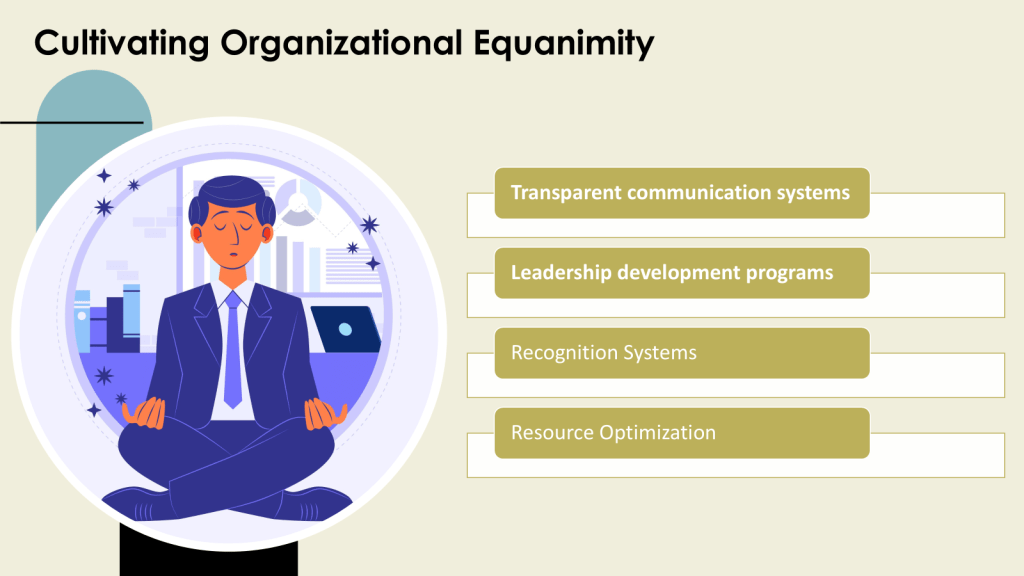
Transparent communication systems represent a foundational element in organizational equanimity. When information about quality metrics, emerging risks, and improvement initiatives flows freely throughout the organization, uncertainty decreases and collective sense-making improves. Digital dashboards tracking real-time quality indicators, regular cross-functional quality briefings, and systematic feedback loops all contribute to an information environment where sudden surprises—a primary threat to equanimity—become less frequent.
Leadership development programs should explicitly address equanimity as a core competency rather than treating it as an incidental personality trait. Training modules focusing on mindfulness, emotional intelligence, and stress resilience build the individual capacities necessary for equanimous leadership. When combined with peer coaching circles where leaders candidly discuss quality challenges and share regulation strategies, these formal development efforts create a leadership culture where balanced responses to pressure become the norm rather than the exception.
Recognition systems that reward equanimous handling of quality challenges—rather than just technical problem-solving—reinforce the importance of balanced responses. Acknowledging professionals who maintain composure while addressing complex quality issues sends a powerful message about organizational values. These recognition practices might highlight situations where teams maintained psychological safety during compliance audits or demonstrated composed problem-solving during manufacturing disruptions.
Resource optimization initiatives that address workload management directly support equanimity by preventing the overwhelm that undermines psychological balance. Realistic staffing models for quality functions, appropriate technological support for monitoring activities, and adequate time allocations for improvement projects all contribute to an environment where maintaining equanimity becomes feasible rather than heroic.
Leadership’s Role in Modeling and Sustaining Equanimity
Executive leadership bears particular responsibility for establishing equanimity as a cultural norm through consistent modeling and systemic reinforcement. Leaders demonstrate their commitment to equanimity not just through words but through visible behaviors during challenging quality scenarios.
Leaders practice vulnerability and transparencyby openly discussing their own experiences with maintaining equanimity during difficult situations. When executives share stories about managing their reactions during regulatory inspections, customer complaints, or internal quality failures, they normalize the emotional challenges inherent in quality work while demonstrating the possibility of balanced responses. This transparent approach creates psychological safety for others to acknowledge their own struggles with maintaining equanimity.
Participation in frontline quality activities provides another powerful demonstration of leadership equanimity. Executives who join quality audits, improvement workshops, or failure investigations gain firsthand exposure to quality challenges while modeling composed engagement. An executive participating in monthly gemba walks not only identifies systemic risks but also demonstrates how to approach quality issues with balanced curiosity rather than blame or anxiety.
Restructuring performance metrics represents a systemic approach to supporting equanimity by emphasizing leading indicators over lagging ones. When leaders prioritize metrics like preventative corrective actions, near-miss reporting, or improvement suggestion implementation, they create an information environment that supports proactive quality management rather than crisis response. This shift reduces the emotional volatility associated with reactive approaches while maintaining appropriate quality vigilance.
Cross-functional collaboration initiatives further support equanimity by distributing quality responsibilities across the organization rather than isolating them within quality departments. When leaders establish quality SWAT teams with representation from various functions, they create shared ownership for quality outcomes while preventing the isolation that can lead to overwhelm within quality functions. This collaborative approach supports equanimity by ensuring that quality challenges receive diverse perspectives and adequate resources.
Equanimity as a Journey, Not a Destination
Equanimity in professional contexts represents an ongoing practice rather than a permanent achievement—a perspective that itself embodies equanimous thinking. Like quality culture more broadly, equanimity requires continual renewal through intentional individual practices and supportive organizational systems. The interplay between complacency cycles and quality culture creates a perpetual tension that demands vigilance without anxiety, commitment without rigidity, and excellence without perfectionism.
Organizations that recognize equanimity as a foundational element of quality culture gain a significant advantage in navigating the complexities of modern business environments. By cultivating this balanced mental state throughout their workforce—particularly within leadership ranks—they establish psychological conditions where quality thrives as a natural expression of organizational values rather than a compliance obligation. This cultural foundation supports the relentless leadership commitment, systems thinking, and psychological safety necessary for sustained excellence.
As professionals and leaders journey toward greater equanimity, they transform not only their individual effectiveness but also the cultural fabric of their organizations. Each composed response to a quality challenge, each balanced decision during a crisis, and each steady commitment during uncertainty contributes to an organizational environment resistant to complacency yet free from reactivity. In this way, equanimity operates not just as a personal virtue but as a collective capability—one that enables organizations to maintain quality focus through changing conditions while remaining adaptive to emerging requirements. The cultivation of equanimity thus represents not merely a philosophical aspiration but a practical necessity for organizations committed to enduring excellence in increasingly turbulent times.
Self-Reflection
In the quiet moments of self-reflection, I have discovered that equanimity—that elusive state of mental calmness and composure, especially under trying circumstances—represents not a destination but an ongoing practice. The journey toward equanimity has been important for me, particularly as I’ve incorporated journaling as a companion practice. This written exploration serves as both a retrospective lens through which to examine past conversations and a preparatory tool for navigating difficult moments with greater balance. Equanimity teaches us to be with whatever shows up, to notice what shuts us down, pushes us away, or tears us wide open. Through the disciplined practice of putting pen to paper, I have found a pathway toward standing equally in both clear and muddy waters, remaining present with each moment exactly as it is.
The act of putting feelings into words helps with cognitive reappraisal—reframing situations to reduce their emotional impact by engaging the prefrontal cortex, our brain’s control center for planning, decision-making, and emotional regulation.
When I first implemented a consistent journaling practice, I noticed immediate benefits in managing workplace stress. After particularly challenging meetings or interactions, taking time to write about these experiences created distance from immediate emotional reactions. Research supports this experience, suggesting that writing about emotional events can benefit both mental and physical health. Journaling has been linked to decreased mental distress, reduced anxiety, and help with breaking cycles of obsessive thinking. Studies even indicate potential physical benefits, with participants who wrote about upsetting events healing faster after medical procedures than those who wrote about neutral topics.
Beyond retrospective analysis, journaling serves as a powerful preparatory tool for approaching challenging situations with greater equanimity. Before difficult conversations or high-stakes presentations, I’ve found that writing helps clarify intentions, anticipate potential triggers, and develop strategies for maintaining balance. This practice creates a foundation for equanimity that proves invaluable when emotions run high.
Pre-mortem analyses—mentally simulating potential failures before they occur—paradoxically strengthen equanimity by reducing uncertainty and surprise when challenges arise. By writing through possible difficult scenarios, I develop response strategies in advance, creating a sense of capability and readiness that supports composed responses during actual difficulties. This preparation reduces the cognitive and emotional load of real-time problem-solving in stressful situations.
There are a lot of reasons I love to sit down and read an Establishment Inspection Report, you can learn a ton from them.
One lesson one should always take from them is it could be your name discussing some awful problem in some regulatory document. I can, for example, read the Sanofi EIRs from 2020 and 2022 and easily see myself in many of the discussed points. I was there for a decade (well at the Allston landing Facility) and to be frank there are a lot of names from some very good people there. And often they are justifying some horrible stuff. I feel pretty bad and I can guess on the series of compromises that got them there.
Add me to the list of people who are disheartened y the silence of the Pharmaceutical Research and Manufacturers of America and the Biotechnology Innovation Organization to the cuts at the FDA. In an interest to write something that should be coming loud and clear from our industry groups, I give you…
The Impact of Recent FDA Layoffs on Agency Capacity and Public Health
The recent wave of layoffs at the U.S. Food and Drug Administration (FDA), enacted as part of broader illegal federal workforce reductions under the Trump administration, has exacerbated long-standing staffing challenges at the agency. By targeting probationary employees—recent hires and those promoted within the past two years—the cuts have disproportionately affected early-career professionals with cutting-edge technical expertise, disrupted workforce development pipelines, and weakened oversight in critical areas such as medical device regulation, food safety, veterinary medicine, and emerging technologies. These reductions come at a time when the FDA is already grappling with recruitment challenges, inspection backlogs, and increasing demands for regulatory innovation.
Scope and Targets of the Layoffs
The Department of Health and Human Services (HHS), under Secretary Robert F. Kennedy Jr., terminated approximately 5,200 probationary employees across its agencies in mid-February 2025, including hundreds at the FDA. While the agency’s drug review divisions were largely spared, layoffs hit staff in the Center for Devices and Radiological Health (CDRH), the Center for Food Safety and Applied Nutrition (CFSAN), the Center for Veterinary Medicine (CVM), and the Center for Tobacco Products (CTP).
Medical Devices and Digital Health
In CDRH, at least 230 employees were dismissed, including specialists in artificial intelligence (AI) and digital health—fields undergoing rapid technological advancement. These roles are critical for evaluating AI-driven diagnostic tools, wearable devices, and software-as-a-medical-device (SaMD) products. The loss of early-career researchers and engineers threatens the FDA’s ability to keep pace with industry innovation, potentially delaying approvals for technologies like neural interfaces and AI-powered imaging systems.
Food Safety and Additives
CFSAN lost staff responsible for reviewing new food additives, colorings, and ingredients—a priority area for Kennedy, who has advocated for stricter chemical regulations. With approximately 2,000 uninspected food and drug facilities globally, the FDA’s inspection backlog is now likely to grow further, raising risks of contamination incidents similar to recent outbreaks linked to infant formula and baby food.
Veterinary Medicine
The Center for Veterinary Medicine (CVM) saw cuts to reviewers assessing the safety of pharmaceuticals for pets and livestock. These roles ensure that medications for animals are effective and that residues in products like milk and eggs remain safe for human consumption. Reductions here could delay approvals for veterinary drugs and weaken monitoring of antimicrobial resistance.
Exacerbating Existing Staffing Challenges
The FDA has historically struggled to recruit and retain specialized staff due to competition from higher-paying private-sector roles. The layoffs worsen these issues by destabilizing workforce development and eroding institutional knowledge.
Loss of Early-Career Talent
Probationary employees—often younger professionals with advanced degrees in fields like data science, bioengineering, and toxicology—represent the FDA’s pipeline for replacing retiring staff. By targeting this group, the cuts disrupt the “learning chain” essential for maintaining expertise. As Kenneth Kaitin, a Tufts University professor, noted: “You’re eliminating the learning chain of people who come into the agency. There’s a long learning curve, and you’re eliminating people at the early stage” (https://www.biopharmadive.com/news/fda-layoffs-trump-doge-hhs-cuts-impact/740499/).
Increased Workloads and Burnout
Remaining staff now face expanded responsibilities. For example, CDRH’s device reviewers, already managing a surge in AI and digital health submissions, must absorb the work of dismissed colleagues without additional support. Similarly, food safety inspectors—many of whom were hired post-pandemic to address backlogs—are now stretched thinner, increasing the likelihood of oversights.
Recruitment and Morale
The layoffs have demoralized the workforce and damaged the FDA’s reputation as a stable employer. As Mitch Zeller, former FDA tobacco director, stated: “The combined effect of what they’re trying to do is going to destroy the ability to recruit and retain talent” (https://www.startribune.com/trump-administration-cuts-reach-fda-employees-in-food-safety-medical-devices-and-tobacco-products/601223844). With hiring frozen under an executive order requiring agencies to replace only one employee for every four departures, the FDA cannot easily rebuild capacity.
The Training Bottleneck
The probationary period at the FDA (1–2 years for new hires) is designed to provide hands-on training in complex regulatory science. Dismissing employees during this phase wastes significant investments in onboarding and delays the development of proficiency.
Specialized Skill Development
Reviewers in areas like AI-driven medical devices or gene therapies require months of training to evaluate technical dossiers, assess clinical data, and understand regulatory precedents. Losing these employees resets progress, forcing the FDA to restart the training process once hiring resumes.
Cross-Departmental Collaboration
New hires often rotate through multiple divisions to build interdisciplinary expertise. For instance, a food additive reviewer might collaborate with toxicologists and epidemiologists to assess long-term health risks. Disrupting these rotations limits opportunities for knowledge-sharing, weakening the agency’s ability to address novel public health challenges.
Long-Term Consequences for Public Health
Slower Product Reviews
User fee-funded positions—which account for nearly half of the FDA’s $6.9 billion budget—were not spared from cuts. Since these roles are financed by industry to expedite reviews, their elimination could delay approvals for new drugs, devices, and food ingredients without reducing federal spending.
Weakened Outbreak Response
The FDA collaborates with the CDC to trace contamination sources during foodborne illness outbreaks. With fewer inspectors and scientists, the agency’s capacity to identify pathogens like Salmonella or Listeria will diminish, prolonging outbreaks and increasing hospitalization risks.
Erosion of Global Leadership
The FDA’s regulatory standards influence global markets. Slower reviews and outdated technical capacity could push companies to seek approvals in regions with more predictable oversight, such as the EU or Singapore, undermining U.S. competitiveness.
Conclusion
The FDA layoffs represent a shortsighted approach to government efficiency that prioritizes short-term spending cuts over long-term public health. By targeting probationary employees, the administration has exacerbated recruitment challenges, disrupted workforce development, and weakened oversight in critical areas. Rebuilding the FDA’s capacity will require reversing hiring freezes, increasing salaries to compete with the private sector, and safeguarding user fee funds from political interference. Without these steps, the agency’s ability to ensure food safety, evaluate emerging technologies, and respond to health crises will continue to erode—with dire consequences for consumers, industry, and global health security.

 Investigations of a Dog