Quality: Think Differently – A World Quality Week 2025 Reflection

As we celebrate World Quality Week 2025 (November 10-14), I find myself reflecting on this year’s powerful theme: “Quality: think differently.” The Chartered Quality Institute’s call to challenge traditional approaches and embrace new ways of thinking resonates deeply with the work I’ve explored throughout the past year on my blog, investigationsquality.com. This theme isn’t just a catchy slogan—it’s an urgent imperative for pharmaceutical quality professionals navigating an increasingly complex regulatory landscape, rapid technological change, and evolving expectations for what quality systems should deliver.

The “think differently” mandate invites us to move beyond compliance theater toward quality systems that genuinely create value, build organizational resilience, and ultimately protect patients. As CQI articulates, this year’s campaign challenges us to reimagine quality not as a department or a checklist, but as a strategic mindset that shapes how we lead, build stakeholder trust, and drive organizational performance. Over the past twelve months, my writing has explored exactly this transformation—from principles-based compliance to falsifiable quality systems, from negative reasoning to causal understanding, and from reactive investigation to proactive risk management.

Let me share how the themes I’ve explored throughout 2024 and 2025 align with World Quality Week’s call to think differently about quality, drawing connections between regulatory realities, organizational challenges, and the future we’re building together.

The Regulatory Imperative: Evolving Expectations Demand New Thinking

Navigating the Evolving Landscape of Validation

My exploration of validation trends began in September 2024 with Navigating the Evolving Landscape of Validation in Biotech,” where I analyzed the 2024 State of Validation report’s key findings. The data revealed compliance burden as the top challenge, with 83% of organizations either using or planning to adopt digital validation systems. But perhaps most tellingly, the report showed that 61% of organizations experienced increased validation workload—a clear signal that business-as-usual approaches aren’t sustainable.

By June 2025, when I revisited this topic in Navigating the Evolving Landscape of Validation in 2025, the landscape had shifted dramatically. Audit readiness had overtaken compliance burden as the primary concern, marking what I called “a fundamental shift in how organizations prioritize regulatory preparedness.” This wasn’t just a statistical fluctuation—it represented validation’s evolution from a tactical compliance activity to a cornerstone of enterprise quality.

The progression from 2024 to 2025 illustrates exactly what “thinking differently” means in practice. Organizations moved from scrambling to meet compliance requirements to building systems that maintain perpetual readiness. Digital validation adoption jumped to 58% of organizations actually using these tools, with 93% either using or planning adoption. More importantly, 63% of early adopters met or exceeded ROI expectations, achieving 50% faster cycle times and reduced deviations.

This transformation demanded new mental models. As I wrote in the 2025 analysis, we need to shift from viewing validation as “a gate you pass through once” to “a state you maintain through ongoing verification.” This perfectly embodies the World Quality Week theme—moving from periodic compliance exercises to integrated systems where quality thinking drives strategy.

Computer System Assurance: Repackaging or Revolution?

One of my most provocative pieces from September 2025, “Computer System Assurance: The Emperor’s New Validation Approach,” challenged the pharmaceutical industry’s breathless embrace of CSA as revolutionary. My central argument: CSA largely repackages established GAMP principles that quality professionals have applied for over two decades, sold back to us as breakthrough innovation by consulting firms.

But here’s where “thinking differently” becomes crucial. The real revolution isn’t CSA versus CSV—it’s the shift from template-driven validation to genuinely risk-based approaches that GAMP has always advocated. Organizations with mature validation programs were already applying critical thinking, scaling validation activities appropriately, and leveraging supplier documentation effectively. They didn’t need CSA to tell them to think critically—they were already living risk-based validation principles.

The danger I identified is that CSA marketing exploits legitimate professional concerns, suggesting existing practices are inadequate when they remain perfectly sufficient. This creates what I call “compliance anxiety”—organizations worry they’re behind, consultants sell solutions to manufactured problems, and actual quality improvement gets lost in the noise.

Thinking differently here means recognizing that system quality exists on a spectrum, not as a binary state. A simple email archiving system doesn’t receive the same validation rigor as a batch manufacturing execution system—not because we’re cutting corners, but because risks are fundamentally different. This spectrum concept has been embedded in GAMP guidance for over a decade. The real work is implementing these principles consistently, not adopting new acronyms.

Regulatory Actions and Learning Opportunities

Throughout 2024-2025, I’ve analyzed numerous FDA warning letters and 483 observations as learning opportunities. In January 2025, A Cautionary Tale from Sanofi’s FDA Warning Letter examined the critical importance of thorough deviation investigations. The warning letter cited persistent CGMP violations, highlighting how organizations that fail to thoroughly investigate deviations miss opportunities to identify root causes, implement effective corrective actions, and prevent recurrence.

My analysis in From PAI to Warning Letter – Lessons from Sanofi traced how leak investigations became a leading indicator of systemic problems. The inspector’s initial clean bill of health for leak deviation investigations suggests either insufficient problems to reveal trends or dangerous complacency. When I published Leaks in Single-Use Manufacturing in February 2025, I explored how functionally closed systems create unique contamination risks that demand heightened vigilance.

The Sanofi case illustrates a critical “think differently” principle: investigations aren’t compliance exercises—they’re learning opportunities. As I emphasized in Scale of Remediation Under a Consent Decree,” even organizations that implement quality improvements with great enthusiasm often see those gains gradually erode. This “quality backsliding” phenomenon happens when improvements aren’t embedded in organizational culture and systematic processes.

The July 2025 Catalent 483 observation, which I analyzed in When 483s Reveal Zemblanity, provided another powerful example. Twenty hair contamination deviations, seven-month delays in supplier notification, and critical equipment failures dismissed as “not impacting SISPQ” revealed what I identified as zemblanity—patterned, preventable misfortune arising from organizational design choices that quietly hardwire failure into operations. This wasn’t bad luck; it was a quality system that had normalized exactly the kinds of deviations that create inspection findings.

Risk Management: From Theater to Science

Causal Reasoning Over Negative Reasoning

In May 2025, I published Causal Reasoning: A Transformative Approach to Root Cause Analysis,” exploring Energy Safety Canada’s white paper on moving from “negative reasoning” to “causal reasoning” in investigations. This framework profoundly aligns with pharmaceutical quality challenges.

Negative reasoning focuses on what didn’t happen—failures to follow procedures, missing controls, absent documentation. It generates findings like “operator failed to follow SOP” or “inadequate training” without understanding why those failures occurred or how to prevent them systematically. Causal reasoning, conversely, asks: What actually happened? Why did it make sense to the people involved at the time? What system conditions made this outcome likely?

This shift transforms investigations from blame exercises into learning opportunities. When we investigate twenty hair contamination deviations using negative reasoning, we conclude that operators failed to follow gowning procedures. Causal reasoning reveals that gowning procedure steps are ambiguous for certain equipment configurations, training doesn’t address real-world challenges, and production pressure creates incentives to rush.

The implications for “thinking differently” are profound. Negative reasoning produces superficial investigations that satisfy compliance requirements but fail to prevent recurrence. Causal reasoning builds understanding of how work actually happens, enabling system-level improvements that increase reliability. As I emphasized in the Catalent 483 analysis, this requires retraining investigators, implementing structured causal analysis tools, and creating cultures where understanding trumps blame.

Reducing Subjectivity in Quality Risk Management

My January 2025 piece Reducing Subjectivity in Quality Risk Management addressed how ICH Q9(R1) tackles persistent challenges with subjective risk assessments. The guideline introduces a “formality continuum” that aligns effort with complexity, and emphasizes knowledge management to reduce uncertainty.

Subjectivity in risk management stems from poorly designed scoring systems, differing stakeholder perceptions, and cognitive biases. The solution isn’t eliminating human judgment—it’s structuring decision-making to minimize bias through cross-functional teams, standardized methodologies, and transparent documentation.

This connects directly to World Quality Week’s theme. Traditional risk management often becomes box-checking: complete the risk assessment template, assign severity and probability scores, document controls, and move on. Thinking differently means recognizing that the quality of risk decisions depends more on the expertise, diversity, and deliberation of the assessment team than on the sophistication of the scoring matrix.

In Inappropriate Uses of Quality Risk Management (August 2024), I explored how organizations misapply risk assessment to justify predetermined conclusions rather than genuinely evaluate alternatives. This “risk management theater” undermines stakeholder trust and creates vulnerability to regulatory scrutiny. Authentic risk management requires psychological safety for raising concerns, leadership commitment to acting on risk findings, and organizational discipline to follow the risk assessment wherever it leads.

The Effectiveness Paradox and Falsifiable Quality Systems

 The Effectiveness Paradox: Why ‘Nothing Bad Happened’ Doesn’t Mean Your Controls Work (August 2025), examined how pharmaceutical organizations struggle to demonstrate that quality controls actually prevent problems rather than simply correlating with good outcomes.

The effectiveness paradox is simple: if your contamination control strategy works, you won’t see contamination. But if you don’t see contamination, how do you know it’s because your strategy works rather than because you got lucky? This creates what philosophers call an unfalsifiable hypothesis—a claim that can’t be tested or disproven.

The solution requires building what I call “falsifiable quality systems”—systems designed to fail predictably in ways that generate learning rather than hiding until catastrophic breakdown. This isn’t celebrating failure; it’s building intelligence into systems so that when failure occurs (as it inevitably will), it happens in controlled, detectable ways that enable improvement.

This radically different way of thinking challenges quality professionals’ instincts. We’re trained to prevent failure, not design for it. But as I discussed on The Risk Revolution podcast, see Recent Podcast Appearance: Risk Revolution (September 2025), systems that never fail either aren’t being tested rigorously enough or aren’t operating in conditions that reveal their limitations. Falsifiable quality thinking embraces controlled challenges, systematic testing, and transparent learning.

Quality Culture: The Foundation of Everything

Complacency Cycles and Cultural Erosion

In February 2025, Complacency Cycles and Their Impact on Quality Culture explored how complacency operates as a silent saboteur, eroding innovation and undermining quality culture foundations. I identified a four-phase cycle: stagnation (initial success breeds overconfidence), normalization of risk (minor deviations become habitual), crisis trigger (accumulated oversights culminate in failures), and temporary vigilance (post-crisis measures that fade without systemic change).

This cycle threatens every quality culture, regardless of maturity. Even organizations with strong quality systems can drift into complacency when success creates overconfidence or when operational pressures gradually normalize risk tolerance. The NASA Columbia disaster exemplified how normalized risk-taking eroded safety protocols over time—a pattern pharmaceutical quality professionals ignore at their peril.

Breaking complacency cycles demands what I call “anti-complacency practices”—systematic interventions that institutionalize vigilance. These include continuous improvement methodologies integrated into workflows, real-time feedback mechanisms that create visible accountability, and immersive learning experiences that make risks tangible. A medical device company’s “Harm Simulation Lab” that I described exposed engineers to consequences of design oversights, leading participants to identify 112% more risks in subsequent reviews compared to conventional training.

Thinking differently about quality culture means recognizing it’s not something you build once and maintain through slogans and posters. Culture requires constant nurturing through leadership behaviors, resource allocation, communication patterns, and the thousand small decisions that signal what the organization truly values. As I emphasized, quality culture exists in perpetual tension with complacency—the former pulling toward excellence, the latter toward entropy.

Equanimity: The Overlooked Foundation

Equanimity: The Overlooked Foundation of Quality Culture (March 2025) explored a dimension rarely discussed in quality literature: the role of emotional stability and balanced judgment in quality decision-making. Equanimity—mental calmness and composure in difficult situations—enables quality professionals to respond to crises, navigate organizational politics, and make sound judgments under pressure.

Quality work involves constant pressure: production deadlines, regulatory scrutiny, deviation investigations, audit findings, and stakeholder conflicts. Without equanimity, these pressures trigger reactive decision-making, defensive behaviors, and risk-averse cultures that stifle improvement. Leaders who panic during audits create teams that hide problems. Professionals who personalize criticism build systems focused on blame rather than learning.

Cultivating equanimity requires deliberate practice: mindfulness approaches that build emotional regulation, psychological safety that enables vulnerability, and organizational structures that buffer quality decisions from operational pressure. When quality professionals can maintain composure while investigating serious deviations, when they can surface concerns without fear of blame, and when they can engage productively with regulators despite inspection stress—that’s when quality culture thrives.

This represents a profoundly different way of thinking about quality leadership. We typically focus on technical competence, regulatory knowledge, and process expertise. But the most technically brilliant quality professional who loses composure under pressure, who takes criticism personally, or who cannot navigate organizational politics will struggle to drive meaningful improvement. Equanimity isn’t soft skill window dressing—it’s foundational to quality excellence.

Building Operational Resilience Through Cognitive Excellence

My August 2025 piece Building Operational Resilience Through Cognitive Excellence connected quality culture to operational resilience by examining how cognitive limitations and organizational biases inhibit comprehensive hazard recognition. Research demonstrates that organizations with strong risk management cultures are significantly less likely to experience damaging operational risk events.

The connection is straightforward: quality culture determines how organizations identify, assess, and respond to risks. Organizations with mature cultures demonstrate superior capability in preventing issues, detecting problems early, and implementing effective corrective actions addressing root causes. Recent FDA warning letters consistently identify cultural deficiencies underlying technical violations—insufficient Quality Unit authority, inadequate management commitment, systemic failures in risk identification and escalation.

Cognitive excellence in quality requires multiple capabilities: pattern recognition that identifies weak signals before they become crises, systems thinking that traces cascading effects, and decision-making frameworks that manage uncertainty without paralysis. Organizations build these capabilities through training, structured methodologies, cross-functional collaboration, and cultures that value inquiry over certainty.

This aligns perfectly with World Quality Week’s call to think differently. Traditional quality approaches focus on documenting what we know, following established procedures, and demonstrating compliance. Cognitive excellence demands embracing what we don’t know, questioning established assumptions, and building systems that adapt as understanding evolves. It’s the difference between quality systems that maintain stability and quality systems that enable growth.

The Digital Transformation Imperative

Throughout 2024-2025, I’ve tracked digital transformation’s impact on pharmaceutical quality. The Draft EU GMP Chapter 4 (2025), which I analyzed in multiple posts, formalizes ALCOA++ principles as the foundation for data integrity. This represents the first comprehensive regulatory codification of expanded data integrity principles: Attributable, Legible, Contemporaneous, Original, Accurate, Complete, Consistent, Enduring, and Available.

In Draft Annex 11 Section 10: ‘Handling of Data‘” (July 2025), I emphasized that bringing controls into compliance with Section 10 is a strategic imperative. Organizations that move fastest will spend less effort in the long run, while those who delay face mounting technical debt and compliance risk. The draft Annex 11 introduces sophisticated requirements for identity and access management (IAM), representing what I called “a complete philosophical shift from ‘trust but verify’ to ‘prove everything, everywhere, all the time.'”

The validation landscape shows similar digital acceleration. As I documented in the 2025 State of Validation analysis, 93% of organizations either use or plan to adopt digital validation systems. Continuous Process Verification has emerged as a cornerstone, with IoT sensors and real-time analytics enabling proactive quality management. By aligning with ICH Q10’s lifecycle approach, CPV transforms validation from compliance exercise to strategic asset.

But technology alone doesn’t constitute “thinking differently.” In Section 4 of Draft Annex 11: Quality Risk Management (August 2025), I argued that the section serves as philosophical and operational backbone for everything else in the regulation. Every validation decision must be traceable to specific risk assessments considering system characteristics and GMP role. This risk-based approach rewards organizations investing in comprehensive assessment while penalizing those relying on generic templates.

The key insight: digital tools amplify whatever thinking underlies their use. Digital validation systems applied with template mentality simply automate bad practices. But digital tools supporting genuinely risk-based, scientifically justified approaches enable quality management impossible with paper systems—real-time monitoring, predictive analytics, integrated data analysis, and adaptive control strategies.

Artificial Intelligence: Promise and Peril

In September 2025, The Expertise Crisis: Why AI’s War on Entry-Level Jobs Threatens Quality’s Future explored how pharmaceutical organizations rushing to harness AI risk creating an expertise crisis threatening quality foundations. Research showing 13% decline in entry-level opportunities for young workers since AI deployment reveals a dangerous trend.

The false economy of AI substitution misunderstands how expertise develops. Senior risk management professionals reviewing contamination events can quickly identify failure modes because they developed foundational expertise through years investigating routine deviations, participating in CAPA teams, and learning to distinguish significant risks from minor variations. When AI handles initial risk assessments and senior professionals review only outputs, we create expertise hollowing—organizations that appear capable superficially but lack deep competency for complex challenges.

This connects to World Quality Week’s theme through a critical question: Are we thinking differently about quality in ways that build capability, or are we simply automating away the learning opportunities that create expertise? As I argued, the choice between eliminating entry-level positions and redesigning them to maximize learning value while leveraging AI appropriately will determine whether we have quality professionals capable of maintaining systems in 2035.

The regulatory landscape is adapting. My July 2025 piece Regulatory Changes I am Watching documented multiple agencies publishing AI guidance. The EMA’s reflection paper, MHRA’s AI regulatory strategy, and EFPIA’s position on AI in GMP manufacturing all emphasize risk-based approaches requiring transparency, validation, and ongoing performance monitoring. The message is clear: AI is a tool requiring human oversight, not a replacement for human judgment.

Data Integrity: The Non-Negotiable Foundation

ALCOA++ as Strategic Asset

Data integrity has been a persistent theme throughout my writing. As I emphasized in the 2025 validation analysis, “we are only as good as our data” encapsulates the existential reality of regulated industries. The ALCOA++ framework provides architectural blueprint for embedding data integrity into every quality system layer.

In Pillars of Good Data (October 2024), I explored how data governance, data quality, and data integrity work together creating robust data management. Data governance establishes policies and accountabilities. Data quality ensures fitness for use. Data integrity ensures trustworthiness through controls preventing and detecting data manipulation, loss, or compromise.

These pillars support continuous improvement cycles: governance policies inform quality and integrity standards, assessments provide feedback on governance effectiveness, and feedback refines policies enhancing practices. Organizations treating these concepts as separate compliance activities miss the synergistic relationship enabling truly robust data management.

The Draft Chapter 4 analysis revealed how data integrity requirements have evolved from general principles to specific technical controls. Hybrid record systems (paper plus electronic) require demonstrable tamper-evidence through hashes or equivalent mechanisms. Electronic signature requirements demand multi-factor authentication, time-zoned audit trails, and explicit non-repudiation provisions. Open systems like SaaS platforms require compliance with standards like eIDAS for trusted digital providers.

Thinking differently about data integrity means moving from reactive remediation (responding to inspector findings) to proactive risk assessment (identifying vulnerabilities before they’re exploited). In my analysis of multiple warning letters throughout 2024-2025, data integrity failures consistently appeared alongside other quality system weaknesses—inadequate investigations, insufficient change control, poor CAPA effectiveness. Data integrity isn’t standalone compliance—it’s quality system litmus test revealing organizational discipline, technical capability, and cultural commitment.

The Problem with High-Level Requirements

In August 2025, The Problem with High-Level Regulatory User Requirements examined why specifying “Meet Part 11” as a user requirement is bad form. High-level requirements like this don’t tell implementers what the system must actually do—they delegate regulatory interpretation to vendors and implementation teams without organization-specific context.

Effective requirements translate regulatory expectations into specific, testable, implementable system behaviors: “System shall enforce unique user IDs that cannot be reassigned,” “System shall record complete audit trail including user ID, date, time, action type, and affected record identifier,” “System shall prevent modification of closed records without documented change control approval.” These requirements can be tested, verified, and traced to specific regulatory citations.

This illustrates broader “think differently” principle: compliance isn’t achieved by citing regulations—it’s achieved by understanding what regulations require in your specific context and building capabilities delivering those requirements. Organizations treating compliance as regulatory citation exercise miss the substance of what regulation demands. Deep understanding enables defensible, effective compliance; superficial citation creates vulnerability to inspectional findings and quality failures.

Process Excellence and Organizational Design

Process Mapping and Business Process Management

Between November 2024 and May 2025, I published a series exploring process management fundamentals. Process Mapping as a Scaling Solution (part 1) and subsequent posts examined how process mapping, SIPOC analysis, value chain models, and BPM frameworks enable organizational scaling while maintaining quality.

The key insight: BPM functions as both adaptive framework and prescriptive methodology, with process architecture connecting strategic vision to operational reality. Organizations struggling with quality issues often lack clear process understanding—roles ambiguous, handoffs undefined, decision authority unclear. Process mapping makes implicit work visible, enabling systematic improvement.

But mapping alone doesn’t create excellence. As I explored in SIPOC (May 2025), the real power comes from integrating multiple perspectives—strategic (value chain), operational (SIPOC), and tactical (detailed process maps)—into coherent understanding of how work flows. This enables targeted interventions: if raw material shortages plague operations, SIPOC analysis reveals supplier relationships and bottlenecks requiring operational-layer solutions. If customer satisfaction declines, value chain analysis identifies strategic-layer misalignment requiring service redesign.

This connects to “thinking differently” through systems thinking. Traditional quality approaches focus on local optimization—making individual departments or processes more efficient. Process architecture thinking recognizes that local optimization can create global problems if process interdependencies aren’t understood. Sometimes making one area more efficient creates bottlenecks elsewhere or reduces overall system effectiveness. Systems-level understanding enables genuine optimization.

Organizational Structure and Competency

Several pieces explored organizational excellence foundations. Building a Competency Framework for Quality (April 2025) examined how defining clear competencies for quality roles enables targeted development, objective assessment, and succession planning. Without competency frameworks, training becomes ad hoc, capability gaps remain invisible, and organizational knowledge concentrates in individuals rather than systems.

The Minimal Viable Risk Assessment Team (June 2025) addressed what ineffective risk management actually costs. Beyond obvious impacts like unidentified risks and poorly prioritized resources, ineffective risk management generates rework, creates regulatory findings, erodes stakeholder trust, and perpetuates organizational fragility. Building minimum viable teams requires clear role definitions, diverse expertise, defined decision-making processes, and systematic follow-through.

In The GAMP5 System Owner and Process Owner and Beyond, I explored how defining accountable individuals in processes is critical for quality system effectiveness. System owners and process owners provide single points of accountability, enable efficient decision-making, and ensure processes have champions driving improvement. Without clear ownership, responsibilities diffuse, problems persist, and improvement initiatives stall.

These organizational elements—competency frameworks, team structures, clear accountabilities—represent infrastructure enabling quality excellence. Organizations can have sophisticated processes and advanced technologies, but without people who know what they’re doing, teams structured for success, and clear accountability for outcomes, quality remains aspirational rather than operational.

Looking Forward: The Quality Professional’s Mandate

As World Quality Week 2025 challenges us to think differently about quality, what does this mean practically for pharmaceutical quality professionals?

First, it means embracing discomfort with certainty. Quality has traditionally emphasized control, predictability, and adherence to established practices. Thinking differently requires acknowledging uncertainty, questioning assumptions, and adapting as we learn. This doesn’t mean abandoning scientific rigor—it means applying that rigor to examining our own assumptions and biases.

Second, it demands moving from compliance focus to value creation. Compliance is necessary but insufficient. As I’ve argued throughout the year, quality systems should protect patients, yes—but also enable innovation, build organizational capability, and create competitive advantage. When quality becomes enabling force rather than constraint, organizations thrive.

Third, it requires building systems that learn. Traditional quality approaches document what we know and execute accordingly. Learning quality systems actively test assumptions, detect weak signals, adapt to new information, and continuously improve understanding. Falsifiable quality systems, causal investigation approaches, and risk-based thinking all contribute to learning organizational capacity.

Fourth, it necessitates cultural transformation alongside technical improvement. Every technical quality challenge has cultural dimensions—how people communicate, how decisions get made, how problems get raised, how learning happens. Organizations can implement sophisticated technologies and advanced methodologies, but without cultures supporting those tools, sustainable improvement remains elusive.

Finally, thinking differently about quality means embracing our role as organizational change agents. Quality professionals can’t wait for permission to improve systems, challenge assumptions, or drive transformation. We must lead these changes, making the case for new approaches, building coalitions, and demonstrating value. World Quality Week provides platform for this leadership—use it.

The Quality Beat

In my August 2025 piece Finding Rhythm in Quality Risk Management,” I explored how predictable rhythms in quality activities—regular assessment cycles, structured review processes, systematic verification—create stable foundations enabling innovation. The paradox is that constraint enables creativity—teams knowing they have regular, structured opportunities for risk exploration are more willing to raise difficult questions and propose unconventional solutions.

This captures what thinking differently about quality truly means. It’s not abandoning structure for chaos, or replacing discipline with improvisation. It’s finding our quality beat—the rhythm at which our organizations can sustain excellence, the cadence enabling both stability and adaptation, the tempo at which learning and execution harmonize.

World Quality Week 2025 invites us to discover that rhythm in our own contexts. The themes I’ve explored throughout 2024 and 2025—from causal reasoning to falsifiable systems, from complacency cycles to cognitive excellence, from digital transformation to expertise development—all contribute to quality excellence that goes beyond compliance to create genuine value.

As we celebrate the people, ideas, and practices shaping quality’s future, let’s commit to more than celebration. Let’s commit to transformation—in our systems, our organizations, our profession, and ourselves. Quality’s golden thread runs throughout business because quality professionals weave it there, one decision at a time, one system at a time, one transformation at a time.

The future of quality isn’t something that happens to us. It’s something we create by thinking differently, acting deliberately, and leading courageously. Let’s make World Quality Week 2025 the moment we choose that future together.

The Risk-Based Electronic Signature Decision Framework

In my recent exploration of the Jobs-to-Be-Done tool I examined how customer-centric thinking could revolutionize our understanding of complex quality processes. Today, I want to extend that analysis to one of the most persistent challenges in pharmaceutical data integrity: determining when electronic signatures are truly required to meet regulatory standards and data integrity expectations.

Most organizations approach electronic signature decisions through what I call “compliance theater”—mechanically applying rules without understanding the fundamental jobs these signatures need to accomplish. They focus on regulatory checkbox completion rather than building genuine data integrity capability. This approach creates elaborate signature workflows that satisfy auditors but fail to serve the actual needs of users, processes, or the data integrity principles they’re meant to protect.

The cost of getting this wrong extends far beyond regulatory findings. When organizations implement electronic signatures incorrectly, they create false confidence in their data integrity controls while potentially undermining the very protections these signatures are meant to provide. Conversely, when they avoid electronic signatures where they would genuinely improve data integrity, they perpetuate manual processes that introduce unnecessary risks and inefficiencies.

The Electronic Signature Jobs Users Actually Hire

When quality professionals, process owners and system owners consider electronic signature requirements, what job are they really trying to accomplish? The answer reveals a profound disconnect between regulatory intent and operational reality.

The Core Functional Job

“When I need to ensure data integrity, establish accountability, and meet regulatory requirements for record authentication, I want a signature method that reliably links identity to action and preserves that linkage throughout the record lifecycle, so I can demonstrate compliance and maintain trust in my data.”

This job statement immediately exposes the inadequacy of most electronic signature decisions. Organizations often focus on technical implementation rather than the fundamental purpose: creating trustworthy, attributable records that support decision-making and regulatory confidence.

The Consumption Jobs: The Hidden Complexity

Electronic signature decisions involve numerous consumption jobs that organizations frequently underestimate:

  • Evaluation and Selection: “I need to assess when electronic signatures provide genuine value versus when they create unnecessary complexity.”
  • Implementation and Training: “I need to build electronic signature capability without overwhelming users or compromising data quality.”
  • Maintenance and Evolution: “I need to keep my signature approach current as regulations evolve and technology advances.”
  • Integration and Governance: “I need to ensure electronic signatures integrate seamlessly with my broader data integrity strategy.”

These consumption jobs represent the difference between electronic signature systems that users genuinely want to hire and those they grudgingly endure.

The Emotional and Social Dimensions

Electronic signature decisions involve profound emotional and social jobs that traditional compliance approaches ignore:

  • Confidence: Users want to feel genuinely confident that their signature approach provides appropriate protection, not just regulatory coverage.
  • Professional Credibility: Quality professionals want signature systems that enhance rather than complicate their ability to ensure data integrity.
  • Organizational Trust: Executive teams want assurance that their signature approach genuinely protects data integrity rather than creating administrative overhead.
  • User Acceptance: Operational staff want signature workflows that support rather than impede their work.

The Current Regulatory Landscape: Beyond the Checkbox

Understanding when electronic signatures are required demands a sophisticated appreciation of the regulatory landscape that extends far beyond simple rule application.

FDA 21 CFR Part 11: The Foundation

21 CFR Part 11 establishes that electronic signatures can be equivalent to handwritten signatures when specific conditions are met. However, the regulation’s scope is explicitly limited to situations where signatures are required by predicate rules—the underlying FDA regulations that mandate signatures for specific activities.

The critical insight that most organizations miss: Part 11 doesn’t create new signature requirements. It simply establishes standards for electronic signatures when signatures are already required by other regulations. This distinction is fundamental to proper implementation.

Key Part 11 requirements include:

  • Unique identification for each individual
  • Verification of signer identity before assignment
  • Certification that electronic signatures are legally binding equivalents
  • Secure signature/record linking to prevent falsification
  • Comprehensive signature manifestations showing who signed what, when, and why

EU Annex 11: The European Perspective

EU Annex 11 takes a similar approach, requiring that electronic signatures “have the same impact as hand-written signatures”. However, Annex 11 places greater emphasis on risk-based decision making throughout the computerized system lifecycle.

Annex 11’s approach to electronic signatures emphasizes:

  • Risk assessment-based validation
  • Integration with overall data integrity strategy
  • Lifecycle management considerations
  • Supplier assessment and management

GAMP 5: The Risk-Based Framework

GAMP 5 provides the most sophisticated framework for electronic signature decisions, emphasizing risk-based approaches that consider patient safety, product quality, and data integrity throughout the system lifecycle.

GAMP 5’s key principles for electronic signature decisions include:

  • Risk-based validation approaches
  • Supplier assessment and leverage
  • Lifecycle management
  • Critical thinking application
  • User requirement specification based on intended use

The Predicate Rule Reality: Where Signatures Are Actually Required

The foundation of any electronic signature decision must be a clear understanding of where signatures are required by predicate rules. These requirements fall into several categories:

  • Manufacturing Records: Batch records, equipment logbooks, cleaning records where signature accountability is mandated by GMP regulations.
  • Laboratory Records: Analytical results, method validations, stability studies where analyst and reviewer signatures are required.
  • Quality Records: Deviation investigations, CAPA records, change controls where signature accountability ensures proper review and approval.
  • Regulatory Submissions: Clinical data, manufacturing information, safety reports where signatures establish accountability for submitted information.

The critical insight: electronic signatures are only subject to Part 11 requirements when handwritten signatures would be required in the same circumstances.

The Eight-Step Electronic Signature Decision Framework

Applying the Jobs-to-Be-Done universal job map to electronic signature decisions reveals where current approaches systematically fail and how organizations can build genuinely effective signature strategies.

Step 1: Define Context and Purpose

What users need: Clear understanding of the business process, data integrity requirements, regulatory obligations, and decisions the signature will support.

Current reality: Electronic signature decisions often begin with technology evaluation rather than purpose definition, leading to solutions that don’t serve actual needs.

Best practice approach: Begin every electronic signature decision by clearly articulating:

  • What business process requires authentication
  • What regulatory requirements mandate signatures
  • What data integrity risks the signature will address
  • What decisions the signed record will support
  • Who will use the signature system and in what context

Step 2: Locate Regulatory Requirements

What users need: Comprehensive understanding of applicable predicate rules, data integrity expectations, and regulatory guidance specific to their process and jurisdiction.

Current reality: Organizations often apply generic interpretations of Part 11 or Annex 11 without understanding the specific predicate rule requirements that drive signature needs.

Best practice approach: Systematically identify:

  • Specific predicate rules requiring signatures for your process
  • Applicable data integrity guidance (MHRA, FDA, EMA)
  • Relevant industry standards (GAMP 5, ICH guidelines)
  • Jurisdictional requirements for your operations
  • Industry-specific guidance for your sector

Step 3: Prepare Risk Assessment

What users need: Structured evaluation of risks associated with different signature approaches, considering patient safety, product quality, data integrity, and regulatory compliance.

Current reality: Risk assessments often focus on technical risks rather than the full spectrum of data integrity and business risks associated with signature decisions.

Best practice approach: Develop comprehensive risk assessment considering:

  • Patient safety implications of signature failure
  • Product quality risks from inadequate authentication
  • Data integrity risks from signature system vulnerabilities
  • Regulatory risks from non-compliant implementation
  • Business risks from user acceptance and system reliability
  • Technical risks from system integration and maintenance

Step 4: Confirm Decision Criteria

What users need: Clear criteria for evaluating signature options, with appropriate weighting for different risk factors and user needs.

Current reality: Decision criteria often emphasize technical features over fundamental fitness for purpose, leading to over-engineered or under-protective solutions.

Best practice approach: Establish explicit criteria addressing:

  • Regulatory compliance requirements
  • Data integrity protection level needed
  • User experience and adoption requirements
  • Technical integration and maintenance needs
  • Cost-benefit considerations
  • Long-term sustainability and evolution capability

Step 5: Execute Risk Analysis

What users need: Systematic comparison of signature options against established criteria, with clear rationale for recommendations.

Current reality: Risk analysis often becomes feature comparison rather than genuine assessment of how different approaches serve the jobs users need accomplished.

Best practice approach: Conduct structured analysis that:

  • Evaluates each option against established criteria
  • Considers interdependencies with other systems and processes
  • Assesses implementation complexity and resource requirements
  • Projects long-term implications and evolution needs
  • Documents assumptions and limitations
  • Provides clear recommendation with supporting rationale

Step 6: Monitor Implementation

What users need: Ongoing validation that the chosen signature approach continues to serve its intended purposes and meets evolving requirements.

Current reality: Organizations often treat electronic signature implementation as a one-time decision rather than an ongoing capability requiring continuous monitoring and adjustment.

Best practice approach: Establish monitoring systems that:

  • Track signature system performance and reliability
  • Monitor user adoption and satisfaction
  • Assess continued regulatory compliance
  • Evaluate data integrity protection effectiveness
  • Identify emerging risks or opportunities
  • Measure business value and return on investment

Step 7: Modify Based on Learning

What users need: Responsive adjustment of signature strategies based on monitoring feedback, regulatory changes, and evolving business needs.

Current reality: Electronic signature systems often become static implementations, updated only when forced by system upgrades or regulatory findings.

Best practice approach: Build adaptive capability that:

  • Regularly reviews signature strategy effectiveness
  • Updates approaches based on regulatory evolution
  • Incorporates lessons learned from implementation experience
  • Adapts to changing business needs and user requirements
  • Leverages technological advances and industry best practices
  • Maintains documentation of changes and rationale

Step 8: Conclude with Documentation

What users need: Comprehensive documentation that captures the rationale for signature decisions, supports regulatory inspections, and enables knowledge transfer.

Current reality: Documentation often focuses on technical specifications rather than the risk-based rationale that supports the decisions.

Best practice approach: Create documentation that:

  • Captures the complete decision rationale and supporting analysis
  • Documents risk assessments and mitigation strategies
  • Provides clear procedures for ongoing management
  • Supports regulatory inspection and audit activities
  • Enables knowledge transfer and training
  • Facilitates future reviews and updates

The Risk-Based Decision Tool: Moving Beyond Guesswork

The most critical element of any electronic signature strategy is a robust decision tool that enables consistent, risk-based choices. This tool must address the fundamental question: when do electronic signatures provide genuine value over alternative approaches?

The Electronic Signature Decision Matrix

The decision matrix evaluates six critical dimensions:

Regulatory Requirement Level:

  • High: Predicate rules explicitly require signatures for this activity
  • Medium: Regulations require documentation/accountability but don’t specify signature method
  • Low: Good practice suggests signatures but no explicit regulatory requirement

Data Integrity Risk Level:

  • High: Data directly impacts patient safety, product quality, or regulatory submissions
  • Medium: Data supports critical quality decisions but has indirect impact
  • Low: Data supports operational activities with limited quality impact

Process Criticality:

  • High: Process failure could result in patient harm, product recall, or regulatory action
  • Medium: Process failure could impact product quality or regulatory compliance
  • Low: Process failure would have operational impact but limited quality implications

User Environment Factors:

  • High: Users are technically sophisticated, work in controlled environments, have dedicated time for signature activities
  • Medium: Users have moderate technical skills, work in mixed environments, have competing priorities
  • Low: Users have limited technical skills, work in challenging environments, face significant time pressures

System Integration Requirements:

  • High: Must integrate with validated systems, requires comprehensive audit trails, needs long-term data integrity
  • Medium: Moderate integration needs, standard audit trail requirements, medium-term data retention
  • Low: Limited integration needs, basic documentation requirements, short-term data use

Business Value Potential:

  • High: Electronic signatures could significantly improve efficiency, reduce errors, or enhance compliance
  • Medium: Moderate improvements in operational effectiveness or compliance capability
  • Low: Limited operational or compliance benefits from electronic implementation

Decision Logic Framework

Electronic Signature Strongly Recommended (Score: 15-18 points):
All high-risk factors align with strong regulatory requirements and favorable implementation conditions. Electronic signatures provide clear value and are essential for compliance.

Electronic Signature Recommended (Score: 12-14 points):
Multiple risk factors support electronic signature implementation, with manageable implementation challenges. Benefits outweigh costs and complexity.

Electronic Signature Optional (Score: 9-11 points):
Mixed risk factors with both benefits and challenges present. Decision should be based on specific organizational priorities and capabilities.

Alternative Controls Preferred (Score: 6-8 points):
Low regulatory requirements combined with implementation challenges suggest alternative controls may be more appropriate.

Electronic Signature Not Recommended (Score: Below 6 points):
Risk factors and implementation challenges outweigh potential benefits. Focus on alternative controls and process improvements.

Implementation Guidance by Decision Category

For Strongly Recommended implementations:

  • Invest in robust, validated electronic signature systems
  • Implement comprehensive training and competency programs
  • Establish rigorous monitoring and maintenance procedures
  • Plan for long-term system evolution and regulatory changes

For Recommended implementations:

  • Consider phased implementation approaches
  • Focus on high-value use cases first
  • Establish clear success metrics and monitoring
  • Plan for user adoption and change management

For Optional implementations:

  • Conduct detailed cost-benefit analysis
  • Consider pilot implementations in specific areas
  • Evaluate alternative approaches simultaneously
  • Maintain flexibility for future evolution

For Alternative Controls approaches:

  • Focus on strengthening existing manual controls
  • Consider semi-automated approaches (e.g., witness signatures, timestamp logs)
  • Plan for future electronic signature capability as conditions change
  • Maintain documentation of decision rationale for future reference

Practical Implementation Strategies: Building Genuine Capability

Effective electronic signature implementation requires attention to three critical areas: system design, user capability, and governance frameworks.

System Design Considerations

Electronic signature systems must provide robust identity verification that meets both regulatory requirements and practical user needs. This includes:

Authentication and Authorization:

  • Multi-factor authentication appropriate to risk level
  • Role-based access controls that reflect actual job responsibilities
  • Session management that balances security with usability
  • Integration with existing identity management systems where possible

Signature Manifestation Requirements:

Regulatory requirements for signature manifestation are explicit and non-negotiable. Systems must capture and display:

  • Printed name of the signer
  • Date and time of signature execution
  • Meaning or purpose of the signature (approval, review, authorship, etc.)
  • Unique identification linking signature to signer
  • Tamper-evident presentation in both electronic and printed formats

Audit Trail and Data Integrity:

Electronic signature systems must provide comprehensive audit trails that support both routine operations and regulatory inspections. Essential capabilities include:

  • Immutable recording of all signature-related activities
  • Comprehensive metadata capture (who, what, when, where, why)
  • Integration with broader system audit trail capabilities
  • Secure storage and long-term preservation of audit information
  • Searchable and reportable audit trail data

System Integration and Interoperability:

Electronic signatures rarely exist in isolation. Effective implementation requires:

  • Seamless integration with existing business applications
  • Consistent user experience across different systems
  • Data exchange standards that preserve signature integrity
  • Backup and disaster recovery capabilities
  • Migration planning for system upgrades and replacements

Training and Competency Development

User Training Programs:
Electronic signature success depends critically on user competency. Effective training programs address:

  • Regulatory requirements and the importance of signature integrity
  • Proper use of signature systems and security protocols
  • Recognition and reporting of signature system problems
  • Understanding of signature meaning and legal implications
  • Regular refresher training and competency verification

Administrator and Support Training:
System administrators require specialized competency in:

  • Electronic signature system configuration and maintenance
  • User account and role management
  • Audit trail monitoring and analysis
  • Incident response and problem resolution
  • Regulatory compliance verification and documentation

Management and Oversight Training:
Management personnel need understanding of:

  • Strategic implications of electronic signature decisions
  • Risk assessment and mitigation approaches
  • Regulatory compliance monitoring and reporting
  • Business continuity and disaster recovery planning
  • Vendor management and assessment requirements

Governance Framework Development

Policy and Procedure Development:
Comprehensive governance requires clear policies addressing:

  • Electronic signature use cases and approval authorities
  • User qualification and training requirements
  • System administration and maintenance procedures
  • Incident response and problem resolution processes
  • Periodic review and update procedures

Risk Management Integration:
Electronic signature governance must integrate with broader quality risk management:

  • Regular risk assessment updates reflecting system changes
  • Integration with change control and configuration management
  • Vendor assessment and ongoing monitoring
  • Business continuity and disaster recovery testing
  • Regulatory compliance monitoring and reporting

Performance Monitoring and Continuous Improvement:
Effective governance includes ongoing performance management:

  • Key performance indicators for signature system effectiveness
  • User satisfaction and adoption monitoring
  • System reliability and availability tracking
  • Regulatory compliance verification and trending
  • Continuous improvement process and implementation

Building Genuine Capability

The ultimate goal of any electronic signature strategy should be building genuine organizational capability rather than simply satisfying regulatory requirements. This requires a fundamental shift in mindset from compliance theater to value creation.

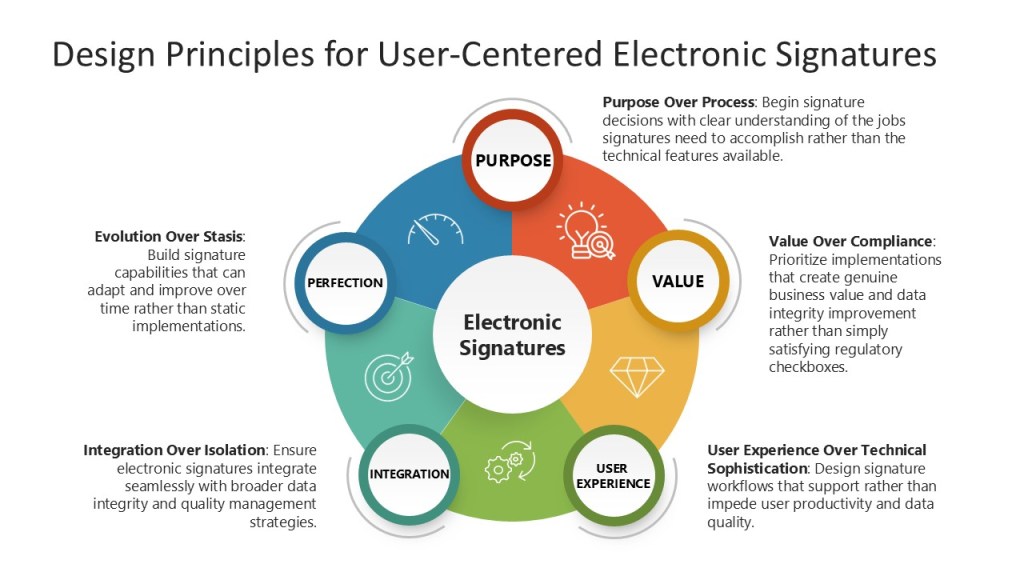
Design Principles for User-Centered Electronic Signatures

Purpose Over Process: Begin signature decisions with clear understanding of the jobs signatures need to accomplish rather than the technical features available.

Value Over Compliance: Prioritize implementations that create genuine business value and data integrity improvement rather than simply satisfying regulatory checkboxes.

User Experience Over Technical Sophistication: Design signature workflows that support rather than impede user productivity and data quality.

Integration Over Isolation: Ensure electronic signatures integrate seamlessly with broader data integrity and quality management strategies.

Evolution Over Stasis: Build signature capabilities that can adapt and improve over time rather than static implementations.

The image illustrates five design principles for user-centered electronic signatures in a circular infographic. At the center is the term "Electronic Signatures," surrounded by five labeled sections: Purpose, Value, User Experience, Integration, and Perfection. Each section contains a principle with supporting text:

Purpose Over Process: Emphasizes understanding the job requirements for signatures before technical features.

Value Over Compliance: Focuses on business value and data integrity, not just regulatory compliance.

User Experience Over Technical Sophistication: Encourages workflows that support productivity and data quality.

Integration Over Isolation: Stresses integrating electronic signatures with broader quality management strategies.

Evolution Over Stasis: Advocates capability improvements over static implementations. The design uses different colors for each principle and includes icons representing their themes.

Building Organizational Trust Through Electronic Signatures

Electronic signatures should enhance rather than complicate organizational trust in data integrity. This requires:

  • Transparency: Users should understand how electronic signatures protect data integrity and support business decisions.
  • Reliability: Signature systems should work consistently and predictably, supporting rather than impeding daily operations.
  • Accountability: Electronic signatures should create clear accountability and traceability without overwhelming users with administrative burden.
  • Competence: Organizations should demonstrate genuine competence in electronic signature implementation and management, not just regulatory compliance.

Future-Proofing Your Electronic Signature Approach

The regulatory and technological landscape for electronic signatures continues to evolve. Organizations need approaches that can adapt to:

  • Regulatory Evolution: Draft revisions to Annex 11, evolving FDA guidance, and new regulatory requirements in emerging markets.
  • Technological Advancement: Biometric signatures, blockchain-based authentication, artificial intelligence integration, and mobile signature capabilities.
  • Business Model Changes: Remote work, cloud-based systems, global operations, and supplier network integration.
  • User Expectations: Consumerization of technology, mobile-first workflows, and seamless user experiences.

The Path Forward: Hiring Electronic Signatures for Real Jobs

We need to move beyond electronic signature systems that create false confidence while providing no genuine data integrity protection. This happens when organizations optimize for regulatory appearance rather than user needs, creating elaborate signature workflows that nobody genuinely wants to hire.

True electronic signature strategy begins with understanding what jobs users actually need accomplished: establishing reliable accountability, protecting data integrity, enabling efficient workflows, and supporting regulatory confidence. Organizations that design electronic signature approaches around these jobs will develop competitive advantages in an increasingly digital world.

The framework presented here provides a structured approach to making these decisions, but the fundamental insight remains: electronic signatures should not be something organizations implement to satisfy auditors. They should be capabilities that organizations actively seek because they make data integrity demonstrably better.

When we design signature capabilities around the jobs users actually need accomplished—protecting data integrity, enabling accountability, streamlining workflows, and building regulatory confidence—we create systems that enhance rather than complicate our fundamental mission of protecting patients and ensuring product quality.

The choice is clear: continue performing electronic signature compliance theater, or build signature capabilities that organizations genuinely want to hire. In a world where data integrity failures can result in patient harm, product recalls, and regulatory action, only the latter approach offers genuine protection.

Electronic signatures should not be something we implement because regulations require them. They should be capabilities we actively seek because they make us demonstrably better at protecting data integrity and serving patients.

When 483s Reveal Zemblanity: The Catalent Investigation – A Case Study in Systemic Quality Failure

The Catalent Indiana 483 form from July 2025 reads like a textbook example of my newest word, zemblanity, in risk management—the patterned, preventable misfortune that accrues not from blind chance, but from human agency and organizational design choices that quietly hardwire failure into our operations.

Twenty hair contamination deviations. Seven months to notify suppliers. Critical equipment failures dismissed as “not impacting SISPQ.” Media fill programs missing the very interventions they should validate. This isn’t random bad luck—it’s a quality system that has systematically normalized exactly the kinds of deviations that create inspection findings.

The Architecture of Inevitable Failure

Reading through the six major observations, three systemic patterns emerge that align perfectly with the hidden architecture of failure I discussed in my recent post on zemblanity.

Pattern 1: Investigation Theatre Over Causal Understanding

Observation 1 reveals what happens when investigations become compliance exercises rather than learning tools. The hair contamination trend—20 deviations spanning multiple product codes—received investigation resources proportional to internal requirement, not actual risk. As I’ve written about causal reasoning versus negative reasoning, these investigations focused on what didn’t happen rather than understanding the causal mechanisms that allowed hair to systematically enter sterile products.

The tribal knowledge around plunger seating issues exemplifies this perfectly. Operators developed informal workarounds because the formal system failed them, yet when this surfaced during an investigation, it wasn’t captured as a separate deviation worthy of systematic analysis. The investigation closed the immediate problem without addressing the systemic failure that created the conditions for operator innovation in the first place.

Pattern 2: Trend Blindness and Pattern Fragmentation

The most striking aspect of this 483 is how pattern recognition failed across multiple observations. Twenty-three work orders on critical air handling systems. Ten work orders on a single critical water system. Recurring membrane failures. Each treated as isolated maintenance issues rather than signals of systematic degradation.

This mirrors what I’ve discussed about normalization of deviance—where repeated occurrences of problems that don’t immediately cause catastrophe gradually shift our risk threshold. The work orders document a clear pattern of equipment degradation, yet each was risk-assessed as “not impacting SISPQ” without apparent consideration of cumulative or interactive effects.

Pattern 3: Control System Fragmentation

Perhaps most revealing is how different control systems operated in silos. Visual inspection systems that couldn’t detect the very defects found during manual inspection. Environmental monitoring that didn’t include the most critical surfaces. Media fills that omitted interventions documented as root causes of previous failures.

This isn’t about individual system inadequacy—it’s about what happens when quality systems evolve as collections of independent controls rather than integrated barriers designed to work together.

Solutions: From Zemblanity to Serendipity

Drawing from the approaches I’ve developed on this blog, here’s how Catalent could transform their quality system from one that breeds inevitable failure to one that creates conditions for quality serendipity:

Implement Causally Reasoned Investigations

The Energy Safety Canada white paper I discussed earlier this year offers a powerful framework for moving beyond counterfactual analysis. Instead of concluding that operators “failed to follow procedure” regarding stopper installation, investigate why the procedure was inadequate for the equipment configuration. Instead of noting that supplier notification was delayed seven months, understand the systemic factors that made immediate notification unlikely.

Practical Implementation:

  • Retrain investigators in causal reasoning techniques
  • Require investigation sponsors (area managers) to set clear expectations for causal analysis
  • Implement structured causal analysis tools like Cause-Consequence Analysis
  • Focus on what actually happened and why it made sense to people at the time
  • Implement rubrics to guide consistency

Build Integrated Barrier Systems

The take-the-best heuristic I recently explored offers a powerful lens for barrier analysis. Rather than implementing multiple independent controls, identify the single most causally powerful barrier that would prevent each failure type, then design supporting barriers that enhance rather than compete with the primary control.

For hair contamination specifically:

  • Implement direct stopper surface monitoring as the primary barrier
  • Design visual inspection systems specifically to detect proteinaceous particles
  • Create supplier qualification that includes contamination risk assessment
  • Establish real-time trend analysis linking supplier lots to contamination events

Establish Dynamic Trend Integration

Traditional trending treats each system in isolation—environmental monitoring trends, deviation trends, CAPA trends, maintenance trends. The Catalent 483 shows what happens when these parallel trend systems fail to converge into integrated risk assessment.

Integrated Trending Framework:

  • Create cross-functional trend review combining all quality data streams
  • Implement predictive analytics linking maintenance patterns to quality risks
  • Establish trigger points where equipment degradation patterns automatically initiate quality investigations
  • Design Product Quality Reviews that explicitly correlate equipment performance with product quality data

Transform CAPA from Compliance to Learning

The recurring failures documented in this 483—repeated hair findings after CAPA implementation, continued equipment failures after “repair”—reflect what I’ve called the effectiveness paradox. Traditional CAPA focuses on thoroughness over causal accuracy.

CAPA Transformation Strategy:

  • Implement a proper CAPA hierarchy, prioritizing elimination and replacement over detection and mitigation
  • Establish effectiveness criteria before implementation, not after
  • Create learning-oriented CAPA reviews that ask “What did this teach us about our system?”
  • Link CAPA effectiveness directly to recurrence prevention rather than procedural compliance

Build Anticipatory Quality Architecture

The most sophisticated element would be creating what I call “quality serendipity”—systems that create conditions for positive surprises rather than inevitable failures. This requires moving from reactive compliance to anticipatory risk architecture.

Anticipatory Elements:

  • Implement supplier performance modeling that predicts contamination risk before it manifests
  • Create equipment degradation models that trigger quality assessment before failure
  • Establish operator feedback systems that capture emerging risks in real-time
  • Design quality reviews that explicitly seek weak signals of system stress

The Cultural Foundation

None of these technical solutions will work without addressing the cultural foundation that allowed this level of systematic failure to persist. The 483’s most telling detail isn’t any single observation—it’s the cumulative picture of an organization where quality indicators were consistently rationalized rather than interrogated.

As I’ve written about quality culture, without psychological safety and learning orientation, people won’t commit to building and supporting robust quality systems. The tribal knowledge around plunger seating, the normalization of recurring equipment failures, the seven-month delay in supplier notification—these suggest a culture where adaptation to system inadequacy became preferable to system improvement.

The path forward requires leadership that creates conditions for quality serendipity: reward pattern recognition over problem solving, celebrate early identification of weak signals, and create systems that make the right choice the easy choice.

Beyond Compliance: Building Anti-Fragile Quality

The Catalent 483 offers more than a cautionary tale—it provides a roadmap for quality transformation. Every observation represents an invitation to build quality systems that become stronger under stress rather than more brittle.

Organizations that master this transformation—moving from zemblanity-generating systems to serendipity-creating ones—will find that quality becomes not just a regulatory requirement but a competitive advantage. They’ll detect risks earlier, respond more effectively, and create the kind of operational resilience that turns disruption into opportunity.

The choice is clear: continue managing quality as a collection of independent compliance activities, or build integrated systems designed to create the conditions for sustained quality success. The Catalent case shows us what happens when we choose poorly. The frameworks exist to choose better.


What patterns of “inevitable failure” do you see in your own quality systems? How might shifting from negative reasoning to causal understanding transform your approach to investigations? Share your thoughts—this conversation about quality transformation is one we need to have across the industry.

Draft revision of Eudralex Volume 4 Chapter 1

The draft revision of Eudralex Volume 4 Chapter 1 marks a substantial evolution from the current version, reflecting regulatory alignment with ICH Q9(R1), enhanced risk-based approaches, and a new emphasis on knowledge management, proactive risk detection, and supply chain resilience.

Core Differences at a Glance

  • The draft update integrates advances in global quality science—especially from ICH Q9(R1)—anchoring the Pharmaceutical Quality System (PQS) more firmly in knowledge management and risk management practice.
  • Proactive risk identification and mitigation are highlighted, reflecting the need to anticipate supply disruptions and quality failures, beyond routine compliance.
  • The requirements for Product Quality Review (PQR) are clarified, notably in how to handle grouped products and limited-batch scenarios, enhancing operational clarity for diverse manufacturing models.

Philosophical Shift: From Compliance to Dynamic Risk Management

Where the current Chapter 1 (in force since 2013) framed the PQS largely as a static structure of roles, documentation, and reviews, the draft version pivots toward a learning organization approach: knowledge acquisition, use, and feedback become core system elements.

Emphasis is now placed on systematic knowledge management as both a regulatory and operational priority. This serves as an overt marker of quality system maturity, intended to reduce “invisible failures” and foster analytical vigilance—aligning closely with falsifiable quality frameworks.

Risk-Based Decision-Making: Explicit and Actionable

The revision operationalizes risk-based thinking by mandating scientific rationale for risk decisions and clarifying expectations for proportionality in risk assessment. The regulator’s intent is clear: risk management can no longer be a box-checking exercise, but must be demonstrably linked to daily site operations and lifecycle decisions.

This brings the PQS into closer alignment with both the adaptive toolbox and the take-the-best heuristics: decisive focus on the most causally relevant risk vectors rather than exhaustive factor listing, echoing playbooks for effective investigation and CAPA prioritization.

Product Quality Review (PQR) and Batch Grouping

Clarification is provided in the revised text on how to perform quality reviews for products manufactured in small numbers or as grouped products, a challenge long met with uncertainty. The draft provides operational guidance, aiming to resolve ambiguities around the statistical and process review requirements for product families and low-volume production.

Supply Chain Resilience, Shortage Prevention, and Knowledge Networks

The draft gives unprecedented attention to shortage prevention and supply chain risk. Manufacturers will be expected to anticipate, document, and mitigate vulnerabilities not only in routine operations but also in emergency or shortage-prone contexts. This aligns the PQS with broader public health objectives, situating quality management as a bulwark against systemic healthcare risk.

International Harmonization and the ICH Q9(R1) Impact

Most significantly, the update explicitly references alignment with ICH Q9(R1) on Quality Risk Management, making harmonization with international best practice an explicit goal. This pushes organizations toward the global baseline for science- and risk-driven GMP.

The effect will be increased regulatory predictability for multinational manufacturers and heightened expectations for knowledge-handling and continuous improvement.

Summary Table: Draft vs. Current Chapter 1

FeatureCurrent Chapter 1 (2013)Draft Chapter 1 (2025)
PQS PhilosophyCompliance/document controlKnowledge management & risk management
Risk ManagementImplied, periodicEmbedded, real-time, evidence-based
ICH Q9 AlignmentPartialExplicit, full alignment to Q9(R1)
Product Quality Review (PQR)General guidanceDetailed, incl. grouped/low-batch
Supply Chain & ShortagesMinimal focusProactive risk, shortage prevention
Corrective/Preventive Action (CAPA)System-orientedRooted in risk, causal prioritization
Lifecycle IntegrationWeakStrong, with embedded feedback

Operational Implications for Quality Leaders

The new Chapter 1 will demand a more dynamic, evidence-driven PQS, with robust mechanisms for knowledge transfer, risk-based priority setting, and system learning cycles. Technical writing, investigation reports, and CAPA logic will need to reference causal mechanisms and risk rationale explicitly—a marked shift from checklists to analytical narratives, aligning with the take-the-best causal reasoning discussed in your recent writings.

To prepare, organizations should:

  • Review and strengthen knowledge management assets
  • Embed risk assessment into the daily decision matrix—not just annual reviews
  • Foster investigative cultures that value causal specificity over exhaustive documentation
  • Reframe supply chain oversight as a continuous risk monitoring exercise

This systemic move, when enacted, will shift GMP thinking from historical compliance to forward-looking, adaptive quality management—an ambitious but necessary corrective for the challenges facing pharmaceutical manufacturing in 2025 and beyond.

Veeva Summit, the Quality Nerd Prom (Day 1)

I am here at the Veeva R&D Summit this year. As always I’m looking forward to nerd prom, I mean the trade show where half the people I know show up.

In this post I’m going to keep a running tally of what stood out to me on day 1, and maybe draw some themes out.

Networking Breakfasts

First, I hate getting up in time to make it to a breakfast. But these are my favorite events, organized networking. No agendas, no slides, no presentations. Just a bunch of fellow professionals who care about a specific topic and are more than happy to share.

Today I went to the Validation Vault breakfast, which means a lot of fellow validation mind folks. What did the folks at my table talk about:

  1. The draft Annex 11, especially with security being the next new thing
  2. Risk assessments leading to testing activities
  3. Building requirements from templates and from risk based approaches
  4. The danger of the Vault Owner
  5. Everyone’s strggles getting people to execute value-added UATs
  6. CSA as a comedy show

Opening Keynote

TAt the keynote, Veeva wanted to stress the company’s strategic direction, highlighting three major themes that will shape the life sciences industry: a strong focus on artificial intelligence through VeevaAI, the push toward industry standard applications, and an overarching emphasis on simplification and standardization.

VeevaAI and the Rise of Intelligent Agents

Veeva certainly hoped that there would be a lot of excitement around their most significant announcement centered on their comprehensive AI initiative, VeevaAI, which represents a shift toward agentic artificial intelligence across their entire platform ecosystem. Veeva wants you to know very explictely that this isn’t merely adding AI features as an afterthought—it’s about building intelligent agents directly into the Vault Platform with secure, direct access to data, documents, and workflows.

Those of us who have implemented a few Vaults know that the concept of AI agents isn’t entirely new to Veeva’s ecosystem. These intelligent assistants have been operating in specific areas like Safety and electronic Trial Master File (eTMF) systems for years. However, the company is now wants to expand this concept, planning to implement custom-built agents across all Veeva applications

They also really want the investors to know they are doing that sexy new thing, AI. Curious as a Public Benefit Corporation that they didn’t talk about their environmental commitements and the known impacts of AI upon the environment.

The Technical Foundation: Model Context Protocol

Veeva is working to implement Anthropic’s Model Context Protocol (MCP) in 2026. MCP represents an open standard that functions like “USB-C for AI applications,” enabling standardized connections between AI models and various data sources and tools. This protocol allows AI agents to communicate seamlessly with each other and access real-time data from distributed environments.

This protocol has gained significant traction across the technology industry. Major companies like Google, OpenAI, and Microsoft have embraced MCP, demonstrating its viability as a foundation for enterprise AI strategies. So this adoption makes sense.

Rollout Timeline and Early Adopter Program

Veeva’s AI implementation follows a structured timeline. The early adopter program launches in 2026, with general availability expected by 2028. This phased approach allows the company to work closely with select customers as a focus group, sharing best practices while developing the pricing model. Different Vault applications will receive AI capabilities across quarters—for example, Quality applications are scheduled for April 2026.

The first release of VeevaAI is planned for December 2025 and will include both AI Agents and AI Shortcuts. AI Agents provide application-specific automation with industry-specific prompts and safeguards, while AI Shortcuts enable user-defined automations for repetitive tasks.

Industry Standard Applications: Building Market Presence

The second major theme from the Summit focused on Industry Standard Applications, which represents an evolution of Veeva’s previous Vault Essentials and Vault Basics initiatives. This strategy aims to solidify Veeva’s market presence by providing standardized, pre-configured applications that organizations can implement quickly and efficiently.

Focus on eTMF and QualityDocs

Veeva is initially concentrating on two key areas: eTMF (electronic Trial Master File) and QualityDocs.

Platform Enhancements: Three Key Features

Beyond AI and standardization, Veeva announced a few potentially significant platform improvements coming in 2025.

Action Triggers

A quick search on Veeva’s web pages tells me that Action Triggers represent a major advancement in Vault Platform functionality, allowing administrators to write simple conditional logic that executes when CREATE, UPDATE, or DELETE operations occur on records. This feature enables Vault to perform actions that previously required complex Java SDK Record Triggers, such as sending notifications when fields are updated, updating related records, starting workflows, or preventing record saves under specific conditions.

The implementation uses IF-THEN-ELSE statements with a context-sensitive editor, making it accessible to administrators without extensive programming knowledge. Recent enhancements include support for the IsChanged() function, which improves efficiency by evaluating whether fields have been modified.

I’ve got uses in mind for this. Pretty important as we start thinking of agentic functionality.

Document View Enhancement

I think I will better understand what is coming here later in the Summit.

Process Monitor

The functionality likely provides enhanced visibility and control over business processes across Vault applications. Hopefully we will learn more, probably at the Quality keynote.

Regulatory Vault: Global Label Authoring and Management

Looking ahead to early 2027, Veeva plans to roll out global label authoring and management capabilities within Regulatory Vault. This enhancement will provide comprehensive tracking and management of labeling concept updates and deviations across global and local levels. Organizations will be able to enter proposed changes, send them to affiliate teams for local disposition, and capture deviations in local labeling while maintaining global visibility throughout the approval and submission process.

Quality Keynote

One of the nice things about being at a CDMO is I’ve pretty much shed all my need to pay attention to the other Vaults, so this will be the first summit in a long time I focus exclusively on Quality Vault.

Veeva really wants us to know they are working hard to streamline user experience enhancements. This makes sense, because boy do people like to complain.

Veeva discussed three key improvements designed to simplify daily operations:

  • Streamlined Document Viewer was poorly defined. I’ll need to see this before weighing in.
  • Action Home Page introduces task-based navigation with faster access to critical content. This redesign recognizes that users need rapid access to their most important tasks and documents, reducing the time spent navigating through complex menu structures.
  • Process Navigator brings dynamic association of content, effectively automating parts of the buildout. The ability to dynamically link relevant content to specific process steps could significantly reduce process deviations and improve consistency. Process navigator is my favorite underused part of Quality Vault, so I am thrilled to see it get some love.

Continuing the theme of Agentic AI, Quality Event Suggestions focuses on aggregating data to enable suggestions for possible texts. I hope this is better than word suggestions in a text app. Should be fun to qualify.

Change Control is receiving significant love with:

  • action paths. This enhancement focuses on grouping and sequencing changes to improve repeatability
  • The expanded capability to involve external partners in change control processes. Managing changes that span partners (suppliers, CxO, sponsors, etc), has traditionally been complex and prone to communication gaps. Streamlined external partner integration should reduce approval cycles and improve change implementation quality.
  • Increased integration between QMS and RIM (Regulatory Information Management) creates a more unified quality ecosystem. This integration enables seamless flow of regulatory requirements into quality processes, ensuring compliance considerations are embedded throughout operations.

The Audit Room feature addresses both front and back room audit activities, providing a structured way to expose inspection requests to auditors. This capability recognizes that inspections and audits increasingly rely on electronic systems and data presentations. Having a standardized audit interface could significantly reduce inspection preparation time and improve confidence in the quality systems. The ability to present information clearly and comprehensively during audits and inspections directly impacts inspection outcomes and business continuity.

The training enhancements demonstrate Veeva’s commitment to modern learning approaches:

  • Refresher training receives increased focus, recognizing that maintaining competency requires ongoing reinforcement rather than one-time training events.
  • Good to see continued LearnGxP library expansion with over 60 new courses and 115+ course updates ensures that training content remains current with evolving regulations and industry best practices. One of the best learning packages out there for purchase continues to get better.
  • Wave-based assignments with curriculum prerequisites introduce more sophisticated training management capabilities. This enhancement allows organizations to create logical learning progressions that ensure foundational knowledge before advancing to complex topics. The approach particularly benefits organizations with high staff turnover or complex training requirements across diverse roles.

Revolutionary LIMS: True Cloud Architecture

Veeva really wants you to know their LIMS is different fro all the other LIMS, stressing they have several key advantages over legacy systems:

  • True Cloud Architecture eliminates the infrastructure management burden that traditionally consumes significant IT resources. Unlike legacy LIMS that are merely hosted in the cloud, Veeva LIMS is built cloud-native, providing better performance, scalability, and automatic updates.
  • Collapsing System Layers represents a philosophical shift in laboratory informatics. Traditionally, lab execution has been separate from LIMS functionality, creating data silos and integration challenges. Veeva’s approach unifies these capabilities. I am excited about what will come as they extend the concept to environmental monitoring and creating a more cohesive laboratory ecosystem.

AI-Powered Quality Agents: Early Adopter Opportunities

Building on the Keynote it was announced that there will be 8-10 early adopters for Quality Event Agents. These AI-powered agents promise three capabilities:

  • Automatic Narrative Summary Generation across quality events could revolutionize how organizations analyze and report on quality trends. Instead of manual compilation of event summaries, AI agents would automatically generate comprehensive narratives that identify patterns, root causes, and improvement opportunities.
  • Document Summarization Agents will summarize SOP version changes and other critical document updates. Automated change summaries could improve change communication and training development. The ability to quickly understand what changed between document versions reduces review time and improves change implementation quality.
  • Document Translation Agents address the global nature of pharmaceutical operations. For CDMOs working with international sponsors or regulatory authorities, automated translation of quality documents while maintaining technical accuracy could accelerate global project timelines and reduce translation costs.

Lunch Networking – LIMS

Another good opportunity to network. The major concern of the table I sat at was migration.

Validation Manager

After four years of watching Validation Manager evolve since its 2021 announcement, the roadmap presentation delivered a compelling case for production readiness. With over 50 customers now actively using the system, Veeva is clearly positioning Validation Manager as a mature solution ready for widespread adoption across the pharmaceutical industry.

Recent Enhancements: Streamlining the Validation Experience

The latest updates to Validation Manager demonstrate Veeva’s commitment to addressing real-world validation challenges through improved user experience and workflow optimization.

User Experience Improvements

Quick Requirement Creation represents a fundamental shift toward simplifying the traditionally complex process of requirement documentation. This enhancement reduces the administrative burden of creating and managing validation requirements, allowing validation teams to focus on technical content rather than system navigation.

The Requirements Burndown Search Bar provides project managers with rapid visibility into requirement status and progress. For organizations managing multiple validation projects simultaneously, this search capability enables quick identification of bottlenecks and resource allocation issues.

Display Workflow Taskbars for Interfaces addresses a common pain point in collaborative validation environments. The enhanced task visibility during authoring, executing, or approving test scripts and protocols ensures that all stakeholders understand their responsibilities and deadlines, reducing project delays due to communication gaps.

Template Standardization and Execution Features

Template Test Protocols and Test Scripts introduce the standardization capabilities that validation professionals have long requested. These templates enable organizations to maintain consistency across projects while reducing the time required to create new validation documentation.

The Copy Test Script and Protocol Enhancements provide more sophisticated version control and reusability features. For organizations with similar systems or repeated validation activities, these enhancements significantly reduce development time and improve consistency.

Periodic Reviews for Entities automate the ongoing maintenance requirements that regulatory frameworks demand. This feature ensures that validation documentation remains current and compliant throughout the system lifecycle, addressing one of the most challenging aspects of validation maintenance.

Dry Run Capabilities

Dry Run for Test Scripts represents perhaps the most significant quality-of-life improvement in the recent updates. The ability to create clones of test scripts for iterative testing during development addresses a fundamental flaw in traditional validation approaches.

Previously, test script refinement often occurred on paper or through informal processes that weren’t documented. The new dry run capability allows validation teams to document their testing iterations, creating a valuable record of script development and refinement. This documentation can prove invaluable during regulatory inspections when authorities question testing methodologies or script evolution.

Enhanced Collaboration and Documentation

Script and Protocol Execution Review Comments improve the collaborative aspects of validation execution. These features enable better communication between script authors, reviewers, and executors, reducing ambiguity and improving execution quality.

Requirement and Specification Reference Tables provide structured approaches to managing the complex relationships between validation requirements and system specifications. This enhancement addresses the traceability requirements that are fundamental to regulatory compliance.

2025 Developments: Advanced Control and Embedded Intelligence

Flexible Entity Management

Optional Entity Versions address a long-standing limitation in validation management systems. Traditional systems often force version control on entities that don’t naturally have versions, such as instruments or facilities. This enhancement provides advanced control capabilities, allowing organizations to manage activities at both entity and version levels as appropriate.

This flexibility is particularly valuable for equipment qualification and facility validation scenarios where the validation approach may need to vary based on the specific context rather than strict version control requirements.

Intelligent Requirement Scoping

In-Scope Requirements for Activities target specific validation scenarios like change management and regression testing. This capability allows validation teams to define precisely which requirements apply to specific activities, reducing over-testing and improving validation efficiency.

For organizations managing large, complex systems, the ability to scope requirements appropriately can significantly reduce validation timelines while maintaining regulatory compliance and system integrity.

Enhanced Test Script Capabilities

Reference Instruction Prompts represent a much needed evolution from current text-only instruction prompts. The ability to embed images and supporting documents directly into test scripts dramatically improves clarity for script executors.

This enhancement is particularly powerful when testing SOPs as part of User Acceptance Testing (UAT) or other validation activities. The embedded documents can reference other quality documents, creating seamless integration between validation activities and broader quality management systems. This capability could transform how organizations approach process validation and system integration testing. It is a great example of why consolidation in Veeva makes sense.

2026 Vision: Enterprise-Scale Validation Management

The 2026 roadmap reveals Veeva’s ambition to address enterprise-scale validation challenges and complex organizational requirements.

Standardization and Template Management

Activity and Deliverable Templates promise to standardize testing activities across asset classes. This standardization addresses a common challenge in large pharmaceutical organizations where different teams may approach similar validation activities inconsistently.

Validation Team Role Filtering introduces the ability to template various roles in validation projects. This capability recognizes that validation projects often involve complex stakeholder relationships with varying responsibilities and access requirements.

Missing Fundamental Features

Test Step Sequencing is conspicuously absent from current capabilities, which is puzzling given its fundamental importance in validation execution. The 2026 inclusion of this feature suggests recognition of this gap, though it raises questions about why such basic functionality wasn’t prioritized earlier.

User Experience Evolution

The continued focus on test authoring and execution UX improvements indicates that a large portion of 2026 development resources will target user experience refinement. This sustained investment in usability demonstrates Veeva’s commitment to making validation management accessible to practitioners rather than requiring specialized system expertise.

Complex Project Support

Complex Validation Projects support through entity hierarchy and site maps addresses the needs of pharmaceutical organizations with distributed operations. These capabilities enable validation teams to manage projects that span multiple sites, systems, and organizational boundaries.

Collaboration with Suppliers and Vendors tackles the challenge of managing validation packages from external suppliers. This enhancement could significantly reduce the effort required to integrate supplier-provided validation documentation into corporate validation programs. Look forward to Veeva doing this themselves with their own documentation including releases.

AI-Powered Documentation Conversion

Documents to Data Conversion represents the most ambitious enhancement, leveraging platform AI capabilities for easy requirement and specification uploading. This feature promises to automate the conversion of traditional validation documents (URS, FRS, DS, Test Protocols, Test Scripts) into structured data.

This AI-powered conversion could revolutionize how organizations migrate legacy validation documentation into modern systems and how they integrate validation requirements from diverse sources. The potential time savings and accuracy improvements could be transformational for large validation programs.

Specialized Validation Activities

Cleaning and Method Result Calculations address specific validation scenarios that have traditionally required manual calculation and documentation. The cleaning sample location identification and process cross-test execution comparisons demonstrate Veeva’s attention to specialized pharmaceutical validation requirements.

Strategic Assessment: Production Readiness Evaluation

After four years of development and with 50 active customers, Validation Manager appears to have reached genuine production readiness. The roadmap demonstrates:

  • Comprehensive Feature Coverage: The system now addresses the full validation lifecycle from requirement creation through execution and maintenance.
  • User Experience Focus: Sustained investment in usability improvements suggests the system is evolving beyond basic functionality toward practitioner-friendly operation.
  • Enterprise Scalability: The 2026 roadmap addresses complex organizational needs, indicating readiness for large-scale deployment.
  • Integration Capabilities: Features like embedded documentation references and supplier collaboration demonstrate understanding of validation as part of broader quality ecosystems.

Batch Management Roadmap

With seven customers now actively using Batch Release Management, Veeva is building momentum in one of the most critical areas of pharmaceutical manufacturing operations. The system’s focus on centralizing batch-related data and content across Veeva applications and third-party solutions addresses the fundamental challenge of modern pharmaceutical manufacturing: achieving real-time visibility and compliance across increasingly complex supply chains and regulatory requirements.

Core Value Proposition: Centralized Intelligence

Batch Release Management operates on three foundational pillars that address the most pressing challenges in pharmaceutical batch release operations.

Aggregation: Unified Data Visibility

The Batch Release Dashboard provides centralized visibility into all batch-related activities, eliminating the information silos that traditionally complicate release decisions. This unified view aggregates data from quality systems, manufacturing execution systems, laboratory information management systems, and regulatory databases into a single interface.

Market Ship Decisions capability recognizes that modern pharmaceutical companies often release batches to multiple markets with varying regulatory requirements. The system enables release managers to make market-specific decisions based on local regulatory requirements and quality standards.

Multiple Decisions per Batch functionality acknowledges that complex batch release scenarios often require multiple approval stages or different approval criteria for different aspects of the batch. This capability enables granular control over release decisions while maintaining comprehensive audit trails.

Genealogy Aware Checks represent perhaps the most sophisticated feature, providing visibility into the complete history of materials and components used in batch production. This capability is essential for investigating quality issues and ensuring that upstream problems don’t affect downstream batches.

Automation: Reducing Manual Overhead

Disposition Document Set Auto-Creation eliminates the manual effort traditionally required to compile release documentation. The system automatically generates the complete set of documents required for batch release, ensuring consistency and reducing the risk of missing critical documentation.

Rules-Based Assignment automates the routing of release activities to appropriate personnel based on product type, market requirements, and organizational structure. This automation ensures that batches are reviewed by qualified personnel while optimizing workload distribution.

Due Dates Calculation automatically determines release timelines based on product requirements, market needs, and regulatory constraints. This capability helps organizations optimize inventory management while ensuring compliance with stability and expiry requirements.

Disposition Dependencies manage the complex relationships between different release activities, ensuring that activities are completed in the correct sequence and that dependencies are clearly understood by all stakeholders.

Optimization: Exception-Based Efficiency

Review by Exception focuses human attention on batches that require intervention while automatically processing routine releases. This approach significantly reduces the time required for batch release while ensuring that unusual situations receive appropriate attention.

Revisionable Plans enable organizations to maintain controlled flexibility in their batch release processes. Plans can be updated and versioned while maintaining full audit trails of changes and their rationale.

Plan Variation allows for material and site-specific customization while maintaining overall process consistency. This capability is particularly valuable for organizations manufacturing across multiple sites or handling diverse product portfolios.

Recent Enhancements: Addressing Real-World Complexity

The 2025 updates demonstrate Veeva’s understanding of the complex scenarios that batch release managers encounter in daily operations.

Quality Event Integration

Disposition Impact Field on Deviations and Lab Investigations creates direct linkage between quality events and batch release decisions. This enhancement ensures that quality issues are automatically considered in release decisions, reducing the risk that batches are released despite outstanding quality concerns.

Change Control Check for Affected Material provides automated verification that materials affected by change controls have been properly evaluated and approved for use. This capability is essential for maintaining product quality and regulatory compliance in dynamic manufacturing environments.

Genealogy and Traceability Enhancements

Genealogy Check represents a significant advancement in batch traceability. The system now examines all quality events, dispositions, and documents for every step in the material genealogy, providing comprehensive visibility into the quality history of released batches.

This capability is particularly valuable during regulatory inspections or quality investigations where complete traceability is required. The automated nature of these checks ensures that no relevant quality information is overlooked in release decisions.

Scalable Plan Management

Disposition Plan Variation addresses the challenge of managing batch release plans across thousands of materials while maintaining consistency. The system enables common checks and settings in parent plans that are shared across child plans, allowing standardization at the category level with specific variations for individual products.

For example, organizations can create parent plans for finished goods or raw materials and then create variations for specific products. This hierarchical approach dramatically reduces the administrative burden of maintaining release plans while ensuring appropriate customization for different product types.

Auto-Close Disposition Items Using Criteria reduces manual administrative tasks by automatically closing routine disposition items when predetermined criteria are met. This automation allows batch release personnel to focus on exception handling rather than routine administrative tasks.

Upcoming 2025 Developments

Manufacturing Intelligence

Change Control Check Using “As Designed” Bill of Materials introduces intelligent verification capabilities that compare actual batch composition against intended design. This check ensures that manufacturing deviations are properly identified and evaluated before batch release.

Material Genealogy and Bill of Materials Check provide comprehensive verification of material usage and composition. These capabilities ensure that only approved materials are used in production and that any substitutions or deviations are properly documented and approved.

Collaborative Release Management

Share Disposition enables collaborative release decisions across multiple stakeholders or organizational units. This capability is particularly valuable for organizations with distributed release authority or complex approval hierarchies.

Independent Disposition Check increases the granularity of check completion, allowing different aspects of batch release to be managed independently while maintaining overall process integrity. This enhancement provides greater flexibility in release workflows while ensuring comprehensive evaluation.

Site-Specific Optimization

Manufacturing Site Specific Plans recognize that different manufacturing sites may have different release requirements based on local regulations, capabilities, or product portfolios. This capability enables organizations to optimize release processes for specific sites while maintaining overall corporate standards.

2026 Vision: Regulatory Integration and Advanced Automation

Regulatory Intelligence

Regulatory Check Integration with RIM promises to revolutionize how organizations manage regulatory compliance in batch release. The system will monitor regulatory approvals for change controls across all markets, providing simple green or red indicators for each market.

This capability addresses one of the most complex aspects of global pharmaceutical operations: ensuring that batches are only released to markets where all relevant changes have been approved by local regulatory authorities. The automated nature of this check significantly reduces the risk of regulatory violations while simplifying the release process.

Supply Chain Intelligence

Supplier Qualification Check extends batch release intelligence to include supplier qualification status. This enhancement ensures that materials from unqualified or suspended suppliers cannot be used in released batches, providing an additional layer of supply chain risk management.

Advanced Automation

Change Control Check Automation will further reduce manual effort in batch release by automatically evaluating change control impacts on batch release decisions. This automation ensures that change controls are properly considered in release decisions without requiring manual intervention for routine scenarios.

Process Flexibility

Disposition Amendment introduces the ability to change disposition decisions with appropriate documentation and approval. This capability includes redline functionality to clearly document what changes were made and why, maintaining full audit trails while providing necessary flexibility for complex release scenarios.

Early but Promising

With seven customers actively using the system, Batch Release Management is still in the early adoption phase. However, the comprehensive feature set and sophisticated roadmap suggest that the system is positioning itself as the definitive solution for pharmaceutical batch release management.

The current customer base likely represents organizations with complex release requirements that traditional systems cannot address effectively. As the system matures and demonstrates value in these demanding environments, broader market adoption should follow.

Batch Release Management represents a fundamental shift from traditional batch release approaches toward intelligent, automated, and integrated release management. The combination of aggregation, automation, and optimization capabilities addresses the core challenges of modern pharmaceutical manufacturing while providing a foundation for future regulatory and operational evolution.

Organizations managing complex batch release operations should seriously evaluate current capabilities, while those with simpler requirements should monitor the system’s evolution. The 2026 regulatory integration capabilities alone could justify adoption for organizations operating in multiple global markets.

Learning from Fujifilm Biotechnologies: Standardizing Document Management and Beyond for Global Quality

The opportunity to hear from Fujifilm Biotechnologies about their approach to global quality standardization provided valuable insights into how world-class organizations tackle the fundamental challenges of harmonizing processes across diverse operations. Their presentation reinforced several critical principles while offering practical wisdom gained from their own transformation journey.

The Foundation: Transparency and Data Governance

Fujifilm’s emphasis on transparency in data governance and harmonization of metadata struck me as foundational to their success. This focus recognizes that effective quality management depends not just on having the right processes, but on ensuring that data flows seamlessly across organizational boundaries and that everyone understands what that data means.

The stress on metadata harmonization is particularly insightful. Too often, organizations focus on standardizing processes while allowing inconsistent data definitions and structures to persist. Fujifilm’s approach suggests that metadata standardization may be as important as process standardization in achieving true global consistency.

Documents as the Strategic Starting Point

The observation that process standardization between sites fuels competitive edge resonates deeply with our own transformation experience. Fujifilm’s decision to focus on documents as “the classic way to start” validates an approach that many quality organizations instinctively understand—documents are core to how quality professionals think about their work.

Veeva’s strategic focus on QualityDocs as the foothold into their platform aligns perfectly with this insight. Documents represent the most tangible and universal aspect of quality management across different sites, regulatory jurisdictions, and organizational cultures. Starting with document standardization provides immediate value while creating the foundation for broader process harmonization.

This approach acknowledges that quality professionals across the globe share common document types—SOPs, specifications, protocols, reports—even when their specific processes vary. By standardizing document management first, organizations can achieve quick wins while building the infrastructure for more complex standardization efforts.

Overcoming System Migration Challenges

One of Fujifilm’s most practical insights addressed change management and the tendency for people to apply their last system experience to new systems. This observation captures a fundamental challenge in system implementations: users naturally try to recreate familiar workflows rather than embracing new capabilities.

Their solution—providing the right knowledge and insights upfront—emphasizes the importance of education over mere training. Rather than simply teaching users how to operate new systems, successful implementations help users understand why new approaches are better and how they can leverage enhanced capabilities.

This insight suggests that change management programs should focus as much on mindset transformation as on skill development. Users need to understand not just what to do differently, but why the new approach creates value they couldn’t achieve before.

Solving Operational Model Questions

The discussion of operating model questions such as business administration and timezone coverage highlighted often-overlooked practical challenges. Fujifilm’s recognition that global operations require thoughtful consideration of communication patterns and support models demonstrates mature thinking about operational sustainability.

The concept of well-worn paths of communication and setting up new ones connects to the idea of desire trails—the informal communication patterns that emerge naturally in organizations. Successful global standardization requires understanding these existing patterns while deliberately creating new pathways that support standardized processes.

This approach suggests that operational model design should be as deliberate as process design. Organizations need to explicitly plan how work will be coordinated across sites, timezones, and organizational boundaries rather than assuming that good processes will automatically create good coordination.

Organizational Change Management (OCM) as Strategy

Fujifilm’s focus on building desired outcomes into processes from the beginning represents sophisticated change management thinking. Rather than treating change management as an add-on activity, they integrate outcome definition into process design itself.

The emphasis on asking “how can this enable our business” throughout the implementation process ensures that standardization efforts remain connected to business value rather than becoming exercises in consistency for its own sake. This business-focused approach helps maintain stakeholder engagement and provides clear criteria for evaluating success.

The stress on good system discovery leading to good requirements acknowledges that many implementation failures stem from inadequate understanding of current state operations. Thorough discovery work ensures that standardization efforts address real operational challenges rather than theoretical improvements.

Sequence Matters: Harmonize First, Then Implement

One of Fujifilm’s most important insights was that harmonizing while implementing can be hard to do. Their recommendation to take the time to harmonize first, and then implement electronic tools challenges the common tendency to use system implementations as forcing mechanisms for harmonization.

This approach requires patience and upfront investment but likely produces better long-term results. When harmonization occurs before system implementation, the technology can be configured to support agreed-upon processes rather than trying to accommodate multiple conflicting approaches.

The sequential approach also allows organizations to resolve process conflicts through business discussions rather than technical compromises. Process harmonization becomes a business decision rather than a systems constraint, leading to better outcomes and stronger stakeholder buy-in.

Business Process Ownership: The Community of Practice Model

Perhaps the most strategic insight was Fujifilm’s approach to business process ownership through global support with local business process owners working together as a community of practice. This model addresses one of the most challenging aspects of global standardization: maintaining consistency while accommodating local needs and knowledge.

The community of practice approach recognizes that effective process ownership requires both global perspective and local expertise. Global support provides consistency, resources, and best practice sharing, while local process owners ensure that standardized approaches work effectively in specific operational contexts.

This model also creates natural mechanisms for continuous improvement. Local process owners can identify improvement opportunities and share them through the community of practice, while global support can evaluate and disseminate successful innovations across the network.

Key Takeaways for Global Quality Organizations

Fujifilm’s experience offers several actionable insights for organizations pursuing global quality standardization:

  • Start with Documents: Document standardization provides immediate value while building infrastructure for broader harmonization efforts.
  • Prioritize Metadata Harmonization: Consistent data definitions may be as important as consistent processes for achieving true standardization.
  • Sequence Implementation Carefully: Harmonize processes before implementing technology to avoid technical compromises that undermine business objectives.
  • Design Operating Models Deliberately: Plan communication patterns and support structures as carefully as process flows.
  • Integrate Change Management into Process Design: Build desired outcomes and business enablement questions into processes from the beginning.
  • Create Communities of Practice: Balance global consistency with local expertise through structured collaboration models.

Fujifilm’s approach suggests that successful global quality standardization requires sophisticated thinking about organizational change, not just process improvement. The integration of change management principles, operating model design, and community-building activities into standardization efforts demonstrates mature understanding of what it takes to achieve lasting transformation.

For quality organizations embarking on global standardization journeys, Fujifilm’s insights provide a valuable roadmap that goes beyond technical implementation to address the fundamental challenges of creating consistent, effective quality operations across diverse organizational contexts.

And That’s a Wrap

This was the last session of the day.