
Certified Food Safety and Quality Auditor Body of Knowledge

Every 5-7 years ASQ reviews and updates each Body of Knowledge (BoK) to ensure the most current state of practice is being tested in the examination. Part of the updating process is to conduct a job analysis survey to determine whether the topics in the 2012 BoK are still relevant to the job role of HACCP auditors and to identify any new topics that have emerged since that BoK was developed. Based upon qualitative research with industry experts and feedback from the CHA Job Analysis Committee, food industry knowledge was included in the job analysis survey. The quantitative results of the CHA job analysis survey indicated that all topics from the 2012 BoK are still relevant to common practice and that food industry knowledge is essential to the role of ASQ Certified HACCP Auditors. To accurately reflect the expanded new knowledge and the practice of ASQ Certified HACCP Auditors, ASQ and the CHA Committee have updated the name of the exam program to the Certified Food Safety and Quality Auditor (CFSQA).

 The 2020 Certified Food Safety and Quality Auditor Body of Knowledge (CFSQA BoK) will be introduced at the January 2020 administration. After that, ASQ Certified HACCP Auditors will be renamed and recertify as ASQ Certified Food Safety and Quality Auditors.

 To see the 2020 Certified Food Safety and Quality Auditor Body of Knowledge, click here, and to see the changes between the 2012 CHA BoK and the 2020 CFSQA BoK, click here. Below are some frequently asked questions regarding the update.

 FAQs

Why will the name be changed?

ASQ conducts a job analysis studies to determine what topics in the existing BoK are still relevant to the job role of HACCP auditors and to identify any new topics that have emerged since that BoK was developed. Based upon qualitative research with industry experts and feedback from the CHA Job Analysis Committee, additional food industry knowledge was included in the job analysis study and was subsequently validated by the active CHAs. To accurately reflect the expanded new knowledge and the practice of ASQ Certified HACCP Auditors, ASQ and the CHA Committee have updated the name of the exam program to the Certified Food Safety and Quality Auditor (CFSQA).

 When will the certification program’s title change?

Starting January 1st, 2020, all Certified HACCP Auditors will be known as Certified Food Safety and Quality Auditors.

 What was the scope of change in content within the Body of Knowledge?

No content from original CHA Body of Knowledge was removed, only new content (primarily related to the food industry) was added to the new BoK in the update. View the CFSQA BoK Map for additional information.

 When will the new CFSQA BoK be tested?

The first administration testing new CFSQA BoK will be during the January 3–19, 2020 testing window.

This is a good move. Its definitely good for folks in the food industry as it better defines the certification to material required in food safety.

It also removes the focus on a tool which is of use for other industries (we use heavily in pharma for example). I often found the focus on the tool for a specific industry confusing for those folks who were looking at the tool for other uses. This clarity is good for everyone.
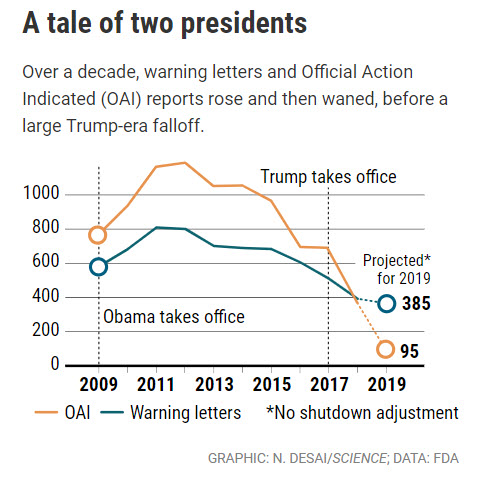
FDA enforcement actions decline

Investigative report on FDA enforcement under Trump from Science’s news department shows a steep decline in enforcement actions.

I’ve noticed this, but it is good to see actual data behind it.

I’ll be frank, it would take a lot of data that does not exist to make me feel the companies under the FDA’s oversight have gotten better as a whole. Anecdotally, well there are a lot of less than sterling players out there.

I have mostly questions:

  1. Have we seen this trend in previous Republican administrations, and is it more pronounced here?
  2. Is there any evidence that the increase under Obama was a reaction to the previous Republican administration? Are we in a cycle of lax and then tougher enforcement that maybe evens out? That sort of variance is not healthy.
  3. What, if any data, will we be able to see about impact? There are certainly concerns that the FDA has not done enough. Will this be exacerbated?
  4. What will it take for this to start affecting the mutual recognition agreements with the EU and other major bodies?

Data Process Mapping

In a presentation on practical applications of data integrity for laboratories at the March 2019 MHRA Laboratories Symposium held in London, UK, MHRA Lead GCP and GLP Inspector Jason Wakelin-Smith highlighted the important role data process mapping plays in understanding these challenges and moving down the DI pathway.

He pointed out that understanding of processes and systems, which data maps facilitate, is a key theme in MHRA’s GxP data integrity guidance, finalized in March of 2018. The guidance is intended to be broadly applicable across the regulated practices, but excluding the medical device arena, which is regulated in Europe by third-party notified bodies.

IPQ. MHRA Inspectors are Advocating Data Mapping as a Key First Step on the Data Integrity Pilgrimage

Data process maps look at the entire data life-cycle from creation through storage (covering key components of create, modify and delete) and include all operations with both paper and electronic records.   Data maps are cross-functional diagrams (swim-lanes) and have the following sections:

  • Prep/Input
  • Data Creation
  • Data Manipulation (include delete)
  • Data  Use
  • Data Storage

Use a standard symbol for paper record, computer data and process step.

For computer data denote (usually by color) the level of controls:

  • Fully aligned with Part 11 and Data Integrity guidances
  • Gaps in compliance but remediation plan in place (this includes places where paper is considered “true copy”
  • Not compliant, no remediation plan

Data operations are depicted utilizing arrows.  The following data operations are probably most common, and are recommended for consistency:

  • Data Entry – input of process, meta data (e.g. lot ID, operator)
  • Data Store – archival location
  • Data Copy – transcription from another system or paper, transfer of data from one system to another, printing (Indicate if it is a manual process).
  • Data Edit – calculations, processing, reviews, unit changes  (Indicate if it is a manual process)
  • Data Move – movement of paper or electronic records

Data operation arrows should denote (again by color) the current controls in place:

  • Technical Controls – Validated Automated Process
  • Operational Controls – Manual Process with Review/Verified/Witness Requirements
  • No Controls – Automated process that is not validated or Manual process with no Review/Verified/Witness Considerations
Example data map

AI/ML-Based SaMD Framework

The US Food and Drug Administration’s proposed regulatory framework for artificial intelligence- (AI) and machine learning- (ML) based software as a medical device (SaMD) is fascinating in what it exposes about the uncertainty around the near-term future of a lot of industry 4.0 initiatives in pharmaceuticals and medical devices.

While focused on medical devices, this proposal is interesting read for folks interested in applying machine learning and artificial intelligence to other regulated areas, such as manufacturing.

We are seeing is the early stages of consensus building around the concept of Good Machine Learning Practices (GMLP), the idea of applying quality system practices to the unique challenges of machine learning.

WCQI Day 4

Last day of the conference and for the first session I present on “Knowledge Enables Change.”

Similar to my BOSCON talk, which was the beta so I think I covered things better in this one.

Expand Your Impact on the Culture of Quality by Kathy Lyall

Solid focus on both external and internal signifiers of quality culture. A little basic but very worth reinforcing.

And then I left, skipping the last keynote to get to the airport.

Good conference this year. Overall I felt that many of my choices for sessions ended up being more basic than I thought, but there is a lot of value in that. I will hopefully make the time to turn my thoughts into better blog posts.