The Attributes of Good Procedure

Good documentation practices when documenting Work as Prescribed stresses the clarity, accuracy, thoroughness and control of the procedural instruction being written.

Clarity and Accuracy: Documentation should be clear and free from errors, ensuring that instructions are understood and followed correctly. This aligns with the concept of being precise in documentation.

Thoroughness: All relevant activities impacting quality should be recorded and controlled, indicating a need for comprehensive documentation practices.

Control and Integrity: The need for strict control over documentation to maintain integrity, accuracy, and availability throughout its lifecycle.

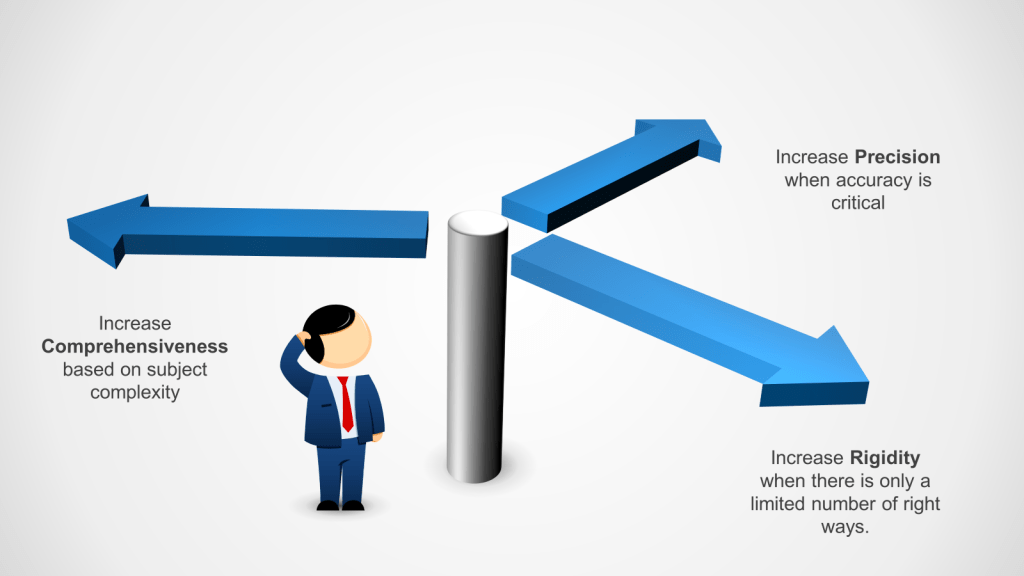
To meet these requirements we leverage three writing principles of precise, comprehensive and rigid.

Type of InstructionDefinitionAttributesWhen NeededWhyDifferencesExample
Precise Exact and accurate, leaving little room for interpretation.– Specific
– Detailed
– Unambiguous
When accuracy is critical, such as in scientific experiments or programming.Regulatory agencies require precise documentation to ensure tasks are performed consistently and correctlyFocuses on exactness and clarity, ensuring tasks are performed without deviation.Instructions for assembling a computer, specifying exact components and steps.
Comprehensive Complete and covering all necessary aspects of a task.– Thorough
– Inclusive
– Exhaustive
When a task is complex and requires understanding of all components, such as in training manuals.Comprehensive SOPs are crucial for ensuring all aspects of a process are covered, ensuring compliance with regulatory requirements.Provides a full overview, ensuring no part of the task is overlooked.Employee onboarding manual covering company policies, procedures, and culture.
Rigid Strict and inflexible, not allowing for changes.– Fixed
– Inflexible
– Consistent
When safety and compliance are paramount, such as batch recordsRigid instructions ensure compliance with strict regulatory standards.Ensures consistency and adherence to specific protocols, minimizing risks.Safety procedures for operating heavy machinery, with no deviations allowed.

When writing documents based on cognitive principles these three are often excellent for detailed task design but there are significant trade-offs inherent in these attributes when we codify knowledge:

  • The more comprehensive the instructions, the less likely that they can be absorbed, understood, and remembered by those responsible for execution – which is why it is important these instructions are followed at time of execution. Moreover, comprehensive instructions also risk can dilute the sense of responsibility felt by the person executing.
  • The more precise the instructions, the less they allow for customization or the exercise of employee initiative.
  • The more rigid the instructions, the less they will be able to evolve spontaneously as circumstances change. They require rigorous change management.

This means these tools are really good for complicated executions that must follow a specific set of steps. Ideal for equipment operations, testing, batch records. But as we shade into complex processes, which relies on domain knowledge, we start decreasing the rigidity, lowering the degree of precision, and walking a fine line on comprehensiveness.

Where organizations continue to struggle is in this understanding that it is not one size fits all. Every procedure is on a continuum and the level of comprehensiveness, precision and rigidity change as a result. Processes involving human judgement, customization for specific needs, or adaptations for changing circumstances should be written to a different standard than those involving execution of a test. It is also important to remember that a document may require high comprehensiveness, medium precision and low rigidity (for example a validation process).

Remember to use them with other tools for document writing. The goal here is to write documents that are usable to reach the necessary outcome.
Types of Work, an Explainer

The concepts of work-as-imagined, work-as-prescribed, work-as-done, work-as-disclosed, and work-as-reported have been discussed and developed primarily within the field of human factors and ergonomics. These concepts have been elaborated by various experts, including Steven Shorrock, who has written extensively on the topic and I cannot recommend enough.

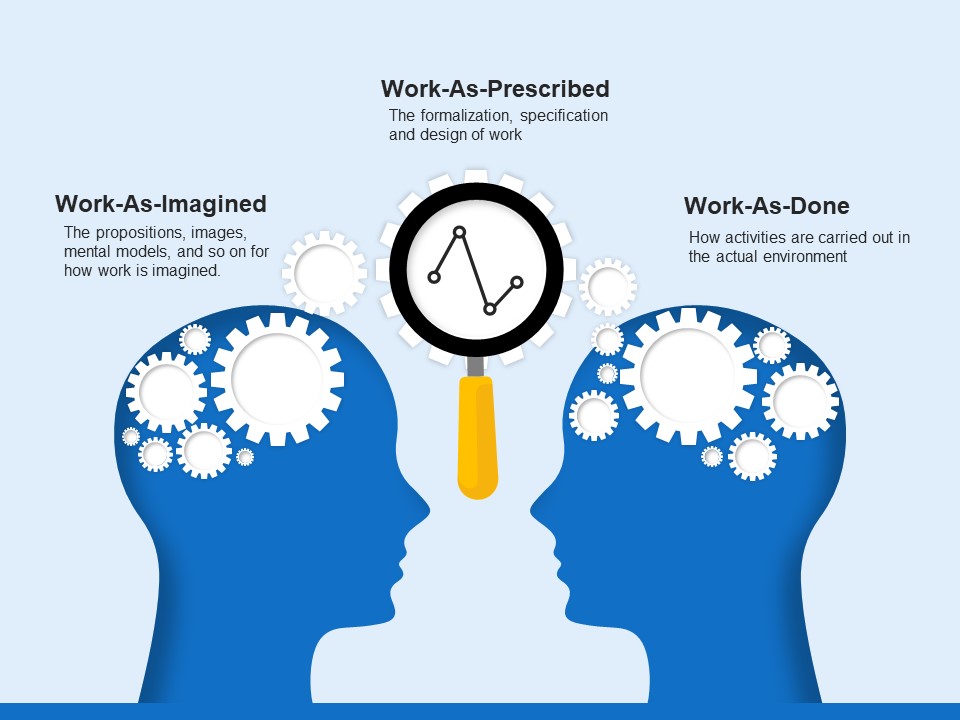
  • Work-as-Imagined: This concept refers to how people think work should be done or imagine it is done. It is often used by policymakers, regulators, and managers who design work processes without direct involvement in the actual work.
  • Work-as-Prescribed: This involves the formalization of work through rules, procedures, and guidelines. It is how work is officially supposed to be done, often documented in organizational standards.
  • Work-as-Done: This represents the reality of how work is actually performed in practice, including the adaptations and adjustments made by workers to meet real-world demands.
  • Work-as-Disclosed: Also known as work-as-reported or work-as-explained, this is how people describe or report their work, which may differ from both work-as-prescribed and work-as-done due to various factors, including safety and organizational culture[3][4].
  • Work-as-Reported: This term is often used interchangeably with work-as-disclosed and refers to the accounts of work provided by workers, which may be influenced by what they believe should be communicated to others.
  • Work-as-Measured: The quantifiable aspects of work that are tracked and assessed, often focusing on performance metrics and outcomes
AspectWork-as-DoneWork-as-ImaginedWork-as-InstructedWork-as-PrescribedWork-as-ReportedWork-as-Measured
DefinitionActual activities performed in the workplace.How work is thought to be done, based on assumptions and expectation.Direct instructions given to workers on task performance.Formalized work according to rules, policies, and procedures.Description of work as shared verbally or in writing.Quantitative assessment of work performance.
PurposeAchieve objectives in real-world conditions, adapting as necessary.Conceptual understanding and planning of work.Ensure tasks are performed correctly and efficiently.Standardize and control work for compliance and safety.Communicate work processes and outcomes.Evaluate work efficiency and effectiveness.
CharacteristicsAdaptive, context-dependent, often involves improvisation.Based on assumptions, may not align with reality.Clear, direct, and often specific to tasks.Detailed, formal, assumed to be the correct way to work.May not fully reflect reality, influenced by audience and context.Objective, based on metrics and data.
AspectWork-as-MeasuredWork-as-Judged
DefinitionQuantification or classification of aspects of work.Evaluation or assessment of work based on criteria or standards.
PurposeTo assess, understand, and evaluate work performance using metrics and data.To form opinions or make decisions about work quality or effectiveness.
CharacteristicsObjective and subjective measures, often numerical; can lack stability and validity.Subjective, influenced by personal biases, experiences, and expectations.
AgencyConducted by supervisors, managers, or specialists in various fields.Performed by individuals or groups with authority to evaluate work performance.
GranularityCan range from coarse (e.g., overall productivity) to fine (e.g., specific actions).Typically broader, considering overall performance rather than specific details.
InfluenceAffected by technological, social, and regulatory contexts.Affected by preconceived notions and potential biases.

Further Reading

Self-Checking in Work-As-Done

Self-checking is one of the most effective tools we can teach and use. Rooted in the four aspects of risk-based thinking (anticipate, monitor, respond, and learn), it refers to the procedures and checks that employees perform as part of their routine tasks to ensure the quality and accuracy of their work. This practice is often implemented in industries where precision is critical, and errors can lead to significant consequences. For instance, in manufacturing or engineering, workers might perform self-checks to verify that their work meets the required specifications before moving on to the next production stage.

A proactive approach enhances the reliability, safety, and quality of various systems and practices by allowing for immediate detection and correction of errors, thereby preventing potential failures or flaws from escalating into more significant issues.

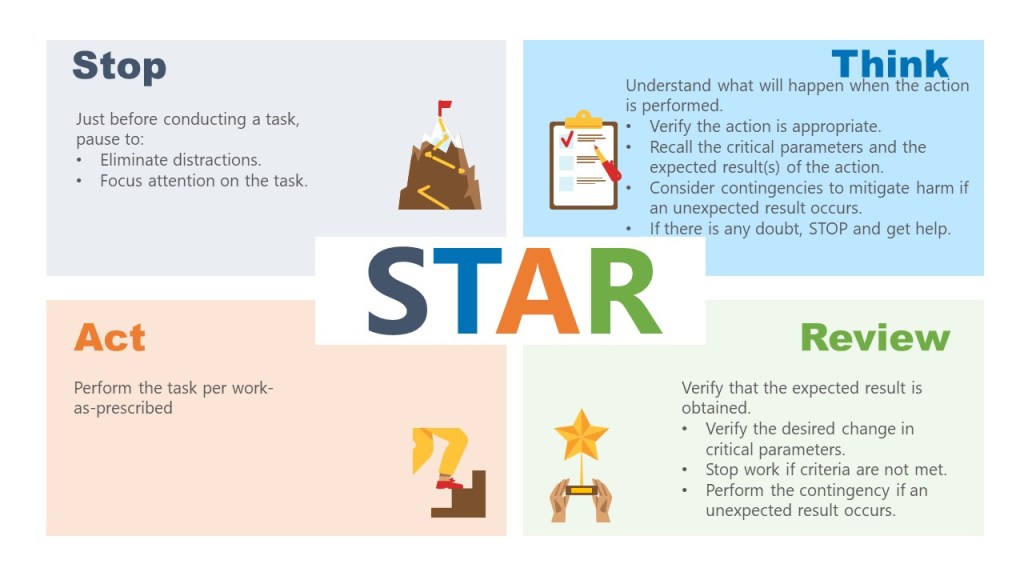
The memory aid STAR (stop, think, act, review) helps the user recall the thoughts and actions associated with self-checking.

  1. Stop – Just before conducting a task, pause to:
    • Eliminate distractions.
    • Focus attention on the task.
  2. Think – Understand what will happen when the action is performed.
    • Verify the action is appropriate.
    • Recall the critical parameters and the action’s expected result(s).
    • Consider contingencies to mitigate harm if an unexpected result occurs.
    • If there is any doubt, STOP and get help.
  3. Act – Perform the task per work-as-prescribed
  4. Review – Verify that the expected result is obtained.
    • Verify the desired change in critical parameters.
    • Stop work if criteria are not met.
    • Perform the contingency if an unexpected result occurs.

The Building Blocks of Work-as-Prescribed

Work-as-Prescribed – how we translate the desired activities into a set of process and procedure – relies on an understanding of how people think and process information.

The format is pivotal. The difficulties we have in quality are really not much different from elsewhere in society in that we are surrounded by confusing documentation and poorly presented explanations everywhere we look, that provide information but not understanding. Oftentimes we rely on canards of “this is what is expected,” “this is what works” – but rarely is that based on anything more than anecdotal. And as the high incidence of issues and the high cost of training shows, less than adequate.

There is a huge body-of-knowledge out there on cognitive-friendly design of visuals, including documentation. This is an area we as a quality profession need to get comfortable with. Most important, we need to give ourselves permission to adapt, modify and transform the information we need into a shape that aids understanding and makes everyone a better thinker.

Work-as-Prescribed (and work-as-instructed) is the creation of tools and technologies to help us think better, understand more and perform at our peak.

Locus of Understanding

Looking at the process at the right level is key. Think of Work-as-Prescribed as a lens. Sometimes you need a high-powered lens so that you can zoom in on a single task. Other times, you need to zoom out to see a set of tasks, a whole process, or how systems interact.

This is the locus of understanding, where understanding happens. When we take this position, we see how understanding is created. Adopting the locus of understanding means going to the right level for the problem at hand. When we apply it to Work-as-Prescribed we are applying the same principles as we do in problem-solving to developing the right tools to govern the work.

We are conducting knowledge management as part of our continuous improvement.

An important way to look is distributed cognitive resources, which means anything that contributes to the cognitive work being done. Adjusting the locus of understanding means that you can, and should, treat an SOP as a cognitive resource. Some of the memory is in your head and some is in the SOP. Work-as-prescribed is a cognitive resource that we distribute, routinely and casually across the brain and our quality system in the form of documents and other execution aids.

Other tools, like my favorite whiteboard, also serve as distributed cognitive resources.

So, as our documents and other tools are distributed cognitive resources it behooves us to ensure they are based on the best cognitive principles possible to drive the most benefit.

As an aside, there is a whole line of thought about why some physical objects are better at distributed cognitive resources than electronic. Movement actually matters.

Taking it even further (shifting the locus) we can see the entire quality system as a part of a single distributed cognitive system where cognitive work is performed via the cognitive functions of communicating, deciding, planning, and problem-solving. These cognitive functions are supported by cognitive processes such as perceiving, analyzing, exchanging, and manipulating.

Cognitive Activity in Work-As-Prescribed

The tools we develop to provide distributed cognitive activity strive to:

  • Provide short-term or long-term memory aids so that memory load can be reduced.
  • Provide information that can be directly perceived and used such that little effort is needed to interpret and formulate the information explicitly.
  • Provide knowledge and skills that are unavailable from internal representations.
  • Support perceptual operators that can recognize features easily and make inferences directly.
  • Anchor and structure cognitive behavior without conscious awareness.
  • Change the nature of a task by generating more efficient action sequences.
  • Stop time and support perceptual rehearsal to make invisible and transient information visible and sustainable.
  • Aid processibility by limiting abstraction.
  • Determine decision making strategies through accuracy maximization and effort minimization.

Driving Work-As Prescribed

As we build our requirements documents, our process and procedure, there are a few principles to keep in mind to better tap into distributed cognitive resources.

Plan for the flow of information: Think about paths, relationships, seams, edges and other hand-offs. Focus on the flow of information. Remember that we learn in a spiral, and the content needed for a novice is different from that of an expert and build our documents and the information flow accordingly. This principle is called Sequencing.

Break information down into pieces: Called, Chunking, the grouping together of information into ideally sized pieces. When building Work-As-Prescribed pay close attention to which of these chunks are reusable and build accordingly.

The deeply about context: How a tool is used drives what the tool should be.

Think deeply about information structures: Not all information is the same, not every example of Work-as-Prescribed should have the same structure.

Be conscientious about the digital and physical divide: Look for opportunities to integrate or connect these two worlds. Be honest of how enmeshed they are at any point in the system.

We are building our Work-as-Prescribed through leveraging our quality culture, our framework for coordinating work. Pay attention to:

  1. Shared Standards – Ways we communicate
  2. Invisible Environments – Ways we align, conceptually
  3. Visible Environments – Ways we collaborate
  4. Psychological Safety – Ways we behave
  5. Perspectives – Ways we see (and see differently)

Principles in Practice

When design process, procedure and task documentation leverage this principles by build blocks, or microcontent, that is:

  • about one primary idea, fact, or concept
  • easily scannable
  • labeled for clear identification and meaning, and
  • appropriately written and formatted for use anywhere and any time it is needed.

There is a common miscomprehension that simple means short. That just isn’t true. Simple means that it passes a test for the appropriateness of the size of a piece of content of providing sufficient details to answer a specific question for the targeted audience. The size of the content must effectively serve its intended purpose with efficiency, stripping off any unnecessary components.

We need to strive to apply cognitive thinking principles to our practice. The day of judging a requirements document by its page length is long over.

Constituents of cognitive thinking applied to Work-As-Prescribed

Procedure is Work-as-Prescribed

Written procedures with their step-by-step breakdown are a fundamental tool for ensuring quality through consistent execution of the work. As a standardized guideline for tasks, procedures serve many additional purposes: basis of training, ensuring regulatory requirements are met, ensuring documentation is prepared and handled correctly.

As written prescriptions of how work is to be performed, they can be based on abstract and often decontextualized expectations of work. The writers of the procedures are translating Work-as-Imagined. As a result, it is easy to write from a perspective of ideal and stable conditions for work and end up ignoring the nuances introduced by the users of procedures and the work environment.

The day-to-day activities where the procedures are implemented is Work-as-Done. Work-is-Done is filled with all the factors that influence the way tasks are carried out – spatial and physical conditions; human factors such as attention, memory, and fatigue; knowledge and skills.

Ensuring that our procedures translate from the abstraction of Work-as-Imagined to the realities of Work-as-Done as closely as possible is why we should engage in step-by-step real-world challenge as part of procedure review.

Steven Shorrock calls this procedural level “Work-as-Prescribed.”

Work-as-Prescribed gives us the structure to take a more dynamic view of workers, the documents they follow, and the procedural and organizational systems in which they work. Deviations from Work-as-Prescribed point-of-view are not exclusively negative and are an ability to close the gap. This is a reason to closely monitor causes such as “inadequate procedure” and “failure to follow procedure” – they are indicators of a drift between Work-as-Prescribed and Work-as-Done. Management review will often highlight a disharmony with Work-As-Imagined.

The place where actions are performed in real-world operations is called, in safety thinking, the sharp-end. The blunt-end is management and those who imagine work, such as engineers, removed from doing the work.

Our goal is to shrink the gap between Work-as-Imagined and Work-as-Done through refining the best possible Work-as-Prescribed and reduce the differences between the sharp and the blunt ends. This is why we stress leadership behaviors like Gemba walks and ensure a good document change process that strives to give those who use procedure a greater voice and agency.