A common and distorted application of psychological safety is that it is somehow a shield from accountability. Non-performing employees tend to invoke it as an excuse for poor performance, insisting that a focus on psychological safety means valuing people and building relationships. That’s true, but stretching the premise, they claim that we should give them a pass when they don’t perform.
The flawed logic seems to be along the lines of because we may have used fear and intimidation, command and control, and manipulative and coercive tactics with people in the past, in an attempt to hold folks accountable, we must shed the artifacts that drive accountability in order to have an environment of psychological safety.
In my experience, this is especially prevalent when discussing metrics around overdue quality systems records and training. How to discuss what is late, can you even publish a list of folks with overdue training?
I want to be very clear, psychological safety is not a kind of diplomatic immunity from having to deliver results. It is not a shield from accountability.
Being held accountable can be looked at as transparency in progress. Psychological safety allows us to be vulnerable and to trust that the organization will take the problems seriously and address them.
Teams and Work-Groups need ground rules, they should have a charter, which includes a nice vision of how the team sees itself.
Let’s be honest, we do not spend enough time building and maintaining these charters. If you are like me you tend to dive right in, and that will always cause some problems. Luckily, it is never too late to take a step back and do the work.
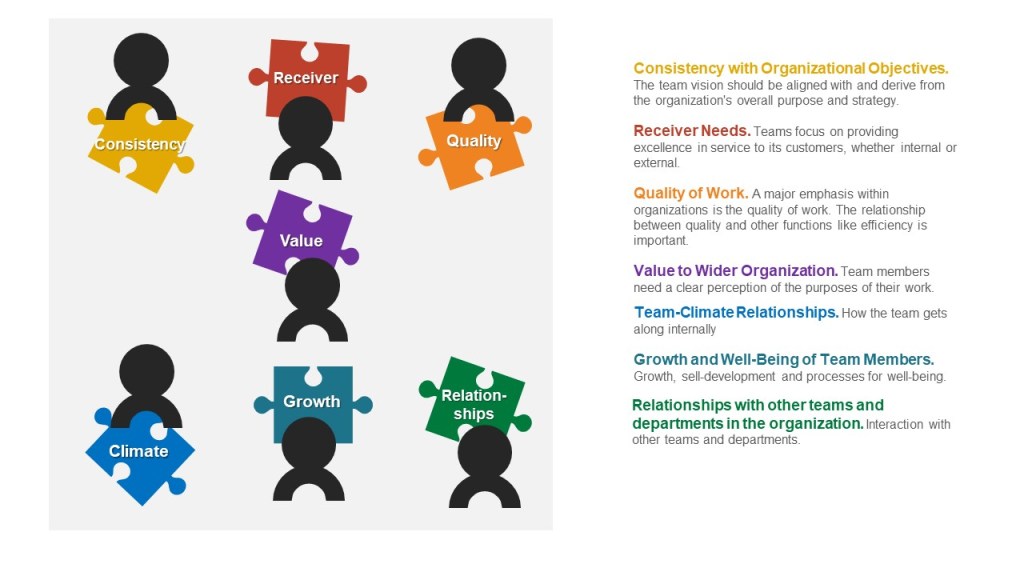
Start by answering these eight questions about the team and its place in the organization.
Consistency with organizational objectives: The team vision should be aligned with and derive from the organization’s overall purpose and strategy. Teams are sub-elements in a wider organization structure and their success will be judged on the extent to which they make valuable contributions to the overall purpose of the organization. In some circumstances, a team may decide that it is important for its own values, purposes, and orientations to act as a minority group that aims to bring about change in organization objectives – perhaps like a red team.
Receiver needs: How a team focuses on providing excellence in service to their customers, whether internal or external.
Quality of work: A major emphasis within organizations is the quality of work. The relationship between quality and other functions like efficiency is important.
Value to the wider organization: Understanding the importance of the team just not for the wider organization but beyond, leads to team cohesion and greater team effectiveness. Team members need a clear perception of the purposes of their work.
Team-climate relationships: Team climate refers to aspects such as warmth, humor, amount of conflict, mutual support, sharing, backbiting, emphasis on status, participation, information sharing, level of criticism of each other’s work, and support for new ideas.
Growth and well-being of team members: Growth, skill development and challenges are central elements of work-life, and teams can be a major source of support. Teams provide opportunities for skill sharing and support for new training. Teams need to be concerned for the well-being of their members, including things like burnout.
Relationships with other teams and departments in the organization: Teams rarely operate in isolation. They interact with other team and departments within the organization. Teams must be committed to working effectively and supporting other teams. Avoid silo thinking.
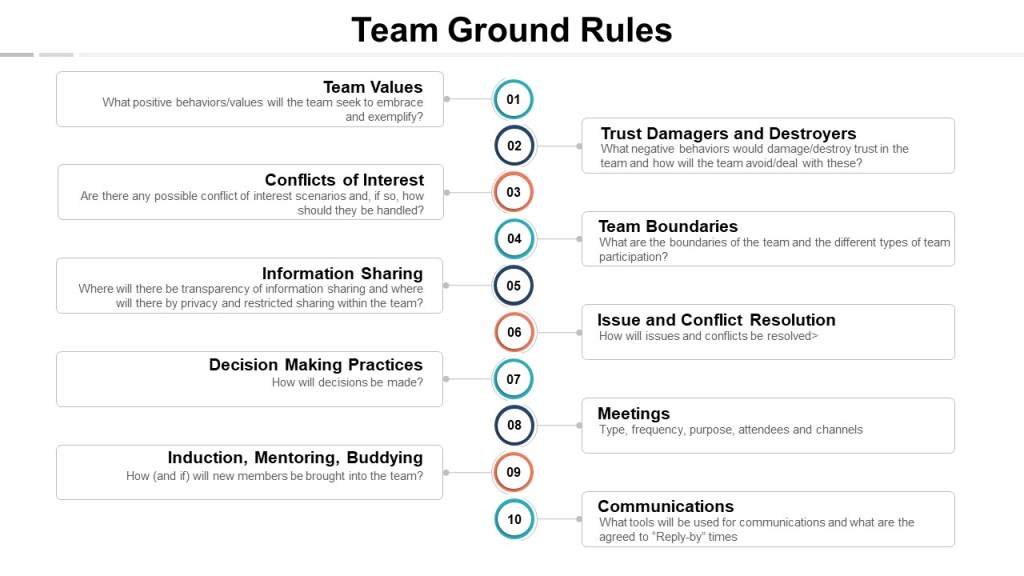
From there you can then generate the 10 aspects of the charter:
Team Ground Rules: What positive behaviors/values will the team seek to embrace and exemplify?
Trust Damagers and Destroyers: What negative behaviors would damage/destroy trust in the team and how will the team avoid/deal with these?
Conflicts of Interest: Are there any possible conflict of interest scenarios and, if so, how should they be handled?
Team Boundaries: What are the boundaries of the team and the different types of team participation?
Information Sharing: Where will there be transparency of information sharing and where will there be privacy and restricted sharing within the team?
Issue and Conflict Resolution: How will issues and conflicts be resolved?
Meetings: Type, frequency, purpose, attendees and channels
Induction, Mentoring, Buddying: How (and if) will new members be brought into the team?
Communications: What tools will be used for communications and what are the agreed to “Reply-by” times
Do not short communication
How much time do you spend communicating every day? Whether this is through phone calls, IM, texts, email, written reports, face-to-face conversations, or meetings, many of us spend a large proportion of our day dealing with messages that demand our attention.
Be deliberate in how we manage these interactions so that people communicate efficiently and effectively. Outline preferred methods of communication, how to use different channels effectively, and what people want to achieve. By improving communication you can drive for effective meetings, reduce the volume of emails, ensure that exchanges are professional, and free up time for high-value tasks.
Include the following in your communication section:
When people need to reply to emails and when they don’t.
When people should “Reply All” to emails and when they should avoid it.
How to organize regular team meetings, who should attend, whether people will “dial in” remotely, what to include in the minutes, who will circulate them, and so on.
How your team communicates with customers internal and external.
How team members interact on internal social media (chat, slack, etc).
When making a video or audio call is appropriate.
How people engage with others face-to-face.
Signs of Team/Work-Group Misalignment
There are some behaviors to look out for, when you see them, it’s time to return to the charter, and improve.
Vague Feelings of Fear. You know what the team is supposed to deliver on, but you don’t know how exactly you’re supposed to work with anything in your power or control to “move the needle.”
Ivory Tower Syndrome. Things aren’t clear or different people have different expectations for a project or initiative. No one is really able to clarify.
Surprises. Someone committed you to a task, but you weren’t part of that decision.
Emergencies. How often are you called on to respond to something that’s absolutely needed by close of business today? How often are you expected to drop everything and take care of it? How often do you have to work nights and weekends to make sure you don’t fall behind?
Cut Off at the Pass: Someone else is doing the same work unaware to all.
Not Writing Things Down. You have to make sure everyone is literally on the same page, seeing the world in a similar enough way to know they are pursuing the same goals and objectives. If you don’t write things down, you may be at the mercy of cognitive biases later. How do you know that your goals and objectives are aligned with your overall company strategy? Can you review written minutes after key meetings? Are your team’s strategic initiatives written and agreed to by decision-makers? Do you implement project charters that all stakeholders have to sign off on before work can commence? What practices do you use to get everyone on the same page?
Does training in your organization seem like death by PowerPoint? Is learning viewed as something an expert dumps in the lap of the learner.? However, that’s not what learning is – lectures and one-way delivery end up resulting in very little learning.
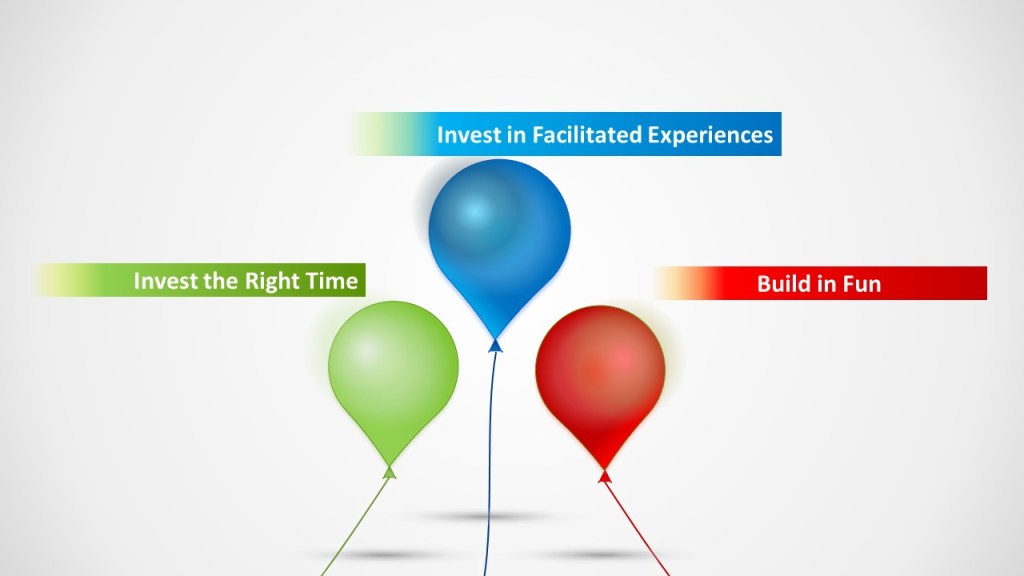
For deeper meaning to occur, invest in professionally facilitated experiences that enable staff to form mental models they remember. Get people thinking before and after the training to ensure that the mental model stays fresh in the mind.
Culture of Cutting Time
Avoid the desire for training in shorter and shorter chunks. The demands of the workplace are increasingly complex and stressful, so any time out of the office is a serious cost. The paradox is that by shortening the training, we don’t give the time for structured learning, which sabotages the investment when the training program could be substantially improved by adding the time to allow the learning to be consolidated.
We know that learning takes place when people have fun, stress is low, and the environment encourages discovery. Make training cheerful and open rather than dull and quiet. Encourage lots of informal learning opportunities. Give more control to the learner to shape their experience. Have fun!
Everyone struggles with meetings, and I am certainly not an exception. As a fan of finding and leveraging expertise, I’d like to share the big thinkers in this space that I rely on and three books that I recommend everyone read.
Elise’s practice, and her book, are all about the best ways to make it easy for people to enjoy meetings that get work done. She emphasizes that the whole point of a meeting is to gather people for a purpose and shares different meeting types to help us get to the why.
The amazing thing is how her book and her company’s practice are all about clear, practical tools and methodologies. Her workshops are well-run and can be transformative.
Everyone should read the book. And when your organization says “Meetings are horrible” then do yourself a favor and leverage Lucid Meeting’s offerings. Trust me, you will be happy you gave Elise a call.
Gamestorming
The book Gamestorming: A Playbook for Innovators, Rulebreakers, and Changemakers literally changed my career trajectory when I read it back in 2010. This book by Dave Gray, Sunni Brown, and James Macanufo taught me methods of meeting facilitation and having fun in meetings, which have made me happier in my professional growth, and hopefully a better leader. I’ve written about this before, and I continue to believe that visual meetings lead to better results and we all need to do more.
GameStormingis a beautiful resource webpage. As a company, they lead some great workshops. The Expeditions I attended, run by Dave Mastronardi, was one of the two best virtual events of 2021 – and yes, the other one was run by Elise! I strongly recommend signing up for an Expedition, and look forward to new offerings from Dave and his team.
Strategyzer
I love this team’s books. Co-founders Alex Osterwalder and Alan Smith have built a set of tools and methodologies to drive innovation in an organization. The 2021 High-Impact Tools for Teams is one of the must-reads in this area, and presents a powerful, highly visual approach to building teams.





 Investigations of a Dog