Common Ownership Challenges

Process Ownership Challenges

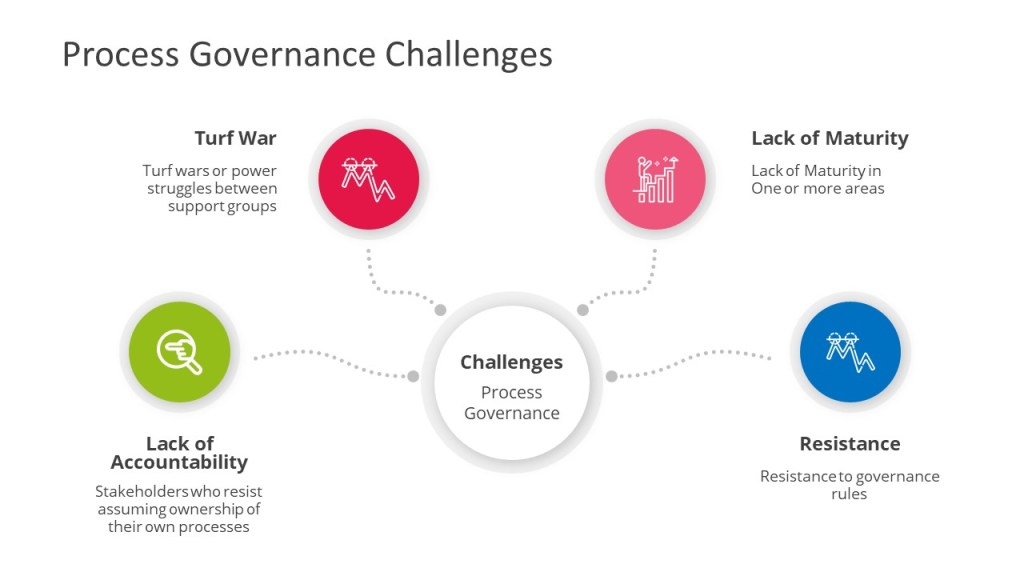
Governance and ownership challenges often arise in an organization for four reasons:

  1. Business stakeholders who resist assuming ownership of their own processes, data and/or knowledge, or have balkanized/siloed accountability
  2. Turf wars or power struggles between groups of stakeholders
  3. Lack of maturity in one or more areas
  4. Resistance to established governance rules

The Business Struggles with Accountability

Processes often have a number of stakeholders, but no apparent owners. This results in opportunity costs as compulsory process changes (e.g. legislative requirements, systems capacity, or company structural changes) or process improvements are not implemented because the business process owner is unaware of the change, or no clear business process owner has been identified which leads to an increase in risk.

Sometimes processes have a number of stakeholders who all think they are the owners of parts of the process or the whole process. When this overlap happens, each supposed owner often identifies their own strategy for the process and issues their own process change instructions to conform to their understanding of the purpose of the business process. These conflicting instructions lead to frustration and confusion by all parties involved.

Lack of accountability in process and system leads to inefficient processes, organizational disharmony, and wasted energy that can be better spent on process improvements.

Turf Wars

Due to silo thinking there can be subdivided processes, owned by different parts of the organization. For example, count how many types of change control your organization has. This requires silos to be broken down, and this takes time.

Lack of Maturity

Governance is challenging if process maturity is uneven across the organization.

Failure to Adhere to Governance

It can be hard to get the business to apply policy and standard consistently.
Contamination Control Policy

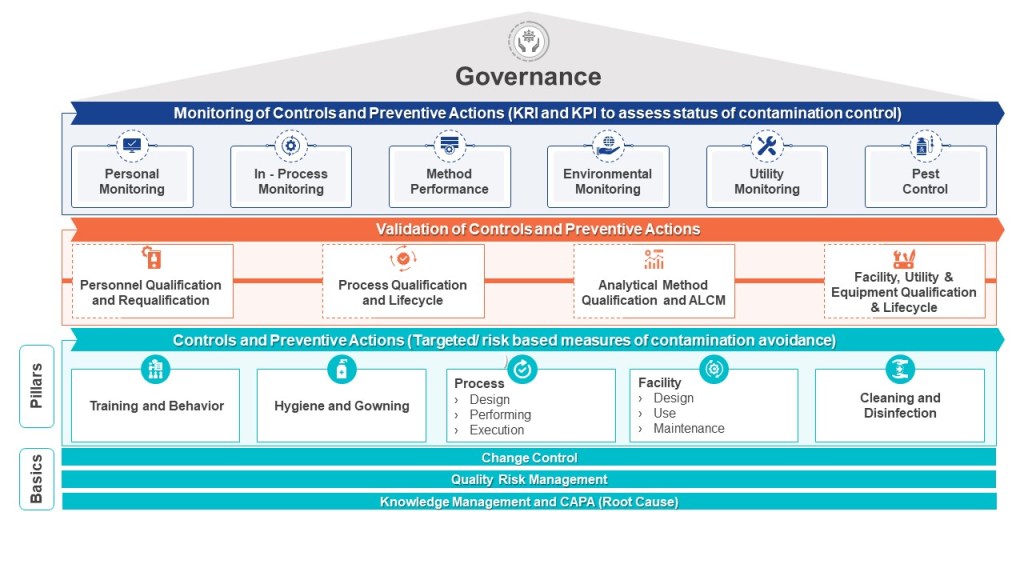
Rationale:  An important element of the protection of patient safety, our highest priority, is preventing contamination and maintaining sterility, as applicable, for products or clinical materials. We have the important responsibility to assure controls are in place to prevent exposure to unintended and potentially harmful materials by patients being treated with products or participating in clinical trials.  Equally important is the protection of personnel working with materials from exposure levels that could exceed safe limits. 

Policy objective:  To define the expectations in implementing containment controls designed to minimize the likelihood of contamination and if applicable to assure the maintenance of sterility.

Procedures will be implemented to assure:

  • Establishment of effective means to contain ingredients, in process and finished materials to the manufacturing equipment and containers designed for their use, and which prevent airborne or physical transmittal of foreign materials into ingredients, in process, or finished products or product contact surfaces.
  • Application of risk based control mechanisms to establish steps to be taken to control cross contamination.  Factors to be considered include, but may not be limited to, toxic risk of materials; physical properties that present contamination risk; product contact surfaces; use of lubricants; establishment and monitoring of air pressure differential cascades in manufacturing areas; filtration of air, water, steam, gases, and vacuum; the proper use of cleaning materials, sanitizers, and application of pesticides; and the use of personal protective equipment for employees who work with high risk materials.
  • Classification of processing areas utilizing accepted international norms for viable and non-viable particulate levels
  • Design of facilities and utilities to ensure appropriate contamination controls and if applicable aseptic conditions
  • Definition of standards for and types of personal protective equipment (PPE) and procedures for donning PPE, plus additional personnel controls (such as hand washing and sanitization), and the exclusion of inappropriate materials (such as fiber shedding paper) as conditions of entry into classified areas.
  • Establishment of alert and action levels of viable and nonviable particulate matter in air, water, gases, product contact surfaces and personnel, together with monitoring methods and frequency, and steps to be taken when such levels are exceeded.
  • Assessment and validation of the effectiveness of containment controls, through methods such as periodic visualization of airflow patterns; water fills; media fills; and oversight of employee practices

Thoughts on ISPE 2022 Aseptic Conference

Just finished up the 2022 ISPE Aseptic Conference, and here are a few thoughts.

EU GMP Annex 1 expected in later half of the year

Paul Gustafson, chair of the Pharmaceutical Inspection Co-operation Scheme (PIC/S) and a senior corporate regulatory compliance and enforcement advisor with Health Canada, stated that the plan was to issue the widely anticipated Annex 1 in mid-year 2022. He repeatedly said July to September so that is interesting news and start getting your contamination control strategies going. There will be a one-year period before in force, with 2 years on some of the lyophilizer requirements.

For those keeping track, it retains the provision calling for testing filters used in the sterilization process, pre-use, post-sterilization integrity testing (PUPSIT). The PUPSIT provision “has driven a substantial amount of discussion and has resulted in a number of papers being drafted,” said Gustafson. This was a very gracious understatement, and I have to admit I really admired his Canadian humor.

FDA continues to evaluate COVID inspection measures

Alonza Cruse, Director of the Office of Pharmaceutical Quality Operations at FDA/ORA did a thorough job going through the COVID measures of Remote Regulatory Assessments and Remote Interactive Evaluations and discussed how the agency was in the process of learning how best to do things going forward.

He also clearly state how they were continuing to get back to normal inspections and discussed new personnel in foreign offices, such as India.

Highlights from Panels

One of my favorite panels was Jo Ann Jacobs and Kara Vogt speaking on “Building Resiliency into Single-Use-Technology Systems” They laid out some good work they are doing as part of a startup to design good functional equivalency and supplier management, obviously learning from PPAP and similar measures. Quite well done. While it leans heavily into my own practice around functional equivalency it was good to see such a rock-solid implementation, and I felt like I learned a few good ideas.

I spoke on Contamination Control, Risk Management and the Quality Management System, having a blast doing so. I was followed by Christa Myers who spoke on “Contamination Control Strategy: From Annex 1 Draft Requirements to Implementation in Practice.” We made a good duo and between the two I hope participants got a real solid idea on how to do this contamination control strategy effectively.

I learned a lot about robotics and isolators.

Still a big fan of ISPE’s Women in Pharma.

Avoiding Logical Pitfalls

When documenting a root cause analysis or risk assessment or any of the myriad other technical reports we are making a logical argument. In this post, I want to evaluate six common pitfalls to avoid in your writing.

Claiming to follow logically: Non Sequiturs and Genetic Fallacies

Non-sequiturs and genetic fallacies involve statements that are offered in a way that suggests they follow logically one from the other, when in fact no such link exists.

Non-sequiturs (meaning ‘that which does not follow’) often happens when we make connective explanations without justification. Genetic fallacies occur when we draw assumptions about something by tracing its origins back even though no necessary link can be made between the present situation and the claimed original one.

This is a very common mistake and usually stems from poor use of causal thinking. The best way to address it in an organization is continuing to build discipline in thought processes and documenting the connections and why things are connected.

Making Assumptions: Begging the Question

Begging the question, assuming the very point at issue happens a lot in investigations. One of the best ways to avoid this is to ensure a proper problem statement.

Restricting the Options to Two: ‘Black and White’ Thinking

In black and white thinking or the false dichotomy, the arguer gives only two options when other alternatives are possible.

Being Unclear: Equivocation and Ambiguity

  • Lexical: Refers to individual words
  • Referential: Occurs when the context is unclear
  • Syntactical: Results from grammatical confusions

Just think of all the various meanings of validation and you can understand this problem.

Thinking Wishfully

Good problem-solving will drive down the tendency to assume conclusions, but these probably exist in every organization.

Detecting the Whiff of Red Herrings

Human error is the biggest red herring of them all.

Six logical fallacies

FDA Quality Metrics…Take 3

The US FDA has released the latest plan to collect quality metrics data in an attempt to unstall efforts to obtain manufacturing quality data as a means of mitigating potential drug shortages and promoting enhanced quality management in the pharmaceutical industry.

The agency promised that this program would be different from the original quality metrics draft guidance unveiled in 2015, as well as the revised draft guidance issued in 2016. The newly devised plan is based in the feedback it received through its voluntary quality metrics site visit and quality metrics feedback programs launched in 2018.

The FDA has identified four areas, and the individual metrics within these areas, for reporting:

  • Manufacturing process performance: This can include the proportion of lots that were accepted in a given time period as well as the proportion of lots manufactured without a non-conformance
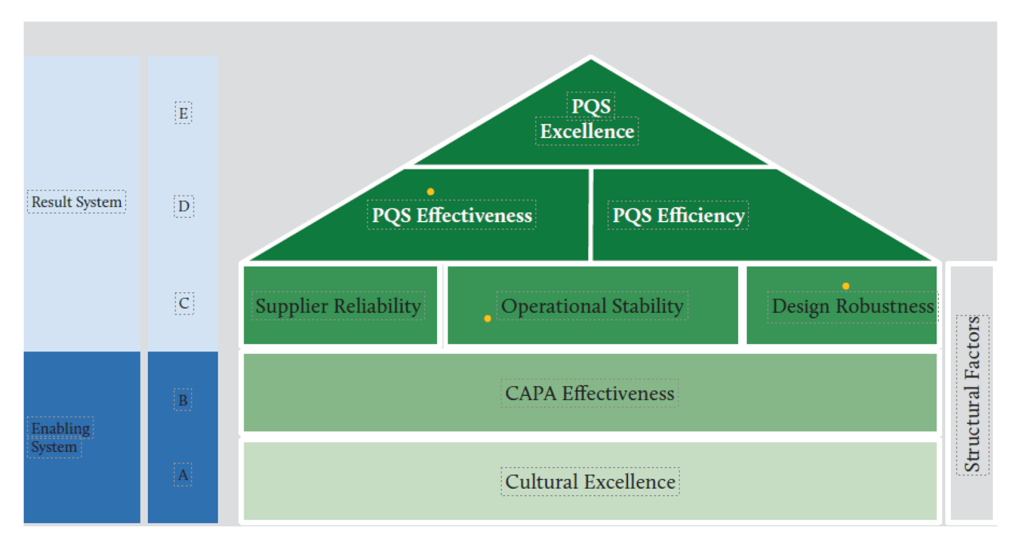
  • Pharmaceutical quality system (PQS) effectiveness: This metric can include the effectiveness of the corrective action and prevention action (CAPA) which can cover the number of CAPAs initiated or closed on time
  • Laboratory performance: This can include the proportion of laboratory test that are completed on schedule
  • Supply chain robustness: This can include the extent to which shipments are delivered on-time and containing the correct quantity