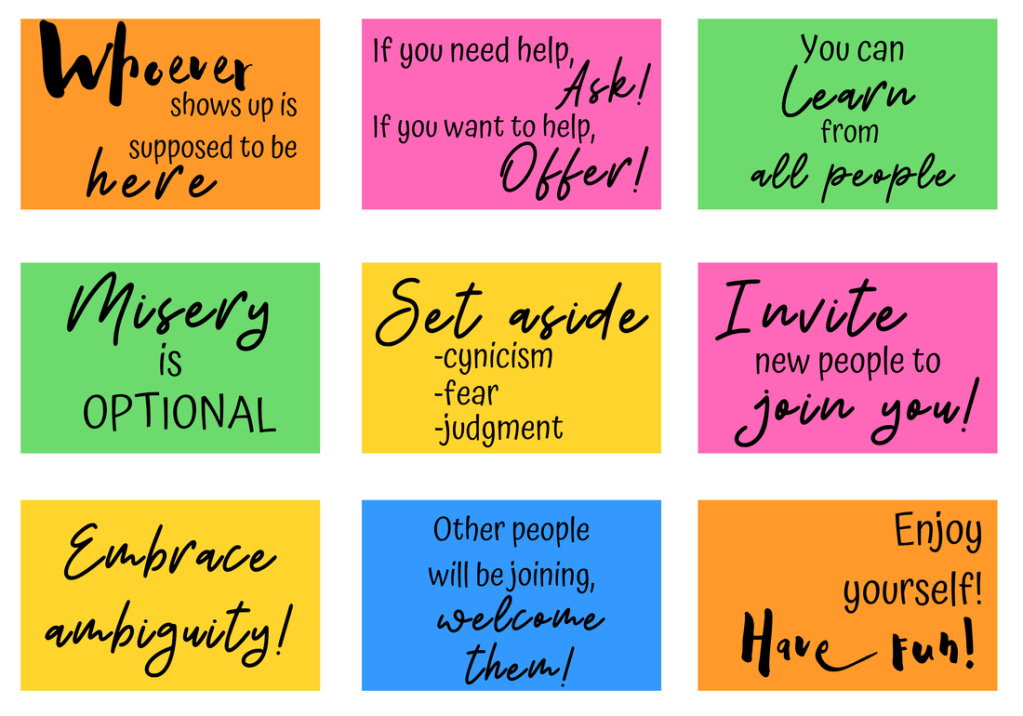
Conference Attendance

Conference attendance is both an important way to make connections and to grow as a quality leader. I’m here in Phoenix for the ASQ Lean and Six Sigma Conference, and in waiting for the event to begin I have a few thoughts on planning for conferences as part of development.

Plan your conference attendance 6-12 months out, and treat it as a rolling calendar.

Go and do some research on the conferences that make sense to you. It is easy to start with those of your professional organization, like the ASQ. Whenever you come across a conference and it seems to be in your wheel house, add it to the list. You want to pay attention to three key dates: When the conference is, when the registration deadlines tend to be, and when the call- for-speaker periods end. This last one is important because…

Speak at the Conference!

The best way to get value for a conference is to speak at it. Conferences compensate attendance, and that means your organization is much more willing to let you go (and pay for travel). Speaking allows you to talk about the work you, your team and your organization have done. This draws in people who are interested in the problems you are solving, which helps with networking. It serves as advertising, can help recruiting, and can build reputation.

Yes, you can speak at a conference. If you are new to it, speak at a local regional conference first. You get better by doing these, and I’m serious, the opportunity to discuss the issues important to you will be plentiful. Your team has solved problems. You have learned things. This is gold to others! There is nothing more popular than a good case study talk.

The people you meet at the conference will be more valuable then the talks you attend. Talks are usually fairly high level and are targeting a wide audience (yes, even mine). But they do help you identify people with problems similar to yours. And you will learn a lot. A few key tactics:

  1. Introduce yourself to each and every speaker you attend. Ask questions, follow-up, share. As a speaker I treasure these conversations
  2. Never sit by yourself. Sit by someone, introduce yourself and talk. Even we introverts can do this, and you will be amazed by what you learn this way.
  3. Engage in the hallway track – those impromptu conversations in the hall can often become the main event (well other than your presentation of course)

Make sure to take notes and share them. With your team back home, with the world. I will always take 3-4 key things I learned and do a lunch-and-learn or coffe klatch at work. I also like to do blog posts and share with the world. This will help solidify your key take aways and continue those excellent conversations.

Remember that conference attendance is part of your development. Do a retrospective and determine what went well, what was valuable, was it as valuable as missing those days of work would have been? Use that learning for the next conference. Take an iterative approach and plan for the next engagement.
Understanding the Levers of Change

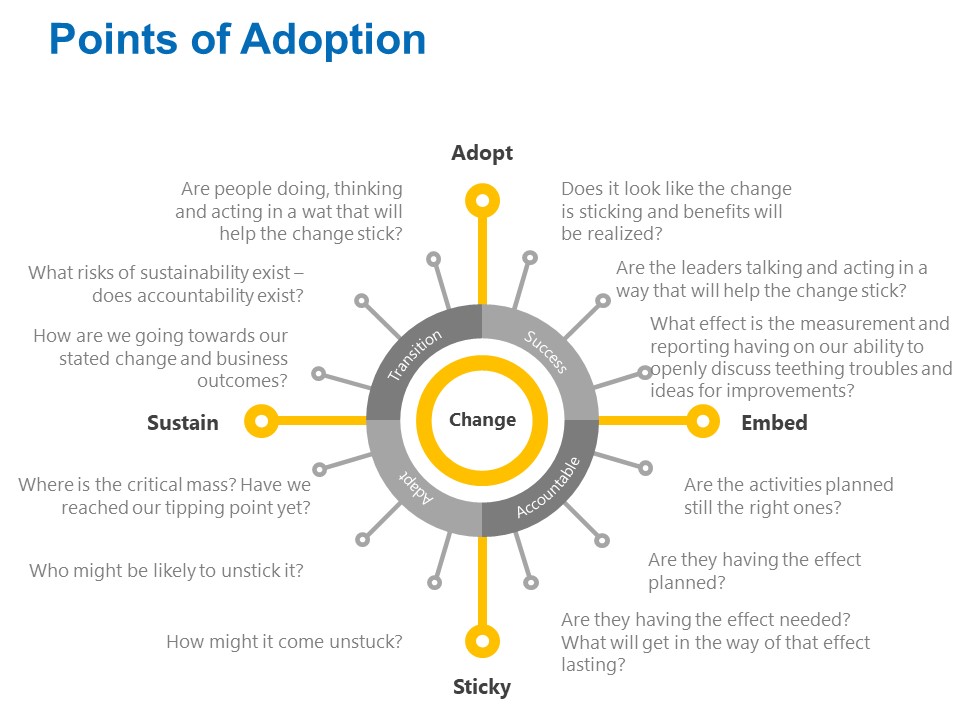
As part of my presentation “Sustaining Change – Executing a Sustainability Plan” at the ASQ Lean and Six Sigma Conference tomorrow I’ll be talking about levers of change.

Understanding the change landscape

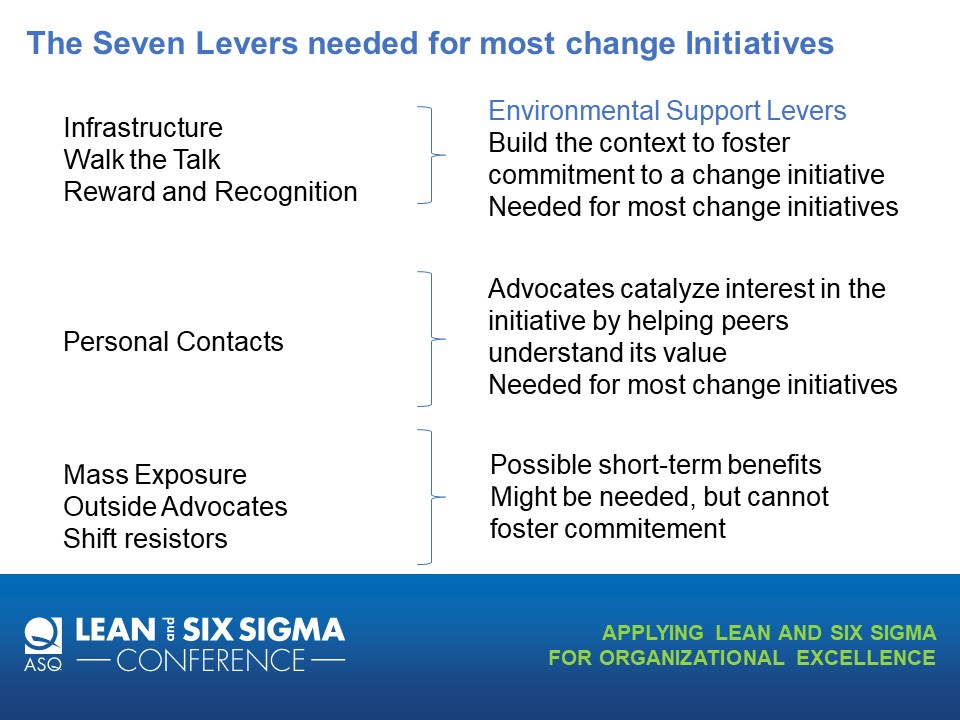
Change Management practitioners usually talk about seven levers:

  1. Infrastructure – Investing in the tools, processes, and other resources that employees need to be successful with the change initiative.
  2. Walk the Talk – active leadership is about ownership; it includes making the business case clear, modeling behaviors, clearing obstacles and making course corrections.
  3. Reward and Recognition – acknowledgement and compensation for employees who work to move the initiative forward
  4. Mass Exposure – getting out information about the change through broadcast messages and other communication pathways
  5. Personal Contacts – creating opportunities for advocates to share their experience of the change with peers who feel disengaged
  6. Outside advocates – bringing in resources (internal or external) to gain expertise for the change initiative
  7. Shift Resisters – moving people to areas less affected by the initiative.
7 levers of change

Facilitation Planning for the Unconference

Some thoughts on how the agenda I pulled together for the 29-February-2020 ASQ Team and Workplace Excellence Forum Unconference.

Kick-Off/Introduction

A good session starts with pulling people out of their comfort zone and getting the energy level right. When building the Unconference agenda I planned for there being people I didn’t know (and I’ve been proven right!). As a facilitator I always want to get people on the right track, and for this introduction I want to go fast so I planned two activities:

  • Draw the neighbor and share. Okay I am the worst at drawing. Think of how bad you are, and I am worse – stick figures are hard to get right. But I love drawing icebreakers for the simple reason that they help get us in a fun place and out of day-to-day. The folks who come to the Unconference are giving up their Saturday and I want to let them at once know this will not be business as usual.
  • Ridiculous “How Might  We”: Start with the funny and ridiculous and you prime the pump and let folks know that we are going to be safe and creative today.

Back of the Napkin

Break into teams of 3 people and answer the question “What does Team Excellence look like” and write/draw it up on the back of a napkin. This allows us to introduce ourselves, and do some networking while at the same time starting to grapple with the core question of the day (and of the Team and Workplace Excellence Forum!)

The back of a napkin is already associated with Aha moments and inspiration.  This informal exercise helps combat people’s instincts towards worrying about whether they can draw, have the “perfect” solution to the question, and other worries that can crop up if we were to use something more formal. This game is meant to inspire conversation and ideation – two things I’m really looking forward to.

Open Space Technology

The heart of an Unconference. Harrison Owen described this methodology in his book Open Space Technology: A User’s Guide. This process is a good match, and I’m pretty excited about this as an experiment. Owen set forth five reasons to use Open Spaces:

  1. There is a genuine business issue: I feel a real urgency around the ASQ’s Team and Workplace Excellence Forum (perhaps the ASQ in general). There is a buring platform of building better culture in our organization, and it is coupled with a person feeling that I have about 18 months to make this division relevant.
  2. A great deal of complexity: Workplace excellence and quality culture are not easy; they are not simple. I am fairly sure that any three reasonable people will find a lot of things to disagree on.
  3. Lots of diversity in terms of people and points of view: This was an aspiration when I chose the agenda. I hoped to be able to attract people from beyond my network. I assumed that given Boston’s size and industrial base we would get members from varied industries, and I hoped we would get participants from various points of their careers (students to grizzled veterans).
  4. Real passion – people care! To say that folks care about quality and how we build it in our organizations may just be an understatement. Does everyone care? No. Will 500 people show up? No. Which is a good thing because I didn’t get that large of a room
  5. Genuine urgency: This may be the weakest of the criteria for me. But urgency is subjective and I for me as an organizer there is a great deal of urgency. I need to get more people involved and empowered in the division!

25/10 Crowd Sourcing

I think it’s important to generate and sort the ideas for action so participants hopefully leave ready to get things done! 25/10 Crowd Sourcing is an excellent activity designed to spread innovations “out and up” as everyone notices the patterns in what emerges. Fun, fast, and casual, it is a serious and valid way to generate an uncensored set of bold ideas and then to tap the wisdom of the whole group to identify the top ten. May go lower with a smaller group.

Every participant writes on an index card their bold idea and first step. Then people mill around, and pass cards from person to person. “Mill and Pass only. No reading.” When the bell rings, people stop passing cards and pair up to exchange thoughts on the cards in their hands. Then participants individually rate the idea/step on their card with a score of 1 to 5 (1 for low and 5 for high) and write it on the back of the card. Again, we pass the cards around a second time and then “Read and Score”. This is done for a total of five scoring rounds. At the end of cycle five, participants add the five scores on the back of the last card they are holding. Finally, the ideas with the top scores are shared with the whole group.

From this – action plan! Agree on way to keep momentum and away we go!

Other thoughts

A key requirement is to record discussions as they happen. Hopefully, that is the case and we get a nice raw output from this.

I use Session Lab for most of my facilitation planning these days. The site is a wonderful way to quickly find activities and build blocks, and the agendas it spits out are very clean.

Food is so critical.  There will be a good hot lunch. I will also grab breakfast for folks on my way in.

This is designed to be an experiment. I have kept the price low, and then charged it to the Division for ASQ members as part of the member value. I want to do at least one more this year. It is important to experiment with content building and sharing, and this format is designed to draw on the expertise and perspective of the participants. I am thrilled to be doing this and going in I am very hopeful of the outcome. 

ASQ Team and Workplace Excellence Unconference

The Team and Workplace Excellence invites you to atted our Unconference on 29-Feb-2020 in Boston, MA.

An unconference is a wonderful way to address a problem by asking people who are passionate about the subject to drive the content, and by flexibly changing the day’s activities based on the interests of the people involved.

We are going to start with a back-of-the napkin exercise to start answering the question “What does Team Excellence look like.” This exercise is just what it sounds like, we will break into teams and write/draw an answer on the back of a napkin.

After this we will role up our sleeves and go from there. The unconference is an experiment, and we expect a small but committed crowd (right now we have about 15 people, if I get 30 I’ll be the happiest of organizers).

An unconference is a great process because everyone who cares about the challenge at hand (team excellence and quality culture) can accept the organizers’ invitation and is included with an equal opportunity to contribute. We are trying to make sure that our participants issues are raised and that there is a sense of responsibility for tacking the issues we care about. The “Law of Two Feet” governs the participation of all attendees in the various sessions: “Go and attend whichever session you want, but if you find yourself in a session where you are not learning or contributing, use your two feet!”

As an experiment, the unconference serves two purposes: 1. Try a slightly different way of working; and, 2. Drive the development of a body of knowledge for the Division and the ASQ.

We will start together in a large circle (or maybe two concentric circles depending on the space). The participants will suggest sessions and then away we go!

We will end the day by a call to action and an agreed upon plan. This will drive a lot of Team and Workplace Excellence activities for the next year.

If the experiment is a success, the Team and Workplace Excellence Forum has funds earmarked to hold 2 more this year. Ideally, I’d like to do at least one in a different region of the country.

The Unconference is free to all ASQ members. There will be a charge for non-ASQ members’ of $15.00 for lunch. This counts as professional development for those with ASQ certifications.

See the my.ASQ event page for details and register here.