
Worker’s Empowerment

Empowerment is a foundational element of a quality culture, where workers are entrusted with the authority to make decisions, initiate actions, and take responsibility for the outcomes of their work. This approach not only enhances job satisfaction and productivity but also fosters a culture of autonomy and participation, which is essential for achieving high organizational performance. However, the concept of empowerment has sometimes been misinterpreted within quality management frameworks such as Total Quality Management (TQM), Lean, and Six Sigma. In these contexts, empowerment rhetoric is occasionally used to justify increased work demands and managerial oversight, rather than genuinely empowering workers to contribute to quality improvements. A true quality culture, therefore, requires a genuine commitment to empowering workers, ensuring that they have the autonomy to drive continuous improvement and innovation.

History of Worker Empowerment

The concept of empowerment has its roots in social movements, including the civil rights and women’s rights movements, where it was used to describe the process of gaining autonomy and self-determination for marginalized groups. In the context of management, empowerment gained prominence in the 1980s and 1990s as a way to improve organizational performance by engaging workers more effectively.

Several management thinkers have discussed and advocated for worker empowerment, contributing significantly to the development of this concept. Here are some key figures and their contributions:

Mary Parker Follett

    • Autonomy and Collective Power: Follett emphasized the importance of giving workers autonomy to complete their jobs effectively. She believed that when workers have the freedom to work independently, they become happier, more productive, and more engaged. Follett’s “power with” principle suggests that power should be shared among many, rather than concentrated in a few hands, fostering a collaborative environment.
    • Collaboration and Flexibility: Follett advocated for establishing personal ownership of company goals while allowing flexibility in achieving them. This approach encourages agile problem-solving and creative solutions that benefit the business.

    Tom Peters

      • Self-Managing Teams: Peters has been a strong advocate for creating self-managing teams where leadership roles rotate among members. He emphasizes the importance of listening to workers and believing in their unlimited potential. Peters’ philosophy includes empowering front-line staff to act as business teams, which can significantly enhance organizational performance.
      • Empowerment through Leadership: Peters suggests that managers should be retrained to become listeners rather than talkers, fostering an environment where every worker feels valued and empowered to contribute.

      W. Edwards Deming

        • Involvement and Autonomy: Deming’s 14 Points for Management include principles that support worker empowerment, such as removing barriers to pride of workmanship and encouraging collaboration across departments. These principles aim to create an environment where workers feel valued and empowered to improve processes.
        • Continuous Improvement: Deming’s emphasis on continuous improvement processes, like kaizen, involves worker participation, which can be seen as a form of empowerment. However, it is crucial to ensure that such participation is genuine and not merely rhetorical.

        Rosabeth Moss Kanter

          • Change Management: Kanter’s change management theory emphasizes creating a collaborative and transparent work environment. Her approach involves empowering worker by encouraging them to speak up, team up, and continuously work towards positive change within the organization.
          • Empowerment through Participation: Kanter’s principles promote worker engagement and loyalty by involving them in organizational changes and decision-making processes.

          Elton Mayo

            • Human Relations Theory: Mayo’s work highlights the importance of social and relational factors in motivating workers. While not directly focused on empowerment, his theory suggests that workers are more motivated by attention and camaraderie than by monetary rewards alone. This perspective supports the idea that empowering workers involves recognizing their social needs and fostering a supportive work environment.

            These thinkers have contributed to the understanding and implementation of worker empowerment by emphasizing autonomy, collaboration, and the importance of recognizing employee contributions. Their ideas continue to influence management practices today.

            Dimensions of Empowerment

            Empowerment can be understood through several key dimensions:

            • Meaning: This refers to the sense of purpose and significance that employees derive from their work. When employees feel that their work is meaningful, they are more likely to be motivated and engaged.
            • Competence: This dimension involves the skills and abilities that employees need to perform their jobs effectively. Empowerment requires that employees have the necessary competencies to make decisions and take actions.
            • Self-Determination: This is the ability of employees to make choices and decisions about their work. Self-determination is crucial for empowerment, as it allows employees to feel in control of their tasks and outcomes.
            • Impact: This dimension refers to the influence that employees have on organizational outcomes. When employees feel that their actions can make a difference, they are more likely to be empowered and motivated.
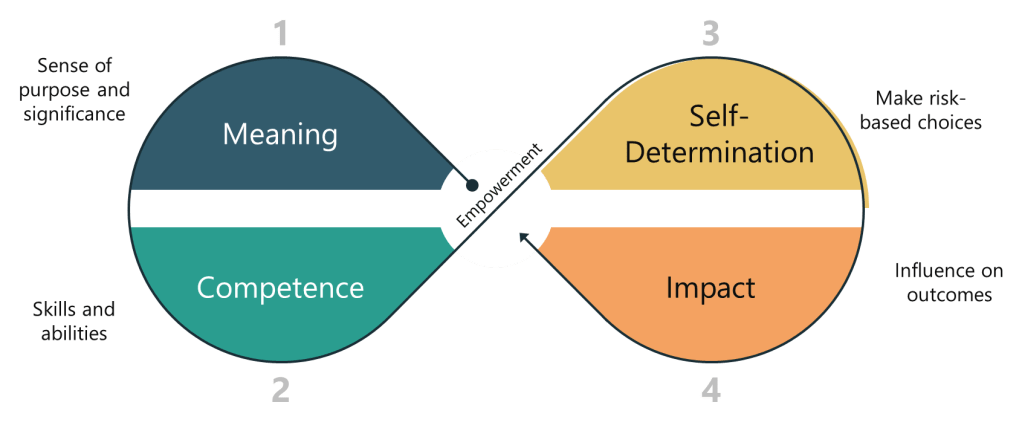
            Four dimensions of empowerment

            Implementation Practices

            Implementing empowerment effectively requires several key practices:

            1. Clear Communication: Employees need clear expectations and goals to understand how their work contributes to the organization’s objectives.
            2. Training and Development: Providing employees with the necessary skills and knowledge to make informed decisions is essential for empowerment.
            3. Autonomy and Decision-Making Authority: Employees should have the freedom to make decisions within their scope of work.
            4. Feedback and Recognition: Regular feedback and recognition of employee contributions help reinforce empowerment by acknowledging their impact.

            Deming’s Involvement in Worker Empowerment

            W. Edwards Deming, a pioneer in quality management, emphasized the importance of employee involvement and empowerment through his 14 Points for Management. Specifically:

            • Point 3: Cease dependence on inspection to achieve quality. Eliminate the need for inspection on a mass basis by building quality into the product in the first place. This point encourages organizations to empower workers by giving them the tools and training needed to ensure quality during production.
            • Point 9: Break down barriers between departments. People in research, design, sales, and production must work as a team to foresee problems of production and in use that may be encountered with the product or service. This emphasizes collaboration and cross-functional teamwork, which is a form of empowerment.
            • Point 12: Remove barriers that rob the hourly worker of his right to pride of workmanship. The responsibility of supervisors must be changed from sheer numbers to quality. This point directly addresses the need to empower workers by removing obstacles that prevent them from taking pride in their work.

            Deming’s philosophy aligns with genuine empowerment by focusing on building quality into processes, fostering teamwork, and recognizing the value of worker pride and autonomy.

            Denison and Organizational Culture

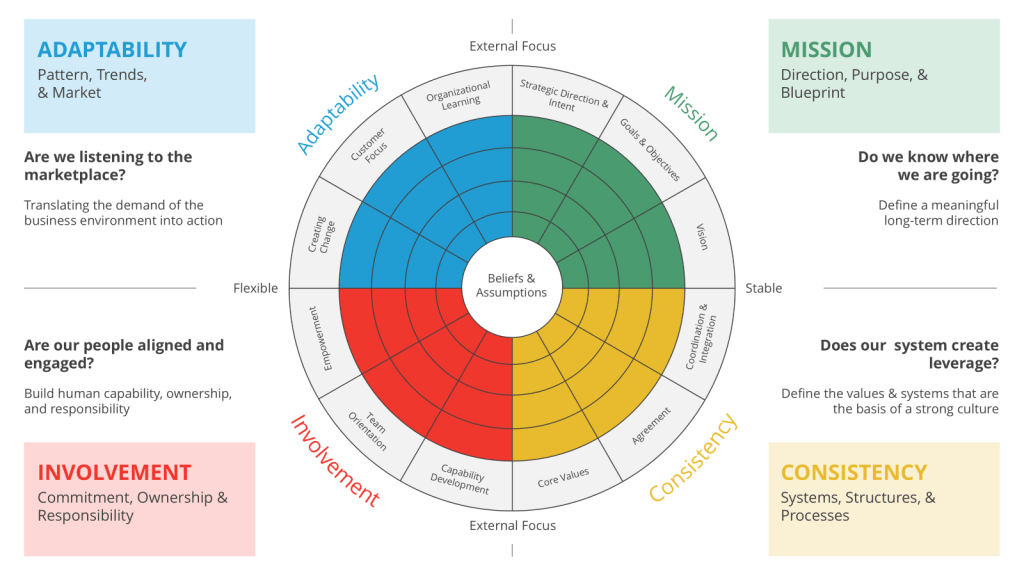
            Daniel Denison’s work on organizational culture, particularly through the Denison Model, assesses culture across four critical traits: Mission, Involvement, Adaptability, and Consistency. Each of these traits is further divided into three indexes, providing a comprehensive framework for understanding and improving organizational culture.

            Involvement and Empowerment

            Denison’s model emphasizes the importance of Involvement, which is the degree to which individuals at all levels are engaged and feel a sense of ownership in the organization. This trait is crucial for empowerment, as it involves aligning employees with the business direction and positioning them to contribute to its success. The indexes under Involvement include aspects such as empowerment, team orientation, and capability development, all of which are essential for creating a culture where employees feel valued and empowered.

            Empowerment through Cultural Alignment

            Denison suggests that empowerment is not just about giving employees authority but also about ensuring they are aligned with and committed to the organization’s mission. By fostering a culture where workers are engaged and capable, organizations can enhance their performance metrics such as innovation, customer satisfaction, and worker satisfaction. Denison’s approach emphasizes the need for leaders to manage culture effectively, recognizing that culture can either support or hinder organizational goals.

            Leadership and Empowerment

            Denison’s model implies that leaders should focus on creating an environment where workers feel empowered to contribute. This involves not only setting a clear mission but also ensuring that systems and processes support worker involvement and adaptability. By doing so, leaders can foster a culture where workers are motivated to drive organizational success. Denison’s philosophy underscores the importance of balancing internal consistency with external adaptability, ensuring that organizations remain responsive to market changes while maintaining internal cohesion.

            Denison’s work provides a structured framework for understanding how empowerment fits into a broader organizational culture. By emphasizing involvement and alignment, organizations can create an environment where workers feel empowered to contribute to success.
            Misuse of Empowerment Rhetoric in Quality Methodologies

            Total Quality Management (TQM)

            TQM emphasizes worker involvement and empowerment as part of its comprehensive approach to quality improvement. However, the emphasis on continuous improvement and customer satisfaction can sometimes lead to increased workloads and stress for workers, undermining genuine empowerment.

            Lean Manufacturing

            Lean manufacturing focuses on eliminating waste and maximizing efficiency, often using empowerment rhetoric to encourage workers to participate in continuous improvement processes like kaizen. However, this can result in workers being manipulated into accepting intensified workloads without real control over their conditions.

            Six Sigma

            Six Sigma uses a structured approach to quality improvement, relying on trained professionals like Green and Black Belts. While it involves worker participation, the focus on defect reduction and process optimization can lead to a narrow definition of empowerment that serves managerial goals rather than worker autonomy.

            Avoiding the Misuse of Empowerment Rhetoric

            To avoid misusing empowerment rhetoric, organizations should focus on creating a genuine culture of empowerment by:

            Ensuring Autonomy

            Ensuring autonomy in the workplace is crucial for empowering workers. This involves providing them with real decision-making authority and the freedom to act within their roles. When workers have autonomy, they are more likely to feel a sense of ownership over their work, which can lead to increased motivation and productivity. Autonomy allows workers to make decisions that align with their expertise and judgment, reducing the need for constant managerial oversight. This not only speeds up decision-making processes but also fosters a culture of trust and responsibility. To implement autonomy effectively, organizations should clearly define the scope of decision-making authority for each role, ensure that workers understand their responsibilities, and provide the necessary resources and support to facilitate independent action. By doing so, organizations can create an environment where workers feel valued and empowered to contribute to organizational success.

            Fostering Meaningful Work

            Fostering meaningful work is essential for creating a sense of purpose and engagement among workers. This involves aligning worker tasks with organizational goals and ensuring that work contributes to a broader sense of purpose. When workers understand how their tasks fit into the larger picture, they are more likely to be motivated and committed to their work. Meaningful work encourages workers to see beyond their immediate tasks and understand the impact of their contributions on the organization and its stakeholders. To foster meaningful work, organizations should communicate clearly about organizational objectives and how individual roles contribute to these goals. Additionally, providing opportunities for workers to participate in goal-setting and strategic planning can enhance their sense of purpose and connection to the organization’s mission. By making work meaningful, organizations can create a workforce that is not only productive but also passionate about achieving shared objectives.

            Developing Competence

            Developing competence is a critical aspect of empowering workers . This involves investing in training and development to enhance their skills and abilities. When workers feel competent in their roles, they are more confident and capable of making decisions and taking initiatives. Competence development should be tailored to the needs of both the organization and the individual worker, ensuring that training programs are relevant and effective. Organizations should also provide ongoing opportunities for learning and growth, recognizing that competence is not static but rather something that evolves over time. By investing in worker development, organizations can create a skilled and adaptable workforce that is better equipped to handle challenges and drive innovation. Moreover, when workers see that their employer is committed to their growth, they are more likely to feel valued and committed to the organization.

            Recognizing Impact

            Recognizing the impact of workers contributions is vital for reinforcing their sense of empowerment. Regularly acknowledging and rewarding worker achievements helps to demonstrate that their work is valued and appreciated. This can be done through various means, such as public recognition, bonuses, or promotions. However, recognition should be genuine and specific, highlighting the specific contributions and outcomes that workers have achieved. Generic or superficial recognition can undermine its effectiveness and lead to skepticism among workers. To make recognition meaningful, organizations should establish clear criteria for what constitutes impactful work and ensure that recognition is timely and consistent. By acknowledging workers contributions, organizations can foster a culture of appreciation and motivation, encouraging workers to continue striving for excellence and making significant contributions to organizational success.

            Encouraging Self-Determination

            Encouraging self-determination is essential for empowering workers to take ownership of their work processes and outcomes. This involves supporting workers in making choices about how they complete their tasks and achieve their objectives. Self-determination allows workers to work in ways that best suit their skills and work styles, leading to increased job satisfaction and productivity. To encourage self-determination, organizations should provide workers with the flexibility to design their work processes and set their own goals, as long as these align with organizational objectives. Additionally, organizations should foster an environment where workers feel comfortable suggesting improvements and innovations, without fear of criticism or reprisal. By giving workers the autonomy to make decisions about their work, organizations can tap into their creativity and initiative, leading to more effective and efficient work processes. This approach not only empowers workers but also contributes to a more agile and responsive organization.

            By focusing on these aspects, organizations can move beyond rhetorical empowerment and create a truly empowered workforce.

            Conclusion

            Worker empowerment is a powerful concept that, when implemented genuinely, can lead to significant improvements in organizational performance and worker satisfaction. However, its misuse in quality methodologies like TQM, Lean, and Six Sigma can undermine its potential benefits. By understanding the dimensions of empowerment and aligning practices with Deming’s principles, organizations can foster a culture of true empowerment that benefits both workers and the organization as a whole.
            The Art of Active Listening

            As quality professionals and leaders of all stripes information bombards us from all directions. This is why the ability to truly listen is a core and valuable skill. Whether in personal relationships, professional settings, or casual interactions, effective listening can be the key to building stronger connections, resolving conflicts, and fostering mutual understanding.

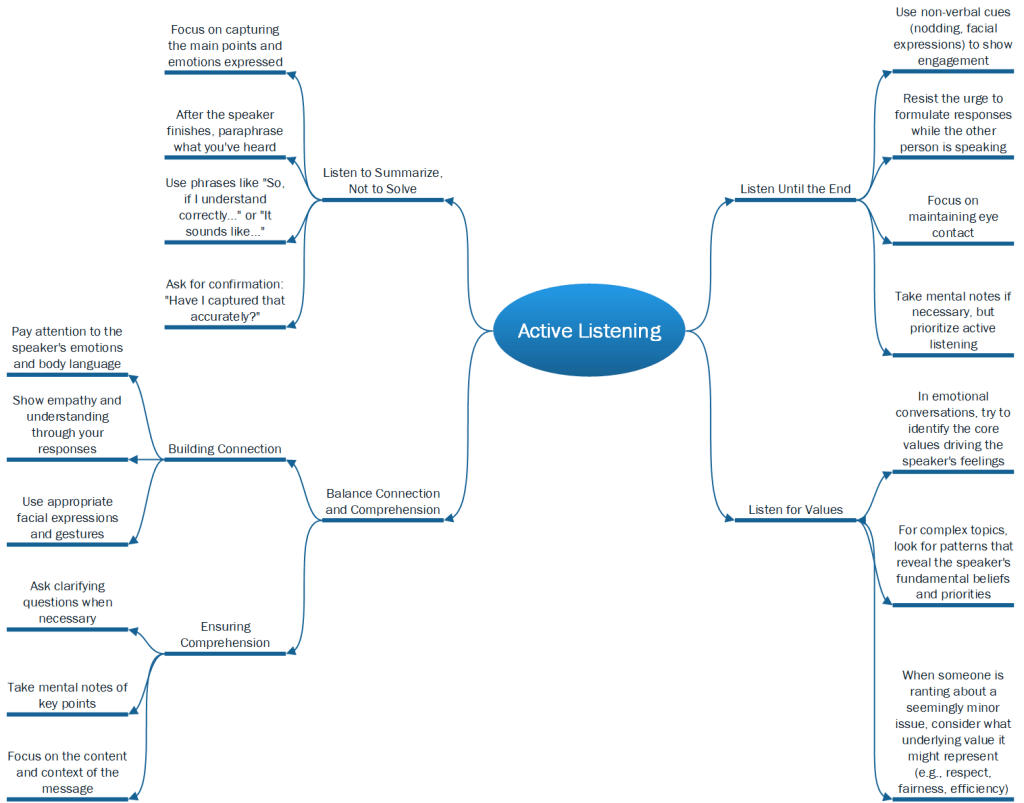
            In this post, I want to look at four powerful techniques that I am working to refine to continually improve my listening skills, and that can help you in your journey to be a more empathetic and insightful communicator.

            The Importance of Active Listening

            Before we explore the techniques, it’s crucial to understand why active listening is so vital. Active listening goes beyond merely hearing words; it involves fully engaging with the speaker, processing their message, and responding thoughtfully. This skill can lead to:

            • Improved relationships and trust
            • Better problem-solving and decision-making
            • Reduced misunderstandings and conflicts
            • Enhanced empathy and emotional intelligence
            • Increased productivity in professional settings

            Now, let’s dive into the four techniques that can elevate your listening game.

            Technique 1: Listen Until the End

            The Power of Patience

            One of the most common pitfalls in communication is the tendency to interrupt or jump in before the speaker has finished expressing their thoughts. This habit not only disrupts the flow of conversation but also sends a message that you value your own input more than the speaker’s.

            Benefits of Listening Completely:

            • You gain a full understanding of the speaker’s perspective
            • The speaker feels respected and valued
            • You avoid making premature judgments or assumptions

            How to Practice:

            • Focus on maintaining eye contact
            • Use non-verbal cues (nodding, facial expressions) to show engagement
            • Resist the urge to formulate responses while the other person is speaking
            • Take mental notes if necessary, but prioritize active listening

            By allowing the speaker to complete their thoughts without interruption, you create an environment of trust and openness, which is essential for effective communication.

            Technique 2: Listen to Summarize, Not to Solve

            The Art of Understanding

            When someone shares a problem or concern, our natural instinct is often to jump into problem-solving mode. However, this approach can be counterproductive, especially if the speaker is simply looking to be heard and understood.

            Why Summarizing is Crucial:

            • It ensures you’ve accurately grasped the speaker’s message
            • It demonstrates that you’re fully engaged in the conversation
            • It allows the speaker to clarify any misunderstandings
            • It gives the speaker a chance to reflect on their own thoughts

            Implementing This Technique:

            • Focus on capturing the main points and emotions expressed
            • After the speaker finishes, paraphrase what you’ve heard
            • Use phrases like “So, if I understand correctly…” or “It sounds like…”
            • Ask for confirmation: “Have I captured that accurately?”

            By prioritizing understanding over immediate problem-solving, you create a space where the speaker feels truly heard, which can often lead to more effective resolution of issues in the long run.

            Technique 3: Balance Connection and Comprehension

            The Dual Focus of Effective Listening

            Listening is not just about absorbing information; it’s also about building a connection with the speaker. Striking the right balance between these two aspects is crucial for meaningful communication.

            Aspects to Focus On:

            1. Building Connection:
              • Pay attention to the speaker’s emotions and body language
              • Show empathy and understanding through your responses
              • Use appropriate facial expressions and gestures
            2. Ensuring Comprehension:
              • Focus on the content and context of the message
              • Ask clarifying questions when necessary
              • Take mental notes of key points

            Strategies for Balancing Both:

            • Practice active empathy by putting yourself in the speaker’s shoes
            • Use reflective listening techniques to confirm understanding while showing support
            • Alternate between focusing on emotional cues and factual content

            By mastering this balance, you not only gain a deeper understanding of the issue at hand but also strengthen your relationship with the speaker, fostering trust and open communication.

            Technique 4: Listen for Values

            Uncovering the Hidden Layers

            Every conversation, whether it’s a casual chat or an emotional outpouring, offers a window into the speaker’s values and priorities. By tuning into these underlying messages, you can gain profound insights into what truly matters to the person you’re communicating with.

            Why Listening for Values Matters:

            • It deepens your understanding of the speaker’s motivations
            • It helps you respond more empathetically and effectively
            • It strengthens your connection by showing genuine interest in the speaker’s worldview

            How to Identify Values in Conversation:

            • Pay attention to recurring themes or concerns
            • Notice what elicits strong emotional responses
            • Listen for statements about what “should” or “ought to” be
            • Observe which topics the speaker spends the most time on

            Applying This Technique:

            • When someone is ranting about a seemingly minor issue, consider what underlying value it might represent (e.g., respect, fairness, efficiency)
            • In emotional conversations, try to identify the core values driving the speaker’s feelings
            • For complex topics, look for patterns that reveal the speaker’s fundamental beliefs and priorities

            By listening for values, you transform every interaction into an opportunity for deeper understanding and connection, enriching your relationships and broadening your perspective.

            Conclusion

            Mastering these four listening techniques – listening until the end, summarizing rather than solving, balancing connection and comprehension, and listening for values – can revolutionize your communication skills. These strategies not only enhance your ability to understand and connect with others but also contribute to your personal and professional growth.

            Remember, effective listening is a skill that requires practice and patience. As you implement these techniques in your daily interactions, you’ll likely find that your conversations become more meaningful, your relationships stronger, and your understanding of others more profound. In a world where genuine connection is increasingly valuable, honing your listening skills is an investment that pays dividends in all areas of life.

            So, the next time you engage in a conversation, challenge yourself to apply these techniques. You might be surprised at how much you can learn and how much deeper your connections can become when you truly listen with intention and care.

            Be Your Authentic Self

            The best quality folks I know, indeed the best of any profession I know, are those who manage to bring their authentic self to the job. This capability is core to building psychological safety and driving quality culture. And yet, too often, we teach people how to bury it or reward a degree of inauthenticity in service of some idea of “professional.” People quickly tune out, disengage, and lose trust when they sense insincerity. Being authentic allows you to connect and relate much more quickly with and bond with our fellow workers. To be an authentic quality champion, you must create a safe space to encourage people to open up and express themselves without fearing retribution. If people do not feel comfortable or safe conveying their feelings, they won’t be able to present their true, authentic selves. Trust is the key to encouraging others to express their thoughts and feelings. Without trust and authenticity, there can be no learning culture, no improvement, and little to no quality.

            Be Yourself

            Authenticity starts with being true to who you are. Don’t try to adopt a stereotypical quality personality or style that doesn’t feel natural to you. Instead:

            • Embrace your unique personality and style, whether that’s reserved, energetic, or straightforward
            • Be honest about your knowledge and expertise
            • Admit when you don’t know something rather than pretending

            By bringing your true self to the role, you build trust and create a psychologically safe environment.

            Foster Genuine Connections

            By building authentic relationships with colleagues, we can enhance collaboration, boost job satisfaction, and contribute to a more fulfilling professional experience. These connections go beyond superficial interactions and involve showing a genuine interest in coworkers’ success, engaging in healthy competition, and contributing to an authentic workplace culture.

            • Strive to find time for relationship-building with and among your fellows
            • Share personal anecdotes and experiences when relevant
            • Demonstrate vulnerability by discussing your own learning journey and challenges you’ve overcome

            Practice Active Listening

            Active listening contributes to authenticity by encouraging open communication and transparency. When we actively listen to one another, we create a safe space for sharing ideas, concerns, and feedback without fear of judgment. This openness allows individuals to be true to their personalities and values, fostering a culture where authenticity is valued and respected. Moreover, active listening helps in recognizing the unsaid emotions and underlying messages, enabling a deeper understanding of colleagues’ experiences and perspectives.

            • Give your full attention to speakers, noting both verbal and non-verbal cues
            • Paraphrase and summarize to ensure you’ve understood correctly
            • Ask probing questions to dig deeper into folk’s thoughts and ideas

            Model the Desired Culture

            When a quality partner brings their authentic self to the team, they set the tone. This demonstrates the behaviors and attitudes we want to see in our culture. This is important at all levels of the quality organization, but frankly I think quality leaders may be a little to uncomfortable here. Many people get ahead in quality by being analytical, which means thse who are outside that norm are asked to act like they are to get ahead. Which frankly, can be prety disastrrious.

            Some Recent Psychological Safety Articles from HBR

            When a Team Member Speaks Up — and It Doesn’t Go Well” by Megan Reitz
             and Amy C. Edmondson addresses the critical issue of speaking up in organizations and the potential negative outcomes that can occur. Great stuff, well worth the read, and particularly relevant to the themes of a just, conducive, and quality culture where open communication and diverse perspectives are core values.

            “Research: “New Hires’ Psychological Safety Erodes Quickly” by Amy C. Edmondson, Derrick P. Bransby, and Michaela J. Kerrissey confirms what I’ve long suspected about a deadly trough in psychological safety. I’ve certainly felt it myself. Going to be thinking about this for a long while.

            Pay Attention to the Psychological Contract

            A psychological contract refers to the unwritten, intangible set of expectations, beliefs, and obligations that define the relationship between an employer and an employee. Unlike a formal employment contract, which is legally binding and outlines specific duties, responsibilities, and compensation, a psychological contract encompasses the informal and often unspoken aspects of the employment relationship.

            Key Characteristics of a Psychological Contract

            1. Unwritten and Intangible: Psychological contracts are not documented formally. They are based on mutual perceptions and understandings that develop through interactions and experiences over time.
            2. Mutual Expectations: These contracts involve what each party expects from the other. For example, an employee might expect job security, opportunities for growth, and fair treatment, while an employer might expect loyalty, hard work, and a willingness to go above and beyond.
            3. Dynamic and Evolving: The terms of a psychological contract can change over time as the needs and circumstances of both the employee and employer evolve. What is considered fair and balanced at one stage of an employee’s career might change as their personal and professional priorities shift.
            4. Relational and Transactional Elements: Psychological contracts can be categorized into relational and transactional. Relational contracts are long-term and based on mutual trust and loyalty, while transactional contracts are short-term and focus on specific exchanges of labor for rewards.

            Importance of Psychological Contracts

            • Employee Engagement and Motivation: A well-balanced psychological contract can increase employee engagement, motivation, and job satisfaction. Employees who feel their expectations are being met are more likely to be committed to their organization and perform better.
            • Organizational Performance: Organizations that manage psychological contracts effectively can benefit from improved performance and lower turnover rates. Employees who perceive their psychological contract as fair are likelier to stay with the company and contribute positively to its goals.
            • Trust and Fairness: The psychological contract is crucial for building trust between employees and employers. When employees feel that their employer is keeping its informal promises, it fosters a sense of fairness and mutual respect.

            Breach of Psychological Contracts

            A breach occurs when one party perceives that the other has failed to fulfill its obligations. This can lead to feelings of betrayal, decreased job satisfaction, and reduced organizational commitment. Common consequences of a breached psychological contract include increased turnover, lower productivity, and higher levels of employee disengagement.

            Examples of Psychological Contracts

            1. Promotion Expectations: An employee might be verbally promised a promotion after completing specific training. If this promotion does not materialize, the employee may feel that the psychological contract has been breached.
            2. Work-Life Balance: An organization might have an unwritten rule that employees can leave early on Fridays. Employees might feel that their psychological contract has been violated if a new manager enforces strict hours.
            3. Job Security: Employees might expect job security in exchange for their loyalty and hard work. If the company undergoes layoffs without clear communication, it can lead to a breach of the psychological contract.

            Managing Psychological Contracts

            • Communicate Clearly: Regular and transparent communication helps align expectations and reduces misunderstandings.
            • Foster Trust: Building a culture of trust and fairness can help maintain a positive psychological contract.
            • Adapt to Changes: Recognize that employees’ needs and expectations change over time and be willing to adapt accordingly.

            Yes, psychological contracts change over time, and there are several ways this can occur:

            1. Organizational changes: Major organizational shifts, such as restructuring, mergers, or leadership changes, can alter the implicit expectations and obligations between employees and employers. For example, a company that previously emphasized job security may shift towards a more flexible workforce, changing the psychological contract around long-term employment.
            2. Societal and economic changes: Broader societal trends and economic conditions can influence psychological contracts. The COVID-19 pandemic, for instance, dramatically shifted expectations around remote work and work-life balance for many employees and employers.
            3. Career progression: As employees advance, their expectations and perceived obligations often evolve. An entry-level employee might prioritize learning opportunities, while a more experienced worker may expect greater autonomy and decision-making power.
            4. Generational differences: Different generations often have varying expectations about work. Younger generations may emphasize work-life balance and purpose-driven work more than older generations.
            5. Technological advancements: The rapid pace of technological change can alter how work is performed and what skills are valued, shifting the psychological contract.
            6. Personal life changes: Major life events for employees (e.g., starting a family or approaching retirement) can change their priorities and expectations from work.
            7. Ongoing experiences and interactions: Day-to-day experiences and interactions between employees and employers continuously shape and refine the psychological contract.
            8. Explicit renegotiation: In some cases, employers and employees may openly discuss and revise their mutual expectations, especially during performance reviews or when job roles change significantly.

            It’s important to note that these changes in psychological contracts can sometimes lead to perceived breaches if not properly managed or communicated. Organizations and employees need to be aware of these potential shifts and work to maintain alignment in their mutual expectations over time. Regular communication, transparency, and flexibility are crucial to adapting psychological contracts as circumstances change.

            Psychological contracts are under constant assault in most workplaces. Just look at all the tension around returning to work, quitting quietly, and whatever the new term de-jour is. We have entered an era in which continuous reinvention is the only way to manage continuous turbulence. This means that, when it comes to the psychological contract, we are (inadvertently) lying to our employees everywhere. Gone are the days when “you support this one-time transformation, and things will return to normal for a few years.” Now is the time for honest dialogue and explicit re-negotiation. We must allocate some of our time and resources to perpetual reinvention to survive and thrive in the perpetually turbulent world. That is the new normal. And psychological contracts are under a lot of tension. Plan to deal with that.