In an era where organizational complexity and interdisciplinary collaboration define success, decision-making frameworks like DACI and RAPID have emerged as critical tools for aligning stakeholders, mitigating biases, and accelerating outcomes. While both frameworks aim to clarify roles and streamline processes, their structural nuances and operational philosophies reveal distinct advantages and limitations.
Foundational Principles and Structural Architectures
The DACI Framework: Clarity Through Role Segmentation
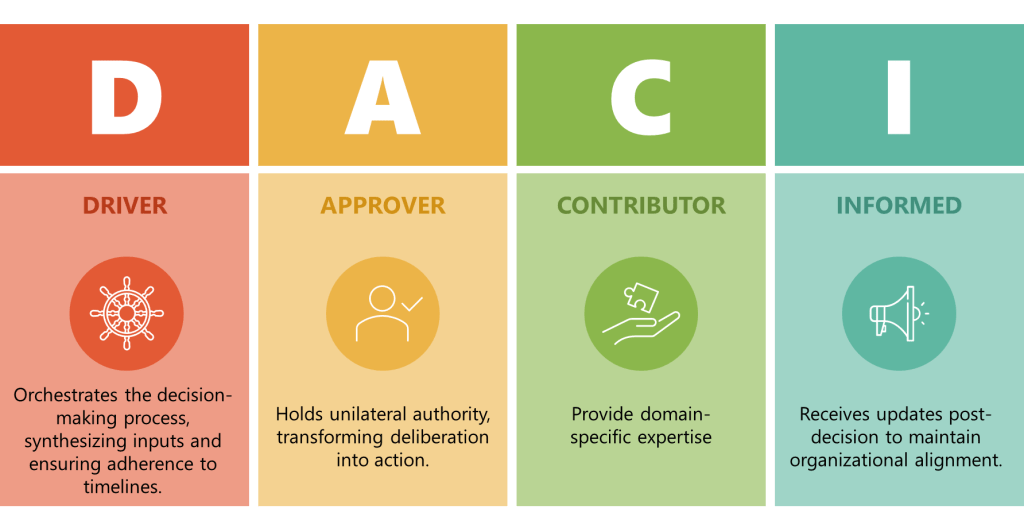
Originating at Intuit in the 1980s, the DACI framework (Driver, Approver, Contributor, Informed) was designed to eliminate ambiguity in project-driven environments. The Driver orchestrates the decision-making process, synthesizing inputs and ensuring adherence to timelines. The Approver holds unilateral authority, transforming deliberation into action. Contributors provide domain-specific expertise, while the Informed cohort receives updates post-decision to maintain organizational alignment.
This structure thrives in scenarios where hierarchical accountability is paramount, such as product development or regulatory submissions. For instance, in pharmaceutical validation processes, the Driver might coordinate cross-functional teams to align on compliance requirements, while the Approver-often a senior quality executive-finalizes the risk control strategy. The framework’s simplicity, however, risks oversimplification in contexts requiring iterative feedback, such as innovation cycles where emergent behaviors defy linear workflows.
The RAPID Framework: Balancing Input and Execution
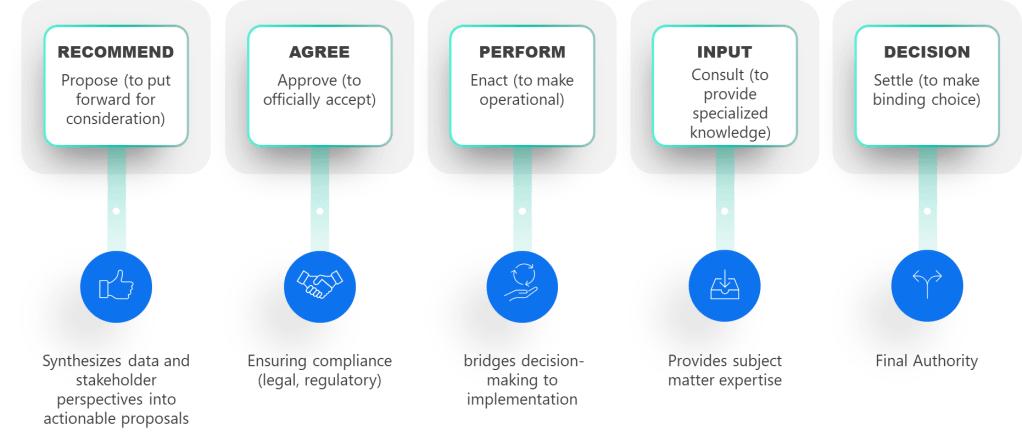
Developed by Bain & Company, RAPID (Recommend, Agree, Perform, Input, Decide) introduces granularity by separating recommendation development from execution. The Recommender synthesizes data and stakeholder perspectives into actionable proposals, while the Decider retains final authority. Crucially, RAPID formalizes the Agree role, ensuring legal or regulatory compliance, and the Perform role, which bridges decision-making to implementation-a gap often overlooked in DACI.
RAPID’s explicit focus on post-decision execution aligns with the demands of an innovative organization. However, the framework’s five-role structure can create bottlenecks if stakeholders misinterpret overlapping responsibilities, particularly in decentralized teams.
Cognitive and Operational Synergies
Mitigating Bias Through Structured Deliberation
Both frameworks combat cognitive noise-a phenomenon where inconsistent judgments undermine decision quality. DACI’s Contributor role mirrors the Input function in RAPID, aggregating diverse perspectives to counter anchoring bias. For instance, when evaluating manufacturing site expansions, Contributors/Inputs might include supply chain analysts and environmental engineers, ensuring decisions balance cost, sustainability, and regulatory risk.
The Mediating Assessments Protocol (MAP), a structured decision-making method highlighted complements these frameworks by decomposing complex choices into smaller, criteria-based evaluations. A pharmaceutical company using DACI could integrate MAP to assess drug launch options through iterative scoring of market access, production scalability, and pharmacovigilance requirements, thereby reducing overconfidence in the Approver’s final call.
Temporal Dynamics in Decision Pathways
DACI’s linear workflow (Driver → Contributors → Approver) suits time-constrained scenarios, such as regulatory submissions requiring rapid consensus. Conversely, RAPID’s non-sequential process-where Recommenders iteratively engage Input and Agree roles-proves advantageous in adaptive contexts like digital validation system adoption, where AI/ML integration demands continuous stakeholder recalibration.
Integrating Strength of Knowledge (SoK)
The Strength of Knowledge framework, which evaluates decision reliability based on data robustness and expert consensus, offers a synergistic lens for both models. For instance, RAPID teams could assign Recommenders to quantify SoK scores for each Input and Agree stakeholder, preemptively addressing dissent through targeted evidence.
Role-Specific Knowledge Weighting
Both frameworks benefit from assigning credibility scores to inputs based on SoK:
In DACI:
Contributors: Domain experts submit inputs with attached SoK scores (e.g., “Toxicity data: SoK 2/3 due to incomplete genotoxicity studies”).
Driver: Prioritizes contributions using SoK-weighted matrices, escalating weak-knowledge items for additional scrutiny.
Approver: Makes final decisions using a knowledge-adjusted risk profile, favoring options supported by strong/moderate SoK.
In RAPID:
Recommenders: Proposals include SoK heatmaps highlighting evidence quality (e.g., clinical trial endpoints vs. preclinical extrapolations).
Input: Stakeholders rate their own contributions’ SoK levels, enabling meta-analyses of confidence intervals
Decide: Final choices incorporate knowledge-adjusted weighted scoring, discounting weak-SoK factors by 30-50%
Contextualizing Frameworks in the Decision Factory Paradigm
Organizations must reframe themselves as “decision factories,” where structured processes convert data into actionable choices. DACI serves as a precision tool for hierarchical environments, while RAPID offers a modular toolkit for adaptive, cross-functional ecosystems. However, neither framework alone addresses the cognitive and temporal complexities of modern industries.
Future iterations will likely blend DACI’s role clarity with RAPID’s execution focus, augmented by AI-driven tools that dynamically assign roles based on decision-criticality and SoK metrics. As validation landscapes and innovation cycles accelerate, the organizations thriving will be those treating decision frameworks not as rigid templates, but as living systems iteratively calibrated to their unique risk-reward contours.
Naïve realism—the unconscious belief that our perception of reality is objective and universally shared—acts as a silent saboteur in professional and personal decision-making. While this mindset fuels confidence, it also blinds us to alternative perspectives, amplifies cognitive biases, and undermines collaborative problem-solving. This blog post explores how this psychological trap distorts critical processes and offers actionable strategies to counteract its influence, drawing parallels to frameworks like the Pareto Principle and insights from risk management research.
Problem Solving: When Certainty Breeds Blind Spots
Naïve realism convinces us that our interpretation of a problem is the only logical one, leading to overconfidence in solutions that align with preexisting beliefs. For instance, teams often dismiss contradictory evidence in favor of data that confirms their assumptions. A startup scaling a flawed product because early adopters praised it—while ignoring churn data—exemplifies this trap. The Pareto Principle’s “vital few” heuristic can exacerbate this bias by oversimplifying complex issues. Organizations might prioritize frequent but low-impact problems, neglecting rare yet catastrophic risks, such as cybersecurity vulnerabilities masked by daily operational hiccups.
Functional fixedness, another byproduct of naïve realism, stifles innovation by assuming resources can only be used conventionally. To mitigate this pitfall, teams should actively challenge assumptions through adversarial brainstorming, asking questions like “Why will this solution fail?” Involving cross-functional teams or external consultants can also disrupt echo chambers, injecting fresh perspectives into problem-solving processes.
Risk Management: The Illusion of Objectivity
Risk assessments are inherently subjective, yet naïve realism convinces decision-makers that their evaluations are purely data-driven. Overreliance on historical data, such as prioritizing minor customer complaints over emerging threats, mirrors the Pareto Principle’s “static and historical bias” pitfall.
Reactive devaluation further complicates risk management. Organizations can counteract these biases by appropriately leveraging risk management to drive subjectivity out while better accounting for uncertainty. Simulating worst-case scenarios, such as sudden supplier price hikes or regulatory shifts, also surfaces blind spots that static models overlook.
Decision Making: The Myth of the Rational Actor
Even in data-driven cultures, subjectivity stealthily shapes choices. Leaders often overestimate alignment within teams, mistaking silence for agreement. Individuals frequently insist their assessments are objective despite clear evidence of self-enhancement bias. This false consensus erodes trust and stifles dissent with the assumption that future preferences will mirror current ones.
Organizations must normalize dissent through anonymous voting or “red team” exercises to dismantle these myths, including having designated critics scrutinize plans. Adopting probabilistic thinking, where outcomes are assigned likelihoods instead of binary predictions, reduces overconfidence.
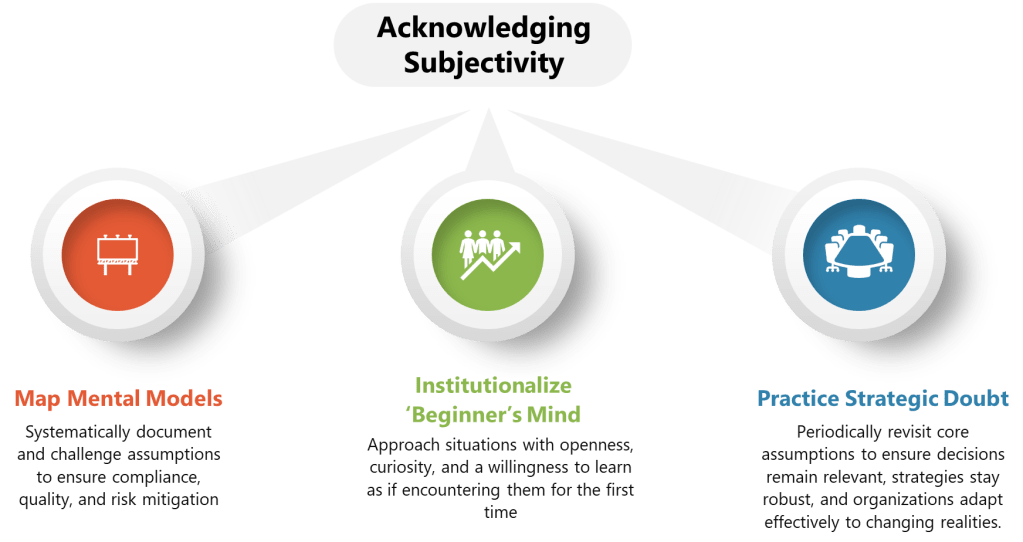
Acknowledging Subjectivity: Three Practical Steps
1. Map Mental Models
Mapping mental models involves systematically documenting and challenging assumptions to ensure compliance, quality, and risk mitigation. For example, during risk assessments or deviation investigations, teams should explicitly outline their assumptions about processes, equipment, and personnel. Statements such as “We assume the equipment calibration schedule is sufficient to prevent deviations” or “We assume operator training is adequate to avoid errors” can be identified and critically evaluated.
Foster a culture of continuous improvement and accountability by stress-testing assumptions against real-world data—such as audit findings, CAPA (Corrective and Preventive Actions) trends, or process performance metrics—to reveal gaps that might otherwise go unnoticed. For instance, a team might discover that while calibration schedules meet basic requirements, they fail to account for unexpected environmental variables that impact equipment accuracy.
By integrating assumption mapping into routine GMP activities like risk assessments, change control reviews, and deviation investigations, organizations can ensure their decision-making processes are robust and grounded in evidence rather than subjective beliefs. This practice enhances compliance and strengthens the foundation for proactive quality management.
2. Institutionalize ‘Beginner’s Mind’
A beginner’s mindset is about approaching situations with openness, curiosity, and a willingness to learn as if encountering them for the first time. This mindset challenges the assumptions and biases that often limit creativity and problem-solving. In team environments, fostering a beginner’s mindset can unlock fresh perspectives, drive innovation, and create a culture of continuous improvement. However, building this mindset in teams requires intentional strategies and ongoing reinforcement to ensure it is actively utilized.
What is a Beginner’s Mindset?
At its core, a beginner’s mindset involves setting aside preconceived notions and viewing problems or opportunities with fresh eyes. Unlike experts who may rely on established knowledge or routines, individuals with a beginner’s mindset embrace uncertainty and ask fundamental questions such as “Why do we do it this way?” or “What if we tried something completely different?” This perspective allows teams to challenge the status quo, uncover hidden opportunities, and explore innovative solutions that might be overlooked.
For example, adopting this mindset in the workplace might mean questioning long-standing processes that no longer serve their purpose or rethinking how resources are allocated to align with evolving goals. By removing the constraints of “we’ve always done it this way,” teams can approach challenges with curiosity and creativity.
How to Build a Beginner’s Mindset in Teams
Fostering a beginner’s mindset within teams requires deliberate actions from leadership to create an environment where curiosity thrives. Here are some key steps to build this mindset:
Model Curiosity and Openness Leaders play a critical role in setting the tone for their teams. By modeling curiosity—asking questions, admitting gaps in knowledge, and showing enthusiasm for learning—leaders demonstrate that it is safe and encouraged to approach work with an open mind. For instance, during meetings or problem-solving sessions, leaders can ask questions like “What haven’t we considered yet?” or “What would we do if we started from scratch?” This signals to team members that exploring new ideas is valued over rigid adherence to past practices.
Encourage Questioning Assumptions Teams should be encouraged to question their assumptions regularly. Structured exercises such as “assumption audits” can help identify ingrained beliefs that may no longer hold true. By challenging assumptions, teams open themselves up to new insights and possibilities.
Create Psychological Safety A beginner’s mindset flourishes in environments where team members feel safe taking risks and sharing ideas without fear of judgment or failure. Leaders can foster psychological safety by emphasizing that mistakes are learning opportunities rather than failures. For example, during project reviews, instead of focusing solely on what went wrong, leaders can ask, “What did we learn from this experience?” This shifts the focus from blame to growth and encourages experimentation.
Rotate Roles and Responsibilities Rotating team members across roles or projects is an effective way to cultivate fresh perspectives. When individuals step into unfamiliar areas of responsibility, they are less likely to rely on habitual thinking and more likely to approach tasks with curiosity and openness. For instance, rotating quality assurance personnel into production oversight roles can reveal inefficiencies or risks that might have been overlooked due to overfamiliarity within silos.
Provide Opportunities for Learning Continuous learning is essential for maintaining a beginner’s mindset. Organizations should invest in training programs, workshops, or cross-functional collaborations that expose teams to new ideas and approaches. For example, inviting external speakers or consultants to share insights from other industries can inspire innovative thinking within teams by introducing them to unfamiliar concepts or methodologies.
Use Structured Exercises for Fresh Thinking Design Thinking exercises or brainstorming techniques like “reverse brainstorming” (where participants imagine how to create the worst possible outcome) can help teams break free from conventional thinking patterns. These activities force participants to look at problems from unconventional angles and generate novel solutions.
Ensuring Teams Utilize a Beginner’s Mindset
Building a beginner’s mindset is only half the battle; ensuring it is consistently applied requires ongoing reinforcement:
Integrate into Processes: Embed beginner’s mindset practices into regular workflows such as project kickoffs, risk assessments, or strategy sessions. For example, make it standard practice to start meetings by revisiting assumptions or brainstorming alternative approaches before diving into execution plans.
Reward Curiosity: Recognize and reward behaviors that reflect a beginner’s mindset—such as asking insightful questions, proposing innovative ideas, or experimenting with new approaches—even if they don’t immediately lead to success.
Track Progress: Use metrics like the number of new ideas generated during brainstorming sessions or the diversity of perspectives incorporated into decision-making processes to measure how well teams utilize a beginner’s mindset.
Reflect Regularly: Encourage teams to reflect on using the beginner’s mindset through retrospectives or debriefs after significant projects and events. Questions like “How did our openness to new ideas impact our results?” or “What could we do differently next time?” help reinforce the importance of maintaining this perspective.
Organizations can ensure their teams consistently leverage the power of a beginner’s mindset by cultivating curiosity, creating psychological safety, and embedding practices that challenge conventional thinking into daily operations. This drives innovation and fosters adaptability and resilience in an ever-changing business landscape.
3. Revisit Assumptions by Practicing Strategic Doubt
Assumptions are the foundation of decision-making, strategy development, and problem-solving. They represent beliefs or premises we take for granted, often without explicit evidence. While assumptions are necessary to move forward in uncertain environments, they are not static. Over time, new information, shifting circumstances, or emerging trends can render them outdated or inaccurate. Periodically revisiting core assumptions is essential to ensure decisions remain relevant, strategies stay robust, and organizations adapt effectively to changing realities.
Why Revisiting Assumptions Matters
Assumptions often shape the trajectory of decisions and strategies. When left unchecked, they can lead to flawed projections, misallocated resources, and missed opportunities. For example, Kodak’s assumption that film photography would dominate forever led to its downfall in the face of digital innovation. Similarly, many organizations assume their customers’ preferences or market conditions will remain stable, only to find themselves blindsided by disruptive changes. Revisiting assumptions allows teams to challenge these foundational beliefs and recalibrate their approach based on current realities.
Moreover, assumptions are frequently made with incomplete knowledge or limited data. As new evidence emerges, whether through research, technological advancements, or operational feedback, testing these assumptions against reality is critical. This process ensures that decisions are informed by the best available information rather than outdated or erroneous beliefs.
How to Periodically Revisit Core Assumptions
Revisiting assumptions requires a structured approach integrating critical thinking, data analysis, and collaborative reflection.
1. Document Assumptions from the Start
The first step is identifying and articulating assumptions explicitly during the planning stages of any project or strategy. For instance, a team launching a new product might document assumptions about market size, customer preferences, competitive dynamics, and regulatory conditions. By making these assumptions visible and tangible, teams create a baseline for future evaluation.
2. Establish Regular Review Cycles
Revisiting assumptions should be institutionalized as part of organizational processes rather than a one-off exercise. Build assumption audits into the quality management process. During these sessions, teams critically evaluate whether their assumptions still hold true in light of recent data or developments. This ensures that decision-making remains agile and responsive to change.
3. Use Feedback Loops
Feedback loops provide real-world insights into whether assumptions align with reality. Organizations can integrate mechanisms such as surveys, operational metrics, and trend analyses into their workflows to continuously test assumptions.
4. Test Assumptions Systematically
Not all assumptions carry equal weight; some are more critical than others. Teams can prioritize testing based on three parameters: severity (impact if the assumption is wrong), probability (likelihood of being inaccurate), and cost of resolution (resources required to validate or adjust).
5. Encourage Collaborative Reflection
Revisiting assumptions is most effective when diverse perspectives are involved. Bringing together cross-functional teams—including leaders, subject matter experts, and customer-facing roles—ensures that blind spots are uncovered and alternative viewpoints are considered. Collaborative workshops or strategy recalibration sessions can facilitate this process by encouraging open dialogue about what has changed since the last review.
6. Challenge Assumptions with Data
Assumptions should always be validated against evidence rather than intuition alone. Teams can leverage predictive analytics tools to assess whether their assumptions align with emerging trends or patterns.
How Organizations Can Ensure Assumptions Are Utilized Effectively
To ensure revisited assumptions translate into actionable insights, organizations must integrate them into decision-making processes:
Monitor Continuously: Establish systems for continuously monitoring critical assumptions through dashboards or regular reporting mechanisms. This allows leadership to identify invalidated assumptions promptly and course-correct before significant risks materialize.
Update Strategies and Goals: Adjust goals and objectives based on revised assumptions to maintain alignment with current realities.
Refine KPIs: Key Performance Indicators (KPIs) should evolve alongside updated assumptions to reflect shifting priorities and external conditions. Metrics that once seemed relevant may need adjustment as new data emerges.
Embed Assumption Testing into Culture: Encourage teams to view assumption testing as an ongoing practice rather than a reactive measure. Leaders can model this behavior by openly questioning their own decisions and inviting critique from others.
From Certainty to Curious Inquiry
Naïve realism isn’t a personal failing but a universal cognitive shortcut. By recognizing its influence—whether in misapplying the Pareto Principle or dismissing dissent—we can reframe conflicts as opportunities for discovery. The goal isn’t to eliminate subjectivity but to harness it, transforming blind spots into lenses for sharper, more inclusive decision-making.
The path to clarity lies not in rigid certainty but in relentless curiosity.
In complex industries such as aviation and biotechnology, effective communication is crucial for ensuring safety, quality, and efficiency. However, the presence of communication loops and silos can significantly hinder these efforts. The concept of the “Tower of Babel” problem, as explored in the aviation sector by Follet, Lasa, and Mieusset in HS36, highlights how different professional groups develop their own languages and operate within isolated loops, leading to misunderstandings and disconnections. This article has really got me thinking about similar issues in my own industry.
The Tower of Babel Problem: A Thought-Provoking Perspective
The HS36 article provides a thought-provoking perspective on the “Tower of Babel” problem, where each aviation professional feels in control of their work but operates within their own loop. This phenomenon is reminiscent of the biblical story where a common language becomes fragmented, causing confusion and separation among people. In modern industries, this translates into different groups using their own jargon and working in isolation, making it difficult for them to understand each other’s perspectives and challenges.
For instance, in aviation, air traffic controllers (ATCOs), pilots, and managers each have their own “loop,” believing they are in control of their work. However, when these loops are disconnected, it can lead to miscommunication, especially when each group uses different terminology and operates under different assumptions about how work should be done (work-as-prescribed vs. work-as-done). This issue is equally pertinent in the biotech industry, where scientists, quality assurance teams, and regulatory affairs specialists often work in silos, which can impede the development and approval of new products.
Tower of Babel by Joos de Momper, Old Masters Museum
Impact on Decision Making
Decision making in biotech is heavily influenced by Good Practice (GxP) guidelines, which emphasize quality, safety, and compliance – and I often find that the aviation industry, as a fellow highly regulated industry, is a great place to draw perspective.
When communication loops are disconnected, decisions may not fully consider all relevant perspectives. For example, in GMP (Good Manufacturing Practice) environments, quality control teams might focus on compliance with regulatory standards, while research and development teams prioritize innovation and efficiency. If these groups do not effectively communicate, decisions might overlook critical aspects, such as the practicality of implementing new manufacturing processes or the impact on product quality.
Furthermore, ICH Q9(R1) guideline emphasizes the importance of reducing subjectivity in Quality Risk Management (QRM) processes. Subjectivity can arise from personal opinions, biases, or inconsistent interpretations of risks by stakeholders, impacting every stage of QRM. To combat this, organizations must adopt structured approaches that prioritize scientific knowledge and data-driven decision-making. Effective knowledge management is crucial in this context, as it involves systematically capturing, organizing, and applying internal and external knowledge to inform QRM activities.
Academic Research on Communication Loops
Research in organizational behavior and communication highlights the importance of bridging these silos. Studies have shown that informal interactions and social events can significantly improve relationships and understanding among different professional groups (Katz & Fodor, 1963). In the biotech industry, fostering a culture of open communication can help ensure that GxP decisions are well-rounded and effective.
Moreover, the concept of “work-as-done” versus “work-as-prescribed” is relevant in biotech as well. Operators may adapt procedures to fit practical realities, which can lead to discrepancies between intended and actual practices. This gap can be bridged by encouraging feedback and continuous improvement processes, ensuring that decisions reflect both regulatory compliance and operational feasibility.
Case Studies and Examples
Aviation Example: The HS36 article provides a compelling example of how disconnected loops can hinder effective decision making in aviation. For instance, when a standardized phraseology was introduced, frontline operators felt that this change did not account for their operational needs, leading to resistance and potential safety issues. This illustrates how disconnected loops can hinder effective decision making.
Product Development: In the development of a new biopharmaceutical, different teams might have varying priorities. If the quality assurance team focuses solely on regulatory compliance without fully understanding the manufacturing challenges faced by production teams, this could lead to delays or quality issues. By fostering cross-functional communication, these teams can align their efforts to ensure both compliance and operational efficiency.
ICH Q9(R1) Example: The revised ICH Q9(R1) guideline emphasizes the need to manage and minimize subjectivity in QRM. For instance, in assessing the risk of a new manufacturing process, a structured approach using historical data and scientific evidence can help reduce subjective biases. This ensures that decisions are based on comprehensive data rather than personal opinions.
Technology Deployment: . A recent FDA Warning Letter to Sanofi highlighted the importance of timely technological upgrades to equipment and facility infrastructure. This emphasizes that staying current with technological advancements is essential for maintaining regulatory compliance and ensuring product quality. However the individual loops of decision making amongst the development teams, operations and quality can lead to major mis-steps.
To overcome the challenges posed by communication loops and silos, organizations can implement several strategies:
Promote Cross-Functional Training: Encourage professionals to explore other roles and challenges within their organization. This can help build empathy and understanding across different departments.
Foster Informal Interactions: Organize social events and informal meetings where professionals from different backgrounds can share experiences and perspectives. This can help bridge gaps between silos and improve overall communication.
Define Core Knowledge: Establish a minimum level of core knowledge that all stakeholders should possess. This can help ensure that everyone has a basic understanding of each other’s roles and challenges.
Implement Feedback Loops: Encourage continuous feedback and improvement processes. This allows organizations to adapt procedures to better reflect both regulatory requirements and operational realities.
Leverage Knowledge Management: Implement robust knowledge management systems to reduce subjectivity in decision-making processes. This involves capturing, organizing, and applying internal and external knowledge to inform QRM activities.
Combating Subjectivity in Decision Making
In addition to bridging communication loops, reducing subjectivity in decision making is crucial for ensuring quality and safety. The revised ICH Q9(R1) guideline provides several strategies for this:
Structured Approaches: Use structured risk assessment tools and methodologies to minimize personal biases and ensure that decisions are based on scientific evidence.
Data-Driven Decision Making: Prioritize data-driven decision making by leveraging historical data and real-time information to assess risks and opportunities.
Cognitive Bias Awareness: Train stakeholders to recognize and mitigate cognitive biases that can influence risk assessments and decision-making processes.
Conclusion
In complex industries effective communication is essential for ensuring safety, quality, and efficiency. The presence of communication loops and silos can lead to misunderstandings and poor decision making. By promoting cross-functional understanding, fostering informal interactions, and implementing feedback mechanisms, organizations can bridge these gaps and improve overall performance. Additionally, reducing subjectivity in decision making through structured approaches and data-driven decision making is critical for ensuring compliance with GxP guidelines and maintaining product quality. As industries continue to evolve, addressing these communication challenges will be crucial for achieving success in an increasingly interconnected world.
Katz, D., & Fodor, J. (1963). The Structure of a Semantic Theory. Language, 39(2), 170–210.
Dekker, S. W. A. (2014). The Field Guide to Understanding Human Error. Ashgate Publishing.
Shorrock, S. (2023). Editorial. Who are we to judge? From work-as-done to work-as-judged. HindSight, 35, Just Culture…Revisited. Brussels: EUROCONTROL.
Prioritization tools are essential for effective decision-making. They help teams decide where to focus their efforts, ensuring that the most critical tasks are completed first.
MoSCoW Prioritization
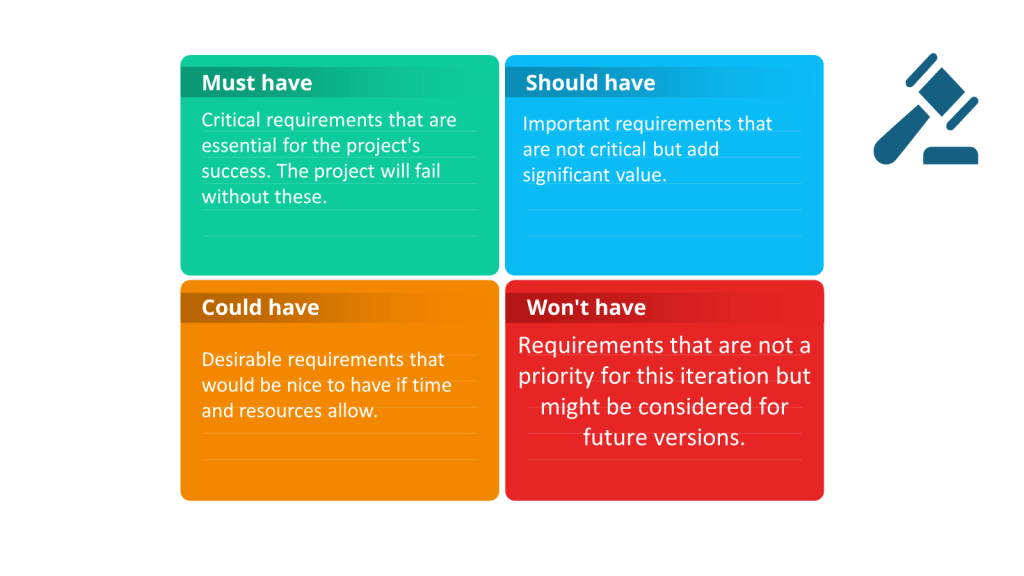
The MoSCoW method is a widely used prioritization technique in project management, particularly within agile frameworks. It categorizes tasks or requirements into four distinct categories:
Must Have: Essential requirements that are critical for the project’s success. Without these, the project is considered a failure.
Should Have: Important but not critical requirements. These can be deferred if necessary but should be included if possible.
Could Have: Desirable but not necessary requirements. These are nice-to-haves that can be included if time and resources permit.
Won’t Have: Requirements agreed to be excluded from the current project scope. These might be considered for future phases.
Advantages:
Clarity and Focus: Clearly distinguish between essential and non-essential requirements, helping teams focus on what truly matters.
Stakeholder Alignment: Facilitates discussions and alignment among stakeholders regarding priorities.
Flexibility: Can be adapted to various project types and industries.
Disadvantages:
Ambiguity: May not provide clear guidance on prioritizing within each category.
Subjectivity: Decisions can be influenced by stakeholder biases or political considerations.
Resource Allocation: Requires careful allocation of resources to ensure that “Must Have” items are prioritized appropriately.
Binary Prioritization
Binary prioritization, often implemented using a binary search tree, is a method for systematically comparing and ranking requirements. Each requirement is compared against others, creating a hierarchical list of priorities.
Process:
Root Node: Start with one requirement as the root node.
Comparison: Compare each succeeding requirement to the root node, establishing child nodes based on priority.
Hierarchy: Continue creating a long list of prioritized requirements, forming a binary tree structure.
Advantages:
Systematic Approach: Provides a clear, structured way to compare and rank requirements.
Granularity: Offers detailed prioritization, ensuring that each requirement is evaluated against others.
Objectivity: Reduces subjectivity by using a consistent comparison method.
Disadvantages:
Complexity: Can be complex and time-consuming, especially for large projects with many requirements.
Resource Intensive: Requires significant effort to compare each requirement systematically.
Scalability: It may become unwieldy with many requirements, making it difficult to manage.
Pairwise Comparison
Pairwise or paired comparison is a method for prioritizing and ranking multiple options by comparing them in pairs. This technique is particularly useful when quantitative, objective data is not available, and decisions need to be made based on subjective criteria.
How Pairwise Comparison Works
Define Criteria: Establish clear criteria for evaluation, such as cost, strategic importance, urgency, resource allocation, or alignment with objectives.
Create a Matrix: List all the items to be compared along its rows and columns. Each cell in the matrix represents a comparison between two items.
Make Comparisons: For each pair of items, decide which item is more important or preferred based on the established criteria. Mark the preferred item in the corresponding cell of the matrix.
Calculate Scores: After all comparisons are made, count the times each item was preferred. The item with the highest count is ranked highest in priority.
Benefits of Pairwise Comparison
Simplicity: It is easy to understand and implement, requiring no special training[3].
Objectivity: Reduces bias and emotional influence in decision-making by focusing on direct comparisons.
Clarity: Provides a clear ranking of options, making it easier to prioritize tasks or decisions.
Engagement: Encourages collaborative discussions among team members, leading to a better understanding of different perspectives.
Limitations of Pairwise Comparison
Scalability: The number of comparisons increases significantly with the number of items, making it less practical for large lists.
Relative Importance: Does not allow for measuring the intensity of preferences, only the relative ranking.
Cognitive Load: Can be mentally taxing if the list of items is long or the criteria are complex.
Applications of Pairwise Comparison
Project Management: Prioritizing project tasks or deliverables.
Product Development: Ranking features or requirements based on customer needs.
Survey Research: Understanding preferences and establishing relative rankings in surveys.
Strategic Decision-Making: Informing decisions by comparing strategic options or initiatives.
Example of Pairwise Comparison
Imagine a project team needs to prioritize seven project deliverables labeled A to G. They create a pairwise comparison matrix and compare each deliverable against the others. For instance, deliverable A is compared to B, then A to C, and so on. The team marks the preferred deliverable in each comparison. After completing all comparisons, they count the number of times each deliverable was preferred to determine the final ranking.
Comparison of MoSCoW Prioritization, Binary Prioritization, and Pairwise Comparison
Here’s a detailed comparison of the three prioritization methods in a tabular format:
Aspect
MoSCoW Prioritization
Binary Prioritization
Pairwise Comparison
Key Aspects
Categorizes tasks into Must, Should, Could, and Won’t have
Compares requirements in pairs to create a hierarchical list
Compares options in pairs to determine relative preferences
Advantages
Simple to understand, clear categorization, stakeholder alignment
Intuitive, suitable for long lists, provides numerical results
Disadvantages
Subjective categorization, may oversimplify complex projects
Time-consuming for large projects, may become complex
Can be cognitively difficult, potential for inconsistency (transitivity violations)
Clarity
High-level categorization
Detailed prioritization within a hierarchy
Provides clear ranking based on direct comparisons
Stakeholder Involvement
High involvement and alignment required
Less direct involvement, more systematic
Encourages collaborative discussions, but can be intensive
Flexibility
Adaptable to various projects
Best suited for projects with clear requirements
Suitable for both small and large lists, but can be complex for very large sets
Complexity
Simple to understand and implement
More complex and time-consuming
Can be cognitively taxing, especially for large numbers of comparisons
Resource Allocation
Requires careful planning
Systematic but resource-intensive
Requires significant effort for large sets of comparisons
Conclusion
Each prioritization method has its own strengths and weaknesses, making them suitable for different contexts:
MoSCoW Prioritization is ideal for projects needing clear, high-level categorization and strong stakeholder alignment. It is simple and effective for initial prioritization but may lack the granularity needed for more complex projects.
Binary Prioritization offers a systematic and detailed approach, reducing subjectivity. However, it can be time-consuming and complex, especially for large projects.
Pairwise Comparison is intuitive and provides clear numerical results, making it suitable for long lists of options. It encourages collaborative decision-making but can be cognitively challenging and may lead to inconsistencies if not carefully managed.
Choosing the right method depends on the specific needs and context of the decision, including the number of items to prioritize, the level of detail required, and the involvement of stakeholders.
ICH Q9(r1) can be reviewed as a revision that addresses long-standing issues of subjectivity in risk management. Subjectivity is a widespread problem throughout the quality sphere, posing significant challenges because it introduces personal biases, emotions, and opinions into decision-making processes that should ideally be driven by objective data and facts.
Inconsistent Decision-Making: Subjective decision-making can lead to inconsistencies because different individuals may have varying opinions and biases. This inconsistency can result in unpredictable outcomes and make it challenging to establish standardized processes. For example, one manager might prioritize customer satisfaction based on personal experiences, while another might focus on cost-cutting, leading to conflicting strategies within the same organization.
Bias and Emotional Influence: Subjectivity often involves emotional influence, which can cloud judgment and lead to decisions not in the organization’s best interest. For instance, a business owner might make decisions based on a personal attachment to a product or service rather than its market performance or profitability. This emotional bias can prevent the business from making necessary changes or investments, ultimately harming its growth and sustainability.
Risk Management Issues: In risk assessments, subjectivity can significantly impact the identification and evaluation of risks. Subjective assessments may overlook critical risks or overemphasize less significant ones, leading to inadequate risk management strategies. Objective, data-driven risk assessments are essential to accurately identify and mitigate potential threats to the business. See ICHQ9(r1).
Difficulty in Measuring Performance: Subjective criteria are often more complicated to quantify and measure, making it challenging to track performance and progress accurately. Objective metrics, such as key performance indicators (KPIs), provide clear, measurable data that can be used to assess the effectiveness of business processes and make informed decisions.
Potential for Misalignment: Subjective decision-making can lead to misalignment between business goals and outcomes. For example, if subjective opinions drive project management decisions, the project may deviate from its original scope, timeline, or budget, resulting in unmet objectives and dissatisfied stakeholders.
Impact on Team Dynamics: Subjectivity can also affect team dynamics and morale. Decisions perceived as biased or unfair can lead to dissatisfaction and conflict among team members. Objective decision-making, based on transparent criteria and data, helps build trust and ensures that all team members are aligned with the business’s goals.
Every organization I’ve been in has a huge problem with subjectivity, and I’m confident in asserting none of us are doing enough to deal with the lack of objectivity, and we mostly rely on our intuition instead of on objective guidelines that will create unambiguous, holistic, and universally usable models.
Understand the Decisions We Make
Every day, we make many decisions, sometimes without even noticing it. These decisions fall into four categories:
Acceptances: It is a binary choice between accepting or rejecting;
Choices: Opting for a subset from a group of alternatives;
Constructions: Creating an ideal solution given accessible resources;
Evaluations: Here, commitments back up the statements of worth to act
These decisions can be simple or complex, with manifold criteria and several perspectives. Decision-making is the process of choosing an option among manifold alternatives.
The Fallacy of Expert Immunity is a Major Source of Subjectivity
There is a widely incorrect belief that experts are impartial and immune to biases. However, the truth is that no one is immune to bias, not even experts. In many ways, experts are more susceptible to certain biases. The very making of expertise creates and underpins many of the biases. For example, experience and training make experts engage in more selective attention, use chunking and schemas (typical activities and their sequence), and rely on heuristics and expectations arising from past base rate experiences, utilizing a whole range of top-down cognitive processes that create a priori assumptions and expectations.
These cognitive processes often enable experts to make quick and accurate decisions. However, these mechanisms also create bias that can lead them in the wrong direction. Regardless of the utilities (and vulnerability) of such cognitive processing in experts, they do not make experts immune from bias, and indeed, expertise and experience may actually increase (or even cause) certain biases. Experts across domains are subject to cognitive vulnerabilities.
Even when experts are made aware of and acknowledge their biases, they nevertheless think they can overcome them by mere willpower. This is the illusion of control. Combating and countering these biases requires taking specific steps—willpower alone is inadequate to deal with the various manifestations of bias.
In fact, trying to deal with bias through the illusion of control may actually increase the bias due to “ironic processing” or “ironic rebound.” Hence, trying to minimize bias by willpower makes you think of it more and increases its effect. This is similar to a judge instructing jurors to disregard specific evidence. By doing so, the judge makes the jurors notice this evidence even more.
Such fallacies’ beliefs prevent dealing with biases because they dismiss their powers and existence. We need to acknowledge the impact of biases and understand their sources to take appropriate measures when needed and when possible to combat their effects.
Fallacy
Incorrect Belief
Ethical Issues
It only happens to corrupt and unscrupulous individuals, an issue of morals and personal integrity, a question of personal character.
Bad Apples
It only happens to corrupt and unscrupulous individuals. It is an issue of morals and personal integrity, a question of personal character.
Expert Immunity
Experts are impartial and are not affected because bias does not impact competent experts doing their job with integrity.
Technological Protection
Using technology, instrumentation, automation, or artificial intelligence guarantees protection from human biases.
Blind Spot
Other experts are affected by bias, but not me. I am not biased; it is the other experts who are biased.
Illusion of Control
I am aware that bias impacts me, and therefore, I can control and counter its affect. I can overcome bias by mere willpower.
Six Fallacies that Increase Subjectivity
Mitigating Subjectivity
There are four basic strategies to mitigate the impact of subjectivity.
Data-Driven Decision Making
Utilize data and analytics to inform decisions, reducing reliance on personal opinions and biases.
Establish clear metrics with key performance indicators (KPI), key behavior indicators (KBI), and key risk indicators (KRI) that are aligned with objectives.
Implement robust data collection and analysis systems to gather relevant, high-quality data.
Use data visualization tools to present information in an easily digestible format.
Train employees on data literacy and interpretation to ensure proper use of data insights.
Regularly review and update data sources to maintain relevance and accuracy.
Standardized Processes
Implement standardized processes and procedures to ensure consistency and fairness in decision-making.
Document and formalize decision-making procedures across the organization.
Create standardized templates, checklists, and rubrics for evaluating options and making decisions.
Implement a consistent review and approval process for major decisions.
Regularly audit and update standardized processes to ensure they remain effective and relevant.
Education, Training, and Awareness
Educate and train employees and managers on the importance of objective decision-making and recognizing and minimizing personal biases.
Conduct regular training sessions on cognitive biases and their impact on decision-making.
Provide resources and tools to help employees recognize and mitigate their own biases.
Encourage a culture of open discussion and constructive challenge to promote diverse perspectives.
Implement mentoring programs to share knowledge and best practices for objective decision-making.
Digital Tools
Leverage digital tools and software to automate and streamline processes, reducing the potential for subjective influence. The last two is still more aspiration than reality.
Implement workflow management tools to ensure consistent application of standardized processes.
Use collaboration platforms to facilitate transparent and inclusive decision-making processes.
Adopt decision support systems that use algorithms and machine learning to provide recommendations based on data analysis.
Leverage artificial intelligence and predictive analytics to identify patterns and trends that may not be apparent to human decision-makers.


 Investigations of a Dog