The Attributes of Good Procedure

Good documentation practices when documenting Work as Prescribed stresses the clarity, accuracy, thoroughness and control of the procedural instruction being written.

Clarity and Accuracy: Documentation should be clear and free from errors, ensuring that instructions are understood and followed correctly. This aligns with the concept of being precise in documentation.

Thoroughness: All relevant activities impacting quality should be recorded and controlled, indicating a need for comprehensive documentation practices.

Control and Integrity: The need for strict control over documentation to maintain integrity, accuracy, and availability throughout its lifecycle.

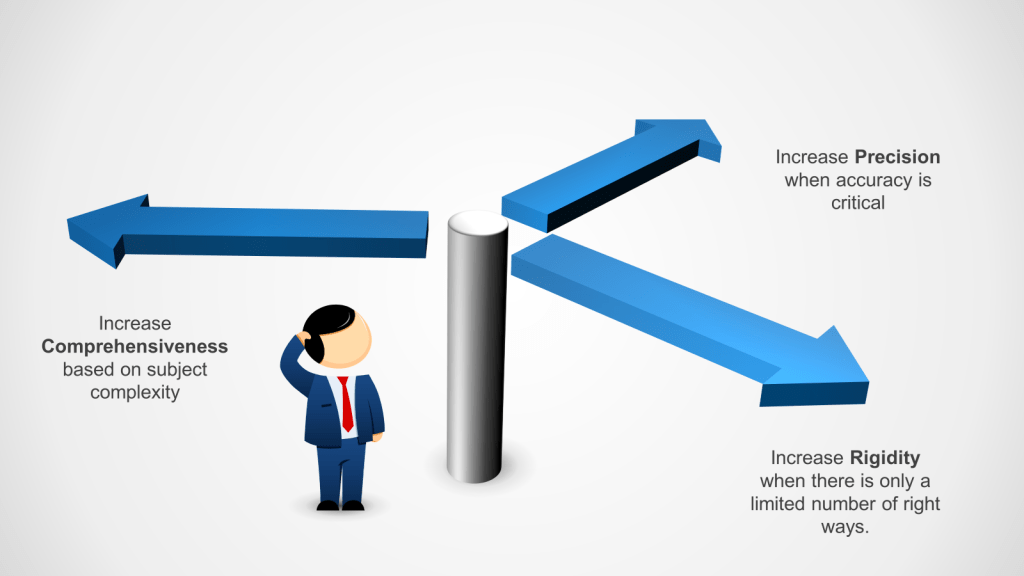
To meet these requirements we leverage three writing principles of precise, comprehensive and rigid.

Type of InstructionDefinitionAttributesWhen NeededWhyDifferencesExample
Precise Exact and accurate, leaving little room for interpretation.– Specific
– Detailed
– Unambiguous
When accuracy is critical, such as in scientific experiments or programming.Regulatory agencies require precise documentation to ensure tasks are performed consistently and correctlyFocuses on exactness and clarity, ensuring tasks are performed without deviation.Instructions for assembling a computer, specifying exact components and steps.
Comprehensive Complete and covering all necessary aspects of a task.– Thorough
– Inclusive
– Exhaustive
When a task is complex and requires understanding of all components, such as in training manuals.Comprehensive SOPs are crucial for ensuring all aspects of a process are covered, ensuring compliance with regulatory requirements.Provides a full overview, ensuring no part of the task is overlooked.Employee onboarding manual covering company policies, procedures, and culture.
Rigid Strict and inflexible, not allowing for changes.– Fixed
– Inflexible
– Consistent
When safety and compliance are paramount, such as batch recordsRigid instructions ensure compliance with strict regulatory standards.Ensures consistency and adherence to specific protocols, minimizing risks.Safety procedures for operating heavy machinery, with no deviations allowed.

When writing documents based on cognitive principles these three are often excellent for detailed task design but there are significant trade-offs inherent in these attributes when we codify knowledge:

  • The more comprehensive the instructions, the less likely that they can be absorbed, understood, and remembered by those responsible for execution – which is why it is important these instructions are followed at time of execution. Moreover, comprehensive instructions also risk can dilute the sense of responsibility felt by the person executing.
  • The more precise the instructions, the less they allow for customization or the exercise of employee initiative.
  • The more rigid the instructions, the less they will be able to evolve spontaneously as circumstances change. They require rigorous change management.

This means these tools are really good for complicated executions that must follow a specific set of steps. Ideal for equipment operations, testing, batch records. But as we shade into complex processes, which relies on domain knowledge, we start decreasing the rigidity, lowering the degree of precision, and walking a fine line on comprehensiveness.

Where organizations continue to struggle is in this understanding that it is not one size fits all. Every procedure is on a continuum and the level of comprehensiveness, precision and rigidity change as a result. Processes involving human judgement, customization for specific needs, or adaptations for changing circumstances should be written to a different standard than those involving execution of a test. It is also important to remember that a document may require high comprehensiveness, medium precision and low rigidity (for example a validation process).

Remember to use them with other tools for document writing. The goal here is to write documents that are usable to reach the necessary outcome.
Brain-Friendly Principles for Document Design

Whether creating Work-as-Prescribed in our documents, or Work-as-Instructed in our training materials, it is important to consider good cognitive practices. If we start from two principles we quickly can start doing some amazing things.

  1. Organize resources so it’s easy to understand. Reduce cognitive load by breaking information down into small, digestible chunks and arranging them into patterns that make sense to the individual. Always start by giving an overview so individuals know how all the smaller chunks fit together.
  2. Use visuals. The brain has an incredible ability to remember visual images so you must exploit that as you look for ways to reinforce key learning points. Create tools that are primarily visual rather than word-based. Use images in place of text (or at least minimize the text). Use videos and animations to help people understand key concepts.

We can drive a lot of effectiveness into our processes by structuring information to make complex documents more transparent and accessible to their users. Visual cues can provide an ‘attention hierarchy’, making sure that what is most important is not overlooked. People tend to find more usable what they find beautiful, and a wall of text simply looks scary, cumbersome, and off-putting for most people. I am a strong advocate of beauty in system design, and I would love to see Quality departments better known for their aesthetic principles and for tying all our documents into good cognitive principles.

Cognitive Load Theory

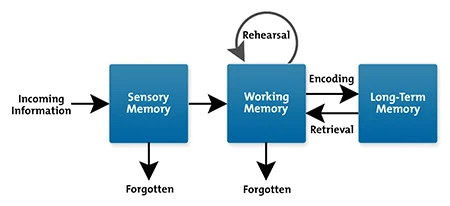
Cognitive load theory (CLT) can help us understand why people struggle so much in reading and understanding contracts. Developed by John Sweller, while initially studying problem-solving, CLT postulates that learning happens best when information is presented in a way that takes into consideration human cognitive structures. Limited working memory capacity is one of the characteristic aspects of human cognition: thus, comprehension and learning can be facilitated by presenting information in ways minimizing working memory load.

Adapted from Atkinson, R.C. and Shiffrin, R.M. (1968). ‘Human memory: A Proposed System and its Control Processes’. In Spence, K.W. and Spence, J.T. The psychology of learning and motivation, (Volume 2). New York: Academic Press. pp. 89–195

Structure and Display

Information structure (how the content is ordered and organized) and information display (how it is visually presented) play a key role in supporting comprehension and performance. A meaningful information structure helps readers preserve continuity, allowing the formation of a useful and easy-to-process mental model. Visual information display facilitates mental model creation by representing information structures and relationships more explicitly, so readers do not have to use cognitive resources to develop a mental model from scratch.

Leveraging in your process/procedure documents

Much of what is considered necessary SOP structure is not based on how people need to find and utilize information. Many of the parts of a document taken for granted (e.g. reference documents, definitions) are relics from paper-based systems. It is past time to reinvent the procedure.

The Epistemic Interactions of Knowledge Management

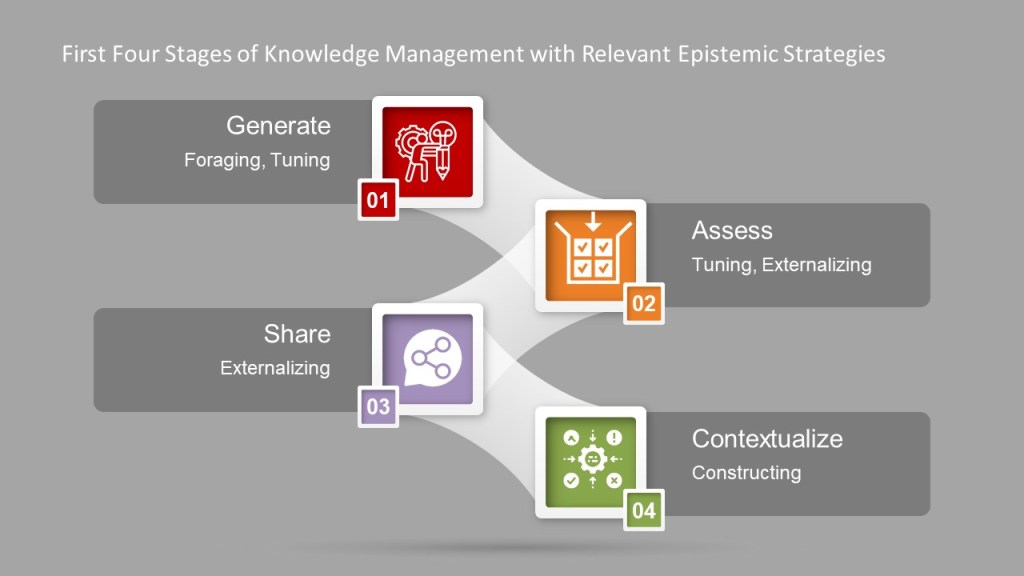
The first four phases of knowledge management are all about identifying and creating meaning and then making that meaning usable. Knowledge management is a set of epistemic actions, creating knowledge through interaction. This interaction is a way of creating a partnership between what happens in the head with everything in the world – Work-as-Imagined and Work-as-Done.

There are really four themes to a set of epistemic actions:

  • Foraging: Locating resources that will lead to understanding
  • Tuning: Adjusting resources to align with desired understanding
  • Externalizing: Moving resources out of the head and into the world
  • Constructing: Forming new knowledge structures in the world

These epistemic actions are all about moving from Work-as-Imagined through Work-as-Prescribed to enable Work-as-Done.

Knowledge Management is really about the embodiment of information, knowledge, and even wisdom through these epistemic actions to apply change upon the world.

Four Themes Mapped to Firts 4 Phases of Knowledge Management

Theme

Epistemic Interaction

Means

Foraging

Locating resources that will lead to understanding

Searching


Searching happens when you need information and believe it exists somewhere.

Searching depends on how we articulate or information needs.

Probing


“Tell me more.” Probing happens when the information you have isn’t quite enough. You are probing when you take the next step, move to the next level, and obtain more salient specifics. Probing is about drilling down and saying “show, explain, and reveal more about this.”

We can probe to reveal new patterns, structures and relationships. It brings to light new information that helps us to reconsider what we already know.

Animating


Animating is when we initiate and control motion in an information source. It includes learning-by-doing.

Collecting

Collecting is how we gather foraged information and tuck it away for future use.

Tuning

Adjusting resources to align with desired understanding

Collecting


Cloning


Cloning lets us take information from one situation and use it in another.

Cutting


Cutting is the way we say “this matters”, that “I need this part, but not the rest.”

Filtering

Filtering reduces complexity by reducing clutter to expose salient details.

Externalizing

Moving resources out of the head and into the world

Annotating


Annotating is how we add context to information. How we adapt and modify the information to the needed context.

Linking

Connecting bits of information together. Forming conceptual maps.

Generating

Introducing new knowledge into the world.

Chunking

Grouping idenpendent yet related information together.

Constructing

Forming new knowledge structures in the world

Chunking


Composing

Producing a new, separate structure from the information that has its own meaning and purpose.

Fragmenting

Taking information and breaking it apart into usable components.

Rearranging

The art of creating meaningful order.

Repicturing

Changing the way the information is represented to create understanding.