The Lotus Blossom Brainstorming Technique

In the world of creative problem-solving and idea generation, the Lotus Blossom technique stands out as a powerful and structured approach to brainstorming. Developed by Yasuo Matsumura, a Japanese management consultant, this method combines the free-flowing nature of traditional brainstorming with a systematic framework that encourages deeper exploration of ideas.

How It Works

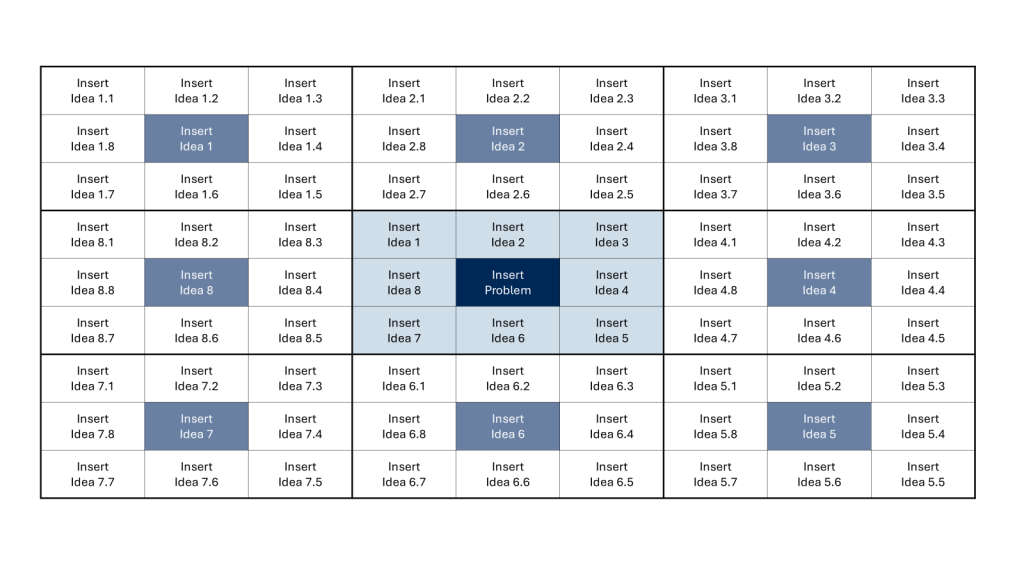
The Lotus Blossom technique uses a visual diagram resembling a lotus flower, hence its name. Here’s a step-by-step breakdown of the process:

  1. Start with a central idea or problem in the middle of a 3×3 grid.
  2. Surround the central concept with eight related ideas or themes.
  3. Take each of these eight ideas and make them the center of their own 3×3 grids.
  4. Generate eight new ideas for each of these secondary grids.
  5. Repeat the process until you have a fully bloomed “lotus” of ideas.

By the end of this process, you’ll have generated up to 64 ideas stemming from your original concept.

Benefits of the Lotus Blossom Technique

Structured Creativity: Unlike traditional brainstorming, which can sometimes feel chaotic, the Lotus Blossom method provides a clear structure for idea generation.

Depth and Breadth: This technique encourages both broad thinking and deep exploration of specific themes.

Visual Organization: The diagram format helps visualize connections between ideas and keeps the brainstorming process organized.

Flexibility: It can be used individually or in small groups, making it versatile for various settings.

Tips for Success

To make the most of the Lotus Blossom technique, consider these tips:

  • Embrace All Ideas: Don’t self-censor. Even seemingly unrelated or far-fetched ideas can spark innovation.
  • Time Management: Set time limits for each phase to maintain momentum and prevent overthinking.
  • Iterate and Refine: After completing the diagram, review and refine your ideas. Look for patterns or combinations that might lead to breakthrough solutions.
Idea Vaults

It is common for numerous meetings to go unrecorded, leading to the risk of losing valuable ideas that are dismissed. This can hinder the group’s ability to achieve its full potential, as revisiting past ideas has the potential to enhance overall performance. Forgetting is a significant barrier to generating innovative ideas; however, engaging in discussions about previous ideas can result in fresh insights. Fortunately, with the aid of chat windows, electronic whiteboards, and other virtual collaboration tools, it is possible to preserve past discussions effectively. This allows for easy access to previously overlooked ideas and facilitates thorough reviews, ultimately contributing to improved collaboration and innovation.

An idea vault is a tool or system that stores, organizes, and manages ideas for future use. This concept can be applied in various contexts, such as personal creativity, business innovation, and project management. Here’s a comprehensive guide on how to use an idea vault effectively:

Organizing Your Ideas

Ideas need to be curated to be of value:

  1. Categorization: Group similar ideas together. Categories can be based on themes, projects, or types of ideas (e.g., story ideas, business concepts, marketing strategies).
  2. Tagging: Use tags to make searching for specific ideas easier. Tags can include keywords, project names, or stages of development.
  3. Prioritization: Rank your ideas based on their potential impact or urgency. This helps in focusing on the most promising ideas first.
  4. Documentation: Provide enough detail for each idea so that you can understand and develop it later. This may include notes, sketches, diagrams, or links to related resources.

Using Your Idea Vault

With your ideas organized, you can now use your vault to enhance your creative and productive processes:

  • Idea Generation: Review your vault regularly to spark new ideas or find inspiration for current projects. Combining or modifying existing ideas can lead to innovative solutions.
  • Project Planning: Pull relevant ideas from your vault to create a solid foundation when starting a new project. This ensures that no good idea goes to waste.
  • Problem Solving: If you encounter a roadblock, your idea vault can provide alternative approaches or solutions you might not have considered initially.
  • Collaboration: Share your idea vault with team members or collaborators to gather feedback and build on each other’s ideas.

Maintenance and Updates

An idea vault is best used as a living document, which requires regular maintenance:

  • Regular Updates: Add new ideas as they come to you and update existing ones with new insights or developments.
  • Review and Cull: Periodically review your vault to remove outdated or irrelevant ideas. This keeps your vault focused and manageable.
  • Track Usage: Mark ideas that have been used or developed to avoid duplication and to keep track of your creative journey.

Blending Ideas

To make your ideas more interesting or unique, consider blending two or more concepts together. This can lead to unexpected and innovative outcomes. For example, combining elements from different genres or industries can result in novel solutions or creative projects.

By following these steps, you can effectively use an idea vault to capture, organize, and utilize your ideas, ensuring you and your team’s creative potential is fully realized.

Vision and Psychology Safety Enable Change

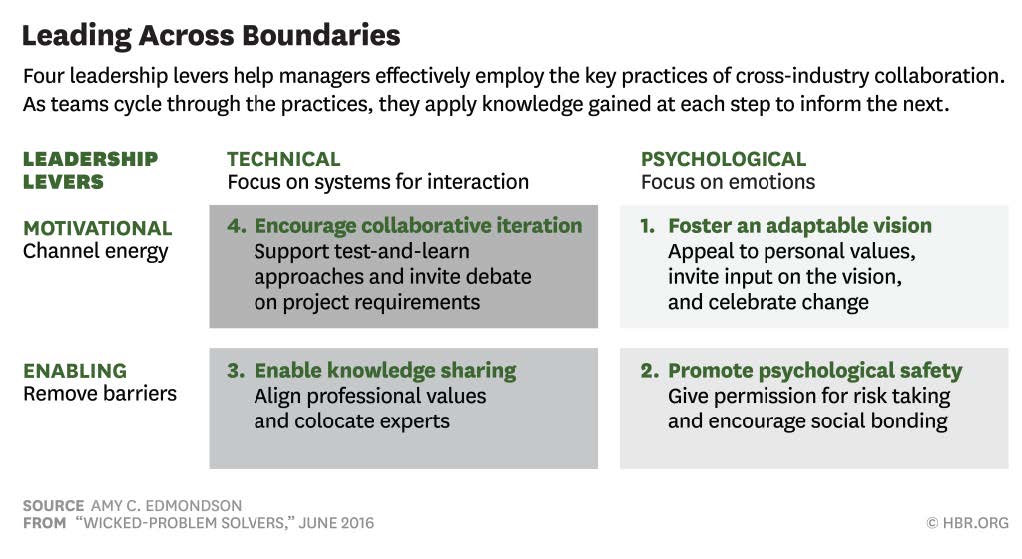
Professor Amy Edmondson in 2016 wrote “Wicked-Problem Solvers” in HBR that laid out four leadership levers for collaboration that fit nicely into quality culture and nestle nicely with Kotter’s Eight Accelerators. Together they help define the leadership behaviors necessary to build quality culture, all informed by the enabler of knowledge management.

Levers and Accelerators of change

Professor Edmondson in this article is discussing cross-industry collaboration, but the central four levers apply in any organization.

Having a vision that strives for a True North of Quality is critical. Make it align to individual needs. Remember that vision grows and adapts as you go, and as others get the opportunity to shape. Vision has six criteria:

  1. Stimulus: Vision needs to include actual benefits for those affected by it. String vision brings people together as community, not as strangers. Stimulus means people see themselves in the vision and understand how they will benefit.
  2. Scale: Vision should be of great breadth and depth with potential for extension at later stages. Vision never leads to or accepts a dead end. It shows multiple potentials for expansion.
  3. Spotlight: Vision assumes responsibility, immediate and extended. The greater the vision, then the greater the responsibility for its impact on people’s lives and the legacy that will be left afterwards. This responsibility needs to bring opportunity for people who are involved. This is part of the vision that will drive the volunteer army.
  4. Scanning: A visionary sees the signs on the way to success. Pay attention to to pain points, spot trends and see where and how value can be added. Gemba walks are critical here.
  5. Simplicity: Vision is elegant thinking about complicated and complex things. A vision is not a vision unless it’s understood. Simplicity lets people believe in vision. If the vision is complicated most people will ignore it. Vision operates and makes execution possible from its simplicity. The simpler the vision in its core meaning, the easier it can be shared with employees, customers and partners and thus, easier to scale inside and outside an organization.
  6. Passion: Vision provokes strong emotions. A strong vision is always accompanied by excitement and passion. Excitement equals passion that gives an emotional power to a vision. A strong vision brings strong excitement that is difficult to contain. Strong excitement and passion are highly contagious. A simple and compelling vision excites more passion than any mere goal.

Psychological safety is the state where employees feel that there is safety in taking risks at work setting. In this safe environment employees will engage in risk-taking actions that are inherent to creative endeavors and if they perceive safety, then they are more comfortable to voice their opinions. This safety makes them more willing to take the chances to own the vision and try to experiment with making that vision a reality which motivates them to develop, promote, and implement new ideas.

This safety will enable knowledge sharing, which can come in many different styles, including combination which creates something new.

Through inclusive, democratic leaders who value the inclusion of employees in a particular work process, employees have the chance to raise their voice for generating, promoting, and implementing useful ideas
Through leveraging vision these inclusive leaders exhibit openness attributes that communicates the importance of taking innovative actions and gives employees the guarantee that in case of negative consequences they will not be punished, experiencing greater psychological safety.

Employees experience non-defensive behavior, and feel high levels of self-worth and self-identity, motivating employees not only to generate new ideas, but also to promote and implement new ideas in the organization.

The organization that is structured to accept these ideas will continue to drive iterative cycles of improvement.