Ambiguity is present in virtually all real-life situations and are those ‘situations in which we do not have sufficient information to quantify the stochastic nature of the problem. It is a lack of knowledge as to the ‘basic rules of the game’ where cause-and-effect are not understood and there is no precedent for making predictions as to what to expect
Ambiguity is often used, especially in the context of VUCA, to cover situations in situations that have:
Doubt about the nature of cause and effect
Little to no historical information to predict the outcome
Difficult to forecast or plan for
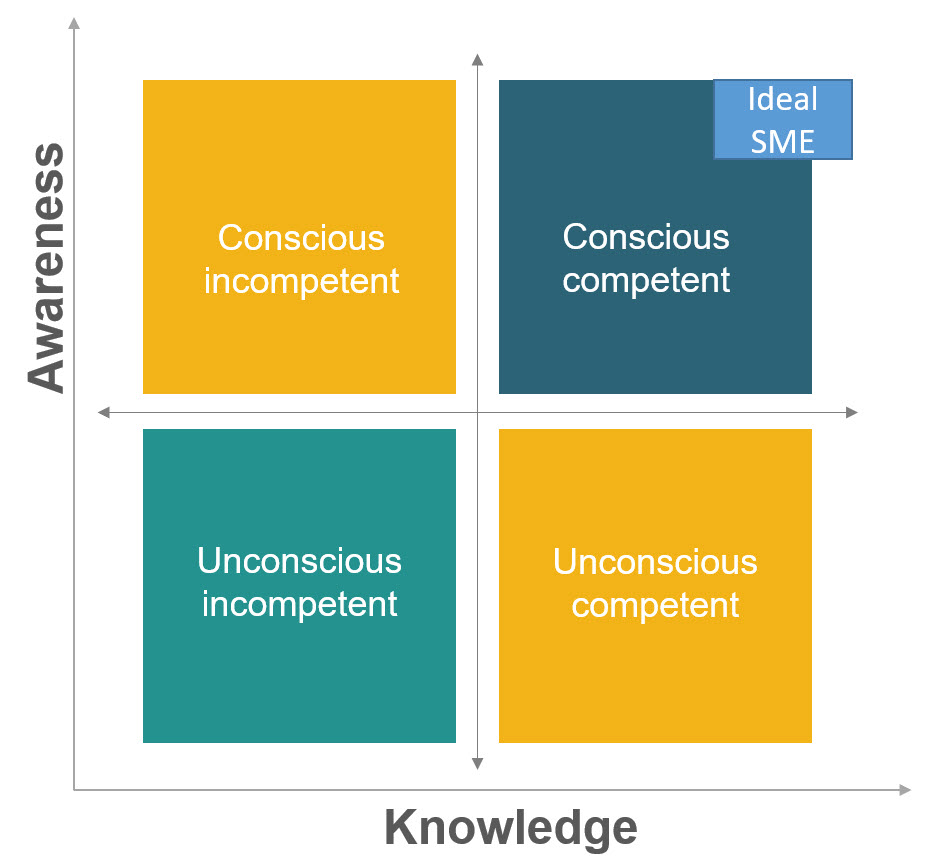
It is important to answer whether there are risks of lack of experience and predictability that might affect the situation, and interrogate our unknown unknowns.
People are ambiguity averse in that they prefer situations in which probabilities are perfectly known to situations in which they are unknown.
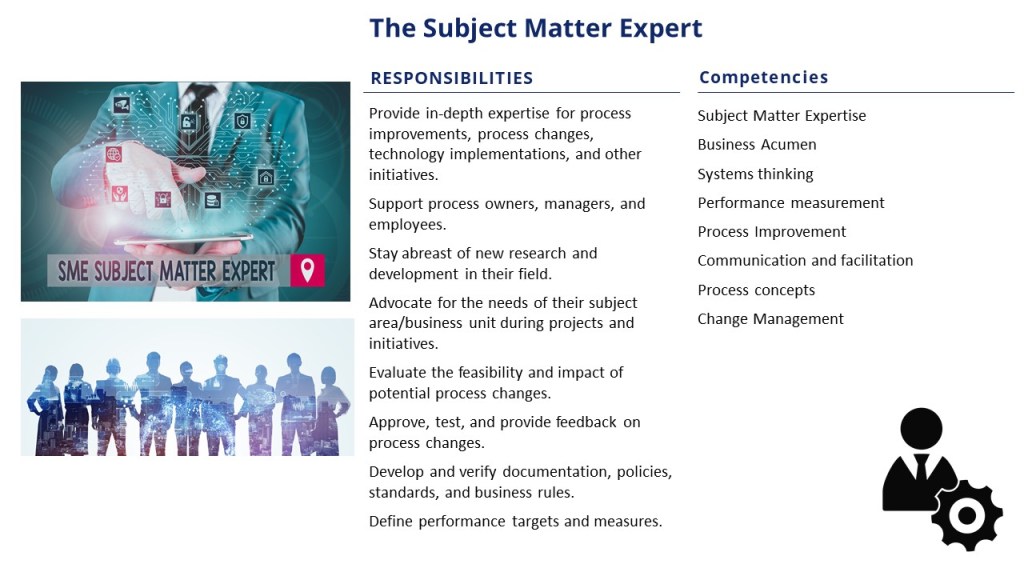
A subject matter expert (SME) is typically an expert on a division of a process, such as a specific tool, technology, or set of process steps. A process may have multiple subject matter experts associated with it, each with varying degrees of understanding of the over-arching process.
SMEs should have depth in their subject area. A great way to identify them is to look for individuals who have a proven track record as formal or informal mentors. To be effective, the SME must be approachable and able to show others the “how” and “why” behind their work. Building expertise, and thus building SMEs, is a fundamental part of a learning organization.
The archetype SMEs has the following attributes:
Are really, really smart and know more about their subjects than anybody else in your universe
Are willing, able, and looking forward to serving as experts
Can tell you what they know in a logical way
Understand why it is important for other people to know what they know
Are approachable and often fun to work with
Love to teach their subjects and make great presenters or facilitators
I love the power of Karl Weick’s future-oriented sensemaking – thinking in the future perfect tense – for supplying us a framework to imagine the future as if it has already occurred. We do not spend enough time being forward-looking and shaping the interpretation of future events. But when you think about it quality is essentially all about using existing knowledge of the past to project a desired future.
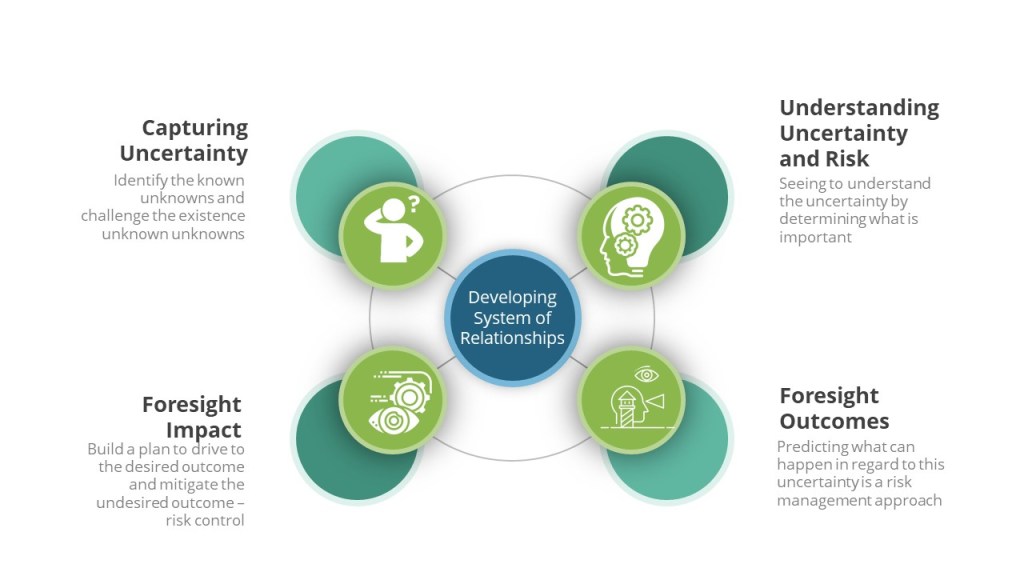
This making sense of uncertainty – which should be a part of every manager’s daily routine – is another name for foresight. Foresight can be used as a discipline to help our organizations look into the future with the aim of understanding and analyzing possible future developments and challenges and supporting actors to actively shape the future.
Sensemaking is mostly used as a retrospective process – we look back at action that has already taken place, Weick himself acknowledged that people’s actions may be guided by future-oriented thoughts, he nevertheless asserted that the understanding that derives from sensemaking occurs only after the fact, foregrounding the retrospective quality of sensemaking even when imagining the future.
“When one imagines the steps in a history that will realize an outcome, then there is more likelihood that one or more of these steps will have been performed before and will evoke past experiences that are similar to the experience that is imagined in the future perfect tense.”
R.B. MacKay went further in a fascinating way by considering the role that counterfactual and prefactual processes play in future-oriented sensemaking processes. He finds that sensemaking processes can be prospective when they include prefactual “whatifs” about the past and the future. There is a whole line of thought stemming from this that looks at the meaning of the past as never static but always in a state of change.
Foresight concerns interpretation and understanding, while simultaneously being a process of thinking the future in order to improve preparedness. Though seeking to understand uncertainty, reduce unknown unknowns and drive a future state it is all about knowledge management fueling risk management.
Do Not Ignore Metaphor
A powerful tool in this reasoning, imagining and planning the future, is metaphor. Now I’m a huge fan of metaphor, though some may argue I make up horrible ones – I think my entire team is sick of the milk truck metaphor by now – but this underutilized tool can be incredibly powerful as we build stories of how it will be.
Think about phrases such as “had gone through”, “had been through” and “up to that point” as commonly used metaphors of emotional experiences as a physical movement or a journey from one point to another. And how much that set of journey metaphors shape much of our thinking about process improvement.
Entire careers have been built on questioning the heavy use of sport or war metaphors in business thought and how it shapes us. I don’t even watch sports and I find myself constantly using it as short hand.
To make sense of the future find a plausible answer to the question ‘what is the story?’, this brings a balance between thinking and acting, and allows us to see the future more clearly.
Bibliography
Cornelissen, J.P. (2012), “Sensemaking under pressure: the influence of professional roles and social accountability on the creation of sense”, Organization Science, Vol. 23 No. 1, pp. 118-137, doi: 10. 1287/orsc.1100.0640.
Luscher, L.S. and Lewis, M.W. (2008), “Organizational change and managerial sensemaking: working through paradox”, Academy of Management Journal, Vol. 51 No. 2, pp. 221-240, doi: 10.2307/20159506.
MacKay, R.B. (2009), “Strategic foresight: counterfactual and prospective sensemaking in enacted environments”, in Costanzo, L.A. and MacKay, R.B. (Eds), Handbook of Research on Strategy and Foresight, Edward Elgar, Cheltenham, pp. 90-112, doi: 10.4337/9781848447271.00011
Tapinos, E. and Pyper, N. (2018), “Forward looking analysis: investigating how individuals “do” foresight and make sense of the future”, Technological Forecasting and Social Change, Vol. 126 No. 1, pp. 292-302, doi: 10.1016/j.techfore.2017.04.025.
Weick, K.E. (1979), The Social Psychology of Organizing, McGraw-Hill, New York, NY.
Weick, K.E. (1995), Sensemaking in Organizations, Sage, Thousand Oaks, CA.
Steven Shorrock writes about “Work-as-Observed” on his blog Humanistic Systems, as part of a great series on Work-as-Done. This is a nice framework for the activity of going to the Gemba, and I strongly recommend the entire series.
One of the dangers in any organization is that the hard-won know-how of our experts remains locked in their brains and is not shared. To beat this tendency, knowledge management should be a continuous activity in any quality system. So why not start by documenting your own knowledge as an expert?
Subject
Answer these Questions
Things to clarify
Foundational Knowledge
What reference materials do you use?
How do you track technical trends?
Should a knowledge recipient own any of these reference materials? What are the best websites? Are there particular journals that you fi nd useful? What about associations?
Technical/Scientific
What kinds of problems do people come to you to solve?
What are the biggest risks in the project, process, or system you manage?
Can you describe a problem brought to you recently? What technical mistakes is a novice likely to make in that project or process?
Professional Network
Whom do you ask about technology trends and innovation?
Whom do you contact for information about government regulations?
What is this go-to person’s complete contact information? What medium does he or she prefer (email versus telephone)? What is his or her background? How do you know this person?
Organizational
Who are the major stakeholders in the project, process, or system you manage?
What are the biggest mistakes newcomers make in trying to get projects going here?
What are the positions of the major stakeholders? Where are there competing priorities? Can you give me an example of a newcomer mistake and suggest how to avoid such mistakes?
Interpersonal
Regarding team leadership, what criteria do you use to select team members?
How do you ensure the team is connected to the overall business strategy?
On a general level, how do you motivate people who report to you?
Why do you use these particular criteria? Have you ever chosen unwisely? What communication strategies are most effective? Can you give an example of what has really helped?
Once you’ve documented this knowledge, identify who else needs to know it, and then ensure the knowledge is transferred.


 Investigations of a Dog