The Theory of Constraints: A Cornerstone for Advanced Quality Systems and Organizational Maturity

A familiar scene exists across every pharmaceutical manufacturing site I’ve ever seen, lot disposition cycle times are a struggle. While management instinctively pushes for “optimization everywhere,” the quality department remains overwhelmed and becomes the weakest link in an otherwise robust chain. This scenario illustrates perfectly why understanding and applying the Theory of Constraints (TOC) is essential for quality excellence in complex systems.

The Fundamentals of Theory of Constraints

The Theory of Constraints, developed by management guru Eliyahu M. Goldratt in his groundbreaking 1984 book The Goal, fundamentally changed how we view process improvement. Unlike approaches that attempt to optimize all parts of a system simultaneously, TOC recognizes a profound truth: in any system, there is always at least one constraint-a bottleneck-that limits overall performance. This constraint determines the maximum throughput of the entire system, regardless of how efficient other components might be.

TOC defines a constraint as “anything that prevents the system from achieving its goal,” which in business typically translates to generating profit but can also be viewed as getting product to the patient. By focusing improvement efforts specifically on these constraints rather than dispersing resources across the system, organizations can achieve more significant results with less effort. This laser-focused approach makes TOC not just another quality tool but a foundational framework that bridges system thinking with practical quality management.

The Power of the Weakest Link Paradigm

Systems thinking teaches us that organizations are networks of interdependent processes in which the performance of the whole exceeds the sum of its parts. TOC enhances this perspective by providing a clear mechanism for prioritization. As Goldratt famously observed, “a chain is only as strong as its weakest link.” This metaphor eloquently captures the essence of constraint management-no matter how much you strengthen other links, the chain’s overall strength remains limited by its weakest component.

This perspective fundamentally challenges the traditional approach of seeking balanced capacity across all processes.

The Five Focusing Steps: A Systematic Approach to Constraint Management

The heart of TOC’s practical application lies in the Five Focusing Steps-a powerful cyclic methodology that systematically addresses constraints:

  1. Identify the system’s constraint(s): Determine what limits the system’s performance.
  2. Decide how to exploit the constraint: Maximize the efficiency of the constraint without major investments.
  3. Subordinate everything else to the above decision: Align all other processes to support the constraint’s optimal performance.
  4. Elevate the system’s constraint: If necessary, make larger investments to increase the constraint’s capacity.
  5. Warning! If in the previous steps a constraint has been broken, go back to step 1, but don’t allow inertia to create a new constraint: Once a constraint is resolved, the improvement cycle begins again with the new limiting factor.

This approach aligns perfectly with the system thinking principles outlined in “Principles behind a good system,” which highlight balance, coordination, and sustainability as critical elements of well-designed systems. The systematic nature of TOC provides a clear roadmap for addressing complex system challenges without becoming overwhelmed by their complexity.

TOC, Lean, and Six Sigma: A Powerful Triad

While TOC focuses on constraints, Lean targets waste elimination, and Six Sigma concentrates on reducing variation. Rather than competing methodologies, these approaches complement each other in what some practitioners call “TLSS” (TOC, Lean, Six Sigma).

The synergy becomes evident when we consider their respective objectives:

MethodologyPrimary FocusKey MetricPhilosophy
TOCBottlenecksThroughput“Find the constraint. Fix it. Repeat.”
LeanWasteValue Flow“If it doesn’t add value, it’s waste.”
Six SigmaVariationQuality“Reduce variation to meet customer expectations.”

TOC says ‘What’s broken?’ Lean says ‘Here’s how to fix it right.'” This complementary relationship makes TOC particularly valuable as a prioritization mechanism for quality improvement initiatives-pointing precisely where Lean and Six Sigma tools should be applied for maximum impact.

Constraints, Waste, and Variation: An Interconnected Trilogy

Constraints in a system often become amplifiers of waste and variation. When a process operates at capacity, minor variations become magnified, and waste becomes more impactful. Consider a quality testing laboratory operating at its constraint-even small variations in testing time or minor errors requiring rework can cascade into significant delays, exacerbating waste throughout the system.

This interconnection helps explain why constraint management must be integrated with waste reduction and variation control. The goal is not just to fix immediate issues but to prevent recurrence and drive continuous improvement. TOC provides the critical prioritization framework to ensure these improvement efforts target the most impactful areas.

Throughput as a Quality Metric: Beyond Efficiency to Effectiveness

TOC introduces a clear set of metrics that differ from traditional accounting measures: throughput (the rate at which the system generates money through sales), inventory (all the money invested in things intended to be sold), and operating expense (all money spent turning inventory into throughput).

This focus on throughput as the primary metric represents a significant shift in quality thinking. Rather than optimizing local metrics or cost-cutting, TOC emphasizes increasing the flow of value through the system-aligning perfectly with the concept of operational stability as “the state where manufacturing and quality processes exhibit consistent, predictable performance over time with minimal unexpected variations”. This emphasis on flow over efficiency helps organizations maintain focus on outcomes rather than activities.

TOC in Quality Maturity: A Path to Excellence

From Constraint Neglect to Strategic Constraint Management

Quality maturity models provide a roadmap for organizational improvement, and TOC can be mapped to these models to illustrate progression in constraint management capability:

Level 1: Initial (Constraint Neglect)

At this level, constraints are neither identified nor managed systematically. The organization experiences frequent firefighting and may attempt to “optimize” all processes simultaneously, resulting in scattered efforts and minimal system improvement. Quality issues are addressed reactively, much like the early stages of validation programs described as “ad hoc and lacking standardization”.

Level 2: Managed (Constraint Awareness)

Organizations at this level recognize the existence of constraints but address them in silos. There’s increased awareness of bottlenecks, but responses remain tactical rather than strategic. This parallels the “Managed” validation maturity level where “basic processes are established but may not fully align with guidelines”. Constraints are managed as isolated problems rather than system limitations.

Level 3: Standardized (Constraint Management)

At this level, constraint identification and management become standardized across the organization. The Five Focusing Steps are consistently applied, and there’s alignment between constraint management and other quality initiatives. This mirrors the “Standardized” level in validation maturity where “processes are well-defined and consistently implemented”.

Level 4: Predictable (Quantitative Constraint Management)

Organizations at this level not only manage current constraints but predict future ones through data analysis. Constraint metrics are established and regularly monitored, similar to the “Predictable” validation maturity level where “KPIs for validation activities are established and regularly monitored”.

Level 5: Optimizing (Strategic Constraint Integration)

At the highest maturity level, constraint management becomes embedded in strategic planning. The organization continuously innovates its approach to constraints and may actively design systems to control where constraints appear. This aligns with the “Optimizing” validation maturity level characterized by “continuous improvement and innovation.”

This maturity progression illustrates how TOC implementation evolves from reactive problem-solving to strategic system design, paralleling broader quality maturity development.

Actionable Insights: Implementing TOC in Your Quality System

Step 1: Map Your Value Stream to Identify Potential Constraints

Process mapping is a fundamental first step in constraint identification. As noted in “Process Mapping as a Scaling Solution,” a process flow diagram is a visual representation of a process’s steps, showing the sequence of activities from start to finish. This visualization helps identify where materials, information, or approvals might be bottlenecked.

When mapping your value stream, pay particular attention to:

  • Where work accumulates or waits
  • Processes with high utilization rates
  • Steps requiring specialized resources or expertise
  • Points where batching occurs
  • Areas with high rework rates

Step 2: Analyze System Performance to Confirm the Constraint

Once potential constraints are identified, analyze performance data to confirm where the true system constraint lies. Remember, as TOC teaches, “organizations have very few true constraints.” Look for:

  • Processes that are consistently running at capacity.
  • Steps that dictate the pace of the entire system
  • Areas where expediting frequently occurs
  • Processes that, when improved, directly improve overall system performance

Step 3: Apply the Five Focusing Steps

With the constraint identified, systematically apply the Five Focusing Steps:

  • Identify: Document exactly what limits the constraint’s performance.
  • Exploit: Before investing in expansion, ensure the constraint operates at maximum efficiency. For example, in a quality testing lab constraint, this might mean eliminating administrative delays, optimizing scheduling, and ensuring the constraint never waits for inputs.
  • Subordinate: Adjust all other processes to support the constraint. This might include changing batch sizes, scheduling, or staffing patterns in non-constraint areas to ensure the constraint never starves or becomes blocked.
  • Elevate: Only after fully exploiting the constraint should you invest in expanding its capacity through additional resources, technology, or process redesign.
  • Repeat: Once the constraint is no longer limiting system performance, a new constraint will emerge. Return to step one to identify this new constraint.

Step 4: Integrate TOC with Your CAPA System

TOC provides an excellent framework for prioritizing corrective and preventive actions. As noted in discussions of CAPA systems, “one reason to invest in the CAPA program is that you will see fewer deviations over time as you fix issues.” By focusing CAPA efforts on constraints, you maximize the system-wide impact of improvements.

Consider this Constraint Prioritization Scorefor CAPA initiatives: Prioritization Score = Impact × (Ease + Risk Reduction)

This approach ensures your quality improvement efforts focus on areas that will most significantly improve overall system performance.

Conclusion: TOC as a Quality Mindset

The Theory of Constraints offers more than just a methodology for improvement-it represents a fundamental shift in how we think about system performance and quality management. By recognizing that systems are inherently limited by constraints and systematically addressing these limitations, organizations can achieve breakthrough improvements with focused effort.

As quality systems mature, the integration of TOC principles becomes increasingly important. From reactive problem-solving to proactive constraint management and ultimately to strategic constraint design, TOC provides a path to quality excellence that complements and enhances other methodologies.

The journey to quality maturity requires system thinking, disciplined focus, and continuous improvement-all principles embodied in the Theory of Constraints. By adopting TOC not just as a tool but as a mindset, quality professionals can navigate the complexity of modern systems with clarity and purpose, ensuring resources are directed where they will have the greatest impact.

I invite you to explore more about integrating TOC with quality systems in related posts on system thinking principles, operational stability, and maturity models. The constraint may be your system’s limitation-but identifying it is your greatest opportunity for breakthrough improvement.
The Walk of the Gemba

What is a “Gemba” – a slight rant

Gemba, as a term, is here to stay. We’re told that gemba comes from the Japanese for “the actual place”, and people who know more than me say it probably should translate as “Genba” but phonetically it uses an “m” instead and as a result, it’s commonly referred to as gemba – so that’s how it is used. Someday I’ll see a good linguistic study of loan words in quality circles, and I have been known to fight against some of the “buzz-terminess” of adopting words from Japanese. But gemba is a term that seems to have settled in, and heck, English is a borrowing language.

Just don’t subject me to any more hour-long talks about how we’re all doing lean wrong because we misunderstood a Japanese written character (I can assure you I don’t know any Japanese written characters). The Lean practitioner community sometimes reminds me of 80s Ninja movies, and can be problematic in all the same ways – you start with “Enter the Ninja” and before long it’s Remo Williams baby!

So let’s pretend that gemba is an English word now, we’ve borrowed it and it means “where the work happens.” It also seems to be a noun and a verb.

And if you know any good studies on the heady blend of Japanophobia mixed with Japanophilia from the 80s and 90s that saturated quality and management thinking, send them my way.

I think we can draw from ethnography more in our methodology.

The Importance of the Gemba Walk

Gemba is a principle from the lean methodology that says “go and see” something happening for real – you need to go and see how the process really works. This principle rightly belongs as one of the center points of quality thinking. This may be fighting words but I think it is the strongest of the principles from Lean because of the straightforward “no duh” of the concept. Any quality idea that feels so straightforward and radical at the same time is powerful.

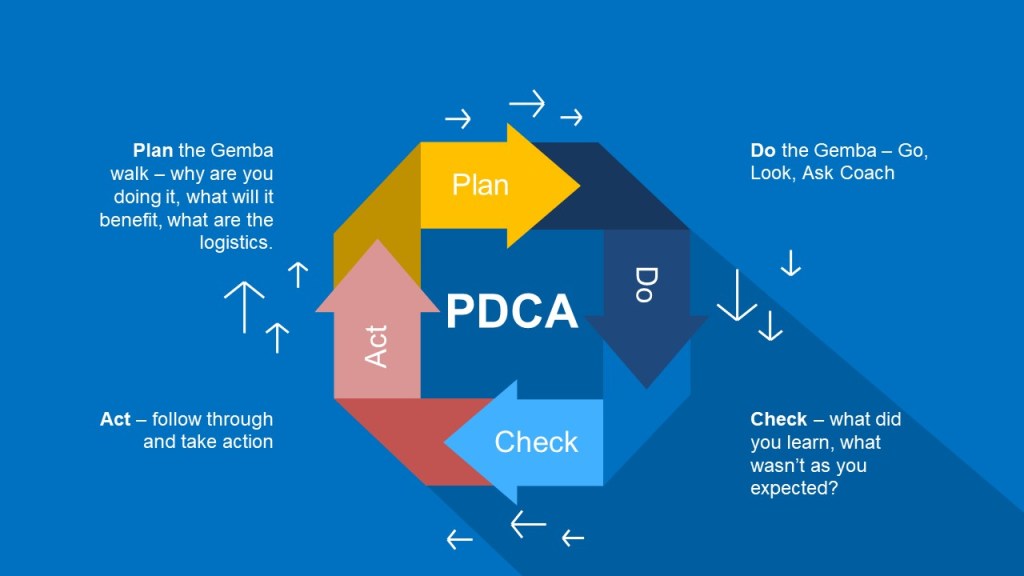
You can think of a gemba through the PDCA lifecycle -You plan, you do it, you decide on the learnings, you follow through.

Gemba seen through the PDCA lense

This is all about building a shared understanding of problems we all face together by:

  1. Observation of specific issues where things don’t go as intended, listening to the people who do the work.
  2. Discussion of what those issues mean both in the details of operations but also on a wider strategic level.
  3. Commitment to problem solving in order to investigate further – not to fix the issue but to have the time to delve deeper. The assumption is that if people understand better what they do, they perform better at every aspects of their job

Gemba walks demonstrate visible commitment from the leadership to all members of the organization. They allow leadership to spread clear messages using open and honest dialogue and get a real indication of the progress of behavioral change at all levels. They empower employees because their contributions to site results are recognized and their ideas for continuous improvements heard.

Conducting a Successful Gemba Walk

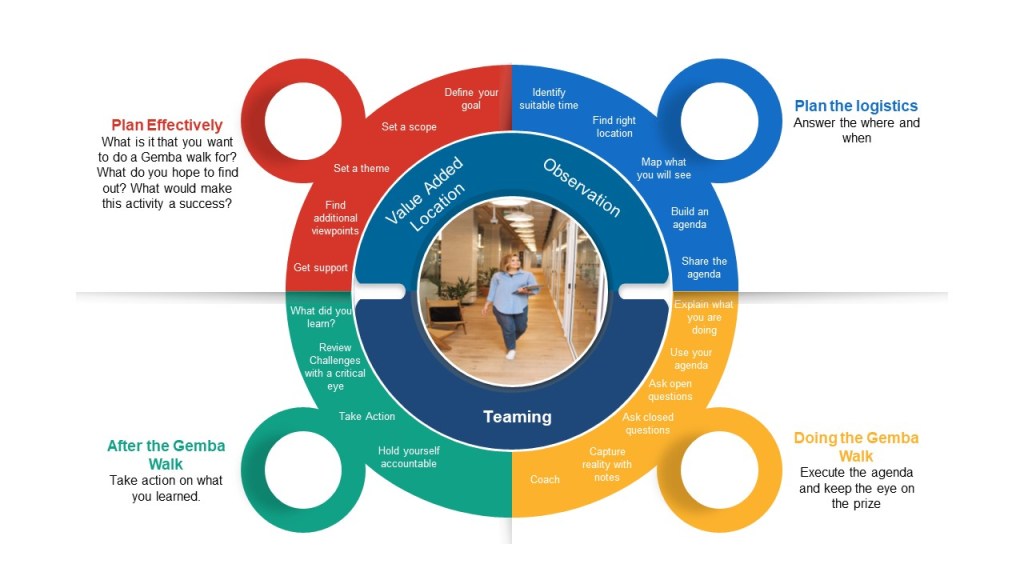
Elements of a Successful Gemba

Plan Effectively
Define your goalWhat is it that you want to do a gemba walk for? What do you hope to find out? What would make this activity a success? A successful walk stresses discovery.
Set a scopeWhich areas will you observe? A specific process? Team? This will allow you to zoom into more detail and get the most out of the activity.
Set a themeWhat challenges or topics will you focus on? Specific and targeted gemba walks are the most effective. For example, having a emba focusing on Data Integrity, or area clearance or error reduction.

Picking the right challenge is critical. Workplaces are complex and confusing, a gemba walk can help find concrete problems and drive improvement linked to strategy.
Find additional viewpointsWho else can help you? Who could add a “fresh pair of eyes” to see the big questions that are left un-asked. Finding additional people to support will result in a richer output and can get buy in from your stakeholders.
Get supportBring visibility and sponsorship for your gemba. Ensure all stakeholders are aware and on board.
Plan the Logistics
Identify Suitable TimeFind a suitable time from the process’ perspective. Be sure to also consider times of day, days of the week and any other time-based variations that occur in the process.
Find right locationWhere should you see the process? Also, do you need to consider visiting multiple sites or areas?
Map what you’ll seeDefine the process steps that you expect to see.
Build an agendaWhat parts of the process will you see in what order? Are there any time sensitive processes to observe?
Share that agendaSharing your agenda to get help from the operational owner and other subject matter experts.
Doing the Gemba Walk
Explain what you are doingPut people at ease when you’re observing the process.

When you are on the walk you need to challenge in a productive yet safe manner to create a place where everyone feels they’ve learned something useful and problems can be resolved. It pays to communicate both the purpose and overall approach by explaining the why, the who, and the when.
Use your agendaKeep some flexibility but also make sure to cover everything.
Ask open questionsOpen discussion and explore the process challenges.
Ask closed questionsUse this to check your understanding of the process.
Capture reality with notesTake notes as soon as possible to make sure you recall the reality of the situation.
CoachAs a coach, your objective is not to obtain results – that’s the person you’re coaching’s role – but to keep them striving to improve. Take a step back and focus on dismantling barriers.
What did you learnWhat did you expect to see but didn’t? Also, what did you not expect to happen?

The ask questions, coach, learn aspect can be summarized as:
  1. Visualize the ideal performance with your inner eye

  2. Spot the specific difficulty the person is having (they’ll tell you – just listen)

  3. Explain that (though sometimes they won’t want to hear it)

  4. Spell out a simple exercise to practice overcoming the difficulty.
After the Gemba Walk
What did you learn?Were challenges widespread or just one offs? Review challenges with a critical eye. The best way I’ve heard this explained is “helicopter” thinking – start n a very detailed operational point and ascend to the big picture and then return to the ground.
Resolve challenges with a critical eyeDefine next steps and agree which are highest priority. It is a good outcome when what is observed on the gemba walk leads to a project that can transform the organization.
Take actionFollow-through on the agreed upon actions. Make them visible. In order to avoid being seen only as a critic you need to contribute firsthand.
Hold yourself to accountShare your recommendations with others. Engage in knowledge management and ensure actions are complete and effective.
Key points for executing a successful GEMBA

Gemba Walks as Standard Work

You can standardize a lot of the preparation of a gemba walk by creating standard work. I’ve seen this successfully done for data integrity, safety, material management, and other topics.

Build a frequency, and make sure they are often, and then hold leaders accountable.

WhoBest Practice FrequencyMinimum Recommended Frequency
First line supervisorsEach shift, multiple timesEach shift
Team leaders in individual unitsDaily covering different shifts2 per week
Unit/Department heads1 per day1 per week
Leadership team1 per day1 per month
Internal customers and support (e.g. purchasing, finance, HR)1 per month1 per quarter
Frequency recommendation example

Going to the Gemba for a Deviation and Root Cause Analysis

These same principles can apply to golden-hour deviation triage and root cause analysis. This form of gemba means bringing together a cross-functional team meeting that is assembled where a potential deviation event occurred. Going to the gemba and “freezing the scene” as close as possible to the time the event occurred will yield valuable clues about the environment that existed at the time – and fresher memories will provide higher quality interviews. This gemba has specific objectives:

  • Obtain a common understanding of the event: what happened, when and where it happened, who observed it, who was involved – all the facts surrounding the event. Is it a deviation?
  • Clearly describe actions taken, or that need to be taken, to contain impact from the event: product quarantine, physical or mechanical interventions, management or regulatory notifications, etc.
  • Interview involved operators: ask open-ended questions, like how the event unfolded or was discovered, from their perspective, or how the event could have been prevented, in their opinion – insights from personnel experienced with the process can prove invaluable during an investigation.

You will gain plenty of investigational leads from your observations and interviews at the gemba – which documents to review, which personnel to interview, which equipment history to inspect, and more. The gemba is such an invaluable experience that, for many minor events, root cause and CAPA can be determined fairly easily from information gathered solely at the gemba.

ASQ Lean and Six Sigma Conference – Day 2

I ran into Stuart MacDonald, the magician from yesterday in several sessions today. I love when keynotes at a conference show their passion by learning from fellow practitioners. I bought his book, so it also worked on that level.

Morning Keynote of “Achieving Operational Excellence with Passion and Creativity” by Kaplan Mobray

As a facilitator I always approve of walking into a session with a name tag, file cards, paper, and crayons. It warms my heart.

Career coaches and motivational speakers are a tough one for me as I rarely connect with them as a conference speaker. Mr. Mobray had a high energy level, but what I really enjoyed was him using various facilitation techniques (graphic drawing) as a way to focus on his simple points, such as “pass it on” or “evolve” or “progress over persecution.”

“Steering Towards Zero Issues” by Franco Seravalli

Starts with the dilemma of poor quality and a high level overview of the case study at an automobile parts supplier in Costa Rica.

Though his case study covered their path root cause analysis and gap analysis and then went to improvement strategy.

  • People – Trust our people
  • Containment
  • Correction/Prevention

People was the most important.

Step by step process to create a quality culture and sell change.

Steps for strengthening people

Focus on people and talked about human error and human performance.

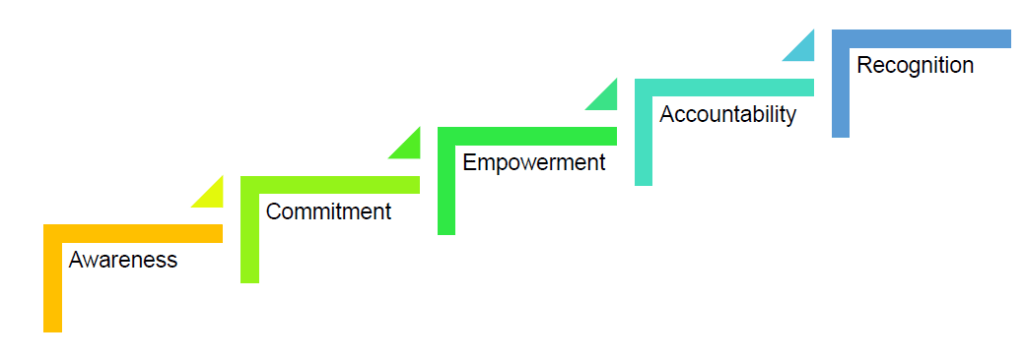
  • Awareness – create a sense of pride and empathy with the customer. Transparency and candor and making the quality issues public
  • Commitment – Public displays of support. Talk and listen. Management walking-the-walk
  • Empowerment – Trust your people, decision-making authority
  • Accountability – interesting point about cultural differences (for example Spanish and Portuguese do not have this word)
  • Recognition
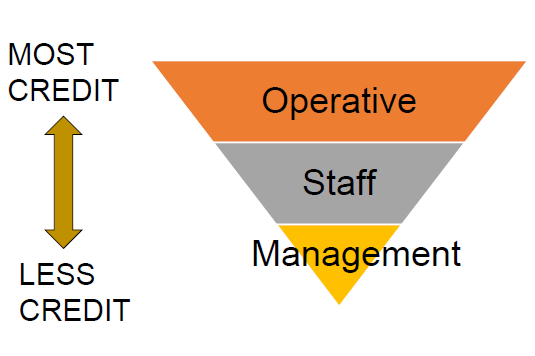
Credit where credit is due

Containment – focused on stop the bleeding and close the circle. Containment is fairly high level and felt very industry specific in his details.

Corrective Actions – laid out the typical deviation to CAPA to effectiveness review path. Covered 8D, talking about need to add risk analysis/management and the place of effectiveness reviews.

Covers risk and PFMEAs.

Again, not an intermediate discussion. We need better criteria for ranking a session. I would have gone to this even if it was marked basic as the speaker is a member of the Team and Workplace Excellence Forum, but I worry for other participants.

“See One, Do One, Go Do One” by Karissa Craig

Karissa laid out a journey to develop, trial, implement, evaluate, and refine their approach through a case study.

Brings a good qualification approach to Lean with “See One” and “Do One” are classroom learning and the “Go Do One” is application.

Talked about the resistance and the need for accountability for application. A “want to” and not a “have to”

Demonstrated the A3 as rubric for the “Go Do One”. Offered some good discussion of how firefighter cultures (which healthcare) and how you need to build the right culture to do problem and root cause and not jump to solutions.

Gave a nice 8-week (with added 1-week pre, 1-week post) schedule for training and doing.

For training focused on basic problem solving, talked about avoiding perfectionism and set reasonable expectations. Karissa described a great sounding training program. This three hour class seemed very well put together.

Had an interesting share on how training led people to realize that problem solving was harder than they used to think and impacted employee engagement. This led to a sponsor training so sponsors understood how to support teams.

“Run with scissors” about how transformation involves risk and the ways to deal with it.

Rest of the Day

I spent the afternoon networking and connecting and conducting some ASQ Team and Workplace Excellence Forum business and didn’t attend any of the afternoon sessions. I was ambivalent about the afternoon keynote speaker/piano player.

Understanding the Levers of Change

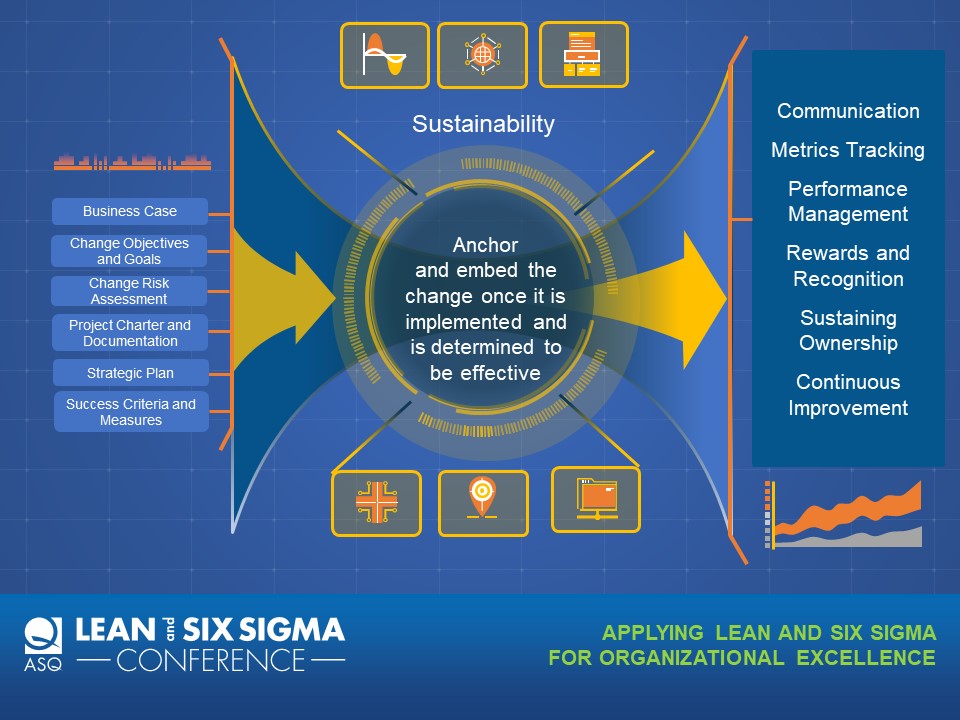
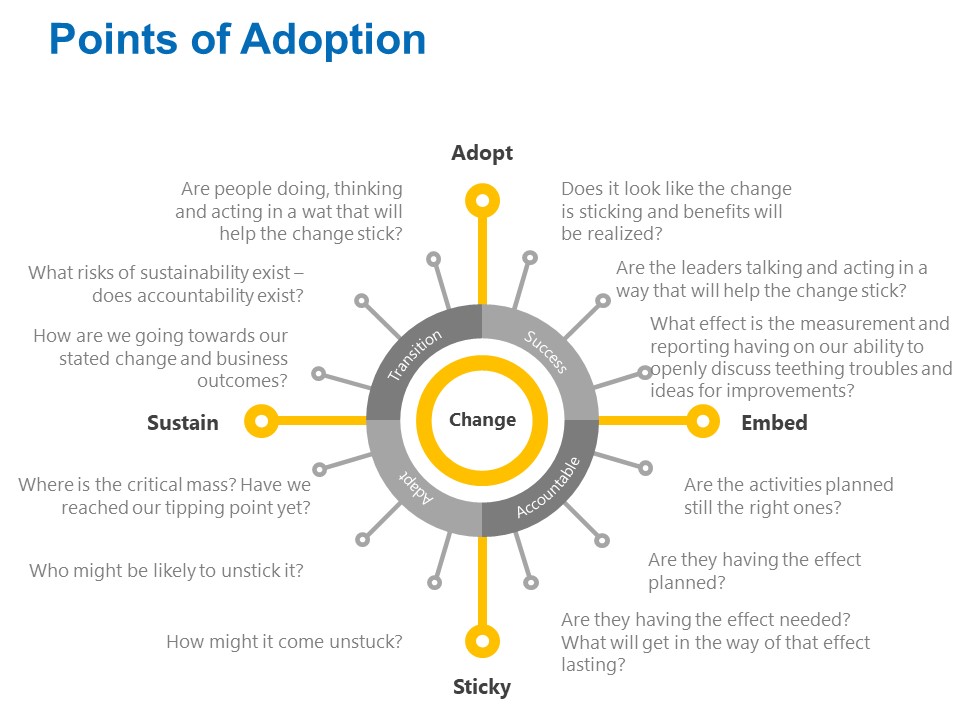
As part of my presentation “Sustaining Change – Executing a Sustainability Plan” at the ASQ Lean and Six Sigma Conference tomorrow I’ll be talking about levers of change.

Understanding the change landscape

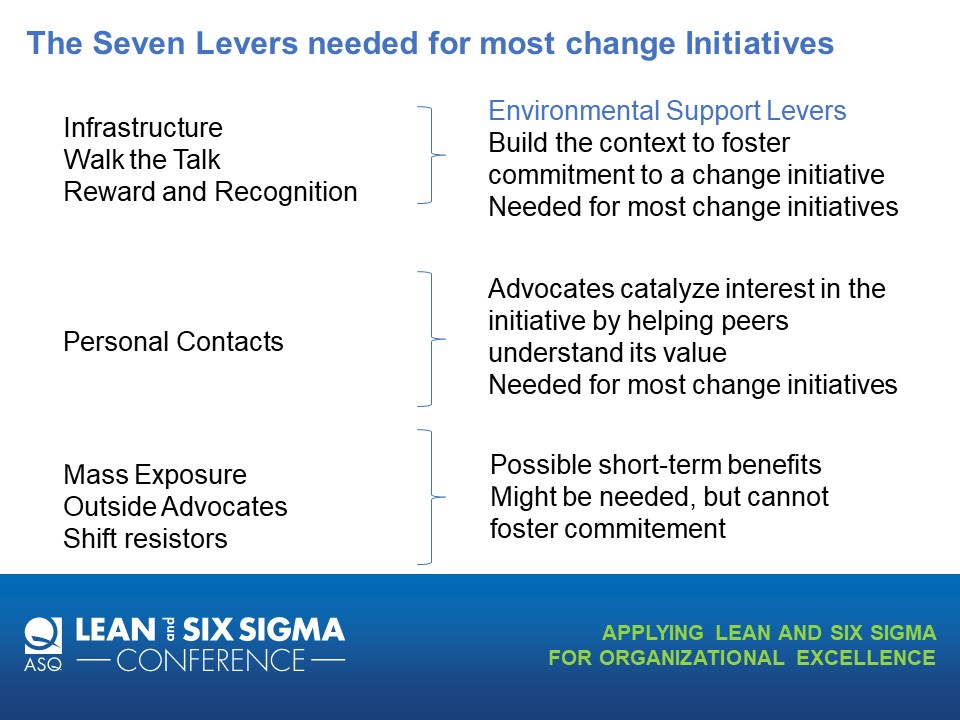
Change Management practitioners usually talk about seven levers:

  1. Infrastructure – Investing in the tools, processes, and other resources that employees need to be successful with the change initiative.
  2. Walk the Talk – active leadership is about ownership; it includes making the business case clear, modeling behaviors, clearing obstacles and making course corrections.
  3. Reward and Recognition – acknowledgement and compensation for employees who work to move the initiative forward
  4. Mass Exposure – getting out information about the change through broadcast messages and other communication pathways
  5. Personal Contacts – creating opportunities for advocates to share their experience of the change with peers who feel disengaged
  6. Outside advocates – bringing in resources (internal or external) to gain expertise for the change initiative
  7. Shift Resisters – moving people to areas less affected by the initiative.
7 levers of change