Talk about strategy, risk management, or change; it is inevitable that the acronym VUCA — short for volatility, uncertainty, complexity, and ambiguity — will come up. VUCA is a catchall for “Hey, it’s crazy out there!” And like many catch-all’s it is misleading, VUCA conflates four distinct types of challenges that demand four distinct types of responses. VUCA can quickly become a crutch, a way to throw off the hard work of strategy and planning—after all, you can’t prepare for a VUCA world, right?
The mistake folks often make here is treating these four traits as a single idea, which leads to poorer decision making.
VUCA really isn’t a tool. It’s a checklist of four things that hopefully your system is paying attention to. All four represent distinct elements that make our environment and organization harder to grasp and control.
Our goal should always be to reduce ignorance. Many unknown unknowns are just things no one has bothered to find out. What we need to do is ensure our processes and systems are constructed so that they recognize unknowns.
There are six factors that need to be explored to find the unknown unknowns.
Complexity: A complex process/system/project contains many interacting elements that increase the variety of its possible behaviors and results. Complexity increases with the number, variety, and lack of robustness of the elements of the process, system or project.
Complicatedness: A complicated process/system/project involves many points of failure, the ease of finding necessary elements and identifying cause-and-effect relationships; and the experts/participants aptitudes and experiences.
Dynamism: The volatility or the propensity of elements and relationships to change.
Equivocality: Knowledge management is a critical enabler of product and project life cycle management. If the information is not crisp and specific, then the people who receive it will be equivocal and won’t be able to make firm decisions. Although imprecise information itself can be a known unknown, equivocality increases both complexity and complicatedness.
Perceptive barriers: Mindlessness. This factor includes a lot of our biases, including an over-reliance on past experiences and traditions, the inability to detect weak signals and ignoring input that is inconvenient or unappealing.
Organizational pathologies: Organizations have problems, culture can have weaknesses. These structural weaknesses allow unknown unknowns to remain hidden.
Interrogating Knowable Unknown Unknowns
The way to address these six factors is to evaluate and challenge by using the following approaches:
Interviewing
Interviews with stakeholders, subject matter experts and other participants can be effective tools for uncovering lurking problems and issues. Interviewers need to be careful not to be too enthusiastic about the projects they’re examining and not asking “yes or no” questions. The best interviews probe deep and wide.
Build Knowledge by Decomposing the System/Process/Project
Standard root cause analysis tools apply here, break it down and interrogate all the subs.
Identifying the goals, context, activities and cause-effect relationships
Breaking the domains into smaller elements — such as processes, tasks and stakeholders
Examining the complexity and uncertainty of each element to identify the major risks (known unknowns) that needed managing and the knowledge gaps that pointed to areas of potential unknown unknowns.
Analyze Scenarios
Construct several different future outlooks and test them out (mock exercises are great). This approach accepts uncertainty, tries to understand it and builds it into the your knowledge base and reasoning. Rather than being predictions, scenarios are coherent and credible alternative futures built on dynamic events and conditions that are subject to change.
Communicate Frequently and Effectively
Regularly and systematically reviewing decision-making and communication processes, including the assumptions that are factored into the processes, and seeking to remove information asymmetries, can help to anticipate and uncover known unknowns. Management Review is part of this, but not the only component. Effective and frequent communication is essential for adaptability and agility. However, this doesn’t necessarily mean communicating large volumes of information, which can cause information overload. Rather, the key is knowing how to reach the right people at the right times. Some important aspects include:
Candor: Timely and honest communication of missteps, anomalies and missing competencies. Offer incentives for candor to show people that there are advantages to owning up to errors or mistakes in time for management to take action. It is imperative to eliminate any perverse incentives that induce people to ignore emerging risks.
Cultivate an Alert Culture: A core part of a quality culture should be an alert culture made up of people who strive to illuminate rather than hide potential problems. Alertness is built by: 1) emphasizing systems thinking; 2) seek to include and build a wide range of experiential expertise — intuitions, subtle understandings and finely honed reflexes gained through years of intimate interaction with a particular natural, social or technological system; and 3) learn from surprising outcomes.
By working to evaluate and challenge, to truly understand our systems and processes, our risk management activities will be more effective and truly serve to make our systems resilient.
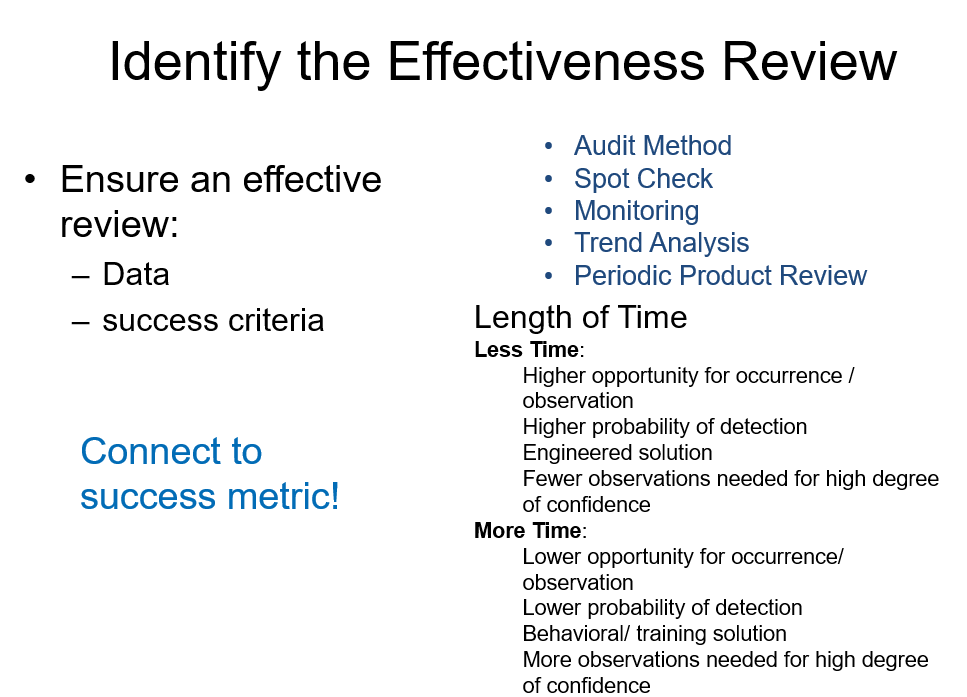
Changes meet their intended objectives and pre-defined effectiveness criteria. Any deviations from those criteria are adequately assessed, accepted and managed/justified. Whenever possible, quantitative data are leveraged to objectively determine change effectiveness (e.g. statistical confidence and coverage).
CQV activities can tell you if the intended objective is met. Effectiveness reviews must be made up of:
Sufficient data points, as described in the implementation plan, gathered to a described timeline, before an assessment of the change is made.
The success criteria should be achieved. If not, reasons why they have not been achieved should be assessed along with the mitigation steps to address the reasons why, including reverting to the previous operating state where appropriate. This may require the proposal of a subsequent change or amendment of the implementation plan to ensure success.
Data and knowledge gathered from implementation of the change should be shared with the development function and other locations, as appropriate, to ensure that learning can be applied in products under development or to similar products manufactured at the same or other locations
As part of the quality risk management activities, residual risks are assessed and managed to acceptable levels, and appropriate adaptations of procedures and controls are implemented.
These are action items in the change control.
As part of the closure activities, revise the risk assessment, clearly delineating risk assessment in two phases.
Any unintended consequences or risks introduced as a result of changes are evaluated, documented, accepted and handled adequately, and are subject to a pre-defined monitoring timeframe.
Leverage the deviation system.
Prior to or after change closure
Requirement
Important Points
Any post-implementation actions needed (including those for deviations from pre-defined acceptance criteria and/or CAPAs) are identified and adequately completed.
If you waterfall into a CAPA system, it is important to include effectiveness reviews that are to the change, and not just to the root cause.
Relevant risk assessments are updated post-effectiveness assessments. New product/process knowledge resulting from those risk assessments are captured in the appropriate Quality and Operations documents (e.g. SOPs, Reports, Product Control Strategy documents, etc.)
Changes are monitored via ongoing monitoring systems to ensure maintenance of a state of control, and lessons learned are captured and shared/communicated.
ICH Q12 “Technical and Regulatory Considerations for Pharmaceutical Product Lifecycle Management” was adopted by the ICH in Singapore, which means Q12 is now in Stage 5, Implementation. Implementation should be interesting as concepts like “established conditions” and “product lifecycle management” which sit at the core of Q12 are still open for interpretation as Q12 is implemented in specific regulatory markets.
This draft guidance is now in a review period by regulatory agencies. Which means no public comments, but it will be applied on a 6-month trial basis by PIC/S participating authorities, which include the US Food and Drug Administration and other regulators across Europe, Australia, Canada, South Africa, Turkey, Iran, Argentina and more.
This document is aligned to ICH Q10, and there should be few surprised in this. Given PIC/S concern that “ongoing continual improvement has probably not been realised to a meaningful extent. The PIC/S QRM Expert Circle, being well-placed to focus on the QRM concepts of the GMPs and of ICH Q10, is seeking to train GMP inspectors on what a good risk-based change management system can look like within the PQS, and how to assess the level of effectiveness of the PQS in this area” it is a good idea to start aligning to be ahead of the curve.
“Changes typically have an impact assessment performed within the change control system. However, an impact assessment is often not as comprehensive as a risk assessment for the proposed change.”
This is a critical thing that agencies have been discussing for years. There are a few key takeaways.
The difference between impact and risk is critical. Impact is best thought of as “What do I need to do to make the change.” Risk is “What could go wrong in making this change?” Impact focuses on assessing the impact of the proposed change on various things such as on current documentation, equipment cleaning processes, equipment qualification, process validation, training, etc. While these things are very important to assess, asking the question about what might go wrong is also important as it is an opportunity for companies to try to prevent problems that might be associated with the proposed change after its implementation.
This 8 page document is really focusing on the absence of clear links between risk assessments, proposed control strategies and the design of validation protocols.
The guidance is very concerned about appropriately classifying changes and using product data to drive decisions. While not specifying it in so many words, one of the first things that popped to my mind was around how we designate changes as like-for-like in the absence of supporting data. Changes that are assigned a like-for-like classification are often not risk-assessed, and are awarded limited oversight from a GMP perspective. These can sometimes result in major problems for companies, and one that I think people are way to quick to rush to.
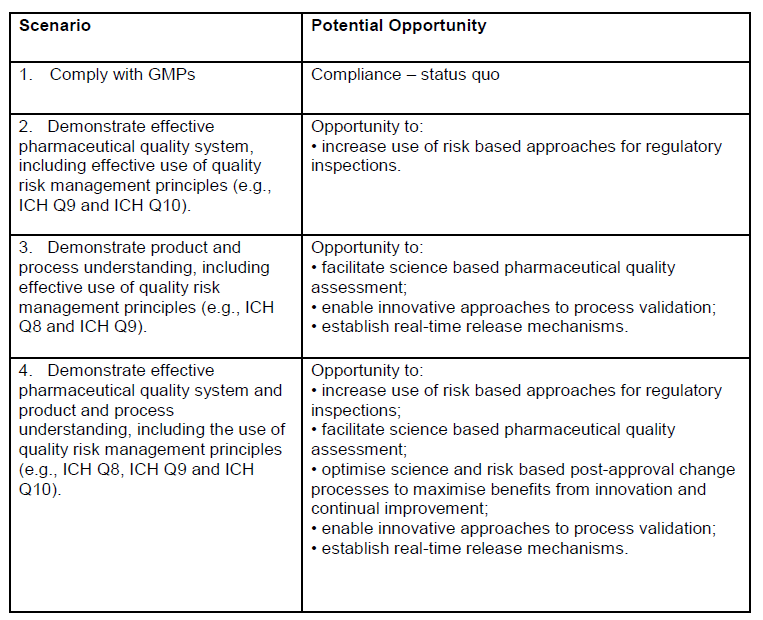
It is fascinating to look at appendix 1, which really lays out some critical goals of this draft guidance: better risk management, real time release, and innovative approaches to process validation. This is sort of the journey we are all on.
Gilbert’s Behavior Engineering Model (BEM) presents a concise way to consider both the environmental and the individual influences on a person’s behavior. The model suggests that a person’s environment supports impact to one’s behavior through information, instrumentation, and motivation. Examples include feedback, tools, and financial incentives (respectively), to name a few. The model also suggests that an individual’s behavior is influenced by their knowledge, capacity, and motives. Examples include training/education, physical or emotional limitations, and what drives them (respectively), to name a few. Let’s look at some further examples to better understand the variability of individual behavioral influences to see how they may negatively impact data integrity.
Good article in Pharmaceutical Online last week. It cannot be stated enough, and it is good that folks like Kip keep saying it — to understand data integrity we need to understand behavior — what people do and say — and realize it is a means to an end. It is very easy to focus on the behaviors which are observable acts that can be seen and heard by management and auditors and other stakeholders but what is more critical is to design systems to drive the behaviors we want. To recognize that behavior and its causes are extremely valuable as the signal for improvement efforts to anticipate, prevent, catch, or recover from errors.
By realizing that error-provoking aspects of design, procedures, processes, and human nature exist throughout our organizations. And people cannot perform better than the organization supporting them.
Design Consideration
Human Error Considerations
Manage Controls
Define the Scope of Work
·Identify the critical steps
·Consider the possible errors associated with each critical step
and the likely consequences.
·Ponder the "worst that could happen."
·Consider the appropriate human performance tool(s) to use.
·Identify other controls, contingencies, and relevant operating
experience.
When tasks are identified and prioritized, and resources
are properly allocated (e.g., supervision, tools, equipment, work
control, engineering support, training), human performance can flourish.
These organizational factors create a unique array of job-site conditions
– a good work environment – that sets people up for success. Human error increases
when expectations are not set, tasks are not clearly identified, and
resources are not available to carry out the job.
The error precursors – conditions that provoke error – are reduced.
This includes things such as:
·Unexpected conditions
·Workarounds
·Departures from the routine
·Unclear standards
·Need to interpret requirements
Properly managing controls is
dependent on the elimination of error precursors that challenge the
integrity of controls and allow human error to become consequential.
Apply proactive Risk Management
When risk is properly analyzed we can take appropriate action to
mitigate the risks. Include the criteria in risk assessments:
·Adverse environmental conditions (e.g. impact of gowning,
noise, temperature, etc)
·Unclear roles/responsibilities
·Time pressures
·High workload
·Confusing displays or controls
Addressing risk through engineering and administrative controls are a
cornerstone of a quality system.
Strong administrative and cultural controls can withstand human error.
Controls are weakened when conditions are present that provoke error.
Eliminating error precursors
in the workplace reduces
the incidences of active errors.
Perform Work
Utilizing error reduction tools as part of all work. Examples
include:
·Self-checking
oQuestioning
attitude
oStop when
unsure
oEffective
communication
oProcedure use
and adherence
oPeer-checking
oSecond-person
verifications
oTurnovers
Engineering Controls can often take the place of some of these, for
example second-person verifications can be replaced by automation.
Appropriate process and tools in place to ensure that the
organizational processes and values are in place to adequately support
performance.
Because people err and make mistakes, it is all the more important
that controls are implemented and properly maintained.
Feedback and Improvement
Continuous improvement is critical. Topics should include:
·Surprises or unexpected outcomes.
·Usability and quality of work documents
·Knowledge and skill shortcomings
·Minor errors during the activity
·Unanticipated workplace conditions
·Adequacy of tools and Resources
·Quality of work planning/scheduling
·Adequacy of supervision
Errors during work are inevitable. If we strive to understand and
address even inconsequential acts we can strengthen controls and make future
performance better.
Vulnerabilities with controls can be found and corrected when management
decides it is important enough to devote resources to the effort
The fundamental aim of oversight is to improve resilience to
significant events triggered by active errors in the workplace—that is, to
minimize the severity of events.
Oversight controls provide opportunities to see what is happening, to
identify specific vulnerabilities or performance gaps, to take action to
address those vulnerabilities and performance gaps, and to verify that they
have been resolved.