The Attributes of Good Procedure

Good documentation practices when documenting Work as Prescribed stresses the clarity, accuracy, thoroughness and control of the procedural instruction being written.

Clarity and Accuracy: Documentation should be clear and free from errors, ensuring that instructions are understood and followed correctly. This aligns with the concept of being precise in documentation.

Thoroughness: All relevant activities impacting quality should be recorded and controlled, indicating a need for comprehensive documentation practices.

Control and Integrity: The need for strict control over documentation to maintain integrity, accuracy, and availability throughout its lifecycle.

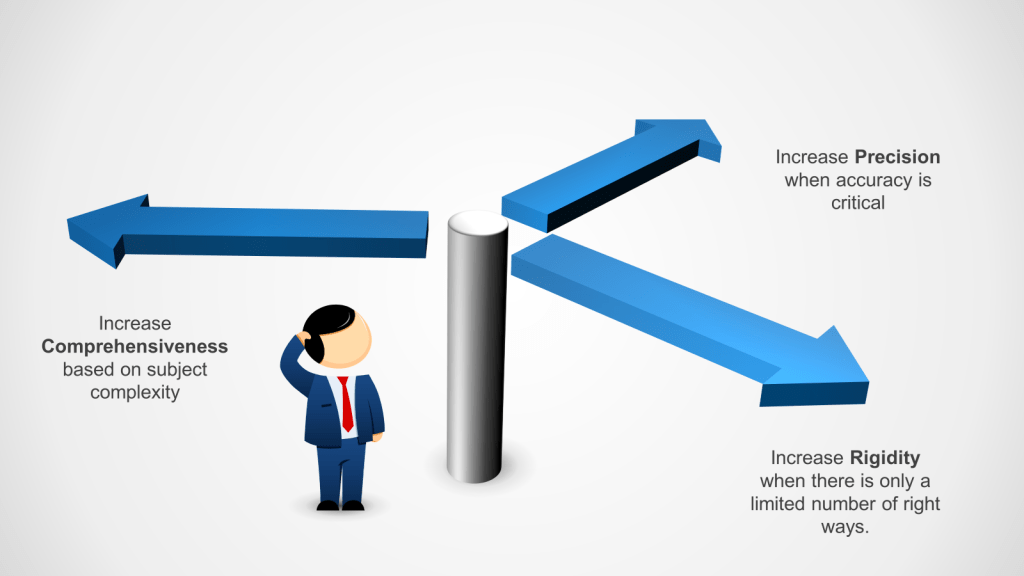
To meet these requirements we leverage three writing principles of precise, comprehensive and rigid.

Type of InstructionDefinitionAttributesWhen NeededWhyDifferencesExample
Precise Exact and accurate, leaving little room for interpretation.– Specific
– Detailed
– Unambiguous
When accuracy is critical, such as in scientific experiments or programming.Regulatory agencies require precise documentation to ensure tasks are performed consistently and correctlyFocuses on exactness and clarity, ensuring tasks are performed without deviation.Instructions for assembling a computer, specifying exact components and steps.
Comprehensive Complete and covering all necessary aspects of a task.– Thorough
– Inclusive
– Exhaustive
When a task is complex and requires understanding of all components, such as in training manuals.Comprehensive SOPs are crucial for ensuring all aspects of a process are covered, ensuring compliance with regulatory requirements.Provides a full overview, ensuring no part of the task is overlooked.Employee onboarding manual covering company policies, procedures, and culture.
Rigid Strict and inflexible, not allowing for changes.– Fixed
– Inflexible
– Consistent
When safety and compliance are paramount, such as batch recordsRigid instructions ensure compliance with strict regulatory standards.Ensures consistency and adherence to specific protocols, minimizing risks.Safety procedures for operating heavy machinery, with no deviations allowed.

When writing documents based on cognitive principles these three are often excellent for detailed task design but there are significant trade-offs inherent in these attributes when we codify knowledge:

  • The more comprehensive the instructions, the less likely that they can be absorbed, understood, and remembered by those responsible for execution – which is why it is important these instructions are followed at time of execution. Moreover, comprehensive instructions also risk can dilute the sense of responsibility felt by the person executing.
  • The more precise the instructions, the less they allow for customization or the exercise of employee initiative.
  • The more rigid the instructions, the less they will be able to evolve spontaneously as circumstances change. They require rigorous change management.

This means these tools are really good for complicated executions that must follow a specific set of steps. Ideal for equipment operations, testing, batch records. But as we shade into complex processes, which relies on domain knowledge, we start decreasing the rigidity, lowering the degree of precision, and walking a fine line on comprehensiveness.

Where organizations continue to struggle is in this understanding that it is not one size fits all. Every procedure is on a continuum and the level of comprehensiveness, precision and rigidity change as a result. Processes involving human judgement, customization for specific needs, or adaptations for changing circumstances should be written to a different standard than those involving execution of a test. It is also important to remember that a document may require high comprehensiveness, medium precision and low rigidity (for example a validation process).

Remember to use them with other tools for document writing. The goal here is to write documents that are usable to reach the necessary outcome.
References and Related Documents in Procedural Documents

It is pretty standard advice that relevant references to other documents should be listed in a separate section of the procedure. The reasoning is that when some standard operating procedures are intimately linked to others – the information contained in more than one document is necessary to complete a task – it is useful to include a cross-reference section in each document. Many also say that this section reinforces the SOP’s authority.

Another fairly common piece of advice is to have this, or another, section in the procedure identify the documents used in the development of the procedure, such as regulatory documents or technical/validation reports.

My take is that neither belongs in a process/procedure (SOP/WI). We should be looking to streamline requirements documents, and these sections are just cruft.

If you have electronic document control systems then cross-references should be handled trough hyperlink. Users are quite comfortable with hyperlinks and will easily navigate between documents.

Listing of regulations and other requirements belongs in a separate design document (ideally part of the document control system), and again add little value to the execution of the document.

There are a lot of so-called “best practices” about documents that stem from the days where everything is paper, and it is okay to move beyond them.

MHRA 2019 GMP Inspection Data and Documentation observations

Transparency is something that regulatory agencies need to get better at, both in sharing more and doing it in a timely manner. The fact that the 2019 data from the MHRA was released in October of 2020 is pretty poor. As a reference, the FDA releases their data pretty reliably at the end of the calendar year for the given year.

Been evaluating the MHRA’s 2020 data on Chapter 4 Documentation, which is the 2nd largest category of observations in 2019 (and in 2018 before it).

80 different inspections cited comments against the Principles section

Good documentation constitutes an essential part of the quality assurance system and is key to operating in compliance with GMP requirements. The various types of documents and media used should be fully defined in the manufacturer’s Quality Management System.


Documentation may exist in a variety of forms, including paper-based, electronic or photographic media. The main objective of the system of documentation utilized must be to establish, control, monitor and record all activities which directly or indirectly impact on all aspects of the quality of medicinal products. The Quality Management System should include sufficient instructional detail to facilitate a common understanding of the requirements, in addition to providing for sufficient recording of the various processes and evaluation of any observations, so that ongoing application of the requirements may be demonstrated.


There are two primary types of documentation used to manage and record GMP compliance: instructions (directions, requirements) and records/reports. Appropriate good documentation practice should be applied with respect to the type of document.


Suitable controls should be implemented to ensure the accuracy, integrity, availability and legibility of documents. Instruction documents should be free from errors and available in writing. The term ‘written’ means recorded, or documented on media from which data may be rendered in a human readable form.

Principles, Chapter 4 Documentation

The Principles section then goes on to lay out the required document types.

I would love to see more. Is this 80 companies who don’t known what a SMF is? Good documentation practices? Don’t have SOPs and batch records? Have errors in their documents? Don’t approve them? More transparency would be valuable here.

We can learn more by drilling down in the document.

  • There are 87 inspections with 4.1 in section “Generation and Control of Documents”. 1 is critical and 25 are major. Here we see failures in understanding types of documents and controlling them, or maybe just having them in the first place.
  • The 82 against 4.2 (1 critical and 20 major) are more about having the manufacturing and testing process defined (and matching the filing).
  • 103 inspections with observations against 4.3 (23 major) show companies that do not have appropriate approval and release controls
  • 14 for 4.4 (6 major) means there are 14 companies out there who can’t write a good process and procedure. 4.4 has one of my favorite requirements “written in an imperative mandatory style”
  • 60 against 4.5 (13 major) demonstrates a lack of review and keeping documents up-to-date.
  • 12 companies (6 major) have terrible handwriting and cannot stick to ballpoints, yes in fact 4.7 states “Handwritten entries should be made in clear, legible, indelible way.”
  • 103 against 4.8 (1 critical and 28 major) is ALCOA focused on contemporaneous, attributable and accurate.
  • 18 for 4.9 (6 major) is for not correcting data correctly. That’s right 18 companies do not know how to comment correctly.
  • 22 for 4.10 (1 critical and 9 major) is for not clearly laying out the manufacturing records and keeping them for the retention period.
  • 19 for 4.29 (5 major) is a lack of process and procedure for a grab-bag of quality processes from change control to equipment management to cleaning

There are more, but we are in single digit observation territory.

Useful things to be evaluating in your own organization. As a good place to start, here are some questions to ask when contemplating data integrity.

Procedure Lifecycle

We write and use procedures to help the user complete the task successfully and avoid undesired outcomes. Well-written procedures are an integral part of any organization for operation, managing risks, and continuous improvement. Effective procedures are important for the transfer of knowledge from the engineers/architects of the system to the users of the system.

Good procedures, and we are not talking format so this can be paper documents to a mixed reality guide, provide these four categories of information:

  1. Goal: The goal presented to the user as a state to be realized. This can be an end state or an intermediate state of the overall system.
  2. Prerequisites: The condition for moving toward the desired state or goal. These are the conditions that must be satisfied so that the user can achieve the goal.
  3. Actions and reactions: These states are reached through actions of the user and the reactions of the system. They may have milestones or sub-goals. It involves the description of (a series of) action steps.
  4. Unwanted: These are the states to be avoided (e.g., errors, malfunctions, injuries). It provides guidelines on what to avoid for successful and safe execution of procedure and may include warning, caution, or instruction for solving a potential problem.

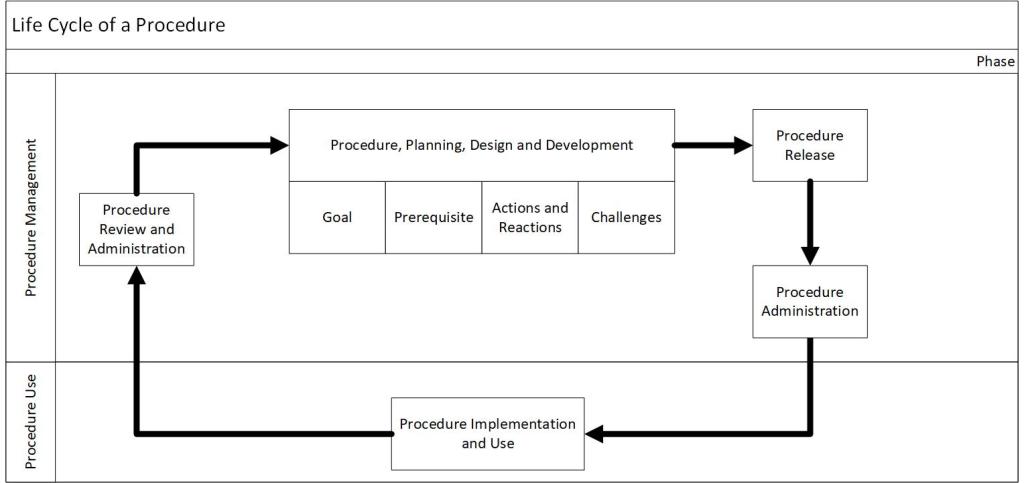
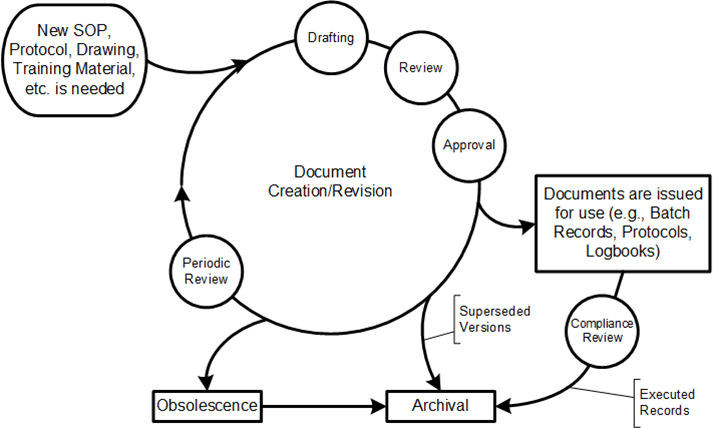
Procedures have a lifecycle through which they are developed, administered, used, reviewed, and updated. In the post “Document Management” I discussed the document management lifecycle.

I want to focus specifically on procedures by covering five distinct phases: procedure plan, design and development, procedure authorization, procedure administration, procedure implementation and use, and procedure review and maintenance.

Outlines the 5 phases of a procedure lifecycle
Lifecycle of a procedure
PhaseIncludesDocument Management Steps
Procedure plan, design and developmentIdentifying whether a procedure is necessary; collecting required information; producing instructions and information on the work, regulatory compliance, process and personnel safety; a walkthrough to ensure quality and potential compliance of the procedure“New SOP is needed”   Drafting    
Procedure AuthorizationProcedure review; publishing the final document; revision control; the approval process.Review Approval
Procedure AdministrationManaging procedure repository, control, and deployment; identifying administers how, when, and to whom procedures are to be delivered. 
Procedure Implementation and UseProcedure is used in operations 
Procedure review and maintenancePeriodic review of documents, as well as updates from the CAPA and Change Management processesPeriodic Review

References

  • Procedure Professionals Association (PPA), 2016. Procedure Process Description. (PPA AP-907-001)
  • Van der Meij, H., Gellevij, M., 2004. The four components of a procedure. IEEE Trans. Prof. Commun. 47 (1), 5–14