GxP New Hire Orientation

Leveraging the company’s new employee orientation program can help both compliance and quality by ensuring that a new hire (or transfer) understands the expectations for employee performance which:

  • Are covered by the GxP regulations, corporate policies and process/procedure
  • Are written and readily available to employees
  • Are mandatory

In a heavily regulated industry, like pharmaceuticals, this is especially important because an individual may not have experienced such regulation in their former position. Even within a regulated organization the level of regulatory experience will change as you move from one area to the next.

The new hire orientation process is not a once-and-done and should be long enough to truly make an impact on the individual’s performance.

This new hire program is seeing to engage new hires more rapidly within the quality culture to ensure that employee’s behavior aligns more rapidly with quality culture.

For example, the new hire orientation should reinforce that a pharmaceutical company is a regulated environment, responsible for products that can directly affect customers’ health and quality of life. Product failure could result in death or sickness. Working for an organization where products help preserve and sustain life comes with the responsibility to know one’s job and perform it correctly at all time.

New hire orientation must present the organization’s cultural imperative for quality – why is it important to fulfill the organization’s purpose or reason for being – and how has this been embedded into the organization’s culture. At heart new hire orientation should answer three questions:

  1. What does quality mean to you personally and how do you exhibit in the organization?
  2. What are the expectations for quality outcomes in the organization and how we judge that they have been met.
  3. How quality is embedded in the culture and daily work of the people in this organization and what represents good role model behaviors.

Content that does not immediately impact the new hire, or only impacts new hires in several departments or units, is better deferred until later training activities.

Topics that would be in that immediate review include:

  • What does it mean to work in a regulated environment
  • The role of the quality system
  • How to access process/procedure and complete training
  • Good documentation practices and data integrity (high level)
  • How to engage with regulatory stakeholders and other external partners (high level)

What other material would you cover?
CVs and JDs and Training Plans

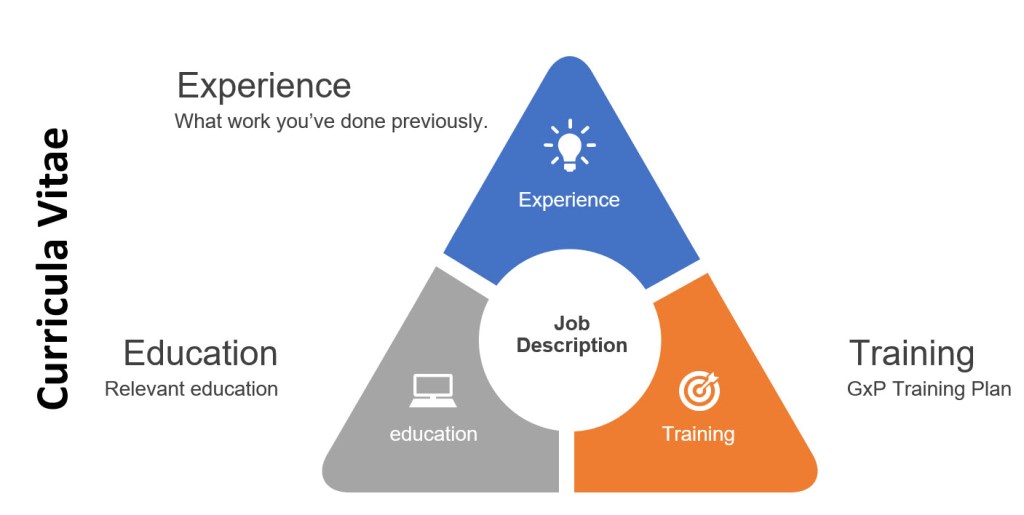
In the post “HR and Quality, joined at the hip” I covered some of the regulations that set the expectations in the pharmaceutical and medical device industries that employees have the appropriate education, experience and training to do their jobs. What is often called the personnel qualification triangle.

A job description is a written document that outlines the duties, responsibilities, contributions, behaviors, outcomes and required qualifications for a specific job in an organization. A good job description is a specification that results from a detailed job analysis. It is used in hiring and performance evaluation. It is also the starting point for determining a good GxP training plan.

In order to providing the specific knowledge, skills, abilities and behaviors that need to be addressed for each employee, the job description needs to specifically call out the roles in the processes an employee will play. Instead of providing broad statements like “participate in CAPAs” or “Manufacture product” it should be more specific such as “create and project manage CAPAs” or “Perform visual inspection.”

I challenge everyone to think broadly about the job description as a tool to drive excellence. Utilized throughout the life of employment, a job description is a powerful tool that can aid managers. Managers have a road map that can help them with their duties of planning, leading, organizing, controlling and staffing. With a road map, the complexities of the organization become easier.

The curricula vitae provides evidence that the employee is fit-for-purpose to the job description. The curricula vitae shows education and experience that demonstrates the possession of knowledge, skills, abilities and behaviors.

The training plan then lays out what the employee needs to bit fit-for-use, to be able to do all the roles in the job description. It includes all the process and role specific training, as well as filling in any gaps that might exist on the curricula vitae.

The Personnel Qualification Triangle of Education, Experience and Training

It is important to note that this may not be a fine equilateral triangle. Experience, for example, can often, but not always make up for education.

Failure Points in the Personnel Qualification Triangle

  • Position and experience descriptions on CVs do not match the corresponding job description. This red flag stems from a lack of coordination between the curricula vitae and job description, which can be particularly concerning when an employee has a job description that requires very specific technical knowledge or oversees other seemingly unrelated areas that their experience would indicate.
  • Employee positions current position is not included in curricula vitae. The curricula vitae should always include the current position. While not a deal breaker, this is perhaps the easiest way to see large gaps in the cv, especially if the employee moves around or up in the same organization.
  • Curricula vitae do not reflect the level of experience expected given the employee’s job title.
  • The roles and responsibilities documented in in the job descriptions do not correspond with those included in SOPs. A reviewer should be able to go from a process to anyone engaged in the process and be able to see the work the individual does reflected.
  • Job titles match. Curricula vitae, job descriptions and what an individual is listed as on an organizational chart need to all match. I usually go as far to check someone’s business card before they go into meet with an inspector or external auditor.

Building a learning culture

Our organizations are either growing or they’re dying. The key thing that drives growth in organizations is when their employees are learning. To strengthen our organizations, our teams, ourselves we need to ensure our culture allows people to be exposed to new and challenging opportunities to learn.

We learn constantly. Most of that learning, however, is incremental, improvements that build on what we already know and do. We expand our knowledge and refine our skills in ways that strengthen our identities and commitments. This process sharpens competence and broadens expertise, and is key in building subject matter experts.

Incremental learning can allow people to grow in a workplace until they reach the limit on their resources for new learning – think of it as an S-curve. Eventually, there isn’t enough opportunities to learn. Furthermore, learning that broadens our expertise is valuable, but it is not enough. Incremental learning does not alter the way we see others, the world, and ourselves.

The second type of learning is called transformative, it changes our perspectives laying the foundations for growth and innovative leaps.

Both kinds of learning are necessary. Incremental learning helps us deliver, while transformative learning helps us develop. Both are necessary, but too often we allow incremental learning to be haphazard and make no space for transformative learning.

In both cases we need to build spaces to drive learning.

We often see incremental in our training programs, while transformative is critical for culture building.

Incremental LearningTransformative Learning
Good forKnowledge and SkillsPurpose and Presence
Source of LearningExperts (models)Experience (moments)
Work requiredDeliberate PracticeReflective engagement
Aim of processNew action (a better way)New meaning (a better why)
Role of othersFocusing practiceInviting Interpretation
Key aspects of the two styles

Bibliography

References

  • Bersin. (2018, July 08). A new paradigm for corporate training: Learning in the flow of work. Retrieved December 31, 2019, from https://joshbersin.com/2018/06/a-new-paradigm-for-corporate-training-learning-in-the-flow-of-work/
  • Boyatzis E., & Akrivou, K. (2006). The ideal self as the driver of intentional change. Journal of Management Development, 25(7), 624-642. doi:10.1108/02621710610678454
  • Brown D., & Starkey, K. (2000). Organizational identity and learning: A psychodynamic perspective. The Academy of Management Review, 25(1), 102. doi:10.2307/259265
  • Hoffman, R., Yeh, C., & Casnocha, B. (2019). Learn from people, not classes. Harvard Business Review, 97(3). Retrieved December 31, 2019, from https://hbr.org/2019/03/educating-the-next-generation-of-leaders
  • Mezirow, J. (1991). Transformative dimensions of adult learning. San Francisco, CA: Jossey-Bass.
  • Petriglieri, G., Petriglieri, J. L., & Wood, J. D. (2017). Fast tracks and Inner Journeys: Crafting Portable selves for contemporary careers. Administrative Science Quarterly, 63(3), 479-525. doi:10.1177/0001839217720930

HR and Quality, joined at the hip

The interface between the Quality and Human Resources departments in pharma and medical devices can be poorly understood by many leaders in both departments. Quality tends to focus on product and process, HR on hiring, benefits, stuff like that. As a quality professional who oversees the training and personnel qualification system, I tend to sit between the two.

A quick summary of some regulations are in order. This is by no ways a comprehensive list.

RegulationRequirement
ICH E6 R2, 2.8Each individual involved in conducting a trial should be qualified by education, training, and experience to perform his or her respective task(s).
US FDA 21CFR 211.25(a) Each person engaged in the manufacture, processing, packing, or holding of a drug product shall have education, training, and experience, or any combination thereof, to enable that person to perform the assigned functions. Training shall be in the particular operations that the employee performs and in current good manufacturing practice (including the current good manufacturing practice regulations in this chapter and written procedures required by these regulations) as they relate to the employee’s functions. Training in current good manufacturing practice shall be conducted by qualified individuals on a continuing basis and with sufficient frequency to assure that employees remain familiar with CGMP requirements applicable to them. (b) Each person responsible for supervising the manufacture, processing, packing, or holding of a drug product shall have the education, training, and experience, or any combination thereof, to perform assigned functions in such a manner as to provide assurance that the drug product has the safety, identity, strength, quality, and purity that it purports or is represented to possess. (c) There shall be an adequate number of qualified personnel to perform and supervise the manufacture, processing, packing, or holding of each drug product.
Canada C.02.006Every lot or batch of a drug shall be fabricated, packaged/labelled, tested and stored under the supervision of personnel who, having regard to the duties and responsibilities involved, have had such technical, academic, and other training as the Minister considers satisfactory in the interests of the health of the consumer or purchaser.
EU EMA/INS/GMP/735037/201 2.1All parts of the Pharmaceutical Quality system should be adequately resourced with competent personnel, and suitable and sufficient premises, equipment and facilities.
WHO Annex 3-GMP9.2 The manufacturer should have an adequate number of personnel with the necessary qualifications and practical experience. The responsibilities placed on any one individual should not be so extensive so as to present any risk to quality. 9.3 Responsible staff should have its specific duties recorded in written descriptions and adequate authority to carry out its responsibilities. Its duties may be delegated to designated deputies of a satisfactory qualification level. There should be no gaps or unexplained overlaps in the responsibilities of personnel concerned with the application of GMP. The manufacturer should have an organization chart. (also see section 9.6 and 9.7 on key personnel)
WHO Annex 5-GDP 7.2Key personnel involved in the distribution of pharmaceutical products should have the ability and experience appropriate to their responsibility for ensuring that pharmaceutical products are distributed properly
Guideline on good pharmacovigilance practices (GVP) EMA/541760/2011Achieving the required quality for the conduct of pharmacovigilance processes and their outcomes by an organisation is intrinsically linked with the availability of a sufficient number of competent and appropriately qualified and trained personnel (see I.B.6.).  All personnel involved in the performance of pharmacovigilance activities shall receive initial and continued training [IR Art 10(3), Art 14(2)]. For marketing authorisation holders, this training shall relate to the roles and responsibilities of the personnel [IR Art 10(3)].
21 CFR 58.29(a) Each individual engaged in the conduct of or responsible for the supervision of a nonclinical laboratory study shall have education, training, and experience, or combination thereof, to enable that individual to perform the assigned functions.
(b) Each testing facility shall maintain a current summary of training and experience and job description for each individual engaged in or supervising the conduct of a nonclinical laboratory study.
(c) There shall be a sufficient number of personnel for the timely and proper conduct of the study according to the protocol.
21CFR 820.25(a)Each manufacturer shall have sufficient personnel with the necessary education, background, training, and experience to assure that all activities required by this part are correctly performed.
A few examples of regulations that touch on personnel

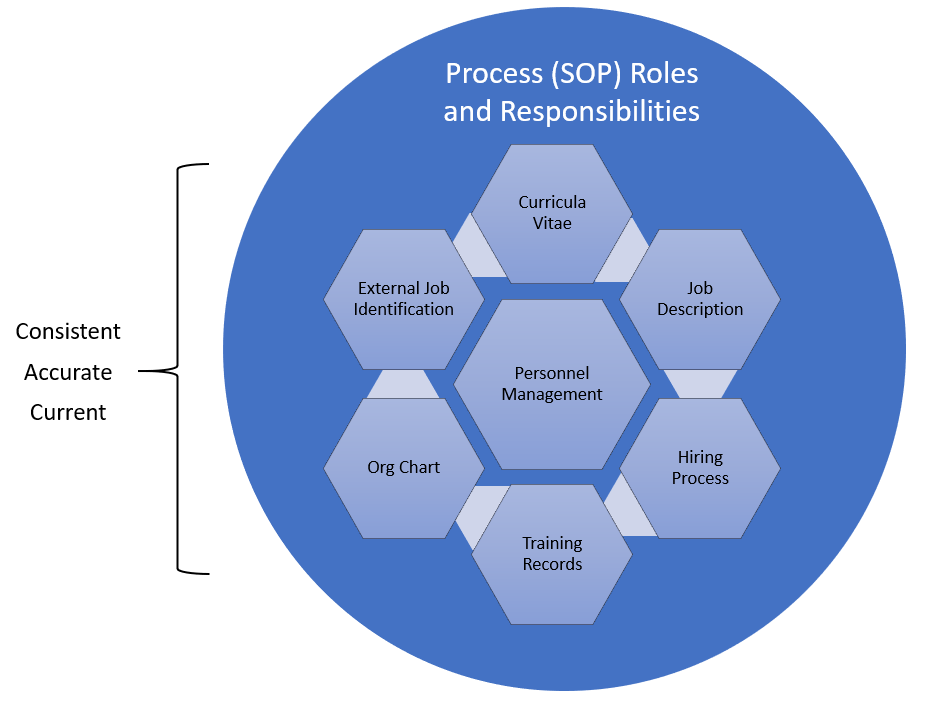
This assortment of regulations provides structure for every aspect of employment from how we hire to how we manage people. We can divide this into the following major areas: Curricula Vitae, Job Description, Hiring Process, Training Records, Org Chart, External Job Identification. All informed by the rest of our quality system, especially Process (SOP) Roles and Responsibilities.

Like most things that concern us we want all of this to be consistent and accurate.

Training and Personnel Qualification within the Quality System

Looking at the 2020 FDA 483 data we can see that these regulations are a concern throughout organizations.

Citation Program AreaReference NumberShort DescriptionLong DescriptionFrequency
Bioresearch Monitoring21 CFR 58.29(a)Personnel: education, training, experienceNot all individuals engaged in the conduct of or responsible for the supervision of a nonclinical laboratory study have education, training, and experience, or combination thereof, to enable that individual to perform assigned functions.  Specifically, ***1
Devices21 CFR 820.25(b)Training – Lack of or inadequate proceduresProcedures for training and identifying training needs have not been [adequately] established. Specifically, *** 30
Devices21 CFR 820.25(b)Training records Personnel training is not documented. Specifically, ***18
Drugs21 CFR 211.25(a)Training–operations, GMPs, written proceduresEmployees are not given training in [the particular operations they perform as part of their function] [current good manufacturing practices] [written procedures required by current good manufacturing practice regulations].  Specifically, ***18
Drugs21 CFR 211.25(a)Training , Education , Experience overallEmployees engaged in the [manufacture] [processing] [packing] [holding] of a drug product lack the [education] [training] [experience] required to perform their assigned functions.  Specifically, ***14
Drugs21 CFR 211.25(a)GMP Training FrequencyGMP training is not conducted [on a continuing basis] [with sufficient frequency] to assure that employees remain familiar with CGMP requirements applicable to them.  Specifically, ***7
Drugs21 CFR 211.25(b)Supervisor Training/Education/ExperienceIndividuals responsible for supervising the [manufacture] [processing] [packing] [holding] of a drug product lack the [education] [training] [experience] to perform their assigned functions in such a manner as to assure the drug product has the safety, identity, strength, quality and purity that it purports or is represented to possess.  Specifically, ***2
2020 483 citations related to Training and Personnel Qualification

Reaching beyond the regulations, we really need to ensure that a fear climate does not exist inside the organization, what is often called psychological safety. Looking to Deming, quality should extend to the performance check processes, and frankly those that introduce ranking of employees or departments are not the best for a culture of excellence.

There are many transactional differences in the roles, but if quality is not at the table for key decisions on hiring and culture the organization has missed opportunities.

Building Experts

Subject matter experts have explicit knowledge from formal education and embedded in reports, manuals, websites, memos, and other corporate documents. But their implicit and tacit knowledge, based on their experience, is perhaps the source of their greatest value — whether the subject-matter expert with decades of experience who is lightning fast with a diagnosis and almost always spot-on or the manager whose team everyone wants to be on because she’s so good at motivating and mentoring.

Experts, no matter the domain, tend to have very similar attributes. Understanding these attributes allows us to start understanding how we build expertise.

DimensionExperts Demonstrate
Cognitive
Critical know-how and “know-what”Managerial, technical, or both; superior, experience-based techniques and processes; extraordinary factual knowledge
System thinkingKnowing interdependencies, anticipating consequences, understanding interactions
JudgementRapid, wise decision making
Context AwarenessAbility to take context into account
Pattern RecognitionSwift recognition of a phenomenon, situation, or process that has been encountered before
Behavioral
Networking (“Known-who”)Building and maintaining an extensive network of professionally important individuals
InterpersonalAbility to deal with individuals, including motivating and leading them; comfort with intellectual disagreement
CommunicationAbility to construct, tailor, and deliver messages through one or more media to build logical and persuasive arguments
Diagnosis and cue seekingAbility to actively identify cues in a situation that would confirm or challenge a familiar pattern; ability to distinguish signal from noise
Physical
SensoryAbility to diagnose, interpret, or predict through appropriate senses
Attributes of an Expert

One of the critical parts of being a subject matter expert is being able to help others absorb knowledge and gain wisdom through learn-by-doing techniques— guided practice, observation, problem solving, and experimentation.

Think of this as an apprenticeship program that provides deliberate practice with expert feedback, which is fundamental to the development of expertise.

Do your organizations have this sort of organized way to train an expert? How does it work?