ASQ WCQI 2023 – Member Leader Day

ASQ WCQI starts with Member Leader Day, the one time a year when we actually get the chance to get a large group of member leaders together.

The ASQ continues to grapple with demographics, and I would love to see the demographics of this group of member leaders. Given that 76% of member leaders joined between 1970 and 2020. I would love to see that a little more granular by decade.

I know that the divisions send 2 members each, but I am not sure what sections are allowed for conferences and travel. Given the huge amount of sections compared to divisions, I would not be surprised if there is a different dynamic. If so, then that would skew the demographics even more.

We made it 12 minutes before the membership challenge was brought up. The value of a professional association remains critical to my mind. I feel that a lot of folks in my own organization don’t see the value, let alone among the wider professional group (and I pay for an ASQE membership as well as a few others for people to take advantage of).

Stephanie Gaulding then presented a diversity moment drawing from a post Belonging: A Conversation about Equity, Diversity, and Inclusion.
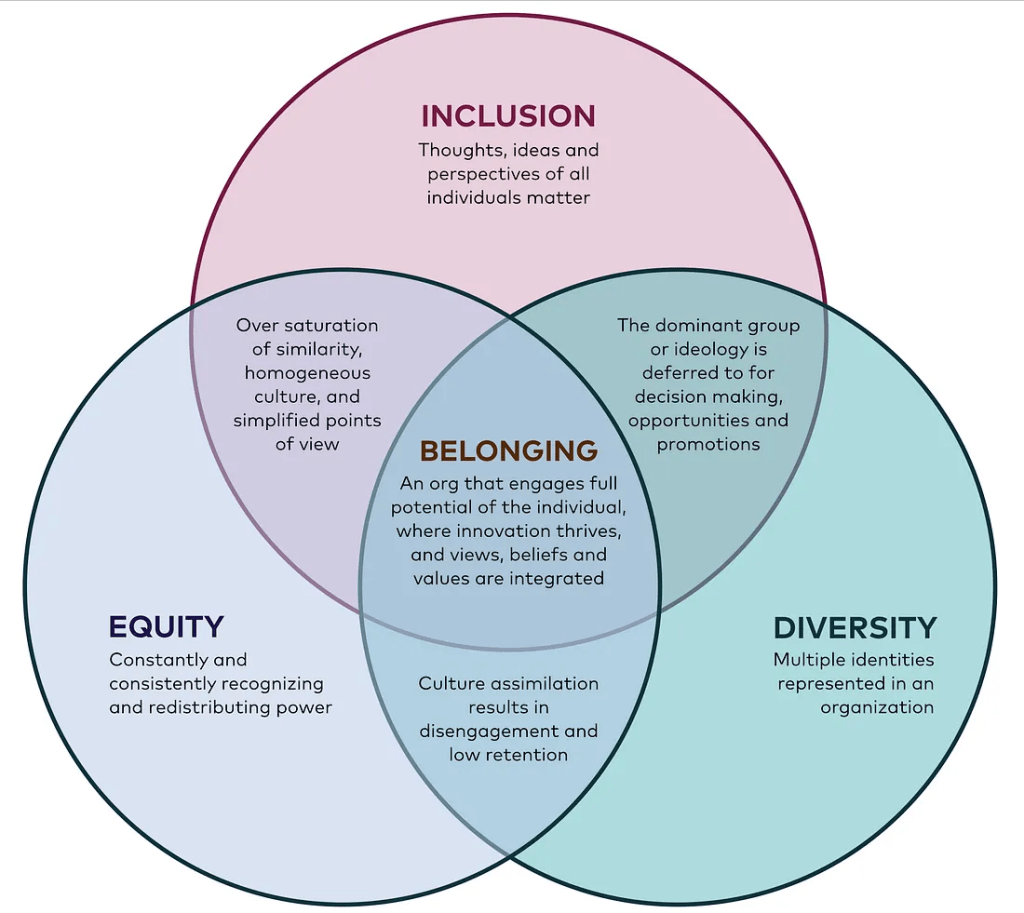
Diagram from Turner Consulting Group 

We then did a brainwriting activity (yes!) on “What is one thing we, as ASQ, Member Leaders, can do together to increase the Society’s value to our members?”

Our table consolidated around push vs pull communications and the value of a personal connection. Other tables talked about entrepreneurship (overuse of the buzz term if you ask me); student organization connections; the value of fun.

I look forward to seeing the full list. More importantly, I would like to see the follow-up. Aspirational activities often end up being just that, with little follow-through.

The CFO then discussed the “Short Term Fixed Income Investment Fund” which seems more directed to the Sections (which seem to sit on a lot of than the Division. Given that on the Division basis, it usually feels like a total lack of money, not sure of the value of this. I definitely zoned out.

And then we got the 3+ year debate on Division funding grumbling through the Q&A. Only took 40 minutes.

We then broke into Geogaphic Communities (the sections) and Technical Community (the divisions). I went to the technical meeting, as I am currently serving as chair-elect of the Food, Drug, and Cosmetics Division.

One can take, from posts like ASQ Technical Forums and Divisions as Knowledge Communities and my thoughts from the 2022 Member Leader Day that I have struggled over the years with the concept of the technical community (divisions). For all the changes happening in the ASQ, blowing up the technical communities would be my favorite thing to happen.

As an aside, the tendency to focus on longevity as a member leader may be counterintuitive to our desperate need to have new member leaders get more engaged.

Scholarship and Donations (including Sponsorship, Grant, and Honorariums) have been a source of discussion for years. Well overdue in having a procedure for this.

It is always embarrassing when folks ask where to find operating procedures. Document/Content management is a core part of the Quality profession, and the fact member leaders continue to complain they aren’t aware of procedure and do not know how to find it is a black mark.

Way too much time spent on scholarships, it is a small segment of our work yet something we discuss a lot. Not even sure why this is such a hard matter, every kid going to college I know uses CommonApp Having 2 kids currently in college I got to know CommonApp really well). Put the scholarships in that, go from there.

And then myASQ was the topic. Same old topic, new platform. I haven’t had a chance to use the new platform that went live on May 1st. Frankly, my.ASQ has never been part of my daily or weekly internet diet, and often my engagement was driven by folks tagging me and me seeing an email. Hopefully, it will be easier to use and drive more content and discussion. Driving engagement is so critical. And at its heart lies the problem core to a lot of ASQ activities, poor communication.

Communication is a theme throughout today. It is a return to fundamentals around communication plans.

Four board initiatives:

  • Quality 4.0
  • Economic and Environmental Sustainability – this is a hard one for me. I agree we should be discussing, but in every organization I’ve been in, Quality is not welcome at this table.
  • NextGen Mentoring
  • Conference/Event Improvement

Financial Update – everyone’s favorite topic! At the end of the day, the membership cliff means everything to the budget (and lack thereof)

I am becoming more and more convinced that the individual membership model is dead. Individuals cannot afford and do not see the value of paying for a membership, so the only way to get members is to make organizations see the value. And there’s the challenge.

Congratulations to all the member units who won Performance Excellence Program (PEP) awards.

I would like to state that any rubric that is secret is not really a rubric. Also, secret scoring mechanisms may be antithetical to quality principles. Make that PEP rubric public!

myASQ Engagement

I worry that myASQ continues to falter because it is viewed as a social medial tool instead of a knowledge management tool that drives communities of practice. That said, this transition has been driven more by member leaders than past attempts, which makes me feel positive that it will meet some unmet needs.

Like a lot of things, a few more tools like job aids would be greatly appreciated.

ASQE Insights of Excellence and the Quality Body of Knowledge

I am so excited we have moved this ahead. I participated in developing this tool and seeing where it is going excites me so much. So much that this will be another post later this week.

Wrap Up Thoughts

I am so done talking about the impact of the new membership model and whether or not member units were ripped off. And the spin off of the ASQE. And the debacle of the first launch of myASQ.

I want to focus on QBoK and member value realization and how the future is in organizations and not individual members. And doing cool things like poster sessions and a few other ideas in the works as I do the 2nd half of my chair-elect term and gear up for my term as chair of the Food, Drug and Cosmetic division.

I have so many thoughts on IoE and QBoK that will definitely be a separate post. Probably after the ASQE meeting on Tuesday.
WCQI – Member Leader Day

I made it to Anaheim, I must admit I am pretty surprised, as I’ve backed out of a few other events this year for reasons of family and health, and while I did do the ISPE Aseptic Conference, being at a WCQI feels almost surreal, especially since this is a fairly small WCQI compared to pre-pandemic years.

I decided to attend the member leader workshops. I thought long and hard, as I have had a rough and rocky road as a member leader during the pandemic and I’ll need to think about what that looks like going forward. I made the decision to attend because I hope the experience will help drive action on my part. Also, in some transparency, I bought my plane ticket without realizing that I would otherwise have a free day, and Disney is not my jam.

I think member leaders have a difficult role. There is a lot of administrative work, on top of the need/desire to drive programming. The changes in ASQs financial structure has made that even harder, with the need to be more revenue-neutral driving a lot of decisions. So member leaders have to find the time to be organizers, raise funds, and make programming happen. All while keeping the day job. I always tend to think this is one of the reasons so many seem to be consultants, who can leverage the time as a way to build a reputation.

Building a reputation as a subject matter expert is a fairly traditional path for many of us. At the heart of a professional organization is the question “How do you build real expertise instead of shallow?” and I think member leaders are one part of the answer to that question.

The future of professional societies strikes me as an interesting one. What is the mix of in-person and remote events? Do you try to do hybrids (my recommendation is no). How do you maintain focus. I was hoping to hear that today, but in general, I do not think I did.

The elephant in the room is that the last few years has seen a lot of change forced on the ASQ. Change often feels like it was done to the membership instead of driven by the membership. The ASQ has really struggled to put the tools and methodologies it advocates for into action. And then, on top of everything, there was the horrible nature of the pandemic, which has slowed down and fragmented change.

For example, the change in the membership model where everyone can join every technical community (divisions) is one that has not been really absorbed beyond the major hit to the budget (again something that feels imposed upon the society).

Perhaps I am some sort of radical and think the technical communities need to be decomposed and restructured, but I think this is a real core thing for my experience. Sometimes it feels like technical communities are fighting for the same volunteers and what any technical community focuses on has more to do with the volunteer base than any rhyme or reason to the QBok.

There was a lot of obvious frustration on the part of the technical community members about their role in the organization.

My.ASQ still remains a major point of contention. I tend to think this stems from a combination of technical design and structure. The design need to push technical communities had led to some real balkanization within the structure, which makes it difficult to find content. Add to the fact the tool is not very flexible in how it manages the content and we have a painful adoption three years later.

Technical communities really exist to drive content creation. But I sometimes feel they are more content silos. Content curation is a topic from and center in a lot of member leaders’ minds.

I’m always disappointed when quality professionals get together and there is no structure, no facilitation. When we don’t use the tools our profession is based on. An over-reliance on brainstorming and discussion I think really limits the value of these events as it feels like we are swirling around the same topics.

I attended the following three breakout sessions.

Young professionals

Less than 10% of the membership is under 35, with students being around 5%. I think the central question for all professional societies is how do we change this? Let’s be honest, I am not a spring chicken at 51 and I sometimes feel young at ASQ events.

I think it’s telling on the communication issue that the NexGen section on my.ASQ, touted during this talk, has 3 posts, the last in February.

Mentorship programs are a lot of work for the mentors involved (and the mentees). How do we incentive folks to do it? What does real mentorship look like?

The Power of Collaboration

The ASQ and ASQE split (one of those things done to members, not from members) certainly are central to the question of collaboration within the ASQ. At the heart of collaboration is the central question of content creation.

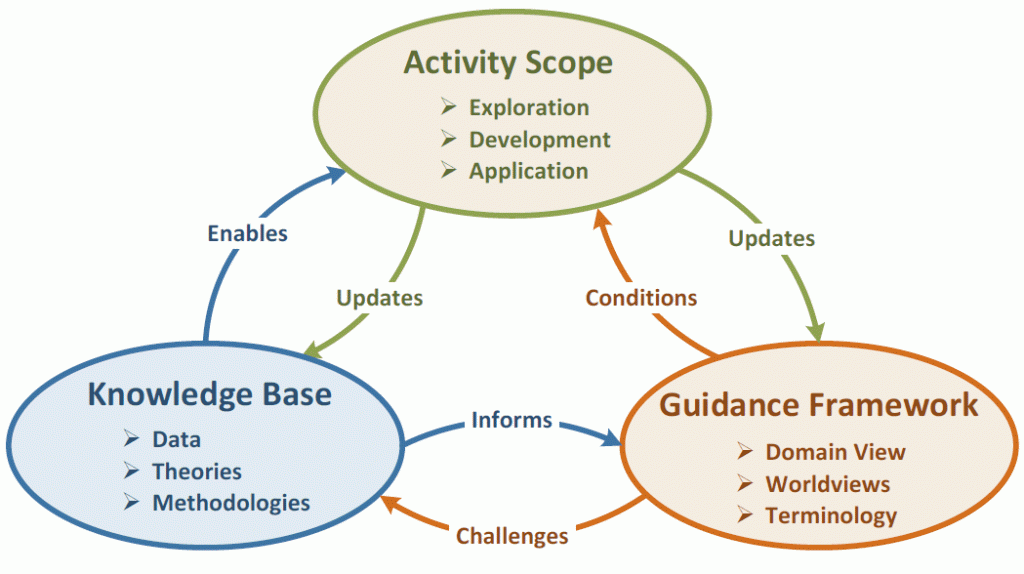
I feel the ASQ is suffering from a lack of a strong model here. The connections between the QBok and the member organizations (technical and geographical) are weak in many places. There is no real definition of activity scope, guidance framework, and knowledge base.

The central question for collaboration in the ASQ is how do we bring more content that is valuable to our members, which means we need to do a better job of identifying what members need.

WhatWhat is this?My thoughts on what this means for the ASQ?
Guidance FrameworkThe guidance framework typically involves multiple worldviews. The same subject matter can be studied from different worldviews, and the theories around a given subject can be interpreted differently from different worldview perspectives.The ASQ as a whole, the principles of the profession.
Knowledge BaseThe data, theories, and methodologies that drive the disciplineThis is the Qbok and the technical communities that serve specific methodologies and approaches (Lean, Statistics, HD&L, QMD, TWEF, Six Signa, etc)
Activity Scope The range of activities in a disciple, including the professional practice.These are the industry segment specific technical communities

There is a real tension right now in that the board of the ASQ and certainly headquarters, wants to see the technical communities generating more content, more IP. But many in the technical communities are feeling tense, and a little abused by the process.

I think a central question is how do we connect folks with questions to subject matter experts who can answer those questions. my.ASQ hasn’t really solved that issue. And something like Connex is really a marketplace to sell consulting services. This leads us to the third breakout session I attended.

Subject Matter Experts of Tomorrow

Building expertise is a particular focus of mine, and I think it is really important for the ASQ to think about what areas we need subject matter experts (SME) in, and how to leverage those SMEs.

I think we really grapple with just what topics are valuable to quality. Frankly, I think we haven’t reached the promise of the core, the foundational knowledge. We need to avoid thinking sexy “whats” are the key to a profession that focuses more on the hows and whys.

Want to call out the facilitators for using a tool to facilitate the session, while still brainstorming it made a difference.

The central question to answer the question about how we can connect knowledge experts with the skills necessary to be an effective SME?

The key is deliberative practice. As an organization, we need to have a deliberative practice pathway that builds skills in speaking, presentation, and develop area expertise. While we cannot directly give most people a job opportunity to do something, we can look for other opportunities to further e

Closing Thoughts

I have many questions, many thoughts, and no good answers. I waited until after the conference to make sure I had a chance to reflect.

WCQI Day 4

Last day.

Disciplined Problem Solving Demands Disciplined Communication by Frasier Pruitt

The Minto Pyramid Principle as a tool for problem communication. I guess I shouldn’t be snarky at a tool that came out of McKinsey. I’m sure organized crime has provided many useful tools for society.

Structuring information is critical, there are lots of tools out there to help utilize storytelling, I’m a big fan of the work of Nancy Duarte, and I have praised the A3 many a time for its use as for structured narrative around problems and solutions.

The Two Elements

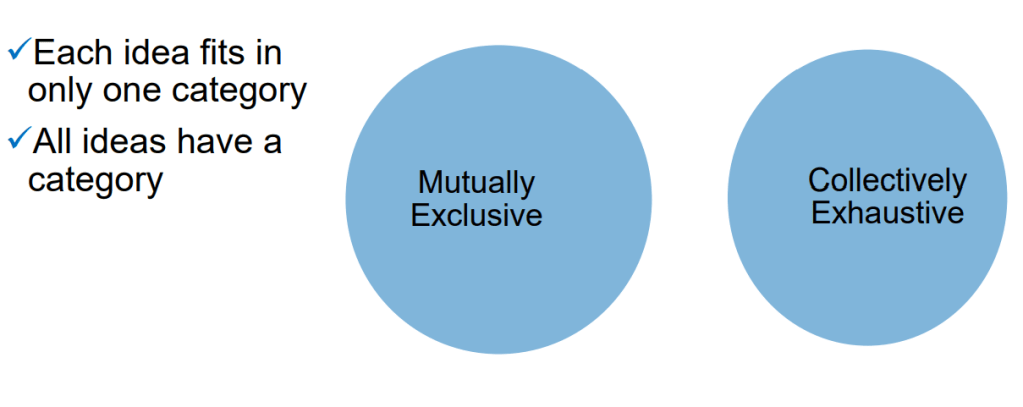
Mutually Exclusive, Collectively Exhaustive (MECE) is a concept that we cannot stress enough as it fundamentally gets to issues of cognitive load, and forms a great example of externalizing and constructing.

Mutually Exclusive, Collectively Exhaustive (MECE)

Great structure, which originally appeared in Quality Progress, for utilizing this with a DMAIC.

Well done structure, this was a great writing training. This could be expanded into a workshop focusing on narrative structure. One recommendation for Fraser would be using a simpler paper for the writing exercise.

The Innovation Management Principles of ISO 56000 by Peter Merrill

Innovation is one of those things that requires system and process to truly be successful. I appreciate the ideas beyond ISO 56000, and the basis of the Innovation Management System

  1. Realization of value; and benefit
  2. Future-focused leaders; curious, courageous
  3. Strategic direction; will change
  4. Culture; creativity and execution to co-exist
  5. Exploiting insights for unmet needs
  6. Managing uncertainty through a portfolio
  7. Adaptability as context changes
  8. Systems approach; serial innovation

Love the focus on how QMS and Innovation interlink.

Closing Keynote by Jose Morey

Okay, I’ve fan-boyed Leonardo da Vinci in the past, but this did not work for me as an ending keynote. It was shallow and rather generic.

But I got my Bingo card completed.

Which is sad.

Good conference. It was great to be back in person.

ASQ 2022 WCQI Day 3 (second half)

Making a Quality Leader: From Theory to Practice

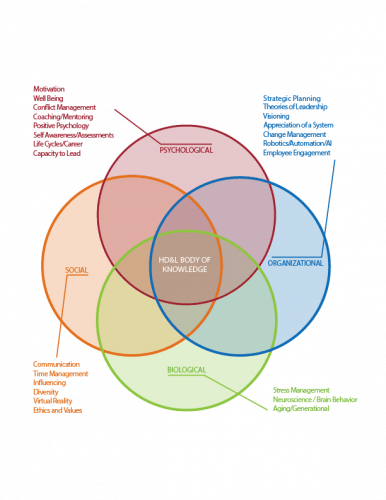
Always a pleasure to hear from the Human Development and Leadership (HDL) technical community. Their competency framework is a great tool that can help many a quality leader as they struggle to build the leadership competencies necessary to strive towards excellence.

Human Development & Leadership Body of Knowledge Model

Having done a lot of comptency frameworks I think the HDL has done a good job building theirs out as a progressive framework. I think a challenge is how do we make it easy to scale up to this more detailed HD&LBok from the QBok, and occasionally the same concept can be discussed a few different ways across different technical community boks and this lack of consistency is a detriment.

Stressing practice as the core part of a competency framework. A good conversation at my table was how often these competencies move back a little as we change roles and organizations.

No competency framework is valuable without a good development plan and the workshop did a great job at introducing how to use one.

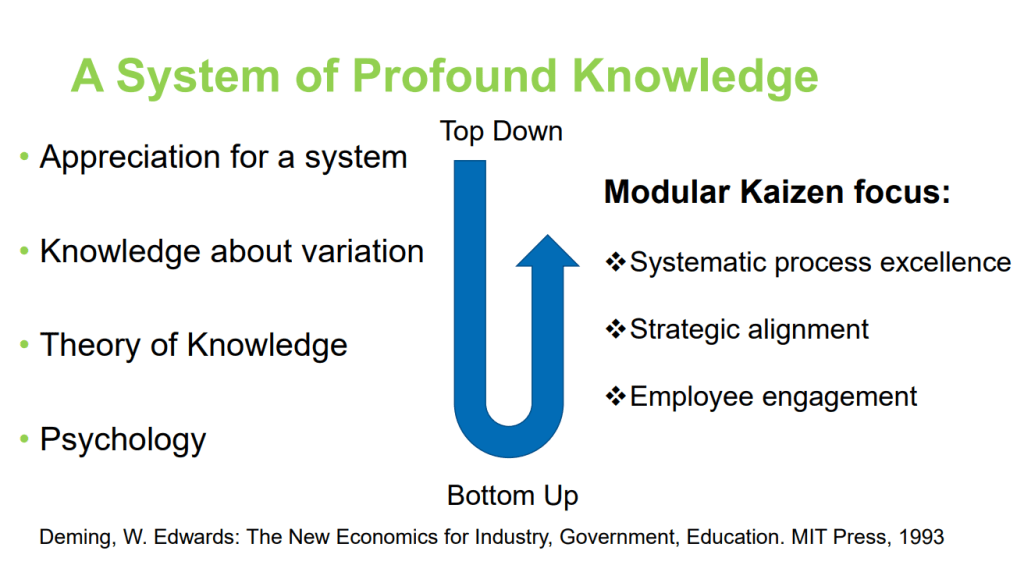
Honor Deming’s 14 Points Through Modular Kaizen by Grace Duffy

Grace has always been a mentor who always brings thought provoking topics to the society.

Goes without saying that I’m a fan of the 14 points and the System of Profound Knowledge. I’ve written a lot about Driving out Fear. It ties in a lot of my thoughts about how much of what is happening now in organizational excellence is the evolution from these 14 points.

Looking to the past is an important part of building the future. I think Grace did a great job of respecting the past to drive innovation and new ideas within the quality practice. I loved the care for our past, and the urge to challenge the future in the audience. She really avoided the tendency in some quality circles to obsess about the past (Toyota nuts I am thinking of you) and thus trap the present and stifle the future.

Grace does an amazing job being a pillar of the quality community while still being an iconcolast. When you see her name on the conference session list I always recommend taking the time to attend.

Quality Past & Present

I found most of the videos to be a little personality driven instead of insightful pieces of history. I would hope this session would draw from our history in exciting ways, that was not realized. However the ending charge to create solutions instead of just solving problems is a pivotal one.

2022 Business Meeting

This business meeting drives home the struggle the ASQ has on figuring out what comes next.

As an organization we do not understand what a digital organization looks like. Only 2000 users of the app in the US is embarrassing. Teens can create apps with 100 times more users.

It is nice to admit that actively listening to the members is crucial. I look forward to that consistently happening. We don’t always do a good job of using the tools at the heart of the QBok.

Finances are still rocky, though the Federal Stimulus has left the ASQ in an okay place.

I was actually shocked to hear the chair of the ASQ say it is hard to have metrics for meeting strategic goals. We have entire methodologies dedicated to that.

There are a lot of challenges ahead of us.

WCQI 2022 Day 3 (first half)

Heather McGowan

I am a huge fan of The Adaptation Advantage: Let Go, Learn Fast, and Thrive in the Future of Work by Heather E. McGowan and Chris Shipley. So I was thrilled when I heard Heather was going to speak. I could write for ever, but you are much better off listening to her yourself.

One of the things I think the quality community is bad about is forming connections with researchers who are basically researching topics at the heart of quality. Heather is a great example of this, she should see herself as a fellow traveler, but I do not think she does. Feels like another post.

Anticipating Disruption in the Supply Chain: Rethinking Business Continuity by Russell Snyder

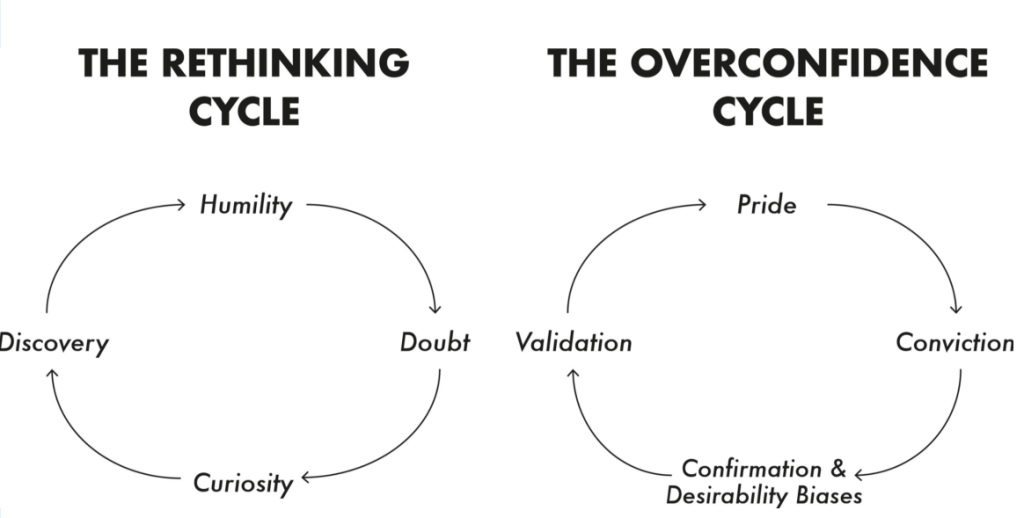
I chose to come to this session because I was really curious about a practical application of Adam Grant’s model from Think Again.

And my bingo card quickly gets another spot marked off by the speaker extolling Steve Jobs as some sort of good role model.

The central point that in times of constraint everything is a quality issue is an important one for us all to ponder.

Does a good job discussing the rethinking cycle vs the overconfidence cycle, and other parts of Grant’s rethinking model.

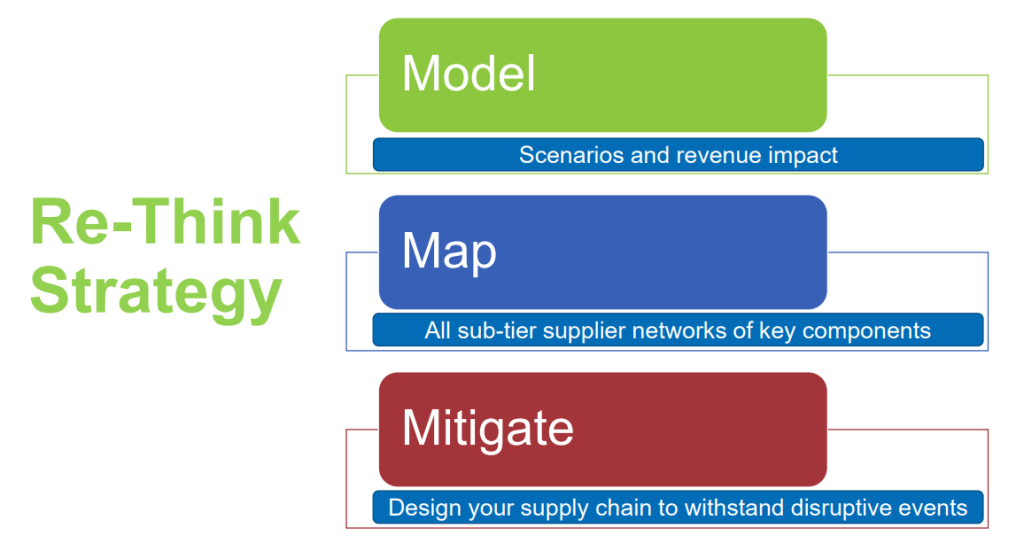
The rethink approach is Model (scenarios and revenue impact); Map (all sub-tier supplier networks of key components); and, Mitigate (design your supply chain to withstand disruptive effects).

Very much aligned with a risk-based approach. The examples he discusses were pretty valuable shares relevant across many industries. I am already adapting several of his slides to an ongoing project I have.

I love seeing Grant’s work percolate into quality thinking. Applying it to supply chain disruptions was as fascinating as I was hoping it would be.

Bingo Card at Half-day

My pessimistic self is surprised I’m not complete yet. Well, one more day to go!

Design & Construction Technical Community Body of Knowledge

Based on the member leaders day on Sunday (I need to finish that post, so may thoughts) I was really curious how a body of knowledge was developed recently by a technical community.

A body of knowledge for a broad area like construction is interesting. You need to make it specific enough to be relevant to construction but broad enough to avoid niches. The speakers spoke passionately about this balancing act.

I wish this had gone deeper. I’m really fascinating to understand how we talk about commonalities likerisk based auditing or knowledge management differently in this body-of-knowledge. It is really that quesiton of application.

ASQ Insights on Excellence Tool

I am so excited to see this tool out in the world. I had the priviledge of providing a few ideas to it a while back, so seeing it in use, at the conference was just amazing.