
FDA issues new guidance on Post Approval Changes

This past week the FDA issued a draft guidance “Post Approval Changes to Drug Substances” from the Center for Drug Evaluation and Research on post-approval changes for drug substances to provide clarity to holders of drug master files and holders of new and generic drug applications on which reporting category manufacturing changes fall into as well as the information required to support these changes.

Like any guidance this is supposed to “describe the Agency’s current thinking on a topic” and in this case this is a pretty important guidance as it is the first on the subject of change management published after the draft of Q12. It also clearly builds on the concepts of Q11 and is the first time the agency has published a guidance on drug substance post approval changes.

The guidance covers changes to facility; scale and equipment changes; specification changes to starting materials; synthetic manufacturing process changes; and, changes to the container closure systems for the drug substance.

It uses the traditional breakdown of major changes (prior approval supplement category), Moderate changes (changes-being-effected-30 (CBE-30) category) and Minor changes (annual report).

The guidance provides some solid requirements for risk assessments, and requires the risk assessment be included with the filing of change. This will require some companies to improve their risk management process, and may cause some to question decision making about their internal formulas for level of effort and the formality of risk management.

The deadline for public comment on the draft is Nov. 13. Submit comments to the docket at: https://www.regulations.gov/docket?D=FDA-2018-D-3152.
Sometimes quality requires forgetting

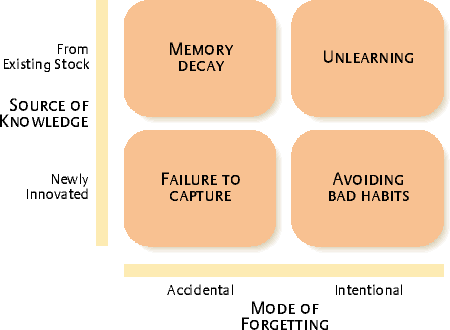
DeHolan and Phillips introduced the concept of organizational forgetting to our concepts of knowledge management. While unintentional forgetting is something we usually want to avoid, there is a time when we want to intentionally forget.  Perhaps after a corporate merger we are combining systems or replacing systems. Perhaps it is the result of a large step forward in technology, or an out-right replacement. Some major cultural transformation comes along. And the last thing we want is for no-one to be able to forget the old. For those concepts to linger in our memory and our decisions. For that is a risk that can easily lead to deviations.


4529-si1-lo8

Take for example changes in document numbering. Fairly simple of the surface but remember that procedure number is the tag which we use in conversation. No-one ever gives the whole title; we throw around these tags left and right and for our own coded language (another topic worthy of a blog post). Then we change our numbering format and a year later everyone still uses the old number. And mistakes start creeping up. Or just the perception of mistakes builds. Or perhaps everyone still thinks in the manner of the old ERP’s logic, and forget to do crucial aspects of master data management when a change is made. You get the idea

This purposeful frogetting, an aspect of knowledge management (and change management) – that of the purposeful removal of knowledge — is a critical step in our systematic approach and an important part of our strategic toolkit. However, it is very difficult, as deeply embedded pieces of organizational knowledge are generally locked in place by various other pieces of organizational knowledge that depend on them, and removing one implies modifying the others as well. We need to develop the tools to dismantle the previous way of doing work — the unneeded routines and formerly dominant logics of our changed systems.

One of the best way to do this is to get rid of cues. All the little breadcrumbs left behind. If you want people to stop using old document numbers, ensure that no document folks would use on their daily basis has those numbers. However, this ideal model of radical elimination of all cues associated with the old routine seems rather unlikely in all changes from old to new . So when we are working on our change its important to select those cues that will have the biggest bang for our buck. Some general ideas to help inform this are:

  • Look for opportunities to drive out mix-messages – aim for consistency in message
  • Ensure there are positive reinforcements for use of the new routine
  • Actively constrain the to-be-forgotten activity. Reduce the time in two different processes. Do a radical transformation. Reduce the confusion.
  • Reward the individual for participating in the new way. The group can’t change faster than the sum of the individuals, so incentive the change.

When doing a change it is important to consider these as risks, and build into your change plan. Incorporate into your training. For the basis of your communications. Drive out the old, embrace the new. Otherwise you are just increasing the risks inherent in your new way of working. But like many aspects of change management, easy in concept, difficult in execution.

Document Management

Today many companies are going digital, striving for paperless, reinventing how individuals find information, record data and make decisions. It is often good when undergoing these decisions to go back to basics and make sure we are all on the same page before we proceed.

There are three major types/functions of documents:

  • Functional Documents provide instructions so people can perform tasks and make decisions safely effectively, compliantly and consistently. This usually includes things like procedures, process instructions, protocols, methods and specifications. Many of these need some sort of training decision. Functional documents should involve a process to ensure they are up-to-date, especially in relation to current practices and relevant standards (periodic review)
  • Records provide evidence that actions were taken and decisions were made in keeping with procedures. This includes batch manufacturing records, logbooks and laboratory data sheets and notebooks. Records are a popular target for electronic alternatives.
  • Reports provide specific information on a particular topic on a formal, standardized way. Reports may include data summaries, findings and actions to be taken.

Often times these types are all engaged in a lifecycle. An SOP directs us to write a protocol (two documents), we execute the protocol (a record) and then write a report. This fluidity allows us to combine the types.

Throughout these types we need to apply good change management and data integrity practices (ALCOA).

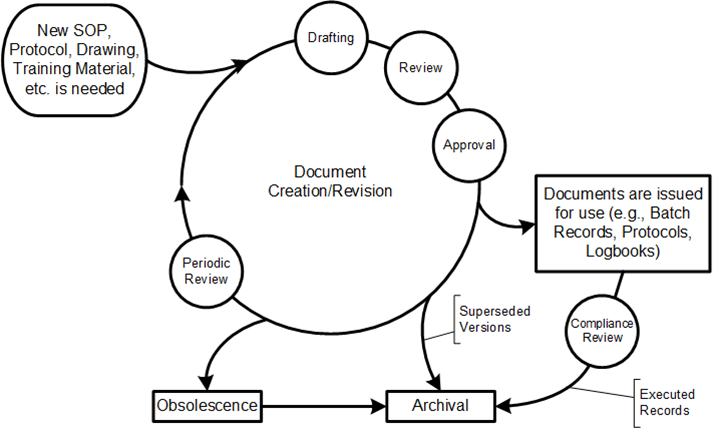
All of these types follow a very similar path for their lifecycle.

document lifecycle

Everything we do is risk based. Some questions to ask when developing and improving this system include:

  • What are the risks of writing procedures at a “low level of detail versus a high level of detail) how much variability do we allow individuals performing a task?) – Both have advantages, both have disadvantages and it is not a one-sized fits all approach.
  • What are the risks in verifying (witnessing) non-critical tasks? How do we identify critical tasks?
  • What are the risks in not having evidence that a procedure-defined task was completed?
  • What are the risks in relation to archiving and documentation retrieval?

There is very little difference between paper records and documents and electronic records and documents as far as what is given above. Electronic records require the same concerns around generation, distribution and maintenance. Just now you are looking at a different set of safeguards and activities to make it happen.

What Closing A Government Radio Station Would Mean For Your Clocks – Start contingency planning

Many clocks sync with a government radio station that’s been proposed to be closed. Scott Simon talks with Thomas Witherspoon of the website The SWLing Post.
— Read on www.npr.org/2018/08/25/641835302/what-closing-a-government-radio-station-would-mean-for-your-clocks

NIST’s full Fiscal Year (FY) 2019 budget request to Congress calls for the agency to “discontinue the dissemination of the US time and frequency via the NIST radio stations in Hawaii and Fort Collins, Colorado.” The agency noted, “These radio stations transmit signals that are used to synchronize consumer electronic products like wall clocks, clock radios, and wristwatches, and may be used in other applications like appliances, cameras, and irrigation controllers.” The specific cut, which would come from the NIST Fundamental Measurement, Quantum Science, and Measurement Dissemination budget, would amount to $6.3 million.

This is the type of thing to add to your SWOTs and other risk management/contingency planning activities. I, too, would like to have confidence it will not be in the final bill, but now is the time to take appropriate actions for your organization.