
Validation, Disposition and Change Control

A colleague asks “How do you manage changes and disposition when doing long-term validation or specification setting in multiple markets?”

Process map for change control, validation, regulatory and disposition

Perhaps it is a cleaning validation or a major process change or a new filter or raw material. You need to be able to disposition products against a change control to some markets but not all.

It is important to realize that changes become effective multiple times. Looking back on the post “Changes become Effective” we are managing after change-in-use where the regulatory approval is not being simultaneously gated and product will be sent to market on a case-by-case basis.

The change control contains a corresponding regulatory assessment with required variations for all impacted markets and a disposition strategy aligned with validation activities. With action items (e.g. work, tasks) in the change control for ongoing evaluation of lots impacted by study.

That disposition strategy might include evaluation of data vs acceptance criteria for each lot via checklist (or another tool) included in disposition packet, or an evaluation of data through change control task and disposition references change control. They are pretty similar in results and it more ends up being a record management preference.
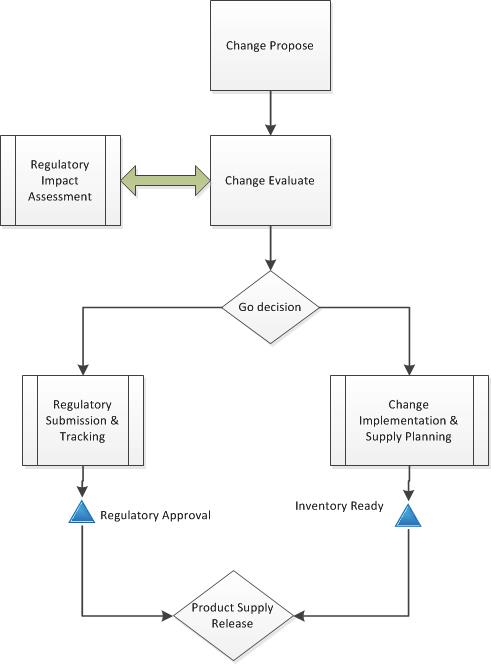
High level match between regulatory and inventory

Understanding Data – A Core Quality Skill

A critical skill of a quality professional (of any professional), and a fundamental part of Quality 4.0, is managing data — knowing how to acquire good data, analyze it properly, follow the clues those analyses offer, explore the implications, and present results in a fair, compelling way.

As we build systems, validate computer systems, create processes we need to ensure the quality of data. Think about the data you generate, and continually work to make it better.

I am a big fan of tools like the Friday Afternoon Measurement to determine where data has problems.

Have the tools to decide what data stands out, use control charts and regression analysis. These tools will help you understand the data. “Looks Good To Me: Visualizations As Sanity Checks” by Michael Correll is a great overview of how data visualization can help us decide if the data we are gathering makes sense.

Then root cause analysis (another core capability) allows us to determine what is truly going wrong with our data.

Throughout all your engagements with data understand statistical significance, how to quantify whether a result is likely due to chance or from the factors you were measuring.

In the past it was enough to understand a pareto chart, and histogram, and maybe a basic control chart. Those days are long gone. What quality professionals need to bring to the table today is a deeper understanding of data and how to gather, analyze and determine relevance. Data integrity is a key concept, and to have integrity, you need to understand data.

Medical Device Enforcement and Quality Report

In light of recent criticism of FDA’s oversight of medical devices, it is curious why FDA did not release a report touting the success of its enforcement activities with the same fanfare as its report on its plan to modernize the 510(k) program, which we reported on here. The Medical Device Enforcement and Quality Report (Report), available here, claims FDA’s increased inspections have led to improved compliance by industry.
— Read on www.fdalawblog.net/2018/12/medical-device-enforcement-and-quality-report/

Change Management – Post Change Evaluation and Action

In “Change Management – Post Change Evaluation and Action” John Hunter (of CuriousCat) writes a nice post on the The W. Edwards Deming Institute Blog on linking change management to the PDSA (PDCA) lifecycle focusing on Act.

Post Change Evaluation is often called the effectiveness review, and is a critical part of change in the pharmaceutical quality system, and frankly is important no matter the industry.

An effectiveness review is the success criteria of the change viewed over enough data points based on a methodology informed by the nature of the change and risk.

 The success criteria should be achieved. If not, reasons why they have not been achieved should be assessed along with the mitigation steps to address the reasons why, including reverting to the previous operating state where appropriate. This may require the proposal of a subsequent change or amendment of the implementation plan to ensure success. Here we see the loop aspects of the PDSA lifecycle.

All changes should have a way back into knowledge management. The knowledge gathered from implementation of the change should be shared with the development function and other locations, as appropriate, to ensure that learning can be applied in products under development or to similar products manufactured at the same or other locations.

When choosing success criteria always strive for leading indicators that tell you how the change is working. Deviations are an awful way to judge the effectiveness of the change. Instead look for walkthroughs, checklists, audits, data gathering. Direct observation and real-time gathering and analysis of data of any sort is the best.

As mentioned above, ensure the change management/change control system is set up to deal with the inevitable change that does not work. Have a clear set of instructions on how to make that decision (returning to the success criteria), what steps to take to mitigate and what to do next. For example having guidance of when to create a deviation and on how to make a decision to rollback versus implement another change.

ICH charts a course

Last week the ICH published a reflection paper “Advancing Biopharmaceutical Quality Standards to Support Continual Improvement and Innovation in Manufacturing Technologies and Approaches.”

The ICH contines to move beyond the prescriptive guidances of Q1-7 and focus more on strengthening the conceptual framework of Q8-Q11 (see some of my thoughts here). There is a lot of talk about strengthening relationships and alignment between regulatory agencies, which is definitely needed. Q12 has had a bumpy road of it (EU saying they might not implement, US FDA issuing a guidance that’s not all that aligned). We see a firm commitment to continuing the QbD work with Q13 (continuous manufacturing) and Q14 (Analytical methods).

Interesting timing with the FDA recent announcement on generics.