The change accelerators help us avoid some pretty common errors in change management.
Neglecting Employees’ Individual Interests
It is not enough to present a compelling case for change. Leaders can explain how the specified changes are in the company’s interests and the collective interests of all employees but for individuals to change their behavior, it must be in their individual interests to do so. There are always some costs to employees in any change program, but the behaviors required for change can still be in their individual interests if there are benefits that, on balance, make it rational to get with the program. It’s up to leadership to understand these cost-benefit analyses and tip the scales as needed to make active support of the collective change an individually winning strategy.
This is one the places having a volunteer army is vital. That army will help ensure the individual and well as the collective interests are engaged.
Under-engaging the Extended Leadership Team
It is crucial to get the extended leadership team seriously engaged in cultural transformation. Much of the coalition of change will be drawn from their numbers. What counts as an extended leadership team is different depending on the organization, but as a rule of thumb go to the top and draw a circle down to 3 levels below.
By drawing from the extended leadership team as the guiding coalition, you give them a personal stake in the outcome. Give the extended leadership team members a voice earlier on in the program and they will feel a greater sense of ownership and will contribute more readily. Their involvement should begin as early as the design stage to leverage their knowledge of the workforce and the situation on the ground. Giving them the opportunity for meaningful input will make them feel included in the program and enthusiastic about it, and will also help keep the program free of design flaws.
Allocating “Set-and-Forget” Targets
The hands-off, set-and-forget model for allocating targets has three major shortcomings:
If senior management neglects to inspire ambitions, to monitor progress and make proper course corrections, and to show sufficient engagement, then the initiative leaders will have little reason to go the extra mile. Presented with an annual target, they will likely focus on measures that aim simply to meet it – typically, shortsighted measures such as reducing deviations per batch or CAPA cycle time. After all, such measures are far easier to implement, and far less threatening to the delivery of day-to-day business results, than broad long-term measures such as seeking sustainable savings through increased productivity. Taking the simpler path is the rational choice when you understandably want to minimize disruption. Unfortunately, the short-tern measures don’t change culture fundamentally or sustainably. Sooner or later they are discontinued, and when that happens, the benefits evaporate.
The initiative leaders will likely seek solutions specific to their own silos rather than pursue opportunities that might contribute to collective, cross-department success. Those promising opportunities remain undiscovered since individual departments left to their own devices have no particular incentive to look beyond their silos. They might even have a disincentive to do so, because they may rightly worry that they wouldn’t get their fair share of credit for the results or that it would be a futile mission and damaging to their prospects.
The hands-off model prevents lead-indicator metrics, timely interventions, and course correction. If senior leaders have little visibility into a departmental initiative, they cannot easily realize that things are going off the hands-off model militates against lead-indicator metrics, timely interventions, and course correction. If senior leaders have little visibility into a departmental initiative, they cannot easily realize that things are going off track through the pursuit of unsustainable, short-term measures – until it is too late to do anything about it.
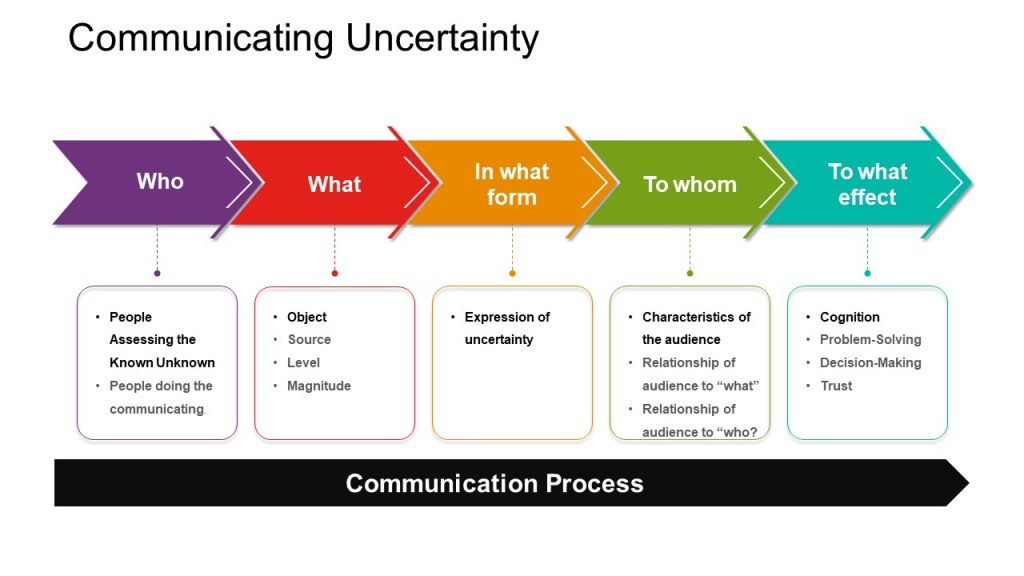
An information gap is a known unknown, a question that one is aware of but for which one is uncertain of the answer. It is a disparity between what the decision maker knows and what could be known The attention paid to such an information gap depends on two key factors: salience, and importance.
The salience of a question indicates the degree to which contextual factors in a situation highlight it. Salience might depend, for example, on whether there is an obvious counterfactual in which the question can be definitively answered.
The importance of a question is a measure of how much one’s utility would depend on the actual answer. It is this factor—importance—which is influenced by actions like gambling on the answer or taking on risk that the information gap would be relevant for assessing.
The day is coming where parts of my team will be returning to the office. However, the days of expecting everyone to be in seat 5 days a week are probably over for a while and the definite reality of hybrid teams is something we need to prepare for.
Hybrid teams have members working in very differing situations, with differing levels of autonomy, ability to socialize and access to the team leader. It will be a key activity to ensure that all team members are treated equally and fairly, regardless of their work arrangement, moving forward. Especially since everyone will be dealing with vulnerabilities, both those back in the office and those remote partially or fully.
Here are some key steps I am planning for, based on advice from this Forbes article.
Relaunching the Team with a Kickoff: As a leader who started remotely almost a year ago, I feel an acute need to meet my team in person and celebrate with them. This will also be an opportunity to kickoff this new chapter in the team’s life.
Level the Playing Field: Ensuring everyone has equal access to me will be key. Team meetings will be fully remote, with on-site folks logging in from their desks. I’m keeping a calendar to track how much face-to-face I get with people and I’ll be looking for opportunities to connect in multiple ways.
Over-communicate: I’ll be honest, I am a little tired from the volume of communication is going on now, but going hybrid means I will need to double-down on my efforts here. I’ll be keeping my consistency meetings, my team meetings, my skip-levels, the over sharing of things I find interesting. I’ll also be looking for ways to recharge myself so the exhaustion level feels a little less.
Understand the individual work styles: It is time to update the communication charter.
Establish New Hybrid Team Rituals and Norms: Learn from what has gone right and create some new rituals. I will be looking for some real innovation from the team here.
Deliberate inclusivity will be critical as we enter this new phase. Planning now as we get ready will lead to better results. Now is the time to start updating your team ground rules.
Here is my current agenda for the team kickoff, developed using SessionLab.
Activity
Description
Breakfast
Introduction
Review Agenda
9 Dimensions Team Building Activity
9 Dimensions is a powerful activity designed to build relationships and trust among team members.
There are 2 variations of this icebreaker. The first version is for teams who want to get to know each other better. The second version is for teams who want to explore how they are working together as a team.
Break
Team Self-Assessment
This is a structured process designed for teams to explore the way they work together. The tight structure supports team members to be open and honest in their assessment. After reflecting as individuals, the team builds a collective map which can serve as the basis for further discussions and actions. The assessment is based around 6 dimensions. Each one encouraging the team to reflect and analyze a different and crucial element of their behavior.
Lunch
Spy
A simple game that will have everyone running within minutes. Very effective to fight the “after-lunch” dip.
Engineering Your Team OS
This is designed to work as a standalone workshop or as a companion to the Team Self-Assessment tool. Using reflections and insights on your working process, your team will ‘update’ its operating system by making deliberate choices about how to work together. The goal is gradual development, not a radical shift. You will design an ideal-state for your team and slowly work towards that.
Break
3 Action Steps
This is a small-scale strategic planning session that helps groups and individuals to take action toward a desired change. It is often used at the end of a workshop or program. The group discusses and agrees on a vision, then creates some action steps that will lead them towards that vision. The scope of the challenge is also defined, through discussion of the helpful and harmful factors influencing the group.
Building culture means change. There are a lot of models for change out there, but for the work we pursue around building a culture of quality and excellence I think there are few better than John Kotter’s model.
Kotter sets forth Eight Accelerators of Change which can be leveraged in cultural change:
Accelerator
Focus when building Culture
Create a Sense of Urgency around a Big Opportunity
The urgency here is the strategic threats from having a less-than-robust quality culture and the opportunities it creates. This is the True North. With this accelerator working, large groups of people are committed to building and improving a culture of quality.
The translation of the sense of urgency from leadership down to the working level is a constant need. People must understand the argument laid out by leadership, but it needs to be linked with their own needs and less about the business need 5 years out. This is pretty fundamental, if folks don’t see how the culture vision will make immediate changes to their work then it will never be prioritized.
It is advantageous to have several different facets of this urgency that might appear to different segments in the organization. Manufacturing may be focused on human error reduction while research is excited around innovation. Both are moving forward in a similar direction.
Build and evolve a guiding coalition
You need a coalition throughout the organization deeply committed to a culture of quality and the benefits it will bring. Culture will never happen when it is viewed as a quality initiative only. Ideally there will be lots of branches and initiatives moving in the same direction. Communicating between these elements of the change initiatives and leveraging between initiatives is vital.
This is about fostering an environment that turns around the big opportunity and gives the member the opportunity to be different and creative. As a result, the participants of the coalition will find ways to work together different from their ordinary habits. This will increase the speed of decision-making and enables the organization to be more agile.
Form a change vision and strategic initiatives
Articulating the vision of culture shows a fit to strategic opportunities can move you with speed and agility to that vision. By choosing a few strategic opportunities around culture you can move quickly to them.
Enlist a volunteer army
Communicate in ways that lead large numbers of people to buy into the vision and want to help. You want to excite and mobilize as many active and passive members of the organization as possible.
Enable action by removing barriers
Work swiftly to achieve initiatives and continue to find new ones that are strategically relevant. Identify barriers that are slowing down the growth of a quality culture and remove them.
Generate (and celebrate) short-term wins
Look for wins big and most specially small and celebrate them. These wins, and their celebration, have psychological power and play a crucial role in building and sustaining culture transformation. The created credibility helps to develop a certain standing for the network within the organization and can also convince people, who did not have a positive attitude towards the network before.
Sustain acceleration
Don’t let a few wins slow you down. Keep going, keep growing, keep doing and celebrating. This accelerator helps to keep the spirit within the employees up and motivates them further to strive for the big opportunity of developing and reaping the benefits of a quality culture.
Many people active in the change, not just the usual few folks
The engagement of a large number of people for part-time involvement in the change, as opposed to relying on the same few people to work it full time.
A want-to and a get-to (not just a have-to) mind-set
People need to want to be change agents and feel that as change agents they have the power to make the change happen. They need to have the ‘spirit of volunteerism” and there needs to be enthusiasm for quality and excellence.
Action that is head and heart driven
People need to be motivated to participate not only by logical arguments based on a business case. Rather there must be an emotional element that drives their engagement.
The Burning Platform element of Culture will undoubtedly speak to the head but also must speak to the heart. In the pharmaceutical industry the Heart elements of the burning platform could include getting medicines to market quicker for the patient as well as making workers lives better.
Leadership is about vision and inspired action and management is about project management and budget reviews. The secondary operating system needs more of the former.
The network and the hierarchy must be inseparable and in constant communication. The idea of a network approach to change is critical here.. Change needs to sit next to traditional ways of working to truly be able to make a difference.
The network has a start-up character, which allows working flexible and agile on the change process and taking fast decisions.
Kotter’s Five Principles for Change
Creating the Movement
A central element of Kotter’s Accelerators is the secondary operating system which relies on a volunteer group of people who are there to propagate the change. These people don’t just magically appear, they are somehow motivated to get involved. How does an organization create the spirit of volunteerism, especially when most employees are disengaged from their organizations?
People will volunteer because they either want to do something for themselves or they want to do something for others.
Self-Enhancement
If someone wants to do something for themselves they are seeking self-enhancement. Self-Enhancement is the desire or observed reality of seeing oneself and by extension one’s actions, traits, and attitudes in the most positive light which can be an attempt to increase status and relationships with the leaders within the organization. This is a primary driver of engagement and behavior change.
Another element of the self-enhancement motive which plays into the formation of the volunteer army is whether we see this group as being part of the inner circle or a favorable group in the eyes of other high status people in the organization. This can be a driver to join the group and once joined we invariably see the group in a positive light and others not in the group are ‘black sheep’. Having the right leadership champions who talk about the efforts is critical.
Pro-Social and Intrinsic Motivation
Pro-social motivation means that the employee sees how their contributions have a positive impact. The underlying driver of this motivation can be because the employee feels it’s the right thing, because they care about the people who would benefit, and because it helps them maintain membership in a group
Intrinsic motivation, as the name suggests, comes from the areas of interest that people have within themselves and the desire to pursue those interests. When someone is intrinsically motivated they are more creative, motivated, and show greater persistence towards complex problems.
We want to be at the intersection of intrinsic motivation and pro-social motivation. Prosocial motivation strengthens and directs intrinsic motivation to be more useful.
Perspective taking, the cognitive process in which individuals adopt others’ viewpoints in an attempt to understand their preferences, values and needs, is a key element in developing pro-social motivation Perspective taking gives a framework to decide what ideas are more useful. If functionally diverse groups of employees can be given opportunities to discuss the strategic imperatives together and with immediate customers they can then find those areas which interest them at the same time they see the possible benefits. This may motivate them to get involved.
Kotter’s Eight Accelerators of change tell us to develop as many change agents and to do this people have to want to get involved and wanting to get involved is both a cognitive and emotional process. This ‘wanting to’ is really our intrinsic and pro-social motivations. Those motivations are stoked in several ways, such as by leadership and the vision they put forth. This vision may be better assimilated if employees have contact with its beneficiaries both internal and external, to see and hear their needs and how elements of the vision may have had a positive effect. This enhances leadership’s credibility with respect to their vision and also plays on the availability bias we all have towards strong examples. Additionally motivations are developed by perspective taking of others, so if employees know the needs of others this helps them filter creative ideas generated via their intrinsic motivation towards useful ideas that they will act on. These motivations must override our natural human tendency to be loss averse and to overweigh unlikely outcomes.
Leadership
The leadership of this volunteer army should be democratic. This style is critical to provide credibility to the vision of transforming culture, otherwise employees just hear new rhetoric which isn’t backed up by action.
There is a great opportunity here to shape the culture transformation as a development opportunity for people, allowing them the time to pursue it and coaching them through the process.
Leaders need to avoid extremely negative or extremely positive language, instead using vocabulary that is more neutral and does not try to seduce people by just manipulating the language.
Storytelling should be used but with the intention of reframing messages about the change and the organization.
Sources
Ackoff, R. L., Magidson, J., & Addison, H. J. (2006). Idealized Design: Creating an Organization’s Future. Upper Saddle River, NJ: Prentice Hall.
Grant, A. M. (2012). Leading with Meaning: Beneficiary Contact, Prosocial Impact, and the Performance Effects of Transformational Leadership. Academy of Management, 458-476.
Grant, A. M., & Berry, J. W. (2011). The necessity of others is the mother of invention: Instrinsic and Prosocial Motiviations, Perspective Taking and Creativity. Academy of Management Journal, 73-96.
Kotter, John P. (2002). The Heart of Change. Boston, MA: Harvard Business School Press.
Kotter, John P. (2014). Accelerate: Building Strategic Agility for a Faster-Moving World. Boston, MA: Harvard Business School Press.
Kotter, John P. (2016). That’s Not How We Do It Here!: A Story about How Organizations Rise and Fall–and Can Rise Again. Boston, MA: Harvard Business School Press.
“There’s a tension because especially in very hierarchical systems they’re quite worried about being and looking competent and at the same time their real performance, their real safety, their longer-term survivability is based on the ability to keep getting better and to be almost unnaturally observant and attentive to failures, little mishaps in processes a weakness. So, for high-risk organizations, they need to be just unnaturally attentive to the things that go wrong but that can feel very much at odds with looking good and with looking like performance. So, one could actually say that the real tensions between the appearance of performance and learning that real performance and particularly overtime, is in fact dependent on about learning.“


 Investigations of a Dog