A long-time reader of this blog, Raz, recently left a comment that I think resonates with a lot of people in our industry:
“As a compliance lead with 10+ years of experience in pharma (API sites, greenfield) but lacking a technical background, what would you suggest to be the best courses / trainings for proper certificates?”
First, thank you for reading and for asking the question publicly. You’re not alone. This is one of the most common career inflection points in pharmaceutical quality and compliance — you’ve spent a decade building deep regulatory instincts, you understand what the rules require, and now you want to close the gap on the how and why behind the technical systems you oversee. That’s exactly the right impulse. Let’s talk about how to act on it.
Your Experience Is the Foundation, Not the Gap
Before diving into specific programs, a reframe is needed. Ten years navigating API manufacturing, greenfield startups, and automation compliance isn’t “lacking a technical background” — it is a technical background, just one built from the compliance and operational side rather than the engineering side. Greenfield experience in particular is rare and valuable; you’ve seen quality systems built from scratch rather than inherited. That perspective is something no certification can teach.
What certifications can do is give you a shared vocabulary with your engineering and validation counterparts, formalize knowledge you’ve likely already absorbed by osmosis, and — importantly — signal to future employers that you’ve made deliberate investments in your professional development. With that framing, here’s how to think about the landscape.
Tier 1: The Flagship Credentials
These are the certifications that carry the most weight on a resume and in hiring conversations across the pharmaceutical industry. They require significant preparation but deliver lasting career value.
ASQ Certified Pharmaceutical GMP Professional (CPGP)
This is the single most relevant certification for someone in Raz’s position. The CPGP is specifically designed for pharmaceutical professionals who work within GMP-regulated environments and covers the full lifecycle — from regulatory governance and quality systems to production operations, laboratory controls, and facility management. Unlike more general quality certifications, every question on the exam is rooted in pharmaceutical context.
The eligibility requirements are straightforward for someone with a decade of experience: five years of on-the-job experience in one or more areas of the CPGP Body of Knowledge, with at least three years in a decision-making position. No specific degree is required. The exam consists of 165 multiple-choice questions over roughly four hours and is open-book. Exam fees run approximately $450–$550 depending on ASQ membership status, and the certification is maintained with 30 continuing education units every three years.
For a compliance lead who wants to demonstrate comprehensive GMP knowledge — not just the regulatory text, but how it applies to actual manufacturing operations — this is the credential that most directly fills the gap.
ASQ Certified Quality Auditor (CQA)
The CQA is the gold standard for professionals whose work involves auditing, supplier qualification, and compliance assessment. If Raz’s role includes conducting or hosting audits (which most compliance leads at API sites do), the CQA formalizes and deepens that skill set. The exam covers auditing fundamentals, techniques, tools, and management of audit programs. It’s industry-agnostic, which is both a strength (portable across sectors) and a limitation (less pharma-specific than the CPGP).
Many professionals pursue the CPGP first for its pharmaceutical depth and then add the CQA to formalize their auditing capabilities. Together, they form a powerful combination for compliance leadership.
ASQ Certified Quality Engineer (CQE)
The CQE is the most broadly recognized ASQ certification and has been the flagship credential for quality professionals for decades. It covers statistical process control, design of experiments, quality management systems, reliability, and continuous improvement. For someone who self-identifies as lacking a technical background, this is the certification that most directly addresses that gap — it teaches the quantitative and analytical toolkit that underpins modern quality engineering.
The CQE body of knowledge directly correlates with statistical methods and tools used across pharmaceutical manufacturing. However, it’s a challenging exam. If statistics and data analysis feel like foreign territory, a preparation course (CQE Academy offers well-regarded ones) is a worthwhile investment before sitting for the exam.
Tier 2: Industry-Specific Technical Programs
These aren’t exam-based certifications in the traditional sense, but they’re recognized across the industry and deliver directly applicable technical knowledge.
ISPE Academy Certificate Programs
ISPE launched its Academy in 2025 with five certificate programs that are highly relevant to pharmaceutical compliance professionals:
Program
Focus Area
Best For
GAMP® Essentials
Computerized system validation, data integrity, risk-based approaches
Automation compliance roles (directly relevant to Raz)
GMP Refresher
Current GMP regulations, quality systems, QA vs. QC distinction
Staying current on evolving requirements
Biopharmaceutical Essentials
Drug substance manufacturing, facility design, aseptic processing
Broadening beyond API into biologics
Good Engineering Practices
Engineering project management, compliance in project delivery
Understanding the engineering lifecycle
Pharmaceutical Water Systems
Water generation, storage, delivery, regulatory compliance
Utility system knowledge
For someone in automation compliance at an API site, the GAMP® Essentials program should be the starting point — it covers risk-based validation, data integrity, and regulatory requirements aligned with the ISPE GAMP® 5 Guide (Second Edition). This is the technical language of computerized system validation, and mastering it transforms a compliance professional from someone who reviews validation documents into someone who can meaningfully challenge and improve them.
ISPE membership also provides access to Baseline Guides, technical articles, and local chapter events — resources that experienced practitioners consistently recommend as among the most valuable in the industry.
PDA Training and Research Institute
The Parenteral Drug Association’s Training and Research Institute (TRI) in Bethesda, Maryland is unique in the industry — it operates an independent manufacturing training facility with cleanrooms where professionals gain hands-on experience without patient or product risk. PDA trains over 1,000 professionals annually, including more than 300 health authority and regulator representatives.
PDA courses cover aseptic processing, process validation, environmental monitoring, quality risk management, and regulatory compliance. For building technical depth, the hands-on format is particularly valuable. Reading about aseptic technique in a guidance document is qualitatively different from gowning up and working in a simulated fill room. PDA is developing a formal TRI Certificate Program with verified digital badges, which will add credentialing to an already excellent training experience.
CfPIE Current Good Manufacturing Practices Certified Professional (GMPCP)
The Center for Professional Innovation and Education (CfPIE) holds an FDA contract to provide Quality System Regulation training to FDA professionals — which speaks to the program’s credibility. Their cGMP certification requires completion of four courses (three core, one elective) and a comprehensive examination. The curriculum covers the full spectrum of cGMP compliance from clinical development through post-approval manufacturing.
CfPIE courses tend to be taught by practitioners with deep industry experience, and they offer both on-site and public sessions. The certification is particularly well-suited for professionals who want structured, classroom-style learning delivered by people who’ve been on the manufacturing floor and in the inspection room.
ECA Academy GMP/GDP Certification Programme
For professionals with international scope or working at sites with European regulatory exposure, the ECA Academy’s certification program is the largest of its kind in Europe. It offers 15 modular certification tracks — including Certified Validation Manager, Certified Biotech Manager, and Certified Quality Assurance Manager — each requiring completion of three courses from a defined list. The modular structure allows professionals to select courses aligned with their specific responsibilities and interests.
Tier 3: Process Improvement and Methodology
Lean Six Sigma (Green Belt or Black Belt)
Lean Six Sigma is the process improvement methodology, and it’s increasingly expected for quality professionals targeting management and leadership roles. In pharmaceutical manufacturing, Green Belt projects commonly focus on cycle time reduction, deviation rate reduction, cleaning optimization, and yield improvement. More than half of Fortune 500 companies follow Lean Six Sigma frameworks, and certified professionals often see 20–25% salary increases at the Green Belt level.
That said, context matters. In GMP environments, the iterative experimentation that Lean Six Sigma encourages can run into regulatory friction — changes to validated processes require formal change control, and FDA doesn’t care about your DMAIC timeline. The real value of Six Sigma for a compliance professional isn’t the belt itself; it’s the statistical literacy and structured problem-solving mindset it develops. If your investigations and CAPAs already reflect that thinking, a certification formalizes what you’re doing. If they don’t, the training will genuinely change how you approach problems.
ASQ’s Green Belt certification is the most broadly recognized and credible option.
RAPS Regulatory Affairs Certification (RAC)
If Raz’s career trajectory points toward regulatory affairs rather than quality operations, the Regulatory Affairs Certification from RAPS is the leading credential in that space. The RAC-Drugs designation validates expertise across the regulatory lifecycle — from product development and registration to post-market compliance. The exam requires at least three years of regulatory experience (or equivalent) and covers U.S., EU, and global regulatory frameworks.
RAPS also offers certificate programs (distinct from the RAC credential) consisting of online course bundles in pharmaceutical or medical device regulatory affairs — nine courses for roughly $2,745–$3,490. These are educational certificates rather than professional credentials, but they provide structured learning paths for professionals building regulatory knowledge.
Building a Technical Vocabulary: Where to Start Without a Certification
Not everything needs a certificate attached to it. For a compliance lead wanting to build technical depth quickly, these resources deliver high impact at low cost:
ICH Q8–Q12 Guidelines: Reading and truly understanding these documents — pharmaceutical development (Q8), quality risk management (Q9), pharmaceutical quality system (Q10), development and manufacture of drug substances (Q11), and product lifecycle management (Q12) — provides the technical vocabulary of modern pharmaceutical quality. They’re free, they’re authoritative, and they’re the foundation everything else builds on.
FDA 483 Observation Database: Reviewing recent observations for your site type (API, biologics, sterile) is free continuing education in what goes wrong and why. Make it a weekly habit.
ISPE Baseline Guides: These are the technical reference documents that engineers and validation professionals use daily. Understanding them closes the gap between “what the regulation says” and “how we build it”.
GAMP® 5 Guide (Second Edition): For anyone in automation compliance, this is the foundational text. It covers risk-based validation of computerized systems and is the de facto standard for computer system validation in pharma. Understanding GAMP categories, the V-model, and risk-based testing strategies is essential.
A Recommended Path for Raz
Given 10+ years in pharma compliance at API sites with greenfield experience and a current role in automation compliance, a prioritized roadmap:
Immediate (next 3–6 months): ISPE GAMP® Essentials certificate program — directly applicable to automation compliance work, builds the technical validation vocabulary, and connects with the ISPE professional community.
Near-term (6–12 months): ASQ CPGP certification — the most relevant formal credential for pharmaceutical GMP professionals, formalizes a decade of accumulated knowledge, and signals comprehensive competence to employers.
Medium-term (12–18 months): Lean Six Sigma Green Belt — adds the statistical and process improvement toolkit, strengthens investigation and CAPA capabilities, and is increasingly expected for management-track roles.
Ongoing: ISPE or PDA membership for continuing education, access to technical resources, and professional networking. Consider PDA TRI hands-on courses for specific technical areas where deeper understanding is needed.
If auditing becomes a larger part of the role: Add the ASQ CQA to formalize and credential auditing expertise.
The Real Advice
Certifications open doors, but they don’t replace the hard work of actually learning the material. The best compliance professionals — the ones who earn the respect of their engineering and manufacturing colleagues — are the ones who can have a conversation about why a cleanroom HVAC system is designed a certain way, not just whether the qualification documentation is complete. They can look at a deviation trend and see a process capability problem, not just a paperwork problem.
Ten years of experience at API sites and greenfield facilities has built a foundation that many credentialed professionals lack. The certifications above will give that experience structure, vocabulary, and formal recognition. Pick the ones that match where you want to go next, not just where you’ve been.
Thanks for reading, Raz. Keep asking the good questions.
I think we all have a central challenge in our professional life: How do we distinguish between genuine scientific insights that enhance our practice and the seductive allure of popularized psychological concepts that promise quick fixes but deliver questionable results. This tension between rigorous evidence and intuitive appeal represents more than an academic debate, it strikes at the heart of our professional identity and effectiveness.
The emergence of emotional intelligence as a dominant workplace paradigm exemplifies this challenge. While interpersonal skills undoubtedly matter in quality management, the uncritical adoption of psychological frameworks without scientific scrutiny creates what Dave Snowden aptly terms the “Woozle effect”—a phenomenon where repeated citation transforms unvalidated concepts into accepted truth. As quality thinkers, we must navigate this landscape with both intellectual honesty and practical wisdom, building systems that honor the genuine insights about human behavior while maintaining rigorous standards for evidence.
This exploration connects directly to the cognitive foundations of risk management excellence we’ve previously examined. The same systematic biases that compromise risk assessments—confirmation bias, anchoring effects, and overconfidence—also make us vulnerable to appealing but unsubstantiated management theories. By understanding these connections, we can develop more robust approaches that integrate the best of scientific evidence with the practical realities of human interaction in quality systems.
The Seductive Appeal of Pop Psychology in Quality Management
The proliferation of psychological concepts in business environments reflects a genuine need. Quality professionals recognize that technical competence alone cannot ensure organizational success. We need effective communication, collaborative problem-solving, and the ability to navigate complex human dynamics. This recognition creates fertile ground for frameworks that promise to unlock the mysteries of human behavior and transform our organizational effectiveness.
However, the popularity of concepts like emotional intelligence often stems from their intuitive appeal rather than their scientific rigor. As Professor Merve Emre’s critique reveals, such frameworks can become “morality plays for a secular era, performed before audiences of mainly white professionals”. They offer the comfortable illusion of control over complex interpersonal dynamics while potentially obscuring more fundamental issues of power, inequality, and systemic dysfunction.
The quality profession’s embrace of these concepts reflects our broader struggle with what researchers call “pseudoscience at work”. Despite our commitment to evidence-based thinking in technical domains, we can fall prey to the same cognitive biases that affect other professionals. The competitive nature of modern quality management creates pressure to adopt the latest insights, leading us to embrace concepts that feel innovative and transformative without subjecting them to the same scrutiny we apply to our technical methodologies.
This phenomenon becomes particularly problematic when we consider the Woozle effect in action. Dave Snowden’s analysis demonstrates how concepts can achieve credibility through repeated citation rather than empirical validation. In the echo chambers of professional conferences and business literature, unvalidated theories gain momentum through repetition, eventually becoming embedded in our standard practices despite lacking scientific foundation.
Understanding why quality professionals become susceptible to popularized psychological concepts requires examining the cognitive architecture underlying our decision-making processes. The same mechanisms that enable our technical expertise can also create vulnerabilities when applied to interpersonal and organizational challenges.
Our professional training emphasizes systematic thinking, data-driven analysis, and evidence-based conclusions. These capabilities serve us well in technical domains where variables can be controlled and measured. However, when confronting the messier realities of human behavior and organizational dynamics, we may unconsciously lower our evidentiary standards, accepting frameworks that align with our intuitions rather than demanding the same level of proof we require for technical decisions.
This shift reflects what cognitive scientists call “domain-specific expertise limitations.” Our deep knowledge in quality systems doesn’t automatically transfer to psychology or organizational behavior. Yet our confidence in our technical judgment can create overconfidence in our ability to evaluate non-technical concepts, leading to what researchers identify as a key vulnerability in professional decision-making.
The research on cognitive biases in professional settings reveals consistent patterns across management, finance, medicine, and law. Overconfidence emerges as the most pervasive bias, leading professionals to overestimate their ability to evaluate evidence outside their domain of expertise. In quality management, this might manifest as quick adoption of communication frameworks without questioning their empirical foundation, or assuming that our systematic thinking skills automatically extend to understanding human psychology.
Confirmation bias compounds this challenge by leading us to seek information that supports our preferred approaches while ignoring contradictory evidence. If we find an interpersonal framework appealing, perhaps because it aligns with our values or promises to solve persistent challenges, we may unconsciously filter available information to support our conclusion. This creates the self-reinforcing cycles that allow questionable concepts to become embedded in our practice.
Evidence-Based Approaches to Interpersonal Effectiveness
The solution to the pop psychology problem doesn’t lie in dismissing the importance of interpersonal skills or communication effectiveness. Instead, it requires applying the same rigorous standards to behavioral insights that we apply to technical knowledge. This means moving beyond frameworks that merely feel right toward approaches grounded in systematic research and validated through empirical study.
Evidence-based management provides a framework for navigating this challenge. Rather than relying solely on intuition, tradition, or popular trends, evidence-based approaches emphasize the systematic use of four sources of evidence: scientific literature, organizational data, professional expertise, and stakeholder perspectives. This framework enables us to evaluate interpersonal and communication concepts with the same rigor we apply to technical decisions.
Scientific literature offers the most robust foundation for understanding interpersonal effectiveness. Research in organizational psychology, communication science, and related fields provides extensive evidence about what actually works in workplace interactions. For example, studies on psychological safety demonstrate clear relationships between specific leadership behaviors and team performance outcomes. This research enables us to move beyond generic concepts like “emotional intelligence” toward specific, actionable insights about creating environments where teams can perform effectively.
Organizational data provides another crucial source of evidence for evaluating interpersonal approaches. Rather than assuming that communication training programs or team-building initiatives are effective, we can measure their actual impact on quality outcomes, employee engagement, and organizational performance. This data-driven approach helps distinguish between interventions that feel good and those that genuinely improve results.
Professional expertise remains valuable, but it must be systematically captured and validated rather than simply accepted as received wisdom. This means documenting the reasoning behind successful interpersonal approaches, testing assumptions about what works, and creating mechanisms for updating our understanding as new evidence emerges. The risk management excellence framework we’ve previously explored provides a model for this systematic approach to knowledge management.
The Integration Challenge: Systematic Thinking Meets Human Reality
The most significant challenge facing quality professionals lies in integrating rigorous, evidence-based approaches with the messy realities of human interaction. Technical systems can be optimized through systematic analysis and controlled improvement, but human systems involve emotions, relationships, and cultural dynamics that resist simple optimization approaches.
This integration challenge requires what we might call “systematic humility“—the recognition that our technical expertise creates capabilities but also limitations. We can apply systematic thinking to interpersonal challenges, but we must acknowledge the increased uncertainty and complexity involved. This doesn’t mean abandoning rigor; instead, it means adapting our approaches to acknowledge the different evidence standards and validation methods required for human-centered interventions.
The cognitive foundations of risk management excellence provide a useful model for this integration. Just as effective risk management requires combining systematic analysis with recognition of cognitive limitations, effective interpersonal approaches require combining evidence-based insights with acknowledgment of human complexity. We can use research on communication effectiveness, team dynamics, and organizational behavior to inform our approaches while remaining humble about the limitations of our knowledge.
One practical approach involves treating interpersonal interventions as experiments rather than solutions. Instead of implementing communication training programs or team-building initiatives based on popular frameworks, we can design systematic pilots that test specific hypotheses about what will improve outcomes in our particular context. This experimental approach enables us to learn from both successes and failures while building organizational knowledge about what actually works.
The systems thinking perspective offers another valuable framework for integration. Rather than viewing interpersonal skills as individual capabilities separate from technical systems, we can understand them as components of larger organizational systems. This perspective helps us recognize how communication patterns, relationship dynamics, and cultural factors interact with technical processes to influence quality outcomes.
Systems thinking also emphasizes feedback loops and emergent properties that can’t be predicted from individual components. In interpersonal contexts, this means recognizing that the effectiveness of communication approaches depends on context, relationships, and organizational culture in ways that may not be immediately apparent. This systemic perspective encourages more nuanced approaches that consider the broader organizational ecosystem rather than assuming that generic interpersonal frameworks will work universally.
Building Knowledge-Enabled Quality Systems
The path forward requires developing what we can call “knowledge-enabled quality systems“—organizational approaches that systematically integrate evidence about both technical and interpersonal effectiveness while maintaining appropriate skepticism about unvalidated claims. These systems combine the rigorous analysis we apply to technical challenges with equally systematic approaches to understanding and improving human dynamics.
Knowledge-enabled systems begin with systematic evidence requirements that apply across all domains of quality management. Whether evaluating a new measurement technology or a communication framework, we should require similar levels of evidence about effectiveness, limitations, and appropriate application contexts. This doesn’t mean identical evidence—the nature of proof differs between technical and behavioral domains—but it does mean consistent standards for what constitutes adequate justification for adopting new approaches.
These systems also require structured approaches to capturing and validating organizational knowledge about interpersonal effectiveness. Rather than relying on informal networks or individual expertise, we need systematic methods for documenting what works in specific contexts, testing assumptions about effective approaches, and updating our understanding as conditions change. The knowledge management principles discussed in our risk management excellence framework provide a foundation for these systematic approaches.
Cognitive bias mitigation becomes particularly important in knowledge-enabled systems because the stakes of interpersonal decisions can be as significant as technical ones. Poor communication can undermine the best technical solutions, while ineffective team dynamics can prevent organizations from identifying and addressing quality risks. This means applying the same systematic approaches to bias recognition and mitigation that we use in technical risk assessment.
The development of these systems requires what we might call “transdisciplinary competence”—the ability to work effectively across technical and behavioral domains while maintaining appropriate standards for evidence and validation in each. This competence involves understanding the different types of evidence available in different domains, recognizing the limitations of our expertise across domains, and developing systematic approaches to learning and validation that work across different types of challenges.
From Theory to Organizational Reality
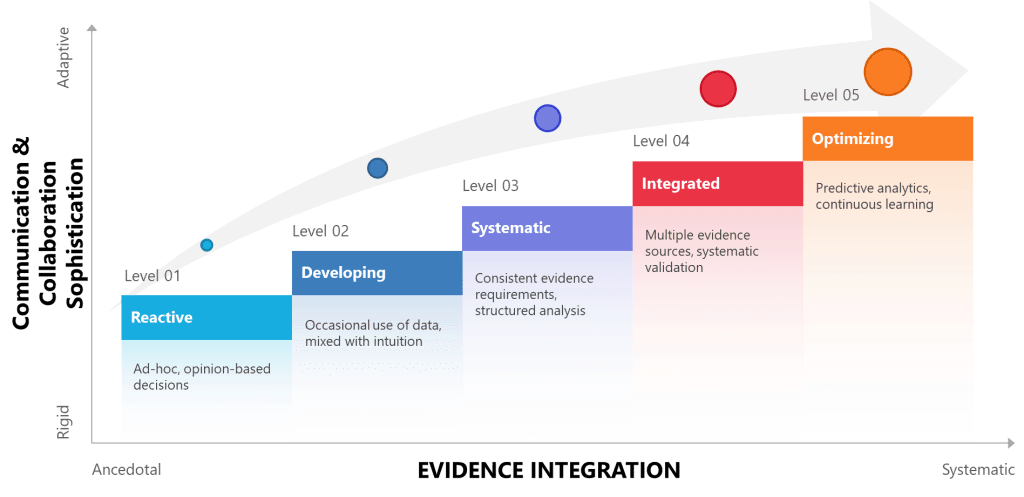
Translating these concepts into practical organizational improvements requires systematic approaches that can be implemented incrementally while building toward more comprehensive transformation. The maturity model framework provides a useful structure for understanding this progression.
Continuing ineffective programs due to past investment
Defending communication strategies despite poor results
Regular program evaluation with clear exit criteria
Organizations beginning this journey typically operate at the reactive level, where interpersonal approaches are adopted based on popularity, intuition, or immediate perceived need rather than systematic evaluation. Moving toward evidence-based interpersonal effectiveness requires progressing through increasingly sophisticated approaches to evidence gathering, validation, and integration.
The developing level involves beginning to apply evidence standards to interpersonal approaches while maintaining flexibility about the types of evidence required. This might include piloting communication frameworks with clear success metrics, gathering feedback data about team effectiveness initiatives, or systematically documenting the outcomes of different approaches to stakeholder engagement.
Systematic-level organizations develop formal processes for evaluating and implementing interpersonal interventions with the same rigor applied to technical improvements. This includes structured approaches to literature review, systematic pilot design, clear success criteria, and documented decision rationales. At this level, organizations treat interpersonal effectiveness as a systematic capability rather than a collection of individual skills.
Integration-level organizations embed evidence-based approaches to interpersonal effectiveness throughout their quality systems. Communication training becomes part of comprehensive competency development programs grounded in learning science. Team dynamics initiatives connect directly to quality outcomes through systematic measurement and feedback. Stakeholder engagement approaches are selected and refined based on empirical evidence about effectiveness in specific contexts.
The optimizing level involves sophisticated approaches to learning and adaptation that treat both technical and interpersonal challenges as part of integrated quality systems. Organizations at this level use predictive analytics to identify potential interpersonal challenges before they impact quality outcomes, apply systematic approaches to cultural change and development, and contribute to broader professional knowledge about effective integration of technical and behavioral approaches.
Level
Approach to Evidence
Interpersonal Communication
Risk Management
Knowledge Management
1 – Reactive
Ad-hoc, opinion-based decisions
Relies on traditional hierarchies, informal networks
Reactive problem-solving, limited risk awareness
Tacit knowledge silos, informal transfer
2 – Developing
Occasional use of data, mixed with intuition
Recognizes communication importance, limited training
Cognitive Bias Recognition and Mitigation in Practice
Understanding cognitive biases intellectually is different from developing practical capabilities to recognize and address them in real-world quality management situations. The research on professional decision-making reveals that even when people understand cognitive biases conceptually, they often fail to recognize them in their own decision-making processes.
This challenge requires systematic approaches to bias recognition and mitigation that can be embedded in routine quality management processes. Rather than relying on individual awareness or good intentions, we need organizational systems that prompt systematic consideration of potential biases and provide structured approaches to counter them.
The development of bias-resistant processes requires understanding the specific contexts where different biases are most likely to emerge. Confirmation bias becomes particularly problematic when evaluating approaches that align with our existing beliefs or preferences. Anchoring bias affects situations where initial information heavily influences subsequent analysis. Availability bias impacts decisions where recent or memorable experiences overshadow systematic data analysis.
Effective countermeasures must be tailored to specific biases and integrated into routine processes rather than applied as separate activities. Devil’s advocate processes work well for confirmation bias but may be less effective for anchoring bias, which requires multiple perspective requirements and systematic questioning of initial assumptions. Availability bias requires structured approaches to data analysis that emphasize patterns over individual incidents.
The key insight from cognitive bias research is that awareness alone is insufficient for bias mitigation. Effective approaches require systematic processes that make bias recognition routine and provide concrete steps for addressing identified biases. This means embedding bias checks into standard procedures, training teams in specific bias recognition techniques, and creating organizational cultures that reward systematic thinking over quick decision-making.
The Future of Evidence-Based Quality Practice
The evolution toward evidence-based quality practice represents more than a methodological shift—it reflects a fundamental maturation of our profession. As quality management becomes increasingly complex and consequential, we must develop more sophisticated approaches to distinguishing between genuine insights and appealing but unsubstantiated concepts.
This evolution requires what we might call “methodological pluralism”—the recognition that different types of questions require different approaches to evidence gathering and validation while maintaining consistent standards for rigor and critical evaluation. Technical questions can often be answered through controlled experiments and statistical analysis, while interpersonal effectiveness may require ethnographic study, longitudinal observation, and systematic case analysis.
The development of this methodological sophistication will likely involve closer collaboration between quality professionals and researchers in organizational psychology, communication science, and related fields. Rather than adopting popularized versions of behavioral insights, we can engage directly with the underlying research to understand both the validated findings and their limitations.
Technology will play an increasingly important role in enabling evidence-based approaches to interpersonal effectiveness. Communication analytics can provide objective data about information flow and interaction patterns. Sentiment analysis and engagement measurement can offer insights into the effectiveness of different approaches to stakeholder communication. Machine learning can help identify patterns in organizational behavior that might not be apparent through traditional analysis.
However, technology alone cannot address the fundamental challenge of developing organizational cultures that value evidence over intuition, systematic analysis over quick solutions, and intellectual humility over overconfident assertion. This cultural transformation requires leadership commitment, systematic training, and organizational systems that reinforce evidence-based thinking across all domains of quality management.
Organizational Learning and Knowledge Management
The systematic integration of evidence-based approaches to interpersonal effectiveness requires sophisticated approaches to organizational learning that can capture insights from both technical and behavioral domains while maintaining appropriate standards for validation and application.
Traditional approaches to organizational learning often treat interpersonal insights as informal knowledge that spreads through networks and mentoring relationships. While these mechanisms have value, they also create vulnerabilities to the transmission of unvalidated concepts and the perpetuation of approaches that feel effective but lack empirical support.
Evidence-based organizational learning requires systematic approaches to capturing, validating, and disseminating insights about interpersonal effectiveness. This includes documenting the reasoning behind successful communication approaches, testing assumptions about what works in different contexts, and creating systematic mechanisms for updating understanding as new evidence emerges.
The knowledge management principles from our risk management excellence work provide a foundation for these systematic approaches. Just as effective risk management requires systematic capture and validation of technical knowledge, effective interpersonal approaches require similar systems for behavioral insights. This means creating repositories of validated communication approaches, systematic documentation of context-specific effectiveness, and structured approaches to knowledge transfer and application.
One particularly important aspect of this knowledge management involves tacit knowledge: the experiential insights that effective practitioners develop but often cannot articulate explicitly. While tacit knowledge has value, it also creates vulnerabilities when it embeds unvalidated assumptions or biases. Systematic approaches to making tacit knowledge explicit enable organizations to subject experiential insights to the same validation processes applied to other forms of evidence.
The development of effective knowledge management systems also requires recognition of the different types of evidence available in interpersonal domains. Unlike technical knowledge, which can often be validated through controlled experiments, behavioral insights may require longitudinal observation, systematic case analysis, or ethnographic study. Organizations need to develop competencies in evaluating these different types of evidence while maintaining appropriate standards for validation and application.
Measurement and Continuous Improvement
The application of evidence-based approaches to interpersonal effectiveness requires sophisticated measurement systems that can capture both qualitative and quantitative aspects of communication, collaboration, and organizational culture while avoiding the reductionism that can make measurement counterproductive.
Traditional quality metrics focus on technical outcomes that can be measured objectively and tracked over time. Interpersonal effectiveness involves more complex phenomena that may require different measurement approaches while maintaining similar standards for validity and reliability. This includes developing metrics that capture communication effectiveness, team performance, stakeholder satisfaction, and cultural indicators while recognizing the limitations and potential unintended consequences of measurement systems.
One promising approach involves what researchers call “multi-method assessment”—the use of multiple measurement techniques to triangulate insights about interpersonal effectiveness. This might include quantitative metrics like response times and engagement levels, qualitative assessment through systematic observation and feedback, and longitudinal tracking of relationship quality and collaboration effectiveness.
The key insight from measurement research is that effective metrics must balance precision with validity—the ability to capture what actually matters rather than just what can be easily measured. In interpersonal contexts, this often means accepting greater measurement uncertainty in exchange for metrics that better reflect the complex realities of human interaction and organizational culture.
Continuous improvement in interpersonal effectiveness also requires systematic approaches to experimentation and learning that can test specific hypotheses about what works while building broader organizational capabilities over time. This experimental approach treats interpersonal interventions as systematic tests of specific assumptions rather than permanent solutions, enabling organizations to learn from both successes and failures while building knowledge about what works in their particular context.
Integration with the Quality System
The ultimate goal of evidence-based approaches to interpersonal effectiveness is not to create separate systems for behavioral and technical aspects of quality management, but to develop integrated approaches that recognize the interconnections between technical excellence and interpersonal effectiveness.
This integration requires understanding how communication patterns, relationship dynamics, and cultural factors interact with technical processes to influence quality outcomes. Poor communication can undermine the best technical solutions, while ineffective stakeholder engagement can prevent organizations from identifying and addressing quality risks. Conversely, technical problems can create interpersonal tensions that affect team performance and organizational culture.
Systems thinking provides a valuable framework for understanding these interconnections. Rather than treating technical and interpersonal aspects as separate domains, systems thinking helps us recognize how they function as components of larger organizational systems with complex feedback loops and emergent properties.
This systematic perspective also helps us avoid the reductionism that can make both technical and interpersonal approaches less effective. Technical solutions that ignore human factors often fail in implementation, while interpersonal approaches that ignore technical realities may improve relationships without enhancing quality outcomes. Integrated approaches recognize that sustainable quality improvement requires attention to both technical excellence and the human systems that implement and maintain technical solutions.
The development of integrated approaches requires what we might call “transdisciplinary competence”—the ability to work effectively across technical and behavioral domains while maintaining appropriate standards for evidence and validation in each. This competence involves understanding the different types of evidence available in different domains, recognizing the limitations of expertise across domains, and developing systematic approaches to learning and validation that work across different types of challenges.
Building Professional Maturity Through Evidence-Based Practice
The challenge of distinguishing between genuine scientific insights and popularized psychological concepts represents a crucial test of our profession’s maturity. As quality management becomes increasingly complex and consequential, we must develop more sophisticated approaches to evidence evaluation that can work across technical and interpersonal domains while maintaining consistent standards for rigor and validation.
This evolution requires moving beyond the comfortable dichotomy between technical expertise and interpersonal skills toward integrated approaches that apply systematic thinking to both domains. We must develop capabilities to evaluate behavioral insights with the same rigor we apply to technical knowledge while recognizing the different types of evidence and validation methods required in each domain.
The path forward involves building organizational cultures that value evidence over intuition, systematic analysis over quick solutions, and intellectual humility over overconfident assertion. This cultural transformation requires leadership commitment, systematic training, and organizational systems that reinforce evidence-based thinking across all aspects of quality management.
The cognitive foundations of risk management excellence provide a model for this evolution. Just as effective risk management requires systematic approaches to bias recognition and knowledge validation, effective interpersonal practice requires similar systematic approaches adapted to the complexities of human behavior and organizational culture.
The ultimate goal is not to eliminate the human elements that make quality management challenging and rewarding, but to develop more sophisticated ways of understanding and working with human reality while maintaining the intellectual honesty and systematic thinking that define our profession at its best. This represents not a rejection of interpersonal effectiveness, but its elevation to the same standards of evidence and validation that characterize our technical practice.
As we continue to evolve as a profession, our ability to navigate the evidence-practice divide will determine whether we develop into sophisticated practitioners capable of addressing complex challenges with both technical excellence and interpersonal effectiveness, or remain vulnerable to the latest trends and popularized concepts that promise easy solutions to difficult problems. The choice, and the opportunity, remains ours to make.
The future of quality management depends not on choosing between technical rigor and interpersonal effectiveness, but on developing integrated approaches that bring the best of both domains together in service of genuine organizational improvement and sustainable quality excellence. This integration requires ongoing commitment to learning, systematic approaches to evidence evaluation, and the intellectual courage to question even our most cherished assumptions about what works in human systems.
Through this commitment to evidence-based practice across all domains of quality management, we can build more robust, effective, and genuinely transformative approaches that honor both the complexity of technical systems and the richness of human experience while maintaining the intellectual honesty and systematic thinking that define excellence in our profession.
I spend a lot of time discussing uncertainty and how to address it in our quality system and within our organization. However, we often find ourselves at a crossroads, faced with uncertainty and the unknown in our careers – certainly, the last few years have been hard in biotech. My current approach has been to reframe this uncertainty not as an obstacle but as a feature of my journey—something it might have taken me 54 years to learn. I am striving to embrace the concept of “trusting the process” personally and as a quality practitioner so I can navigate life’s twists and turns with greater ease and purpose. As we go into the New Year, here are my current approaches.
The Power of Small Steps
If you are like me, it is easy to get lost in the day-to-day pressures of work. There is always a new issue, a new course correction. It is easy to focus on the overwhelming big picture to our next best steps and forget that the journey counts. My QA problem-solving self often wants to focus on problem-solving and forgets that we must strike a balance between action and acceptance, recognizing that while we can’t control every outcome, we can control our response to each situation. I am working to maintain agency in the present moment while surrendering to the unfolding path ahead.
Embracing Uncertainty as a Catalyst for Growth
Uncertainty, often viewed as a source of anxiety, can actually be a powerful catalyst for growth and innovation. By reframing uncertainty as a feature, we can open ourselves up to new possibilities and unexpected opportunities. This mindset shift encourages us to:
We create a culture of continuous learning and improvement by incorporating regular experimentation into our personal and professional lives. This approach is particularly valuable when balancing the demands of serving an organization while pursuing personal growth.
Balancing Service and Growth
The challenge of running small experiments while fulfilling organizational responsibilities is common. Here are some strategies to help strike that balance:
Integrate experiments into daily work: Look for opportunities to test new ideas or approaches within your existing projects and responsibilities.
Time-box your experiments: Set aside specific, limited time periods for experimentation to ensure it doesn’t interfere with core duties.
Communicate with stakeholders: Share your experimental approach, highlighting how it can benefit.
Learn from successes and failures: Treat every experiment as a learning opportunity, regardless of the outcome.
Start small and scale up: Begin with low-risk, high-potential experiments and gradually expand based on results and buy-in.
Cultivating Trust in the Process
Trusting the journey is not about blind faith or passivity. Instead, it’s about developing a deep relationship with your wisdom and decision-making process. This trust is built over time through:
Consistent self-reflection
Recognizing patterns in your choices and their outcomes
Staying connected to your core values and goals
Celebrating small wins and learning from setbacks
As you cultivate this trust, you’ll find yourself better equipped to navigate uncertainty confidently and gracefully.
Embracing the Journey
Trusting the journey can feel counterintuitive in a world that often demands certainty and immediate results. However, by embracing uncertainty as a feature of our growth process, we open ourselves to a richer, more fulfilling experience. Through small experiments, mindful action, and a willingness to surrender to the unknown, we can create a life and career that is both purposeful and adaptable.
Remember, the journey itself is where true growth and discovery happen. By trusting the process and focusing on our next best steps, we can navigate the complexities of life with greater ease and authenticity. So, take that first step, run that small experiment, and trust that the journey will unfold in ways you may never have imagined.
This is my New Year’s plan: to continue to apply to my personal space the skills and mindsets that have made my career so fruitful.
My greatest weakness is my poor track record of practicing humbleness. Balancing humility with assertiveness in professional life is essential for effective leadership and personal growth. It is critical to being an expert. So here are the things I remind myself of and practice as part of my mindfulness.
Acknowledge your limitations and knowledge gaps
Be open about areas where you still have more to learn
Admit when you don’t know something or are uncertain
Recognize that expertise in one area doesn’t make you an expert in everything
Remain open to learning from others
Listen attentively to different perspectives and ideas
Be willing to change your views based on new information
Seek out opportunities to expand your knowledge
Give credit to others
Recognize the contributions and insights of colleagues and mentors
Share credit for successes and accomplishments
Use “we” instead of “I” when discussing team achievements
Practice gratitude
Express appreciation for opportunities you’ve had to develop expertise
Thank those who have supported your growth and learning
Be grateful for chances to share your knowledge with others
Stay curious and ask questions
Maintain a learner’s mindset, even as an expert
Ask thoughtful questions to deepen your understanding
Be open to new ideas and approaches in your field
Focus on serving others with your expertise
Use your knowledge to help and empower others
Prioritize making a positive impact over personal recognition
Share your expertise generously without expectation of reward
Reflect on your journey and growth
Remember the challenges you faced in developing your expertise
Consider how much more there is still to learn in your field
Appreciate the ongoing nature of learning and development
Accept and learn from criticism and feedback
Be open to constructive criticism of your work
Use feedback as an opportunity for improvement
Avoid becoming defensive when your ideas are challenged
By consistently practicing these behaviors, we can maintain humility while confidently sharing our expertise. This approach allows us to continue growing professionally while fostering positive relationships and respect from colleagues and peers.


 Investigations of a Dog