Benefits of Written Rules: Capture important learnings and assumptions Establish a standardized, organized and reproducible, method of conducting work safely Ensure effective transfer of knowledge to new members of the group Require disciplined thinking to formally document thus reducing errors in processes Create a framework for delegation of decision-making Demonstrate the organizations commitment to safety
I don’t think there is a quality person who would read that list and not nod knowingly. Reading the excellent article quoted above reminded me that we all probably do EHS, Quality and compliance in general all wrong.
Yes, Health & Safety is about the employee; Quality is about the product (and legal is about following the law and finance does something about money) but what when you look at the tools we pretty much have a common tool-box. Root cause analysis, procedures, risk management, system thinking.
What is truly different is the question we ask:
Quality asks about the customer
Health and Safety asks about the employee
Environment asks about, well, the environment
I find it fascinating that it became environment, health and safety and most companies, as again, the question asked is rather different. In companies where care of the environment is separate (such as the energy industry) you will definitely see it as a separate entity.
I have only been at one company that was on the path of looking at quality, environment, health and safety were all similar disciplines and united them under a chief compliance officer (who was also head of legal). My current company is still struggling along the path of uniting standards and tools.
There is definitely a lot of different domain knowledge between the three, the same way quality is different between industries. However the commonalities that unite us are many and ones we should spend more time exploring.
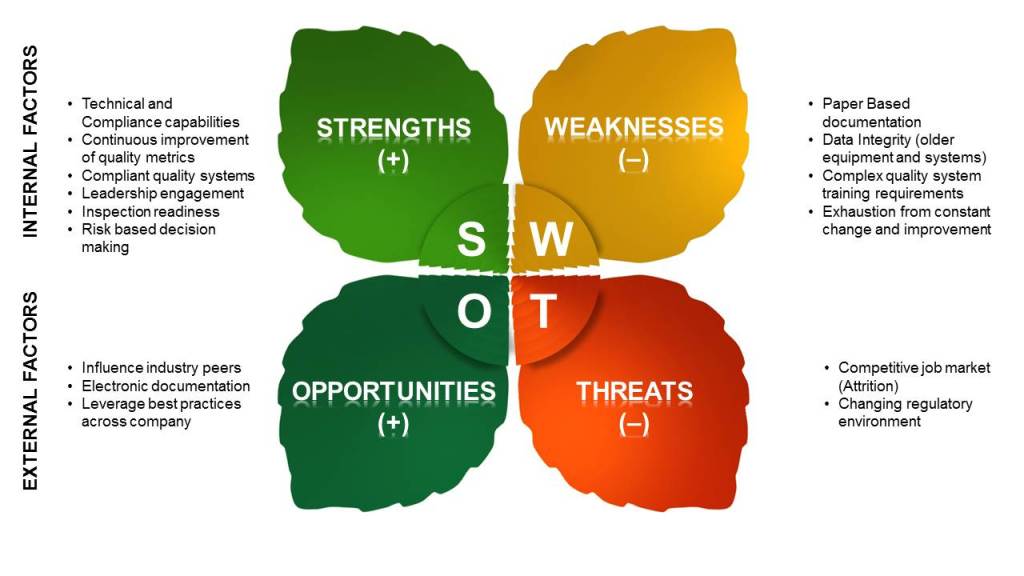
Looking back at my SWOT, I can see that it was a very useful tool for charting where this blog would take me. Change, risk, data, quality culture, knowledge management. All the items I spent time thinking about are there. I hope folks go as much use out of my thinking aloud as I did.
In the next few weeks I’ll be trying to utilize a few quality tools to lay out my goals for both this blog and my other professional endeavors in 2019.
As you wrap up 2018 and look forward to 2019, what quality matters are important to you?
How do regions acquire the knowledge they need to diversify their economic activities? How does the migration of workers among firms and industries contribute to the diffusion of that knowledge? Here we measure the industry-, occupation-, and location-specific knowledge carried by workers from one establishment to the next, using a dataset summarizing the individual work history for an entire country. We study pioneer firms—firms operating in an industry that was not present in a region—because the success of pioneers is the basic unit of regional economic diversification. We find that the growth and survival of pioneers increase significantly when their first hires are workers with experience in a related industry and with work experience in the same location, but not with past experience in a related occupation. We compare these results with new firms that are not pioneers and find that industry-specific knowledge is significantly more important for pioneer than for nonpioneer firms. To address endogeneity we use Bartik instruments, which leverage national fluctuations in the demand for an activity as shocks for local labor supply. The instrumental variable estimates support the finding that industry-specific knowledge is a predictor of the survival and growth of pioneer firms. These findings expand our understanding of the micromechanisms underlying regional economic diversification.
C. Jara-Figueroa, Bogang Jun, Edward L. Glaeser, and Cesar A. Hidalgo. “The role of industry-specific, occupation-specific, and location-specific knowledge in the growth and survival of new firms” PNAS December 11, 2018 115 (50) 12646-12653; published ahead of print December 10, 2018 https://doi.org/10.1073/pnas.1800475115
Interesting academic paper on industry domain knowledge that has ramifications on the pharmaceutical industry, including the quality domain.
This paper discusses background information related to RM regulatory requirements and industry challenges, and then highlights key principles to consider in setting up a risk-based RM management approach and control strategy. This paper then provides an example of how to translate those key principles into a detailed RM risk assessment methodology, and how to apply this methodology to specific raw materials. To better illustrate the diversity and nuance in applying a corresponding RM control strategy, a number of case studies with raw materials typically utilized in the manufacture of biological medicinal products have been included as well as discussion on phase-based mitigations.
One of the hallmarks of a quality culture is learning from our past experiences, to eliminate repeat mistakes and to reproduce success. The more times you do an activity, the more you learn, and the better you get (within limits for simple activities). Knowledge management is an enabler of quality systems, in part, to focus on learning and thus accelerate learning across the organization as a whole, and not just one person or a team.
This is where the” lessons learned” process comes in. There are a lot of definitions of lessons learned out there, but the definition I keep returning to is that a lessons learned is a change in personal or organizational behavior as a result from learning from experience. Ideally, this is a permanent, institutionalized change, and this is often where our quality systems can really drive continuous improvement.
Lessons identified is generate, assess, and share.
Updated processes (and documents) is contextualize, apply and update.
Lessons Learned in the Context of Knowledge Management
Identify Lessons Learned
Identifying lessons needs to be done regularly, the closer to actual change management and control activities the better. The formality of this exercise depends on the scale of the change. There are basically a few major forms:
After action reviews: held daily (or other regular cycle) for high intensity learning. Tends to be very focused on questions of the day.
Retrospective: Held at specific periods (for example project gates or change control status changes. Tends to have a specific focus on a single project.
Consistency discussions: Held periodically among a community of practice, such as quality reviewers or multiple site process owners. This form looks holistically at all changes over a period of time (weekly, monthly, quarterly). Very effective when linked to a set of leading and lagging indicators.
Incident and events: Deviations happen. Make sure you learn the lessons and implement solutions.
The chosen formality should be based on the level of change. A healthy organization will be utilizing all of these.
Level of Change
Form of Lesson Learned
Transactional
Consistency discussion After action (when things go wrong)
Organizational
Retrospective After action (weekly, daily as needed)
Transformational
Retrospective After action (daily)
Successful lessons learned:
Are based on solid performance data: Based on facts and the analysis of facts.
Separate experience from opinion as much as possible. A lesson arises from actual experience and is an objective reflection on the results.
Generate distinct lessons from which others can learn and take action. A good action avoids generalities.
In practice there are a lot of similarities between the techniques to facilitate a good lessons learned and a root cause analysis. Start with a good core of questions, starting with the what:
What were some of the key issues?
What were the success factors?
What worked well?
What did not work well?
What were the challenges and pitfalls?
What would you approach differently if you ever did this again?
From these what questions, we can continue to narrow in on the learnings by asking why and how questions. Ask open questions, and utilize all the techniques of root cause analysis here.
Then once you are at (or close) to a defined issue for the learning (a root cause), ask a future-tense question to make it actionable, such as:
What would your advice be for someone doing this in the future?
What would you do next time?
Press for specifics. if it is not actionable it is not really a learning.
Update the Process
Learning implies memory, and an organization’s memories usually require procedures, job aids and other tools to be updated and created. In short, lessons should evolve your process. This is often the responsibility of the change management process owner. You need to make sure the lesson actually takes hold.
Differences between effectiveness reviews and lesson’s learned
What can we learn from this change for the next change?
Effectiveness reviews are 1 and 2 (based on a risk based approach) while lessons learned is 3. Lessons learned contributes to the health of the system and drives continuous improvements in the how we make changes.
Citations
Lesson learned management model for solving incidents. (2017). 2017 12th Iberian Conference on Information Systems and Technologies (CISTI), Information Systems and Technologies (CISTI), 2017 12th Iberian Conference On, 1.
Fowlin, J. j & Cennamo, K. (2017). Approaching Knowledge Management Through the Lens of the Knowledge Life Cycle: a Case Study Investigation. TechTrends: Linking Research & Practice to Improve Learning, 61(1), 55–64.
Michell, V., & McKenzie, J. (2017). Lessons learned: Structuring knowledge codification and abstraction to provide meaningful information for learning. VINE: The Journal of Information & Knowledge Management Systems, 47(3), 411–428.
Milton, N. J. (2010). The Lessons Learned Handbook : Practical Approaches to Learning From Experience. Burlington: Chandos Publishing.
Paul R. Carlile. (2004). Transferring, Translating, and Transforming: An Integrative Framework for Managing Knowledge across Boundaries. Organization Science, (5), 555.
Secchi, P. (Ed.) (1999). Proceedings of Alerts and Lessons Learned: An Effective way to prevent failures and problems. Technical Report WPP-167. Noordwijk, The Netherlands: ESTEC




 Investigations of a Dog