The Building Blocks of Work-as-Prescribed

Work-as-Prescribed – how we translate the desired activities into a set of process and procedure – relies on an understanding of how people think and process information.

The format is pivotal. The difficulties we have in quality are really not much different from elsewhere in society in that we are surrounded by confusing documentation and poorly presented explanations everywhere we look, that provide information but not understanding. Oftentimes we rely on canards of “this is what is expected,” “this is what works” – but rarely is that based on anything more than anecdotal. And as the high incidence of issues and the high cost of training shows, less than adequate.

There is a huge body-of-knowledge out there on cognitive-friendly design of visuals, including documentation. This is an area we as a quality profession need to get comfortable with. Most important, we need to give ourselves permission to adapt, modify and transform the information we need into a shape that aids understanding and makes everyone a better thinker.

Work-as-Prescribed (and work-as-instructed) is the creation of tools and technologies to help us think better, understand more and perform at our peak.

Locus of Understanding

Looking at the process at the right level is key. Think of Work-as-Prescribed as a lens. Sometimes you need a high-powered lens so that you can zoom in on a single task. Other times, you need to zoom out to see a set of tasks, a whole process, or how systems interact.

This is the locus of understanding, where understanding happens. When we take this position, we see how understanding is created. Adopting the locus of understanding means going to the right level for the problem at hand. When we apply it to Work-as-Prescribed we are applying the same principles as we do in problem-solving to developing the right tools to govern the work.

We are conducting knowledge management as part of our continuous improvement.

An important way to look is distributed cognitive resources, which means anything that contributes to the cognitive work being done. Adjusting the locus of understanding means that you can, and should, treat an SOP as a cognitive resource. Some of the memory is in your head and some is in the SOP. Work-as-prescribed is a cognitive resource that we distribute, routinely and casually across the brain and our quality system in the form of documents and other execution aids.

Other tools, like my favorite whiteboard, also serve as distributed cognitive resources.

So, as our documents and other tools are distributed cognitive resources it behooves us to ensure they are based on the best cognitive principles possible to drive the most benefit.

As an aside, there is a whole line of thought about why some physical objects are better at distributed cognitive resources than electronic. Movement actually matters.

Taking it even further (shifting the locus) we can see the entire quality system as a part of a single distributed cognitive system where cognitive work is performed via the cognitive functions of communicating, deciding, planning, and problem-solving. These cognitive functions are supported by cognitive processes such as perceiving, analyzing, exchanging, and manipulating.

Cognitive Activity in Work-As-Prescribed

The tools we develop to provide distributed cognitive activity strive to:

  • Provide short-term or long-term memory aids so that memory load can be reduced.
  • Provide information that can be directly perceived and used such that little effort is needed to interpret and formulate the information explicitly.
  • Provide knowledge and skills that are unavailable from internal representations.
  • Support perceptual operators that can recognize features easily and make inferences directly.
  • Anchor and structure cognitive behavior without conscious awareness.
  • Change the nature of a task by generating more efficient action sequences.
  • Stop time and support perceptual rehearsal to make invisible and transient information visible and sustainable.
  • Aid processibility by limiting abstraction.
  • Determine decision making strategies through accuracy maximization and effort minimization.

Driving Work-As Prescribed

As we build our requirements documents, our process and procedure, there are a few principles to keep in mind to better tap into distributed cognitive resources.

Plan for the flow of information: Think about paths, relationships, seams, edges and other hand-offs. Focus on the flow of information. Remember that we learn in a spiral, and the content needed for a novice is different from that of an expert and build our documents and the information flow accordingly. This principle is called Sequencing.

Break information down into pieces: Called, Chunking, the grouping together of information into ideally sized pieces. When building Work-As-Prescribed pay close attention to which of these chunks are reusable and build accordingly.

The deeply about context: How a tool is used drives what the tool should be.

Think deeply about information structures: Not all information is the same, not every example of Work-as-Prescribed should have the same structure.

Be conscientious about the digital and physical divide: Look for opportunities to integrate or connect these two worlds. Be honest of how enmeshed they are at any point in the system.

We are building our Work-as-Prescribed through leveraging our quality culture, our framework for coordinating work. Pay attention to:

  1. Shared Standards – Ways we communicate
  2. Invisible Environments – Ways we align, conceptually
  3. Visible Environments – Ways we collaborate
  4. Psychological Safety – Ways we behave
  5. Perspectives – Ways we see (and see differently)

Principles in Practice

When design process, procedure and task documentation leverage this principles by build blocks, or microcontent, that is:

  • about one primary idea, fact, or concept
  • easily scannable
  • labeled for clear identification and meaning, and
  • appropriately written and formatted for use anywhere and any time it is needed.

There is a common miscomprehension that simple means short. That just isn’t true. Simple means that it passes a test for the appropriateness of the size of a piece of content of providing sufficient details to answer a specific question for the targeted audience. The size of the content must effectively serve its intended purpose with efficiency, stripping off any unnecessary components.

We need to strive to apply cognitive thinking principles to our practice. The day of judging a requirements document by its page length is long over.

Constituents of cognitive thinking applied to Work-As-Prescribed

Implementing a Quality Ambassador Program

Quality ambassadors can influence their peers to prioritize quality, thereby strengthening the culture of quality in the organization. Quality leaders can use this guide to develop a quality ambassador program by identifying, training, and engaging ambassadors.

Utilizing Kotter’s eight accelerators for change, we can implement a Quality Ambassador program like this:

AcceleratorActions
Create a strong sense of urgency around a big opportunityDemonstrate the organizational value of Ambassadors by performing a needs analysis to assess the current state of employee engagement with quality.
Build and evolve a guiding coalitionBring together key stakeholders from across the organization who will provide input in the program’s design and support its implementation.
Form a change vision and strategic initiativesIdentify the key objectives for implementing a Quality Ambassador program and outline the lines of effort required to successfully design and pilot it.
Enlist a volunteer armyReach out and engage informal leaders at all levels of the organization. Find your current informal Ambassadors and draw them in.
Enable action by removing barriersBe vigilant for factors that impede progress. Work with your Ambassadors and senior leaders to give teams the freedom and support to succeed.
Generate and celebrate short-term winsPilot the program. Create success stories by looking at the successful outcomes of teams that have Quality Ambassadors and by listening to team members and their customers for evidence that quality culture is improving. Your goal will be to create an environment where teams that do not have Quality Ambassadors are asking how they can participate.
Sustain accelerationScale the impact of your program by implementing it more broadly within the organization.

Define the Key Responsibilities of Quality Ambassadors

  
What activities should Quality Ambassadors focus on?  Example: Reinforce key quality messages with co-workers. Drive participation in quality improvement projects. Provide inputs to improve culture of quality. Provide inputs to improve and maintain data integroty
What will Quality Ambassadors need from their managers?    Example: Approval to participate, must be renewed annually
What will Quality Ambassadors receive from the Quality team?    Example: Training on ways to improve employee engagement with quality. Support for any questions/objections that ariseTraining on data integrity  
What are Quality Ambassadors’ unique responsibilities?    Example: Acting as the point of contact for all quality-related queries. Reporting feedback from their teams to the Quality leadership. Conveying to employees the personal impact of quality on their effectiveness. Mitigating employee objections about pursuing quality improvement projects. Tackling obstacles to rolling out quality initiatives
What responsibilities do Quality Ambassadors share with other employees?    Example: Constantly prioritize quality in their day-to-day work  
Expected time commitment    Example: 8-10 hours/month, plus 6 hours of training at launch

Metrics to Measure Success

Type of MetricsList of MetricsDirect Impact of Ambassador’s workRecommendations
Active Participation LevelsPercentage of organizational units adopting culture of quality program.
The number of nominations for quality recognition programs. Quality observations were identified during Gemba walks. Participation or effectiveness of problem-solving or root-cause processes. The number of ongoing quality improvement projects. Percentage of employees receiving quality training  
HighAmbassadors should be directly held responsible for these metrics
Culture of Quality AssessmentsCulture of quality surveys. Culture of quality maturity assessmentsMediumThe Quality Ambassador program is a factor for improvement.
Overall Quality PerformanceKey KPI associated with Quality. Audit scoresCost of poor qualityLowThe Quality Ambassador program is a factor for improvement.

Hierarchy is not inevitable

I’m on the record in believing that Quality as a process is an inherently progressive one and that when we stray from those progressive roots we become exactly what we strive to avoid. One only has to look at the history of Six Sigma, TQM, and even Lean to see that.

I’m a big proponent of Humanocracy for that very reason.

One cannot read much of business writing without coming across the great leader (or even worse great man) hypothesis, which serves to naturalize power and existing forms of authority. One cannot even escape the continued hagiography of Jack Welch, even though he’s been discredited in many ways for his toxic legacy.

We cannot drive out fear unless we unmask power by revealing its contradictions, hypocrisies, and reliance on violence and coercion. The way we work is a result of human decisions, and thus capable of being remade.

We all have a long way to go here. I, for example, catch myself all the time speaking of leadership in hierarchical ways. One of the current things I am working on is exorcising the term ‘leadership team’ from my vocabulary. It doesn’t serve any real purpose and it fundamentally puts the idea of leadership as a hierarchical entity.

Another thing I am working on is to tackle the thorn of positional authority, the idea that the higher the rank in the organization the more decision-making authority you have. Which is absurd. In every organization, I’ve been in people have positions of authority that cover areas they do not have the education, experience, and training to make decisions in. This is why we need to have clear decision matrixes, establish empowered process owners and drive democratic leadership throughout the organization.

The stick is broken, regulatory agencies are toothless

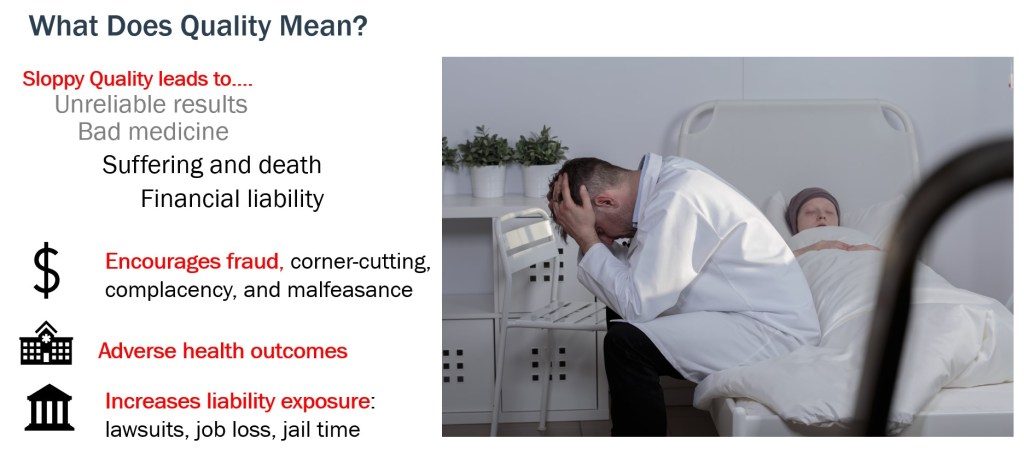
Admit it, we’ve all been through GxP training that utilizes the stick. I’m assuming many of you have designed it. It might have looked like this:

Perhaps you have went over the hundred-and-fifty-plus years history of regulatory action, discussing Elixir Sulfanilamide, thalidomide, and a dozen other noteworthy cases that shared the modern regulatory environment.

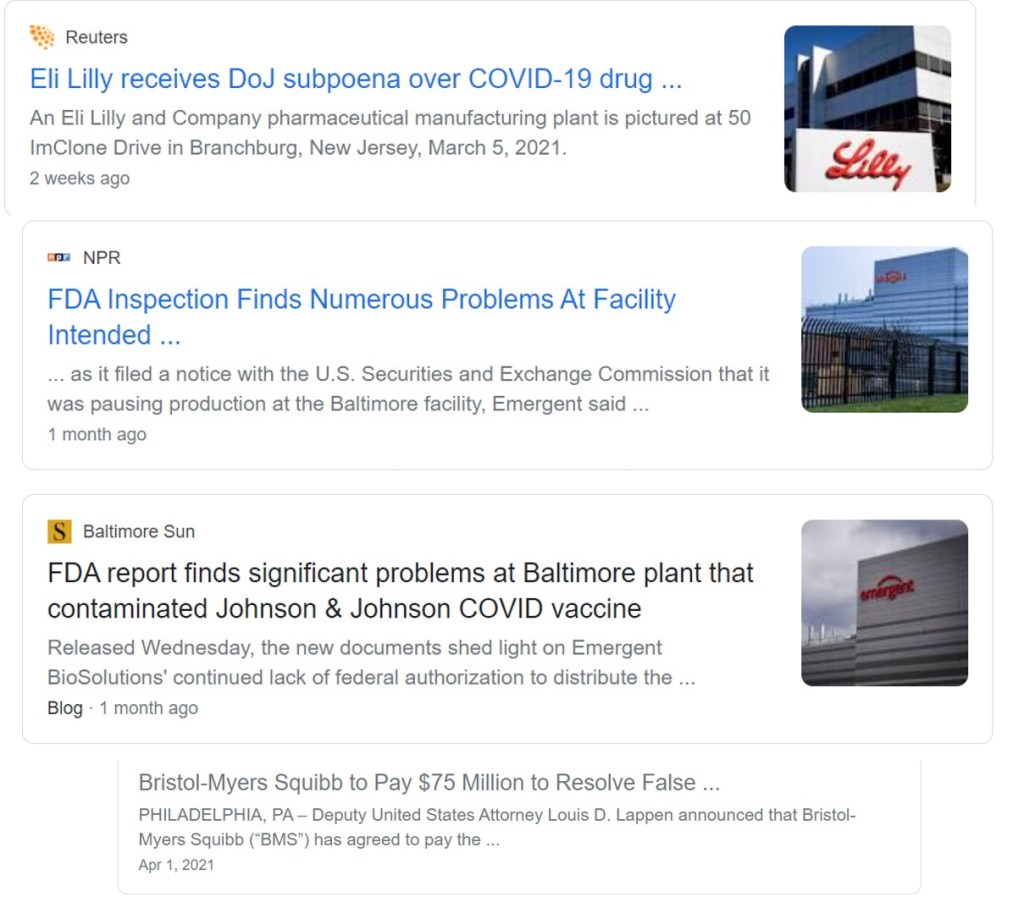
Or perhaps you just like to show a slide with recent headlines on it.

Let’s put aside all the excellent research about the power of positive messaging etc. Valid stuff but not the point I’m trying to make.

The point I want to make in this post is that the regulatory stick has long been broken. Companies suffer at most a slap on the wrist, fines that are weeks or months of profit. But real repercussions are absent.

The Sackler family walks away with billions, MacKenzie gets a slap on the wrist, and other companies are all protected from their deliberate actions in fueling the opioid epidemic.

J&J avoids all real accountability for knowingly causing cancer.

The list goes on.

Frankly, I think this is really bad for our industry. If the price of being caught is pennies to the dollar earned, it has become merely a cost of doing business.

This erodes trust in the safety of our drug supply. And if the last year hasn’t brought home the importance of that trust, you may be hiding under a rock.

We need more perp walks. We need a real system of deterrence that involves arrests and punishments that match the crimes. We can’t even count on the one form of deterrence left, liability lawsuits because companies are playing shenanigans with bankruptcy laws.

We talk about how quality culture starts at the top. But as we see again and again, the top only cares about profit.

That makes me fundamentally worry about the safety of our drugs and medical devices. And if I someone who has dear friends who work at large and small pharma worry, I must admit I can understand why people start to hold suspicions.

Engaging for Quality

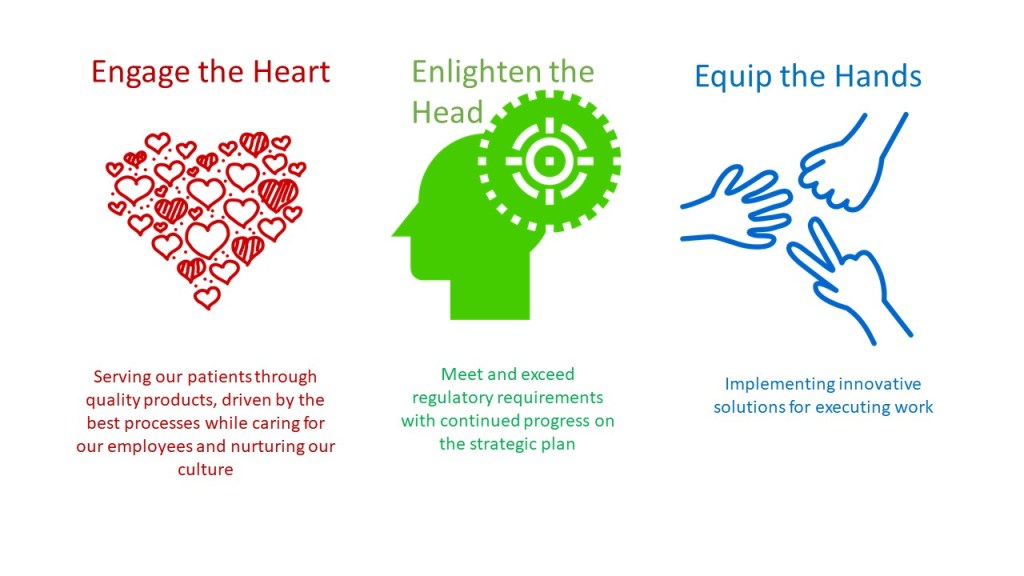
When building a quality organization, we are striving to do three things: get employees (and executives) to feel the need for quality in their bones; get them to understand what quality is and why it is important; and build the process, procedure, and tools to make quality happen. Practitioners in change management often call this heart, head, and hands.

Engage the heart, head and hands to build a quality culture

In our efforts we strive to answer give major themes of questions about why building a culture of quality is critical.

ThemeQuestions
WhyWhy do we need quality? Why is it important? What are the regulatory expectations? What happens if we do nothing?
WhatWhat results are expected for our patients? Our organization? Our people? What does out destination look and feel like?
HowHow will we get there? What’s our plan and process? What new behaviors do we each need to demonstrate?
YouWhat do you need to fulfill your role in quality? What do we need from you?
MeWhat do I commit to as a leader? What will I do to make change a reality? How will I support my team?
Five Themes of Change

The great part of this is that the principles of building a quality culture are the same mindsets we want embedded in our culture. By demonstrating them, we build and strengthen the culture, and will reap the dividends.

Be Preventative: What actions can be taken to prevent undesirable/unintended consequences with employees and other stakeholders. We do this by:

  • Involving end-users in the design process
  • Conduct risk assessments and lessons learned to predict possible failures
  • Ensure the reason for change is holistic and accounts for all internal and external obligations
  • Determine metrics as soon as possible
  • Focus on how the organization is responding to ongoing change
  • Think through how roles need to change and what employees need to be accountable for

Be Proactive: What actions can be taken to successfully meet objectives?

Be Responsive: What evidence-based techniques can be used to respond to issues, including resistance?

This is all about leveraging the 8 change accelerators and effectively developing strategies for change.