Multi-Criteria Decision-Making to Drive Risk Control

To be honest, too often, we perform a risk assessment not to make decisions but to justify an already existing risk assessment. The risk assessment may help define a few additional action items and determine how rigorous to be about a few things. It actually didn’t make much of an impact on the already-decided path forward. This is some pretty bad risk management and decision-making.

For highly important decisions with high uncertainty or complexity, it is useful to consider the options/alternatives that exist and assess the benefits and risks of each before deciding on a path forward. Thoroughly identifying options/alternatives and assessing the benefits and risks of each can help the decision-making process and ultimately reduce risk.

An effective, highly structured decision-making process can help answer the question, ‘How can we compare the consequences of the various options before deciding?

The most challenging risk decisions are characterized by having several different, important things to consider in an environment where there are often multiple stakeholders and, often, multiple decision-makers. 

In Multi-Criteria Decision-Making (MCDM), the primary objective is the structured consideration of the available alternatives (options) for achieving the objectives in order to make the most informed decision, leading to the best outcome.

In a Quality Risk Management context, the decision-making concerns making informed decisions in the face of uncertainty about risks related to the quality (and/or availability) of medicines.

Key Concepts of MCDM

  1. Conflicting Criteria: MCDM deals with situations where criteria conflict. For example, when purchasing a car, one might need to balance cost, comfort, safety, and fuel economy, which often do not align perfectly.
  2. Explicit Evaluation: Unlike intuitive decision-making, MCDM involves a structured approach to explicitly evaluate multiple criteria, which is crucial when the stakes are high, such as deciding whether to build additional manufacturing capacity for a product under development.
  3. Types of Problems:
  • Multiple-Criteria Evaluation Problems: These involve a finite number of alternatives known at the beginning. The goal is to find the best alternative or a set of good alternatives based on their performance across multiple criteria.
  • Multiple-Criteria Design Problems: In these problems, alternatives are not explicitly known and must be found by solving a mathematical model. The number of alternatives can be very large, often exponentially.

Preference Information: The methods used in MCDM often require preference information from decision-makers (DMs) to differentiate between solutions. This can be done at various stages of the decision-making process, such as prior articulation of preferences, which transforms the problem into a single-criterion problem.

MCDM focuses on risk and uncertainty by explicitly weighing criteria and trade-offs between them. Multi-criteria decision-making (MCDM) differs from traditional decision-making methods in several key ways:

  1. Explicit Consideration of Multiple Criteria: Traditional decision-making often focuses on a single criterion like cost or profit. MCDM explicitly considers multiple criteria simultaneously, which may be conflicting, such as cost, quality, safety, and environmental impact[1]. This allows for a more comprehensive evaluation of alternatives.
  2. Structured Approach: MCDM provides a structured framework for evaluating alternatives against multiple criteria rather than relying solely on intuition or experience. It involves techniques like weighting criteria, scoring alternatives, and aggregating scores to rank or choose the best option.
  3. Transparency and Consistency: MCDM methods aim to make decision-making more transparent, consistent, and less susceptible to individual biases. The criteria, weights, and evaluation process are explicitly defined, allowing for better justification and reproducibility of decisions.
  4. Quantitative Analysis: Many MCDM methods employ quantitative techniques, such as mathematical models, optimization algorithms, and decision support systems. This enables a more rigorous and analytical approach compared to traditional qualitative methods.
  5. Handling Complexity: MCDM is particularly useful for complex decision problems involving many alternatives, conflicting objectives, and multiple stakeholders. Traditional methods may struggle to handle such complexity effectively.
  6. Stakeholder Involvement: Some MCDM methods, like the Analytic Hierarchy Process (AHP), facilitate the involvement of multiple stakeholders and the incorporation of their preferences and judgments. This can lead to more inclusive and accepted decisions.
  7. Trade-off Analysis: MCDM techniques often involve analyzing trade-offs between criteria, helping decision-makers understand the implications of prioritizing certain criteria over others. This can lead to more informed and balanced decisions.

While traditional decision-making methods rely heavily on experience, intuition, and qualitative assessments, MCDM provides a more structured, analytical, and comprehensive approach, particularly in complex situations with conflicting criteria.

Multi-Criteria Decision-Making (MCDM) is typically performed following these steps:

  1. Define the Decision Problem: Clearly state the problem or decision to be made, identify the stakeholders involved, and determine the desired outcome or objective.
  2. Establish Criteria: Identify the relevant criteria that will be used to evaluate the alternatives. These criteria should be measurable, independent, and aligned with the objectives. Involve stakeholders in selecting and validating the criteria.
  3. Generate Alternatives: Develop a comprehensive list of potential alternatives or options that could solve the problem. Use techniques like brainstorming, benchmarking, or scenario analysis to generate diverse alternatives.
  4. Gather Performance Data: Assess how each alternative performs against each criterion. This may involve quantitative data, expert judgments, or qualitative assessments.
  5. Assign Criteria Weights: By assigning weights, determine each criterion’s relative importance or priority. This can be done through methods like pairwise comparisons, swing weighting, or direct rating. Stakeholder input is crucial here.
  6. Apply MCDM Method: Choose an appropriate MCDM technique based on the problem’s nature and the available data. Some popular methods include: Analytic Hierarchy Process (AHP); Technique for Order of Preference by Similarity to Ideal Solution (TOPSIS); ELimination and Choice Expressing REality (ELECTRE); Preference Ranking Organization METHod for Enrichment of Evaluations (PROMETHEE); and, Multi-Attribute Utility Theory (MAUT).
  7. Evaluate and Rank Alternatives: Apply the chosen MCDM method to evaluate and rank the alternatives based on their performance against the weighted criteria. This may involve mathematical models, software tools, or decision support systems.
  8. Sensitivity Analysis: Perform sensitivity analysis to assess the robustness of the results and understand how changes in criteria weights or performance scores might affect the ranking or choice of alternatives.
  9. Make the Decision: Based on the MCDM analysis, select the most preferred alternative or develop an action plan based on the ranking of alternatives. Involve stakeholders in the final decision-making process.
  10. Monitor and Review: Implement the chosen alternative and monitor its performance. Review the decision periodically, and if necessary, repeat the MCDM process to adapt to changing circumstances or new information.

MCDM is an iterative process; stakeholder involvement, transparency, and clear communication are crucial. Additionally, the specific steps and techniques may vary depending on the problem’s complexity, the data’s availability, and the decision-maker’s preferences.

MCDM TechniqueDescriptionApplicationKey Features
Analytic Hierarchy Process (AHP)A structured technique for organizing and analyzing complex decisions, using mathematics and psychology.Widely used in business, government, and healthcare for prioritizing and decision-making.Pairwise comparisons, consistency checks, and hierarchical structuring of criteria and alternatives.
Technique for Order Preference by Similarity to Ideal Solution (TOPSIS)Based on the concept that the chosen alternative should have the shortest geometric distance from the positive ideal solution and the longest geometric distance from the negative ideal solution.Frequently used in engineering, management, and human resource management for ranking and selection problems.Compensatory aggregation, normalization of criteria, and calculation of geometric distances.
Elimination and Choice Expressing Reality (ELECTRE)An outranking method that compares alternatives by considering both qualitative and quantitative criteria. It uses a pairwise comparison approach to eliminate less favorable alternatives.Commonly used in project selection, resource allocation, and environmental management.Use of concordance and discordance indices, handling of both qualitative and quantitative data, and ability to deal with incomplete rankings.
Preference Ranking Organization Method for Enrichment Evaluation (PROMETHEE)An outranking method that uses preference functions to compare alternatives based on multiple criteria. It provides a complete ranking of alternatives.Applied in various fields such as logistics, finance, and environmental management.Preference functions, visual interactive modules (GAIA), and sensitivity analysis.
Multi-Attribute Utility Theory (MAUT)Involves converting multiple criteria into a single utility function, which is then used to evaluate and rank alternatives. It takes into account the decision-maker’s risk preferences and uncertainties.Used in complex decision-making scenarios involving risk and uncertainty, such as policy analysis and strategic planning.Utility functions, probabilistic weights, and handling of uncertainty.
Popular MCDM Techniques

Fostering Critical Thinking

As a leader, fostering critical thinking in my team and beyond is a core part of my job. Fostering critical thinking means an approach that encourages open-mindedness, curiosity, and structured problem-solving.

Encourage Questioning and Healthy Debate

It is essential to create an environment where team members feel comfortable questioning assumptions and engaging in constructive debates. Encourage them to ask “why” and explore different perspectives. This open dialogue promotes deeper thinking and prevents groupthink.

Foster a Culture of Curiosity

Inspire your team to ask questions and seek deeper understanding. Role model this behavior by starting meetings with thought-provoking “what if” scenarios or sharing your own curiosities. Celebrate curiosity and reward those who think outside the box.

Assign Stretch Assignments

Provide your team with challenging tasks that push them beyond their comfort zones. These stretch assignments force them to think critically, analyze information from multiple angles, and develop innovative solutions.

Promote Diverse Perspectives

Encourage diversity of thought within your team. Diverse backgrounds, experiences, and viewpoints can challenge assumptions and biases, leading to a more comprehensive understanding and better decision-making.

Engage in Collaborative Problem-Solving

Involve your team in decision-making processes and problem-solving exercises. Techniques like role reversal debates, where team members argue a point they disagree with, can help them understand different perspectives and refine their argumentative skills.

Provide Training and Resources

Offer training sessions on critical thinking techniques, such as SWOT analysis, root cause analysis, and logical fallacies. Equip your team with the tools and frameworks they need to think critically.

Lead by Example

As a leader, model critical thinking behaviors. Discuss your thought processes openly, question your assumptions, and show the value of critical evaluation in real-time decision-making. Your team will be more likely to emulate these habits.

Encourage Continuous Learning

Recommend learning resources, such as courses, articles, and books from diverse fields. Continuous learning can broaden perspectives and foster multifaceted thinking.

Embrace Feedback and Mistakes

Establish feedback loops within the team and create a safe environment where mistakes are treated as learning opportunities. Receiving and giving feedback helps refine understanding and overcome biases.

Implement Role-Playing Scenarios

Use role-playing scenarios to simulate real-world challenges. This helps team members practice critical thinking in a controlled environment, enhancing their ability to apply these skills in actual situations.

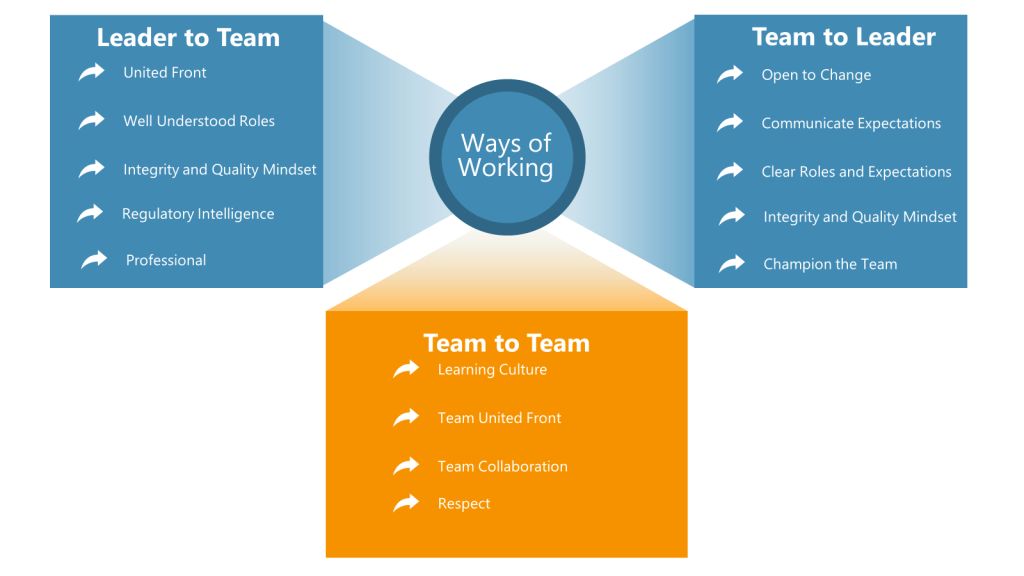
Build Into the Team Charter

Building these expectations into the team charter holds you and your team accountable.

Value: Regulatory Intelligence

Definition: Stay current on industry regulations and guidances. 

Desired Behaviors:

  1. I will dedicate time to reading industry-related guidance and regulation publications related to my job.
  2. I will share publications that I find interesting or applicable to my job with the team
  3. I will present to the team on at least one topic per year to share learnings with the team (or wider organization)

Value: Learning Culture

Definition: Share lessons learned from projects so the team can grow together and remain aligned.  Engage in knowledge-sharing sessions.

Desired Behaviors:

  1. I will share lessons learned from each project with the wider team via the team channel and/or weekly team meeting.
  2. I will encourage team members to openly share their experiences, successes, and challenges without fear of judgement.
  3. I will update RAID log with decisions made by the team.
  4. I will identify possible process improvements and update the process improvement tracker.

Value: Team Collaboration

Definition: Willingness to help teammates when they reach out for input/help

Desired Behaviors:

  1. I will be supportive of my teammate’s requests for assistance
  2. I will engage and offer my SME advice when asked or help identify another SME to assist 
  3. I will not ignore requests for input/help
  4. I will contribute to an environment where teammates can request help

Thinking of Swiss Cheese: Reason’s Theory of Active and Latent Failures

The Theory of Active and Latent Failures was proposed by James Reason in his book, Human Error. Reason stated accidents within most complex systems, such as health care, are caused by a breakdown or absence of safety barriers across four levels within a system. These levels can best be described as Unsafe Acts, Preconditions for Unsafe Acts, Supervisory Factors, and Organizational Influences. Reason used the term “active failures” to describe factors at the Unsafe Acts level, whereas “latent failures” was used to describe unsafe conditions higher up in the system.

This is represented as the Swiss Cheese model, and has become very popular in root cause analysis and risk management circles and widely applied beyond the safety world.

Swiss Cheese Model

In the Swiss Cheese model, the holes in the cheese depict the failure or absence of barriers within a system. Such occurrences represent failures that threaten the overall integrity of the system. If such failures never occurred within a system (i.e., if the system were perfect), then there would not be any holes in the cheese. We would have a nice Engelberg cheddar.

Not every hole that exists in a system will lead to an error. Sometimes holes may be inconsequential. Other times, holes in the cheese may be detected and corrected before something bad happens. This process of detecting and correcting errors occurs all the time.

The holes in the cheese are dynamic, not static. They open and close over time due to many factors, allowing the system to function appropriately without catastrophe. This is what human factors engineers call “resilience.” A resilient system is one that can adapt and adjust to changes or disturbances.

Holes in the cheese open and close at different rates. The rate at which holes pop up or disappear is determined by the type of failure the hole represents.

  1. Holes that occur at the Unsafe Acts level, and even some at the Preconditions level, represent active failures. Active failures usually occur during the activity of work and are directly linked to the bad outcome. Active failures change during the process of performing, opening, and closing over time as people make errors, catch their errors, and correct them.
  2. Latent failures occur higher up in the system, above the Unsafe Acts level — the Organizational, Supervisory, and Preconditions levels. These failures are referred to as “latent” because when they occur or open, they often go undetected. They can lie “dormant” or “latent” in the system for an extended period of time before they are recognized. Unlike active failures, latent failures do not close or disappear quickly.

Most events (harms) are associated with multiple active and latent failures. Unlike the typical Swiss Cheese diagram above, which shows an arrow flying through one hole at each level of the system, there can be a variety of failures at each level that interact to produce an event. In other words, there can be several failures at the Organizational, Supervisory, Preconditions, and Unsafe Acts levels that all lead to harm. The number of holes in the cheese associated with events are more frequent at the Unsafe Acts and Preconditions levels, but (usually) become fewer as one progresses upward through the Supervisory and Organizational levels.

Given the frequency and dynamic nature of activities, there are more opportunities for holes to open up at the Unsafe and Preconditions levels on a frequent basis and there are often more holes identified at these levels during root cause investigation and risk assessments.

The way the holes in the cheese interact across levels is important:

  • One-to-many mapping of causal factors is when a hole at a higher level (e.g., Preconditions) may result in several holes at a lower level (e.g. Unsafe acts)
  • Many-to-one mapping of causal factors when multiple holes at the higher level (e.g. preconditions) might interact to produce a single hole at the lower level (e.g. Unsafe Acts)

By understand the Swiss Cheese model, and Reason’s wider work in Active and Latent Failures, we can strengthen our approach to problem-solving.

Plus cheese is cool.

Swiss Cheese on a cheese board with knife

Call a Band-Aid a Band-Aid: Corrections and Problem-Solving

A common mistake made in problem-solving, especially within the deviation process, is not giving enough foresight to band-aids. As I discussed in the post “Treating All Investigations the Same” it is important to be able to determine what problems need deep root-cause analysis and which ones should be more catch and release.

For catch and release you usually correct, document, and close. In these cases the problem is inherently small enough and the experience suggesting a possible course of action – the correction – sound enough, that you can proceed without root cause analysis and a solution. If those problems persist, and experience and intuition-drive solutions prove ineffective, then we might decide to engage in structured problem-solving for a more effective solution and outcome.

In the post “When troubleshooting causes trouble” I discussed that lays out the 4Cs: Concern, Cause, Countermeasure, Check Results. It is during the Countermeasure step that we determine what immediate or temporary countermeasures can be taken to reduce or eliminate the problem? Where we apply correction and immediate action.

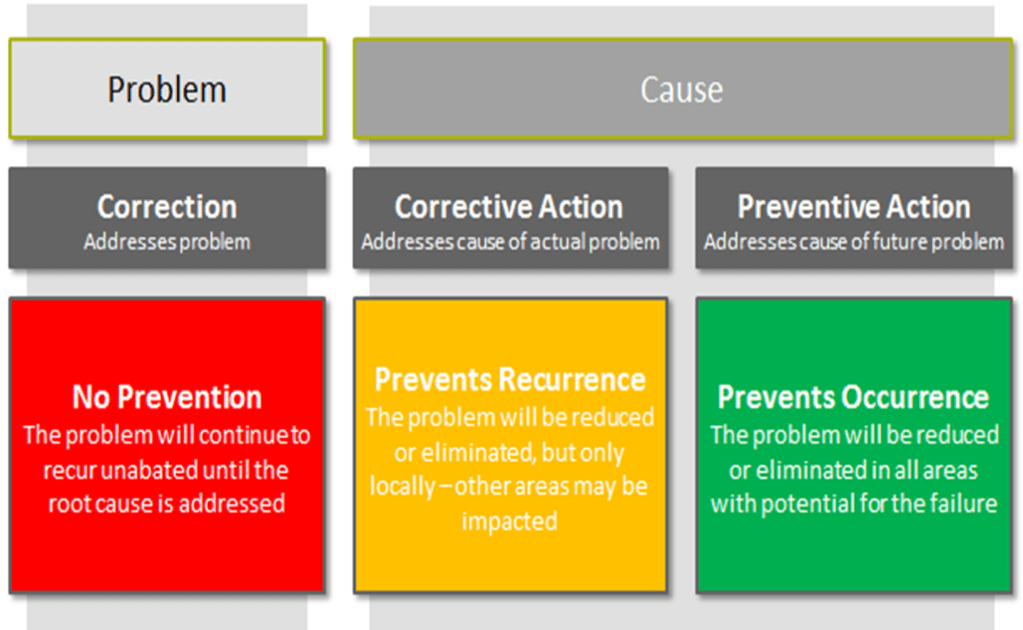
It helps to agree on what a correction is, especially as it relates to corrective actions. Folks often get confused here. A Correction addresses the problem, it does not get to addressing the cause.

Fixing a tire, rebooting a computer, doing the dishes. These are all corrections.

As I discussed in “Design Problem Solving into the Process” good process design involves thinking of as many problems that could occur, identifying the ways to notice these problems, and having clear escalation paths. For low-risk issues, that is often just fix, record, move on. I talk a lot more about this in the post “Managing Events Systematically.”

A good problem-solving system is built to help people decide when to apply these band-aids, and when to engage in more structured problem-solving. This reliance on situational awareness is key to build into the organization.

Design Problem Solving into the Process

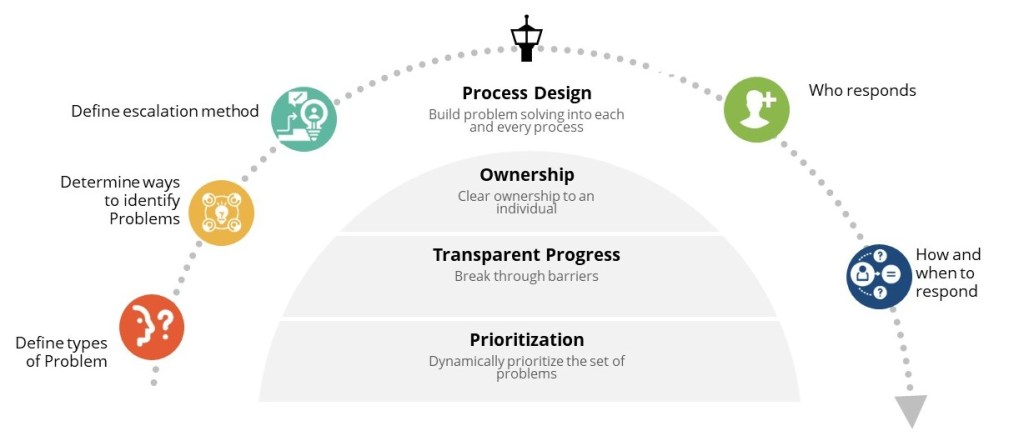
Good processes and systems have ways designed into them to identify when a problem occurs, and ensure it gets the right rigor of problem-solving. A model like Art Smalley’s can be helpful here.

Each and every process should go through the following steps:

  1. Define those problems that should be escalated and those that should not. Everyone working in a process should have the same definition of what is a problem. Often times we end up with a hierarchy of issues that are solved within the process – Level 1 – and those processes that go to a root cause process (deviation/CAPA) – level 2.
  2. Identify the ways to notice a problem. Make the work as visual as possible so it is easier to detect the problem.
  3. Define the escalation method. There should be one clear way to surface a problem. There are many ways to create a signal, but it should be simple, timely, and very clear.

These three elements make up the request for help.

The next two steps make up the response to that request.

  1. Who is the right person to respond? Supervisor? Area management? Process Owner? Quality?
  2. How does the individual respond, and most importantly when? This should be standardized so the other end of that help chain is not wondering whether, when, and in what form that help is going to arrive.

In order for this to work, it is important to identify clear ownership of the problem. There always must be one person clearly accountable, even if only responsible for bits, so they can push the problem forward.

It is easy for problem-solving to stall. So make sure progress is transparent. Knowing what is being worked on, and what is not, is critical.

Prioritization is key. Not every problem needs solving so have a mechanism to ensure the right problems are being solved in the process.

Problem solving within a process