Automation has been a truism throughout my career. Organizations that leveraged that automation to create value were superior to the ones which used that automation as an excuse to cut jobs.
As we move oh so quickly to dealing with the impact of hyper-automation on our organizations it is important to have a vision and a strategy. Apply quality principles, and remember to drive out fear through the strategic execution.
The word quality is a loaded word in organizations, and I’m sure most of my readers have been in a least one major discussion that has felt like an Abbott and Costello routine.
The difference between “quality” and the “Quality department” is that “quality” refers to the overall level of excellence or excellence in a product, service, or process, while the “Quality department” is part of an organization that is responsible for ensuring that the organization’s products, services, or processes meet certain quality standards.
In other words, “quality” is a general concept that refers to the level of excellence or excellence in something, while the “Quality department” is a specific part of an organization that is responsible for managing and improving the quality of that organization’s products, services, or processes.
The Quality department typically plays a key role in ensuring that an organization’s products, services, or processes meet the required quality standards. This might involve activities such as conducting quality assurance audits, implementing quality control measures, or providing training and support to help employees understand and comply with quality standards.
Overall, the difference between “quality” and the “Quality department” is that “quality” is a broad concept that refers to the overall level of excellence or excellence in something, while the “Quality department” is the specific part of an organization that is responsible for managing and improving the quality of that organization’s products, services, or processes.
In FDA-regulated industries, this continues to be a stressful point. We have some regulations that specifically call out the Quality Unit or Quality Control (a different point of fun), while others provide quality expectations that may or may not be the responsibility of the Quality Unit, depending on the way your organization is built.
Add to this that quality is a culturally sensitive term. It gets to the heart of what people consider integral to themselves. That they have quality in their work. And there can be gaps between people’s perceptions and the reality of the organization. The whole concept of what quality is in an organization gets to three central aspects:
Role Conception: what people think their jobs are and how they have been trained to perform them
Role Expectation: what others in the organization think another person’s job is and how it should be carried out
Role Behavior: what people actually do in carrying out their job
So we have quality as a set of habits and practices and Quality as a concept of a role within an organization. And the boundaries between the two can be contentious. Add in the quality control layer (and how quality control does not require a department called quality control) and we can have a whole fun set of arguments.
This post was brought to you by me being in a meeting where someone referenced a version of the golden triangle and I instantly wondered what work someone else was trying to foist off onto me.
Engaging with knowledge and Knowledge Management are critical parts of development. The ability to navigate the flood of available data to find accurate information is tied directly to individuals’ existing knowledge and their skills at distinguishing credible information from misleading content.
There is ample evidence that many individuals lack the ability to accurately judge their understanding or the quality and accuracy of their performance (i.e., calibration). To truly develop our knowledge, we need to be engaged in deliberative practice. But to truly calibrate requires feedback, guidance, and coaching that you may not have access to within our organizations. This requires effort and deliberate building of a system and processes.
Information can be found with little mental effort but without critical analysis of its legitimacy or validity, the ease of information can actually work against the development of deeper-processing strategies. It is really easy to go-online and get an answer, but unless learners put themselves in positions to struggle cognitively with an issue, and unless they have occasions to transform or reframe problems, their likelihood of progressing into competence is jeopardized.
The more learners forge principled knowledge in a professional domain, the greater their reported interest in and identity with that field. Therefore, without the active pursuit of knowledge, these individuals’ interest in professional development may wane and their progress toward expertise may stall. This is why I find professional societies so critical, and why I am always pushing people to step up.
My constant goal as a mentor is to help people do the following:
Refuse to be lulled into accepting a role as passive consumers of information, striving instead to be active producers of knowledge
Probe and critically analyze the information they encounter, rather than accepting quick, simple answers
Forge a meaningful interest in the profession and personal connections to members of professional communities, instead of relying on moment-by-moment stimulation and superficial relationships
If we are going to step up to the challenges ahead of us, to address the skill gaps we are seeing, we each need to be deliberate in how we develop and deliberate in how we build our organizations to support development.
The process of writing and speaking is a core part of the Quality profession. Only through these activities can we truly contemplate and learn from our accomplishments to propel us forward to new heights.
There are some great speaking opportunities for folks around the Boston area coming up:
BOSCON is November 6 and 7th and is looking for speakers. I’m a huge fan of this regional convention and strongly recommend it. Submissions are due August 15th, 2023.
The ASQ’s Quality Innovations Summit (formerly the Quality 4.0 Summit) is September 19–21 in Boston, MA with a theme of “Innovations and Future Trends for Excellence.” Submission deadline is June 9th, 2023, with more information here.
I’m quite happy to help coach potential new speakers, both in the development of your proposal and in your presentation.
The World Economic Forum (WEF) has developed a Global Skills Taxonomy that provides a framework for aligning around a universal language for skills. It synthesizes and builds on existing taxonomies by integrating definitions and categorizations of skills that are of growing relevance in a fast-changing labor market 1
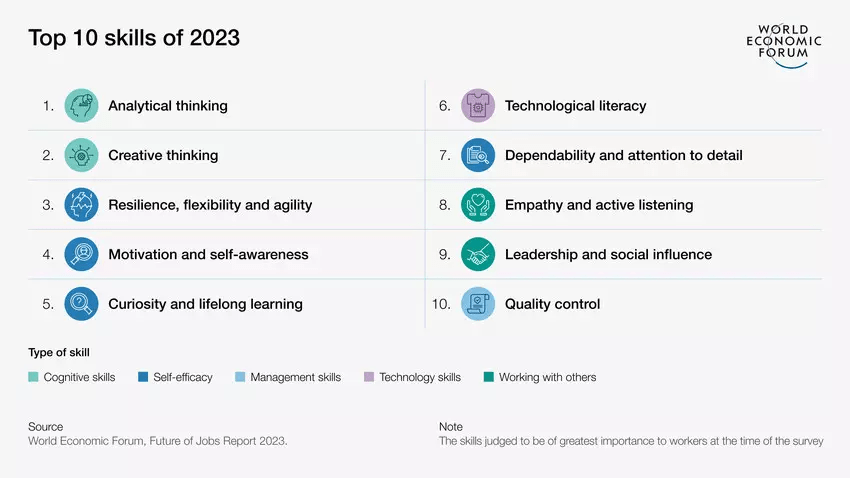
According to the World Economic Forum’s Future of Jobs Report 2023, quality control is one of the top 10 core skills listed in the Global Skills Taxonomy. In the WEF taxonomy, Quality control refers to the process of verifying that a product or service meets specified standards or requirements. It appears to bundle both quality control and quality assurance into this definition.
Quality Control was not listed in the top 10 in the 2020 report. Throughout you find reference to a skill set called “Quality control and safety awareness”, so we can assume this is a refinement in the reporting. In any case, this is an interesting development that I wish the WEF’s material provided more detail on, especially as the 2021 Skills Taxonomy doesn’t include an entry for Quality Control.
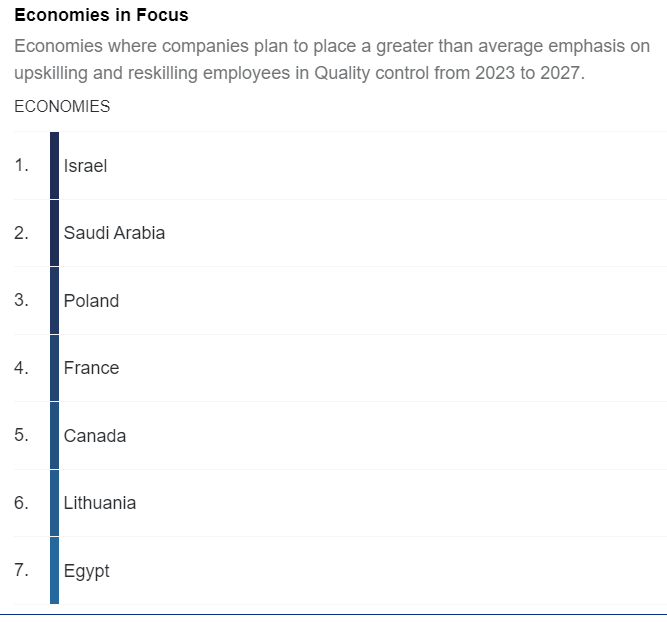
You need to go to the Data Explorer for Quality Control to see valuable information. Including this nice chart on the 7 top countries emphasizing quality control.
What facinates me most here is how it is not developing countries, there are some economic power houses here.
The industry categories of importance are interesting. Some industries I consider strong on quality rank below the mean and ohers above the mean. Others, Information and technology services I am looking at you, rate well below the mean on importance and it explains a lot of what is wrong with the world.
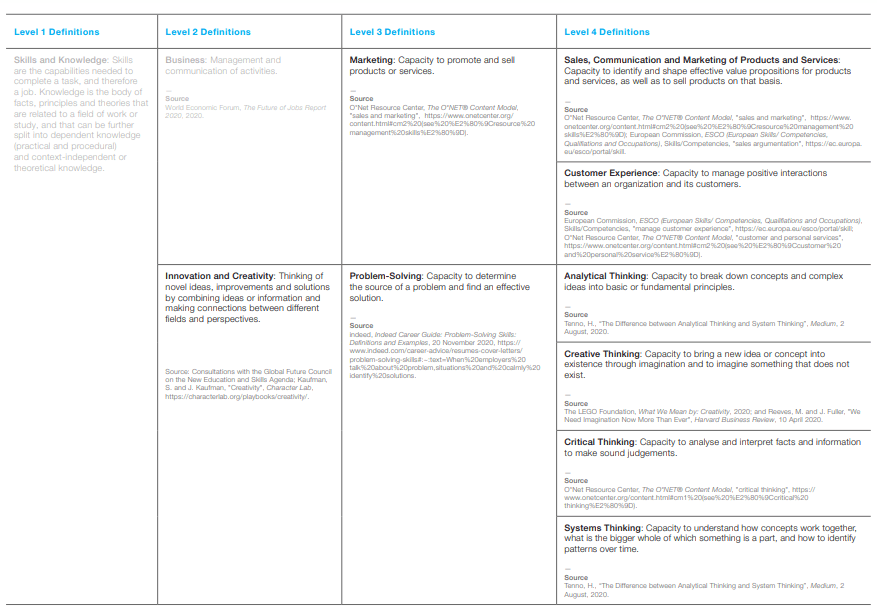
It would be nice to see the taxonomic entry. I’m fascinated by this one on Problem-Solving, which contains the first 2 in the top 10.
Interesting read that creates a lot of questions for me. But France and Canada, feel free to hit me up since it seems you are skill building.
And to help the WEF out, here is a nice way to break down what Quality is all about.



 Investigations of a Dog