
Utilizing Rubrics

A rubric is a tool used primarily in educational settings to evaluate and assess student performance. It provides a clear set of criteria and standards that describe varying levels of quality for a specific assignment or task. Rubrics are designed to ensure consistency and objectivity in grading and feedback, making them a valuable resource for both teachers and students.

Rubrics are useful in assessing competencies and skills within organizations, providing a structured way to evaluate strengths and weaknesses, which makes them perfect for knowledge based activities to gauge appropriate training and execution. They can really help demonstrate that an outcome is a good one.

Key Features of a Rubric

  • Criteria: Rubrics list specific criteria that are important for the assignment. These criteria outline what is expected from the intended work, such as clarity, organization, and mechanics in a writing assignment.
  • Performance Levels: Rubrics define different levels of achievement for each criterion, often using descriptive language (e.g., excellent, good, needs improvement) or numerical scores (e.g., 4, 3, 2, 1).
  • Feedback and Guidance: Rubrics provide detailed feedback, helping individuals understand their strengths and areas for improvement. This feedback can guide executors in revising their work to meet learning objectives more effectively.

Types of Rubrics

  • Analytic Rubrics: These break down the assignment into several components, each with its own set of criteria and performance levels. This type provides detailed feedback on specific areas of the work.
  • Holistic Rubrics: These assess the work as a whole rather than individual components. They provide a single overall score based on the general quality of the work.
  • Single-Point Rubrics: These focus on a single level of performance for each criterion, highlighting areas that meet expectations and those that need improvement.
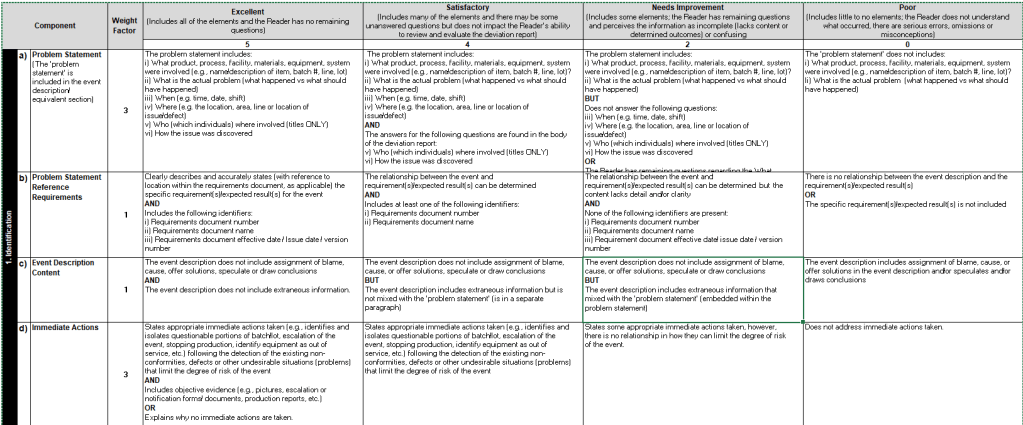
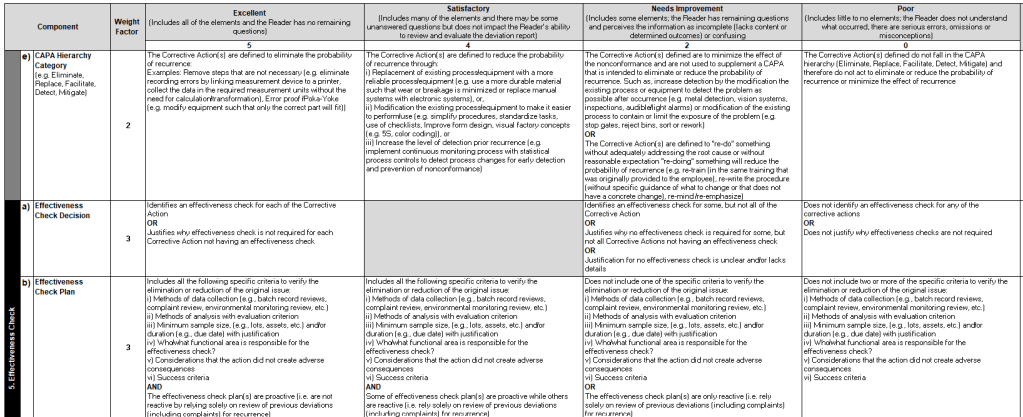
An example from a deviation rubric

Benefits of Using Rubrics

  • Clarity and Consistency: Rubrics help clarify expectations for students, ensuring they understand what is required to be good. They also promote consistency across activities.
  • Self-Assessment: Rubrics encourage individuals to reflect on their own work and understand the standards they need to meet. This can lead to improved learning outcomes as individuals become more aware of their progress and areas needing improvement.

I love rubrics. They are great for all quality systems. They can be used for on-the-job training, for record writing and review, for re-qualifications. By creatin rubrics you define what good looks like by providing a structured and objective framework that improves clarity, consistency, and specificity in evaluations. It holds both the writer and the reviewer accountable.
When Your Deviation/CAPA Program Runs Smoothly Expect a Period of Increased Deviations

One reason to invest in the CAPA program is that you will see fewer deviations over time as you fix issues. That is true, but it takes time. Yes, you’ve dealt with your backlog, improved your investigations, integrated risk management, built problem-solving into your processes, and are truly driving preventative actions. And yet your deviations remain high. What is going on?

It’s because you are getting good at things and working your way through the bolus of problems. Here’s what is going on:

  1. Improved Detection and Reporting: As a CAPA program matures, it enhances an organization’s ability to detect and report deviations. Employees become more adept at identifying and documenting deviations due to better training and awareness, leading to a temporary increase in reported deviations.
  2. Thorough Root Cause Analysis: A well-functioning CAPA program emphasizes thorough root cause analysis. This process often uncovers previously unnoticed issues and identifies additional deviations that need to be addressed.
  3. Increased Scrutiny and Compliance: As the CAPA program gains momentum, management usually scrutinizes it more, which can lead to the discovery of more deviations. Organizations become more vigilant in maintaining compliance, resulting in more deviations being reported and documented.
  4. Systematic Process Improvements: The CAPA process often leads to systemic improvements in processes and procedures. As these improvements are implemented, any deviations from the new standards are more likely to be identified and recorded, contributing to an initial rise in deviation reports.
  5. Cultural Shift Towards Quality: A successful CAPA program fosters a culture of quality and continuous improvement. Employees may feel more empowered and responsible for reporting deviations, increasing the number of deviations captured.

Expect these changes and build your metric program around them. Avoid introducing a metric like a reduction in deviations in the first year, as such a metric will drive bad behavior. Instead, focus on metrics that demonstrate the success of the changes and, over time, introduce metrics to see the overall benefits.

Risk Management Addresses Uncertainty

The ICH Q9 guideline on Quality Risk Management (QRM), including its revised version ICH Q9(R1), addresses the concept of uncertainty as a critical component in risk management within the pharmaceutical industry.

Understanding Uncertainty in ICH Q9

Uncertainty in the context of ICH Q9 refers to the lack of complete knowledge about a process and its expected or unexpected variability. This uncertainty can stem from various sources, including gaps in knowledge about pharmaceutical science, process understanding, and potential failure modes.

Key Points on Uncertainty from ICH Q9(R1)

Sources of Uncertainty:

    • Knowledge Gaps: Incomplete understanding of the scientific and technical aspects of processes.
    • Process Variability: Both expected and unexpected changes in process performance.
    • Failure Modes: Unidentified or poorly understood potential points of failure in processes or systems.

    Managing Uncertainty:

      • Risk-Based Decision Making: The guideline emphasizes that decisions should be made based on the level of uncertainty, importance, and complexity of the situation. This means that more formal and structured approaches should be used when uncertainty is high.
      • Formality in QRM: ICH Q9(R1) introduces the concept of formality as a spectrum, suggesting that the degree of formality in risk management activities should be commensurate with the level of uncertainty. Less formal methods may be appropriate for well-understood processes, while highly structured methods are necessary for areas with high uncertainty.

      Reducing Subjectivity:

        • The guideline acknowledges that subjectivity can impact the effectiveness of risk management. It recommends strategies to minimize subjectivity, such as using well-recognized risk assessment tools and involving cross-functional teams to provide diverse perspectives.

        Continuous Improvement:

          • ICH Q9(R1) stresses the importance of continual improvement in risk management processes. This involves regularly updating risk assessments and control measures as new information becomes available, thereby reducing uncertainty over time.

          Practical Implementation

          In practice, managing uncertainty within the framework of ICH Q9 involves:

          • Conducting thorough risk assessments to identify potential hazards and their associated risks.
          • Applying appropriate risk control measures based on the level of uncertainty and the criticality of the process.
          • Documenting and reviewing risk management activities to ensure they remain relevant and effective as new information is obtained.

          Conclusion

          The ICH Q9 approach to uncertainty underscores the importance of a structured, knowledge-based approach to risk management in the pharmaceutical industry. By addressing uncertainty through rigorous risk assessments and appropriate control measures, organizations can enhance the reliability and safety of their processes and products, ultimately safeguarding patient health and safety.

          The Importance for USP <665> for E&L

          The United States Pharmacopeia (USP) General Chapter <665> focuses on the plastic components and systems used in the manufacturing of pharmaceutical drug products and biopharmaceutical drug substances and products and is one the fundamental documents for manufacturers, especially in the age of single use.

          Key Changes in USP <665>

          1. Effective Date Extension

          The official effective date for USP <665> has been extended to May 1, 2026. This extension is intended to give stakeholders enough time to follow the new requirements and to align with the development of the ICH Q3E guideline for extractables and leachables (E&Ls).

          2. Mandatory Compliance

          Previously, USP <665> was informational and not mandatory for compendial compliance. The revisions will make it a mandatory chapter, meaning that compliance will be required for regulatory purposes.

          3. Risk-Based Assessments

          The revised chapter emphasizes risk-based assessments for the qualification of plastic components. This approach aligns with modern regulatory expectations and provides a structured methodology for evaluating the safety and compatibility of materials used in pharmaceutical manufacturing.

          4. Scope and Applicability

          USP <665> will cover single-use systems (SUS) and container closure systems used in the storage and processing of pharmaceutical and biopharmaceutical products. This includes guidance on the characterization and qualification of these systems to ensure they do not adversely affect product quality.

          5. No Grandfathering of Existing Products

          The revisions explicitly state that there will be no grandfathering of existing products. All products, including those already on the market, will need to comply with the new requirements by the effective date.

          6. Alignment with USP <1665>

          USP <665> is closely related to USP <1665>, which provides guidance on the characterization and qualification processes. Together, these chapters offer a comprehensive framework for managing the risks associated with plastic components in pharmaceutical manufacturing.

          7. Stakeholder Engagement

          The USP has planned to engage with stakeholders throughout the revision process to ensure that the new requirements are practical and achievable. This includes public notices, comment periods, and collaboration with industry experts.

          Implications for Manufacturers

          Preparation and Compliance

          Manufacturers are advised to start preparing for the changes now to avoid potential backlogs and delays. Early compliance will help make sure a smooth transition and keep product quality.

          Global Considerations

          While the USP is a U.S.-based standard, its guidelines are often adopted globally. Manufacturers should consider the potential for international regulatory bodies to require equivalency to USP <665> compliance in the future.