Walker et al. (2010) developed a taxonomy of “levels of uncertainty”, ranging from Level 1 to Level 4, which is useful in problem-solving:
Level 1uncertainties are defined as relatively minor – as representing “a clear enough future” set within a “single system model” whereby outcomes can be estimated with reasonable accuracy;
Level 2 uncertainties display “alternative futures” but, again, within a single system in which probability estimates can be applied with confidence.
Levels 3 and 4 uncertainties are described as representing “deep uncertainty”.
Level 3 uncertainties are described as “a multiplicity of plausible futures”, in which multiple systems interact, but in which we can identify “a known range of outcomes”
Level 4 uncertainties lead us to an “unknown future” in which we don’t understand the system: we know only that there is something, or are some things, that we know we don’t know.
This hierarchy can be useful to help us think carefully about whether the uncertainty behind a problem can be defined in terms of a Level 1 prediction, with parameters for variation. Or, can it be resolved as group of Level 2 possibilities with probability estimates for each? Can the issue only be understood as a set of different Level 3 futures, each with a clear set of defined outcomes, or only by means of a Level 4 statement to the effect that we know only that there is something crucial that we don’t yet know?
There is often no clear or unanimous view of whether a particular uncertainty is set at a specific level. Uncertainty should always be considered at the deepest proposed level, unless or until those that propose this level can be convinced by an evidence-based argument that it should be otherwise.
Sources
Walker, W.E., Marchau, V.A.W.J. and Swanson, D. (2010) “Addressing Deep Uncertainty using Adaptive Policies: Introduction to Section 2”, Technological Forecasting & Social Change, 77: 917–23.
Written procedures with their step-by-step breakdown are a fundamental tool for ensuring quality through consistent execution of the work. As a standardized guideline for tasks, procedures serve many additional purposes: basis of training, ensuring regulatory requirements are met, ensuring documentation is prepared and handled correctly.
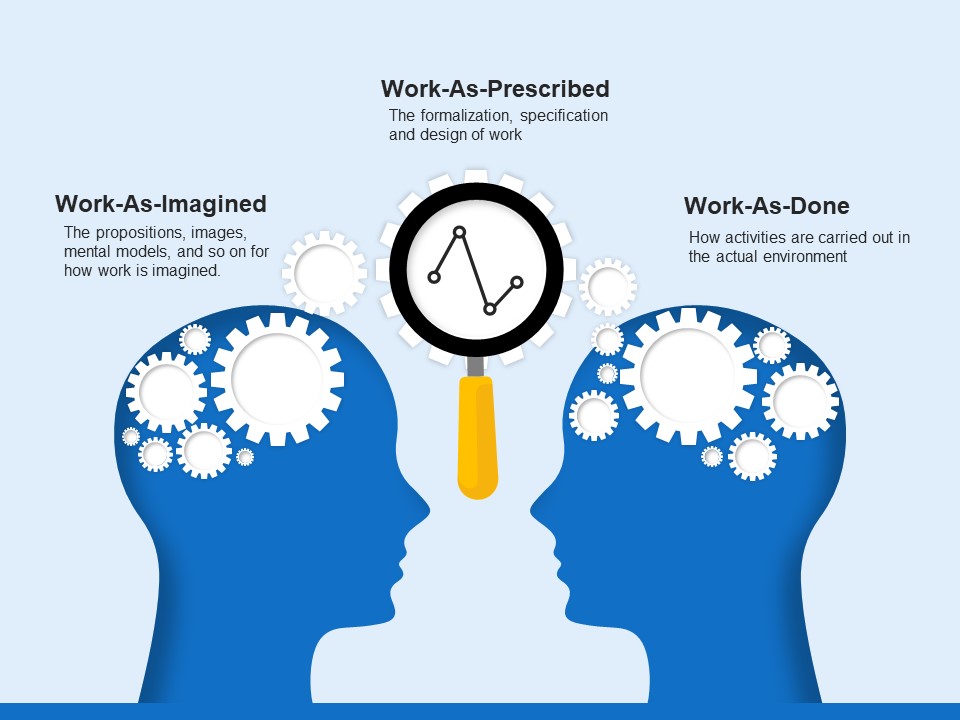
As written prescriptions of how work is to be performed, they can be based on abstract and often decontextualized expectations of work. The writers of the procedures are translating Work-as-Imagined. As a result, it is easy to write from a perspective of ideal and stable conditions for work and end up ignoring the nuances introduced by the users of procedures and the work environment.
The day-to-day activities where the procedures are implemented is Work-as-Done. Work-is-Done is filled with all the factors that influence the way tasks are carried out – spatial and physical conditions; human factors such as attention, memory, and fatigue; knowledge and skills.
Ensuring that our procedures translate from the abstraction of Work-as-Imagined to the realities of Work-as-Done as closely as possible is why we should engage in step-by-step real-world challenge as part of procedure review.
Work-as-Prescribed gives us the structure to take a more dynamic view of workers, the documents they follow, and the procedural and organizational systems in which they work. Deviations from Work-as-Prescribed point-of-view are not exclusively negative and are an ability to close the gap. This is a reason to closely monitor causes such as “inadequate procedure” and “failure to follow procedure” – they are indicators of a drift between Work-as-Prescribed and Work-as-Done. Management review will often highlight a disharmony with Work-As-Imagined.
The place where actions are performed in real-world operations is called, in safety thinking, the sharp-end. The blunt-end is management and those who imagine work, such as engineers, removed from doing the work.
Our goal is to shrink the gap between Work-as-Imagined and Work-as-Done through refining the best possible Work-as-Prescribed and reduce the differences between the sharp and the blunt ends. This is why we stress leadership behaviors like Gemba walks and ensure a good document change process that strives to give those who use procedure a greater voice and agency.
I went and did it. I now have a song on complex and complicated. A rap anthem to a subject I hold so dear. I bought this through Fiverr from Burtonm6, who was a joy to work with.
Lyrics below
Complicated and complex
these words are not synonyms/
people often misunderstand
i can break down for you
lets begin
problems that are complicated
gotta check how they originated/
from causes that can be addressed
piece by piece
individually distinguished/
yea
hope that you get the idea
cause and effect is linear
when we’re dealing with complicated
there’s more so listen here
learn the difference
ah yea we got to
I’m here to help yes i got you
remember
every input always has a proportionate output
now its time we move on to complex
lets learn what its about and how its so different
it deals with many causes that cant be distinguished
as individual
because it all intersects
and we must address as an entire system
and if you try to solve it then its not a one and done
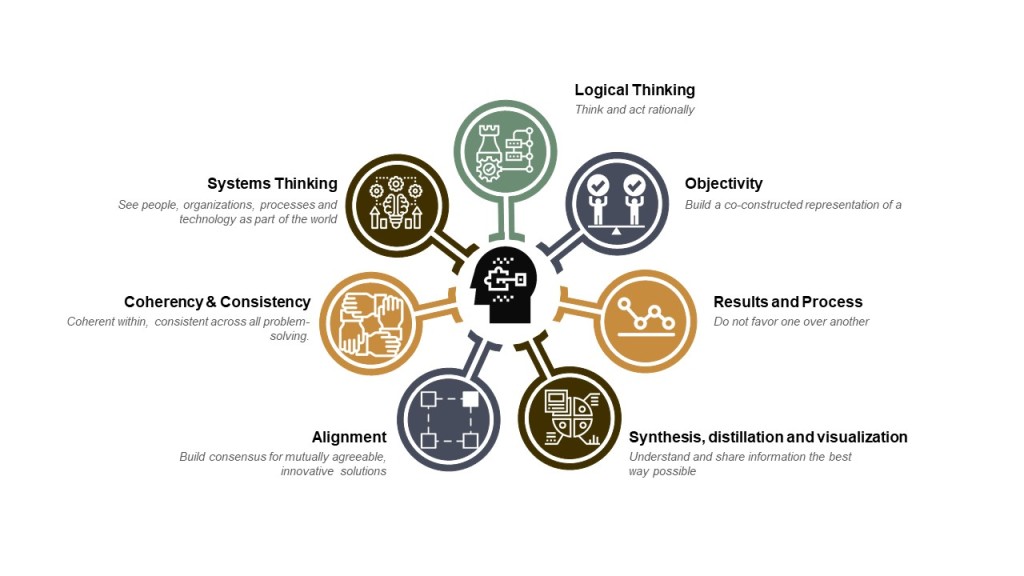
Perhaps more than anything else, we want our people to be able to think and then act rationally in decision making and problem-solving. The basic structure and technique embodied in problem solving is a combination of discipline when executing PDCA mixed with a heavy dose of the scientific method of investigation.
Logical thinking is tremendously powerful because it creates consistent, socially constructed approaches to problems, so that members within the organization spend less time spinning their wheels or trying to figure out how another person is approaching a given situation. This is an important dynamic necessary for quality culture.
The right processes and tools reinforce this as the underlying thinking pattern, helping to promote and reinforce logical thought processes that are thorough and address all important details, consider numerous potential avenues, take into account the effects of implementation, anticipate possible stumbling blocks, and incorporate contingencies. The processes apply to issues of goal setting, policymaking, and daily decision making just as much as they do to problem-solving.
Objectivity
Because human observation is inherently subjective, every person sees the world a little bit differently. The mental representations of the reality people experience can be quite different, and each tends to believe their representation is the “right” one. Individuals within an organization usually have enough common understanding that they can communicate and work together to get things done. But quite often, when they get into the details of the situation, the common understanding starts to break down, and the differences in how we see reality become apparent.
Problem-solving involves reconciling those multiple viewpoints – a view of the situation that includes multiple perspectives tends to be more objective than any single viewpoint. We start with one picture of the situation and make it explicit so that we can better share it with others and test it. Collecting quantitative (that is, objective) facts and discussing this picture with others is a key way in verifying that the picture is accurate. If it is not, appropriate adjustments are made until it is an accurate representation of a co-constructed reality. In other words, it is a co-constructed representation of a co-constructed reality.
Objectivity is a central component to the problem solving mindset. Effective problem-solvers continually test their understanding of a situation for assumptions, biases, and misconceptions. The process begins by framing the problem with relevant facts and details, as objectively as possible. Furthermore, suggested remedies or recommended courses of action should promote the organizational good, not (even if subconsciously) personal agendas.
Results and Process
Results are not favored over the process used to achieve them, nor is process elevated above results. Both are necessary and critical to an effective organization.
Synthesis, Distillation and and Visualization
We want to drive synthesis of the learning acquired in the course of understanding a problem or opportunity and discussing it with others. Through this multiple pieces of information from different sources are integrated into a coherent picture of the situation and recommended future action.
Visual thinking plays a vital role in conveying information and the act of creating the visualization aids the synthesis and distillation process.
Alignment
Effective implementation of a change often hinges on obtaining prior consensus among the parties involved. With consensus, everyone pulls together to overcome obstacles and make the change happen. Problem-solving teams communicates horizontally with other groups in the organization possibly affected by the proposed change and incorporates their concerns into the solution. The team also communicates vertically with individuals who are on the front lines to see how they may be affected, and with managers up the hierarchy to determine whether any broader issues have not been addressed. Finally, it is important that the history of the situation be taken into account, including past remedies, and that recommendations for action consider possible exigencies that may occur in the future. Taking all these into consideration will result in mutually agreeable, innovative solutions.
Coherency and Consistency
Problem-solving efforts are sometimes ineffective simply because the problem-solvers do not maintain coherency. They tackle problems that are not important to the organization’s goals, propose solutions that do not address the root causes, or even outline implementation plans that leave out key pieces of the proposed solution. So coherency within the problem-solving approach is paramount to effective problem resolution.
Consistent approaches to problem-solving speed up communication and aid in establishing shared understanding. Organizational members understand the implicit logic of the approach, so they can anticipate and offer information that will be helpful to the problem-solvers as they move through the process.
An important part of innovation, risk management, change management, continuous improvement is overcoming the fear of the unknown. We humans are wired with an intense aversion to both risk and uncertainty. Research shows that both have separate neural reactions and that choices with ambiguous outcomes trigger a stronger fear response than do risky choices. Additional research shows that the risk itself isn’t so much the problem, but the uncertainty is: we are afraid primarily because we don’t know the outcome and less so because of the risk.
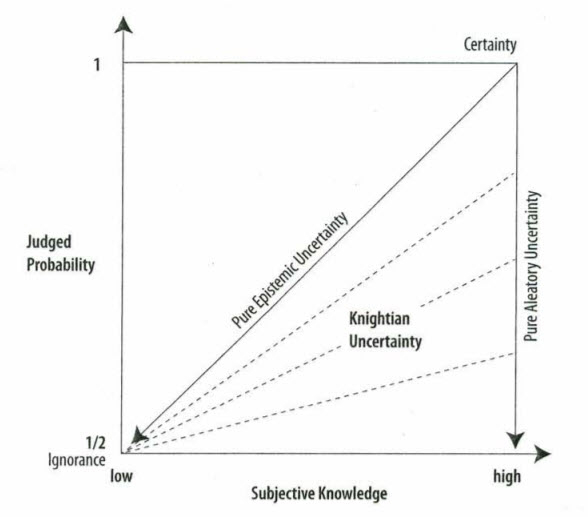
There are three types of uncertainty:
Aleatoric Uncertainty: The uncertainty of quantifiable probabilities.
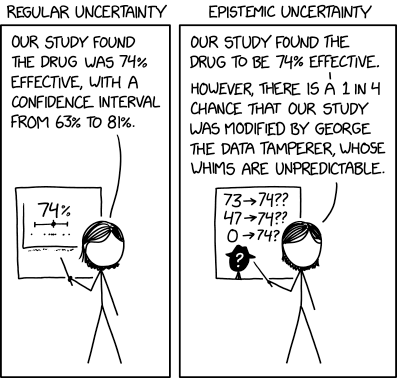
Epistemic Uncertainty: The uncertainty of knowledge.
Knightian Uncertainty: The uncertainty of nonquantifiable risk.

 Investigations of a Dog