Teams Need Vision Too

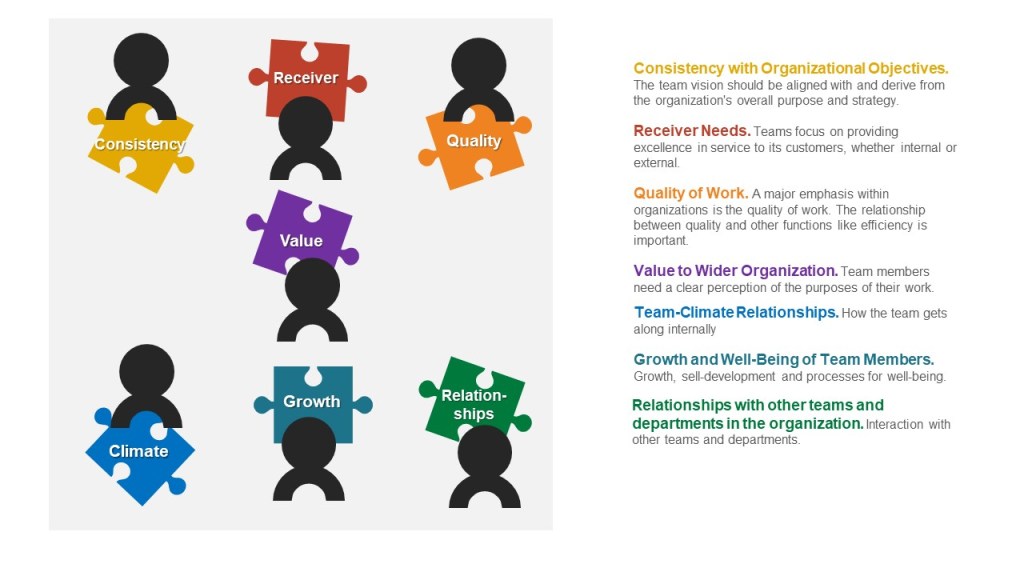
Teams exist to execute to organization objectives. In order to meet these objectives, a team needs a vision of itself. There are eight major elements to a team’s vision:

  1. Consistency with organizational objectives: The team vision should be aligned with and derive from the organization’s overall purpose and strategy. Teams are sub-elements in a wider organization structure and their success will be judged on the extent to which they make valuable contributions to the overall purpose of the organization. In some circumstances a team may decide that it is important for its own values, purposes and orientations to act as a minority group which aims to bring about change in organization objectives – perhaps like a red team.
  2. Receiver needs: Teams focus on providing excellence in service to its customers, whether internal or external.
  3. Quality of work: A major emphasis within organizations is the quality of work. The relationship between quality and other functions like efficiency is important.
  4. Value to the wider organization: Understanding the importance of the team just not for the wider organization but beyond, leads to team cohesion and greater team effectiveness. Team members need a clear perception of the purposes of their work.
  5. Team-climate relationships: Team climate refers to aspects such as the warmth, humor, amount of conflict, mutual support, sharing, backbiting, emphasis on status, participation, information sharing, level of criticism of each other’s work and support for new ideas.
  6. Growth and well-being of team members: Growth, skill development and challenge are central elements of work life and teams can be a major source of support. Teams provide opportunities for skill sharing and support for new training. Teams need to be concerned for the well-being of its members, including things like burnout.
  7. Relationships with other teams and departments in the organization: Teams rarely operate in isolation. They interact with other team and departments within the organization. Teams must be committed to working effectively and supporting other teams. Avoid silo thinking.
Criteria for Team Vision

Drive Out Fear on International Workers Day

Happy International Workers Day. Let’s celebrate by Driving Out Fear!

Thirty-five years ago Deming wrote that “no one can put in his best performance unless he feels secure.” Unfortunately, today we still live in a corporate world where fear and management by fear is ubiquitous. That fear is growing after more than a year of a global pandemic. As quality professionals we must deal with it at every opportunity.

Fear undermines quality, productivity, and innovation. The existence of fear leads to a vicious downward spiral.

Some sources of fear include:

  • Competition: Many managers use competition to instill fear. Competition is about winners and losers. Success cannot exist without failure. Managers deem the anxiety generated by competition between co-workers a good thing as they compete for scarce resources, power and status. Therefore, management encourage competition between individuals, between groups and departments and between business units.
  • “Us and Them” Culture: The “us and them” culture that predominates in so many organizations proliferated by silos. Includes barriers between staff and supervisors.
  • Blame Culture: Fear predominates in a blame culture. Blame culture can often center around enshrining the idea of human error.

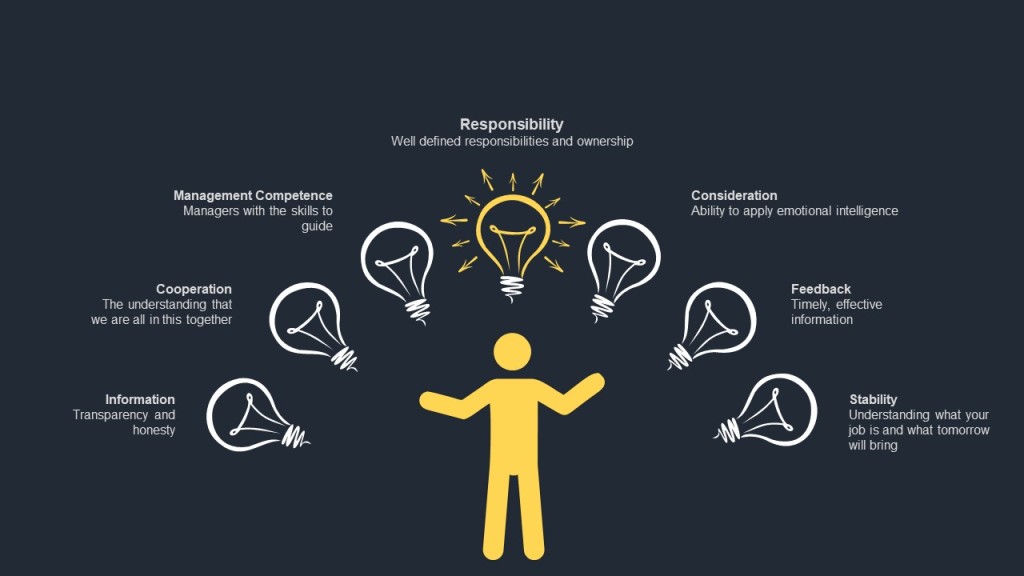
We drive out fear by building a culture centered on employee well-being. This is based on seven factors.

FactorMeansObtained by
ResponsibilityWell defined responsibilities and ownershipThe opportunity an employee has to provide input into decision making in his department
An individual employees’ own readiness to set high personal standards
An individual employee’s interest in challenging work assignments
The opportunity an employee has to improve skills and capabilities
Excellent career advancement opportunities
The organization’s encouragement of problem-solving and innovative thinking
Management CompetenceManagers trained with skills that lend themselves to contributing to the work of their team ensures that they will be looked to for help. Managers need to be able to guide.Direct Supervisor/Manager Leadership Abilities Management is engaged and leads by example (Gemba walks)
Management by Facts
ConsiderationWhen managers act as if employees have no feelings and just expect them to do their work as if they are robots, it can make employees uneasy. Such behavior makes them feel detached and merely a tool to carry out an end. In such environments, many times the only times employees hear from the manager is when something goes well or really bad. In either case, the perception could be that the manager has mood swings and that also adds to the employee’s insecurity. They may feel reluctant to talk to their manager for fear he is in one of his bad moods.Senior Management’s sincere interest in employee well-being
An individual employee’s relationship with their supervisor
Open and effective communication
Trust in management and co-workers
CooperationThe feeling that every person is on their own to look out for their interest is a sad state to be in. Yet when everyone has a fear that the other workers will take advantage of them or make them look bad at the first opportunity, a selfish and insecure environment will result. Employees should be able to work together for the benefit of the company. They should focus on group goals in addition to their personal goals, recognizing that individually there will be failures, but that the whole is more important than the individual parts.Trust Well trained employees Collaboration as a process Organizational culture (psychological safety) Hire and promote the right behaviors & traits to match the culture
FeedbackInformation that is given back to the employee regarding their performance on the job.Know what is expected of them (clear job descriptions)
Effective processes for timely feedback
Recognition
Know their opinion matters
InformationTransparency is critical. When employees know nothing about how a company is doing in terms of where they should be, it is a source of uneasiness. Without that knowledge, for all they know the company could be doing very poorly and that could be a bad thing for everyone. When they have a better sense of where the company is in the scheme of their objectives set by management, it helps them feel more secure. That is not to say it is the news being good or bad that affects their security, but rather the fact that they actually have the news.Strategy and Mission — especially the freedom and autonomy to succeed and contribute to an organization’s success
Organizational Culture and Core/Shared
Values
Feel that their job is important
StabilityEmployees feel more secure when their role does not change frequently and they understand what tomorrow will mean.Job Content — the ability to do what I do best
Availability of Resources to Perform the Job Effectively
Career development – opportunities to learn and grow
Photo by fauxels on Pexels.com

Teams reason better

Teams collaborate better than individuals on a wide range of problem-solving for two reason:

  • People are exposed to points of view different from their own. If the arguments are good enough, people can change their mind to adopt better beliefs. This requires structure, such as “Yes…but…and
  • The back-and-forth of a conversation allows people to address counterarguments, and thus to refine their arguments, making it more likely that the best argument carries the day.

Both of these work to reduce bias and subjectivity.

Principles of Team Collaboration

There are a few principles to make this team collaboration work.

  • Clear purpose: What is the reason for the collaboration? What’s the business case or business need? Without alignment on the purpose and its underlying importance to the organization, the collaboration will fail. The scope will start to change, or other priorities will take precedence. 
  • Clear process: How will the collaboration take place? What are the steps? What is the timing? Who is responsible for what?
  • Clear expectations: What is the specific goal or outcome we are striving for through this collaboration? 
  • Clear supportProblems will arise that the team cannot handle on their own. In those cases, what is the escalation process, including who and when? 

Ensure these are in your team ground rules, measure success and perform continuous improvement.

Moving to Hybrid Teams

The day is coming where parts of my team will be returning to the office. However, the days of expecting everyone to be in seat 5 days a week are probably over for a while and the definite reality of hybrid teams is something we need to prepare for.

Hybrid teams have members working in very differing situations, with differing levels of autonomy, ability to socialize and access to the team leader. It will be a key activity to ensure that all team members are treated equally and fairly, regardless of their work arrangement, moving forward. Especially since everyone will be dealing with vulnerabilities, both those back in the office and those remote partially or fully.

Here are some key steps I am planning for, based on advice from this Forbes article.

Relaunching the Team with a Kickoff: As a leader who started remotely almost a year ago, I feel an acute need to meet my team in person and celebrate with them. This will also be an opportunity to kickoff this new chapter in the team’s life.

Level the Playing Field: Ensuring everyone has equal access to me will be key. Team meetings will be fully remote, with on-site folks logging in from their desks. I’m keeping a calendar to track how much face-to-face I get with people and I’ll be looking for opportunities to connect in multiple ways.

Over-communicate: I’ll be honest, I am a little tired from the volume of communication is going on now, but going hybrid means I will need to double-down on my efforts here. I’ll be keeping my consistency meetings, my team meetings, my skip-levels, the over sharing of things I find interesting. I’ll also be looking for ways to recharge myself so the exhaustion level feels a little less.

Understand the individual work styles: It is time to update the communication charter.

Establish New Hybrid Team Rituals and Norms: Learn from what has gone right and create some new rituals. I will be looking for some real innovation from the team here.

Deliberate inclusivity will be critical as we enter this new phase. Planning now as we get ready will lead to better results. Now is the time to start updating your team ground rules.

Here is my current agenda for the team kickoff, developed using SessionLab.

ActivityDescription
Breakfast 
IntroductionReview Agenda
9 Dimensions Team Building Activity9 Dimensions is a powerful activity designed to build relationships and trust among team members.

There are 2 variations of this icebreaker. The first version is for teams who want to get to know each other better. The second version is for teams who want to explore how they are working together as a team.
Break 
Team Self-AssessmentThis is a structured process designed for teams to explore the way they work together. The tight structure supports team members to be open and honest in their assessment. After reflecting as individuals, the team builds a collective map which can serve as the basis for further discussions and actions. The assessment is based around 6 dimensions. Each one encouraging the team to reflect and analyze a different and crucial element of their behavior.
Lunch 
SpyA simple game that will have everyone running within minutes. Very effective to fight the “after-lunch” dip.
Engineering Your Team OSThis is designed to work as a standalone workshop or as a companion to the Team Self-Assessment tool. Using reflections and insights on your working process, your team will ‘update’ its operating system by making deliberate choices about how to work together. The goal is gradual development, not a radical shift. You will design an ideal-state for your team and slowly work towards that.
Break 
3 Action StepsThis is a small-scale strategic planning session that helps groups and individuals to take action toward a desired change. It is often used at the end of a workshop or program. The group discusses and agrees on a vision, then creates some action steps that will lead them towards that vision. The scope of the challenge is also defined, through discussion of the helpful and harmful factors influencing the group.
Review Action ItemsEnsure actions are assigned and trackable
Dinner 

Team Feedback

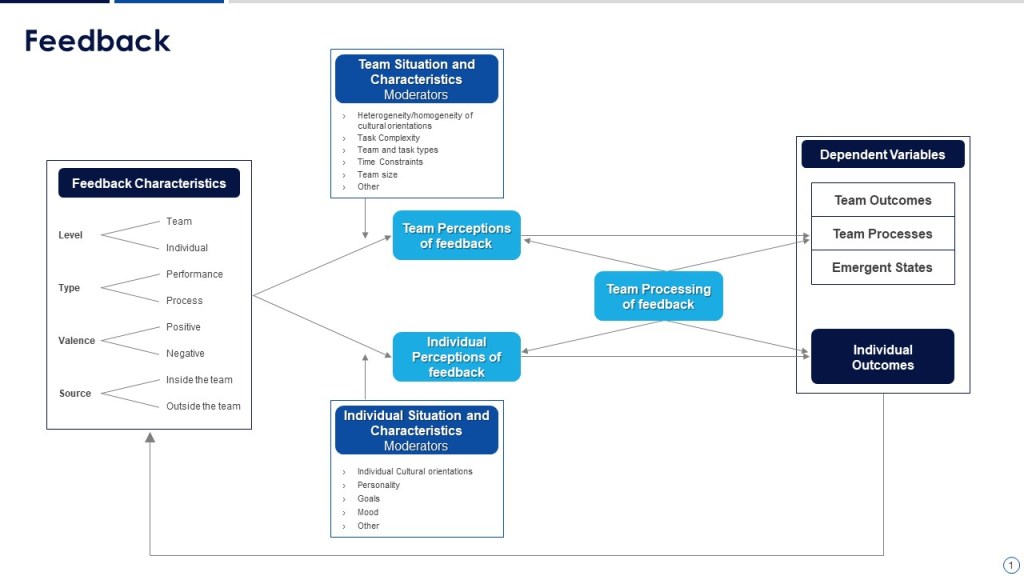
Research on feedback in teams recognizes the importance of continuous reflection and feedback mechanisms to team success and generally finds that the feedback process is an ongoing dynamic system of performance management rather than an isolated event. Feedback is critical to teams learning.

Four characteristics make feedback effective:

  • Type of feedback: Feedback can describe performance or processes behaviors. Performance feedback contains information about individual or team performance to reinforce good performance or repair poor performance by identifying areas for improvement. Process feedback is information regarding the way one performed a task and did or did not reach expected results.
  • Feedback level: Feedback can target the team as a whole (i.e., team-level feedback), individual team members (i.e., individual-level feedback), or both. In the latter, team members receive information about how the team behaves as a whole along with information about their individual contribution.
  • Feedback valence: The positive or negative evaluation of one’s performance in relation to the goal or standard. In teams, potential benefits of negative feedback might be explained by the activation of goal-striving iterative cycles.
  • Feedback source: Objective (e.g., a measure of delay of delivery) or subjective (i.e., opinion of a source). Feedback-subjective sources can be classified as (a) sources from outside the team (e.g., manager, researcher, expert, and customers) and (b) sources from inside the team (e.g., the team leader debriefing about the feedback or team members who give feedback to each other).

Feedback quality is determined by how specific, well timed, regular, non-threatening, shared, directed at teams it targets, and fairly distributed among team members the feedback is. When feedback meets these criteria, it has been found to be most effective.

Most feedback models state that feedback can only be powerful when individuals attend to and perceive this feedback as being relevant, meaningful, and useful. Conversely, if team members perceive feedback as being unrelated to actual performance, irrelevant, or inaccurate, or do not pay attention to cues presented in the feedback, they are likely to disregard, discount, or reject this feedback. If feedback perception is favorable for team members, and if individual perceptions are externalized in the team and shared among team mem-bers (i.e., team perception), teams as a whole will likely engage in interactions during which they will collectively make sense of the feedback and plan changes accordingly.

We live in the age of culturally heterogeneous teams, defined as two or more individuals from different cultural backgrounds who pursue a common goal, work on interdependent tasks, require social interaction, share responsibility for a team product, and have clear differentiated responsibilities and roles. Teams with members from various cultures can provide a broader range of perspectives, task-related knowledge, abilities, and skills. However, culturally related individual differences in social behavior, communication, and cognition can greatly increase the complexity of intra-team dynamics.