The Hidden Pitfalls of Naïve Realism in Problem Solving, Risk Management, and Decision Making

Naïve realism—the unconscious belief that our perception of reality is objective and universally shared—acts as a silent saboteur in professional and personal decision-making. While this mindset fuels confidence, it also blinds us to alternative perspectives, amplifies cognitive biases, and undermines collaborative problem-solving. This blog post explores how this psychological trap distorts critical processes and offers actionable strategies to counteract its influence, drawing parallels to frameworks like the Pareto Principle and insights from risk management research.

Problem Solving: When Certainty Breeds Blind Spots

Naïve realism convinces us that our interpretation of a problem is the only logical one, leading to overconfidence in solutions that align with preexisting beliefs. For instance, teams often dismiss contradictory evidence in favor of data that confirms their assumptions. A startup scaling a flawed product because early adopters praised it—while ignoring churn data—exemplifies this trap. The Pareto Principle’s “vital few” heuristic can exacerbate this bias by oversimplifying complex issues. Organizations might prioritize frequent but low-impact problems, neglecting rare yet catastrophic risks, such as cybersecurity vulnerabilities masked by daily operational hiccups.

Functional fixedness, another byproduct of naïve realism, stifles innovation by assuming resources can only be used conventionally. To mitigate this pitfall, teams should actively challenge assumptions through adversarial brainstorming, asking questions like “Why will this solution fail?” Involving cross-functional teams or external consultants can also disrupt echo chambers, injecting fresh perspectives into problem-solving processes.

Risk Management: The Illusion of Objectivity

Risk assessments are inherently subjective, yet naïve realism convinces decision-makers that their evaluations are purely data-driven. Overreliance on historical data, such as prioritizing minor customer complaints over emerging threats, mirrors the Pareto Principle’s “static and historical bias” pitfall.

Reactive devaluation further complicates risk management. Organizations can counteract these biases by appropriately leveraging risk management to drive subjectivity out while better accounting for uncertainty. Simulating worst-case scenarios, such as sudden supplier price hikes or regulatory shifts, also surfaces blind spots that static models overlook.

Decision Making: The Myth of the Rational Actor

Even in data-driven cultures, subjectivity stealthily shapes choices. Leaders often overestimate alignment within teams, mistaking silence for agreement. Individuals frequently insist their assessments are objective despite clear evidence of self-enhancement bias. This false consensus erodes trust and stifles dissent with the assumption that future preferences will mirror current ones.

Organizations must normalize dissent through anonymous voting or “red team” exercises to dismantle these myths, including having designated critics scrutinize plans. Adopting probabilistic thinking, where outcomes are assigned likelihoods instead of binary predictions, reduces overconfidence.

Acknowledging Subjectivity: Three Practical Steps
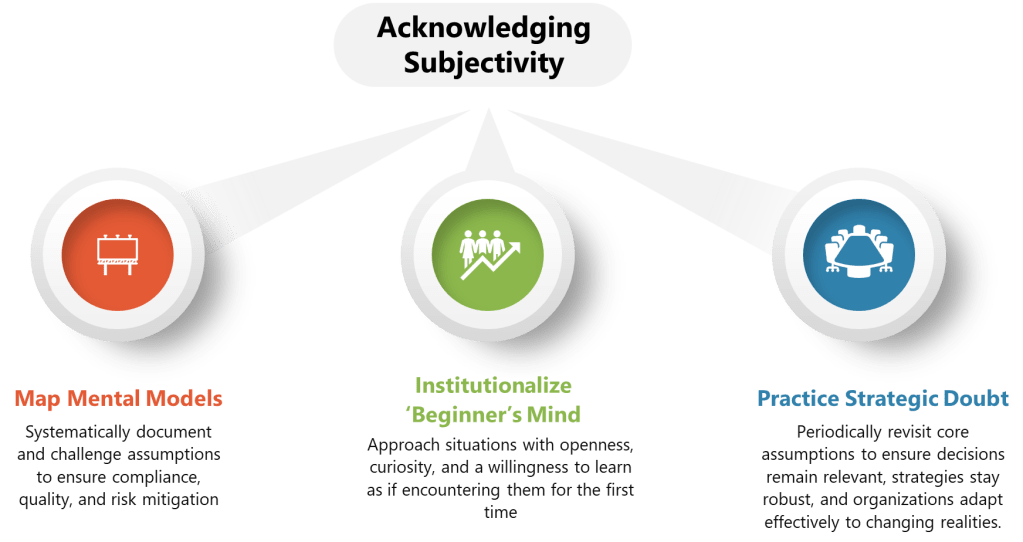
1. Map Mental Models

Mapping mental models involves systematically documenting and challenging assumptions to ensure compliance, quality, and risk mitigation. For example, during risk assessments or deviation investigations, teams should explicitly outline their assumptions about processes, equipment, and personnel. Statements such as “We assume the equipment calibration schedule is sufficient to prevent deviations” or “We assume operator training is adequate to avoid errors” can be identified and critically evaluated.

Foster a culture of continuous improvement and accountability by stress-testing assumptions against real-world data—such as audit findings, CAPA (Corrective and Preventive Actions) trends, or process performance metrics—to reveal gaps that might otherwise go unnoticed. For instance, a team might discover that while calibration schedules meet basic requirements, they fail to account for unexpected environmental variables that impact equipment accuracy.

By integrating assumption mapping into routine GMP activities like risk assessments, change control reviews, and deviation investigations, organizations can ensure their decision-making processes are robust and grounded in evidence rather than subjective beliefs. This practice enhances compliance and strengthens the foundation for proactive quality management.

2. Institutionalize ‘Beginner’s Mind’

A beginner’s mindset is about approaching situations with openness, curiosity, and a willingness to learn as if encountering them for the first time. This mindset challenges the assumptions and biases that often limit creativity and problem-solving. In team environments, fostering a beginner’s mindset can unlock fresh perspectives, drive innovation, and create a culture of continuous improvement. However, building this mindset in teams requires intentional strategies and ongoing reinforcement to ensure it is actively utilized.

What is a Beginner’s Mindset?

At its core, a beginner’s mindset involves setting aside preconceived notions and viewing problems or opportunities with fresh eyes. Unlike experts who may rely on established knowledge or routines, individuals with a beginner’s mindset embrace uncertainty and ask fundamental questions such as “Why do we do it this way?” or “What if we tried something completely different?” This perspective allows teams to challenge the status quo, uncover hidden opportunities, and explore innovative solutions that might be overlooked.

For example, adopting this mindset in the workplace might mean questioning long-standing processes that no longer serve their purpose or rethinking how resources are allocated to align with evolving goals. By removing the constraints of “we’ve always done it this way,” teams can approach challenges with curiosity and creativity.

How to Build a Beginner’s Mindset in Teams

Fostering a beginner’s mindset within teams requires deliberate actions from leadership to create an environment where curiosity thrives. Here are some key steps to build this mindset:

  1. Model Curiosity and Openness
    Leaders play a critical role in setting the tone for their teams. By modeling curiosity—asking questions, admitting gaps in knowledge, and showing enthusiasm for learning—leaders demonstrate that it is safe and encouraged to approach work with an open mind. For instance, during meetings or problem-solving sessions, leaders can ask questions like “What haven’t we considered yet?” or “What would we do if we started from scratch?” This signals to team members that exploring new ideas is valued over rigid adherence to past practices.
  2. Encourage Questioning Assumptions
    Teams should be encouraged to question their assumptions regularly. Structured exercises such as “assumption audits” can help identify ingrained beliefs that may no longer hold true. By challenging assumptions, teams open themselves up to new insights and possibilities.
  3. Create Psychological Safety
    A beginner’s mindset flourishes in environments where team members feel safe taking risks and sharing ideas without fear of judgment or failure. Leaders can foster psychological safety by emphasizing that mistakes are learning opportunities rather than failures. For example, during project reviews, instead of focusing solely on what went wrong, leaders can ask, “What did we learn from this experience?” This shifts the focus from blame to growth and encourages experimentation.
  4. Rotate Roles and Responsibilities
    Rotating team members across roles or projects is an effective way to cultivate fresh perspectives. When individuals step into unfamiliar areas of responsibility, they are less likely to rely on habitual thinking and more likely to approach tasks with curiosity and openness. For instance, rotating quality assurance personnel into production oversight roles can reveal inefficiencies or risks that might have been overlooked due to overfamiliarity within silos.
  5. Provide Opportunities for Learning
    Continuous learning is essential for maintaining a beginner’s mindset. Organizations should invest in training programs, workshops, or cross-functional collaborations that expose teams to new ideas and approaches. For example, inviting external speakers or consultants to share insights from other industries can inspire innovative thinking within teams by introducing them to unfamiliar concepts or methodologies.
  6. Use Structured Exercises for Fresh Thinking
    Design Thinking exercises or brainstorming techniques like “reverse brainstorming” (where participants imagine how to create the worst possible outcome) can help teams break free from conventional thinking patterns. These activities force participants to look at problems from unconventional angles and generate novel solutions.

Ensuring Teams Utilize a Beginner’s Mindset

Building a beginner’s mindset is only half the battle; ensuring it is consistently applied requires ongoing reinforcement:

  • Integrate into Processes: Embed beginner’s mindset practices into regular workflows such as project kickoffs, risk assessments, or strategy sessions. For example, make it standard practice to start meetings by revisiting assumptions or brainstorming alternative approaches before diving into execution plans.
  • Reward Curiosity: Recognize and reward behaviors that reflect a beginner’s mindset—such as asking insightful questions, proposing innovative ideas, or experimenting with new approaches—even if they don’t immediately lead to success.
  • Track Progress: Use metrics like the number of new ideas generated during brainstorming sessions or the diversity of perspectives incorporated into decision-making processes to measure how well teams utilize a beginner’s mindset.
  • Reflect Regularly: Encourage teams to reflect on using the beginner’s mindset through retrospectives or debriefs after significant projects and events. Questions like “How did our openness to new ideas impact our results?” or “What could we do differently next time?” help reinforce the importance of maintaining this perspective.

Organizations can ensure their teams consistently leverage the power of a beginner’s mindset by cultivating curiosity, creating psychological safety, and embedding practices that challenge conventional thinking into daily operations. This drives innovation and fosters adaptability and resilience in an ever-changing business landscape.

3. Revisit Assumptions by Practicing Strategic Doubt

Assumptions are the foundation of decision-making, strategy development, and problem-solving. They represent beliefs or premises we take for granted, often without explicit evidence. While assumptions are necessary to move forward in uncertain environments, they are not static. Over time, new information, shifting circumstances, or emerging trends can render them outdated or inaccurate. Periodically revisiting core assumptions is essential to ensure decisions remain relevant, strategies stay robust, and organizations adapt effectively to changing realities.

Why Revisiting Assumptions Matters

Assumptions often shape the trajectory of decisions and strategies. When left unchecked, they can lead to flawed projections, misallocated resources, and missed opportunities. For example, Kodak’s assumption that film photography would dominate forever led to its downfall in the face of digital innovation. Similarly, many organizations assume their customers’ preferences or market conditions will remain stable, only to find themselves blindsided by disruptive changes. Revisiting assumptions allows teams to challenge these foundational beliefs and recalibrate their approach based on current realities.

Moreover, assumptions are frequently made with incomplete knowledge or limited data. As new evidence emerges, whether through research, technological advancements, or operational feedback, testing these assumptions against reality is critical. This process ensures that decisions are informed by the best available information rather than outdated or erroneous beliefs.

How to Periodically Revisit Core Assumptions

Revisiting assumptions requires a structured approach integrating critical thinking, data analysis, and collaborative reflection.

1. Document Assumptions from the Start

The first step is identifying and articulating assumptions explicitly during the planning stages of any project or strategy. For instance, a team launching a new product might document assumptions about market size, customer preferences, competitive dynamics, and regulatory conditions. By making these assumptions visible and tangible, teams create a baseline for future evaluation.

2. Establish Regular Review Cycles

Revisiting assumptions should be institutionalized as part of organizational processes rather than a one-off exercise. Build assumption audits into the quality management process. During these sessions, teams critically evaluate whether their assumptions still hold true in light of recent data or developments. This ensures that decision-making remains agile and responsive to change.

3. Use Feedback Loops

Feedback loops provide real-world insights into whether assumptions align with reality. Organizations can integrate mechanisms such as surveys, operational metrics, and trend analyses into their workflows to continuously test assumptions.

4. Test Assumptions Systematically

Not all assumptions carry equal weight; some are more critical than others. Teams can prioritize testing based on three parameters: severity (impact if the assumption is wrong), probability (likelihood of being inaccurate), and cost of resolution (resources required to validate or adjust). 

5. Encourage Collaborative Reflection

Revisiting assumptions is most effective when diverse perspectives are involved. Bringing together cross-functional teams—including leaders, subject matter experts, and customer-facing roles—ensures that blind spots are uncovered and alternative viewpoints are considered. Collaborative workshops or strategy recalibration sessions can facilitate this process by encouraging open dialogue about what has changed since the last review.

6. Challenge Assumptions with Data

Assumptions should always be validated against evidence rather than intuition alone. Teams can leverage predictive analytics tools to assess whether their assumptions align with emerging trends or patterns. 

How Organizations Can Ensure Assumptions Are Utilized Effectively

To ensure revisited assumptions translate into actionable insights, organizations must integrate them into decision-making processes:

Monitor Continuously: Establish systems for continuously monitoring critical assumptions through dashboards or regular reporting mechanisms. This allows leadership to identify invalidated assumptions promptly and course-correct before significant risks materialize.

Update Strategies and Goals: Adjust goals and objectives based on revised assumptions to maintain alignment with current realities. 

Refine KPIs: Key Performance Indicators (KPIs) should evolve alongside updated assumptions to reflect shifting priorities and external conditions. Metrics that once seemed relevant may need adjustment as new data emerges.

Embed Assumption Testing into Culture: Encourage teams to view assumption testing as an ongoing practice rather than a reactive measure. Leaders can model this behavior by openly questioning their own decisions and inviting critique from others.

From Certainty to Curious Inquiry

Naïve realism isn’t a personal failing but a universal cognitive shortcut. By recognizing its influence—whether in misapplying the Pareto Principle or dismissing dissent—we can reframe conflicts as opportunities for discovery. The goal isn’t to eliminate subjectivity but to harness it, transforming blind spots into lenses for sharper, more inclusive decision-making.

The path to clarity lies not in rigid certainty but in relentless curiosity.
Building a Data-Driven Culture: Empowering Everyone for Success

Data-driven decision-making is an essential component for achieving organizational success. Simply adopting the latest technologies or bringing on board data scientists is not enough to foster a genuinely data-driven culture. Instead, it requires a comprehensive strategy that involves every level of the organization.

This holistic approach emphasizes the importance of empowering all employees—regardless of their role or technical expertise—to effectively utilize data in their daily tasks and decision-making processes. It involves providing training and resources that enhance data literacy, enabling individuals to understand and interpret data insights meaningfully. Moreover, organizations should cultivate an environment that encourages curiosity and critical thinking around data. This might include promoting cross-departmental collaboration where teams can share insights and best practices regarding data use. Leadership plays a vital role in this transformation by modeling data-driven behaviors and championing a culture that values data as a critical asset. By prioritizing data accessibility and encouraging open dialogue about data analytics, organizations can truly empower their workforce to harness the potential of data, driving informed decisions that contribute to overall success and innovation.

The Three Pillars of Data Empowerment

To build a robust data-driven culture, leaders must focus on three key areas of readiness:

Data Readiness: The Foundation of Informed Decision-Making

Data readiness ensures that high-quality, relevant data is accessible to the right people at the right time. This involves:

  • Implementing robust data governance policies
  • Investing in data management platforms
  • Ensuring data quality and consistency
  • Providing secure and streamlined access to data

By establishing a strong foundation of data readiness, organizations can foster trust in their data and encourage its use across all levels of the company.

Analytical Readiness: Cultivating Data Literacy

Analytical readiness is a crucial component of building a data-driven culture. While access to data is essential, it’s only the first step in the journey. To truly harness the power of data, employees need to develop the skills and knowledge necessary to interpret and derive meaningful insights. Let’s delve deeper into the key aspects of analytical readiness:

Comprehensive Training on Data Analysis Tools

Organizations must invest in robust training programs that cover a wide range of data analysis tools and techniques. This training should be tailored to different skill levels and job functions, ensuring that everyone from entry-level employees to senior executives can effectively work with data.

  • Basic data literacy: Start with foundational courses that cover data types, basic statistical concepts, and data visualization principles.
  • Tool-specific training: Provide hands-on training for popular data analysis tools and the specialized business intelligence platforms that are adopted.
  • Advanced analytics: Offer more advanced courses on machine learning, predictive modeling, and data mining for those who require deeper analytical skills.

Developing Critical Thinking Skills for Data Interpretation

Raw data alone doesn’t provide value; it’s the interpretation that matters. Employees need to develop critical thinking skills to effectively analyze and draw meaningful conclusions from data.

  • Data context: Teach employees to consider the broader context in which data is collected and used, including potential biases and limitations.
  • Statistical reasoning: Enhance understanding of statistical concepts to help employees distinguish between correlation and causation, and to recognize the significance of findings.
  • Hypothesis testing: Encourage employees to formulate hypotheses and use data to test and refine their assumptions.
  • Scenario analysis: Train staff to consider multiple interpretations of data and explore various scenarios before drawing conclusions.

Encouraging a Culture of Curiosity and Continuous Learning

A data-driven culture thrives on curiosity and a commitment to ongoing learning. Organizations should foster an environment that encourages employees to explore data and continuously expand their analytical skills.

  • Data exploration time: Allocate dedicated time for employees to explore datasets relevant to their work, encouraging them to uncover new insights.
  • Learning resources: Provide access to online courses, webinars, and industry conferences to keep employees updated on the latest data analysis trends and techniques.
  • Internal knowledge sharing: Organize regular “lunch and learn” sessions or internal workshops where employees can share their data analysis experiences and insights.
  • Data challenges: Host internal competitions or hackathons that challenge employees to solve real business problems using data.

Fostering Cross-Functional Collaboration to Share Data Insights

Data-driven insights become more powerful when shared across different departments and teams. Encouraging cross-functional collaboration can lead to more comprehensive and innovative solutions.

  • Interdepartmental data projects: Initiate projects that require collaboration between different teams, combining diverse datasets and perspectives.
  • Data visualization dashboards: Implement shared dashboards that allow teams to view and interact with data from various departments.
  • Regular insight-sharing meetings: Schedule cross-functional meetings where teams can present their data findings and discuss potential implications for other areas of the business.
  • Data ambassadors: Designate data champions within each department to facilitate the sharing of insights and best practices across the organization.

By investing in these aspects of analytical readiness, organizations empower their employees to make data-informed decisions confidently and effectively. This not only improves the quality of decision-making but also fosters a culture of innovation and continuous improvement. As employees become more proficient in working with data, they’re better equipped to identify opportunities, solve complex problems, and drive the organization forward in an increasingly data-centric business landscape.

Infrastructure Readiness: Enabling Seamless Data Operations

To support a data-driven culture, organizations must have the right technological infrastructure in place. This includes:

  • Implementing scalable hardware solutions
  • Adopting user-friendly software for data analysis and visualization
  • Ensuring robust cybersecurity measures to protect sensitive data
  • Providing adequate computing power for complex data processing
  • Build a clear and implementable qualification methodology around data solutions

With the right infrastructure, employees can work with data efficiently and securely, regardless of their role or department.

The Path to a Data-Driven Culture

Building a data-driven culture is an ongoing process that requires commitment from leadership and active participation from all employees. Here are some key steps to consider:

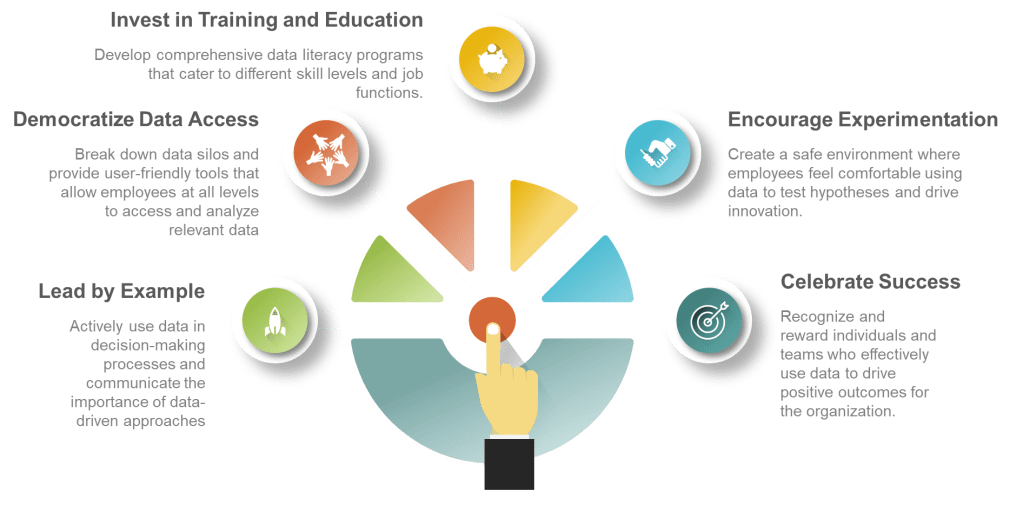
  1. Lead by example: Executives should actively use data in their decision-making processes and communicate the importance of data-driven approaches.
  2. Democratize data access: Break down data silos and provide user-friendly tools that allow employees at all levels to access and analyze relevant data.
  3. Invest in training and education: Develop comprehensive data literacy programs that cater to different skill levels and job functions.
  4. Encourage experimentation: Create a safe environment where employees feel comfortable using data to test hypotheses and drive innovation.
  5. Celebrate data-driven successes: Recognize and reward individuals and teams who effectively use data to drive positive outcomes for the organization.

Conclusion

To build a truly data-driven culture, leaders must take everyone along on the journey. By focusing on data readiness, analytical readiness, and infrastructure readiness, organizations can empower their employees to harness the full potential of data. This holistic approach not only improves decision-making but also fosters innovation, drives efficiency, and ultimately leads to better business outcomes.

Remember, building a data-driven culture is not a one-time effort but a continuous process of improvement and adaptation. By consistently investing in these three areas of readiness, organizations can create a sustainable competitive advantage in today’s data-centric business landscape.

Build Wonder in the Organization

A sense of wonder significantly enhances critical thinking by fostering curiosity, creativity, and deeper engagement with the subject matter.

  1. Curiosity and Inquiry: Wonder naturally leads to curiosity, prompting individuals to ask questions and seek answers. This inquisitive mindset is a cornerstone of critical thinking, as it drives the exploration of new ideas and the examination of existing knowledge.
  2. Engagement and Motivation: Experiencing awe and wonder can make learning more engaging and enjoyable. This emotional engagement motivates individuals to delve deeper into subjects, enhancing their understanding and retention of information.
  3. Creativity and Imagination: Wonder stimulates the imagination, allowing individuals to think beyond conventional boundaries and explore new possibilities. This creative thinking is essential for problem-solving and innovation. Critical thinking involves analyzing information and synthesizing new ideas, which is facilitated by a sense of wonder.
  4. Empathy and Perspective-Taking: Wonder can also foster empathy by encouraging individuals to see the world from different perspectives. This empathetic understanding is crucial for critical thinking, allowing for a more comprehensive and nuanced analysis of issues.
  5. Mindfulness and Reflection: Engaging with wonder often involves mindfulness and reflection, which are essential for critical thinking. Taking time to contemplate and reflect on experiences allows individuals to process information more thoroughly and develop well-reasoned conclusions. This reflective practice helps shift perspectives and integrate new knowledge.
Photo by Magda Ehlers: https://www.pexels.com/photo/brown-monkey-photo-767197/

Building a sense of wonder in the workplace involves creating an environment that encourages curiosity, creativity, and engagement.

1. Encourage Curiosity and Open-Mindedness

  • Ask Open-Ended Questions: Encourage open-ended questions that stimulate thinking and discussion to promote a culture where employees feel comfortable asking questions and exploring new ideas.
  • Vocalize Thoughts: Create an environment where employees are encouraged to share their thoughts and ideas openly, without fear of judgment. This helps in fostering a culture of curiosity and innovation.

2. Foster a Positive and Supportive Environment

  • Effective Communication: Ensure that communication within the organization is open and transparent. This builds trust and collaboration among team members, essential for a positive work environment.
  • Recognition and Rewards: Acknowledge and celebrate achievements. This boosts morale and encourages employees to continue exploring and innovating.

3. Create Opportunities for Exploration and Learning

  • Professional Development: Offer opportunities for continuous learning and professional growth. This can include training sessions, workshops, and access to educational resources.
  • Encourage Experimentation: Allow employees to experiment with new ideas and projects. The freedom to explore can lead to innovative solutions and a greater sense of wonder.

4. Incorporate Sensory Experiences

  • Engage the Senses: Create a work environment that stimulates the senses. This can include visual displays and frequent and deliberate time on the front line. Engaging the senses can enhance well-being and foster a sense of wonder.
  • Mindful Practices: Encourage mindfulness practices such as meditation or nature walks. These activities can help employees stay present and appreciate the beauty and complexity of their surroundings.

5. Promote a Culture of Reflection and Feedback

  • Reflective Space: Provide spaces where employees can reflect and think deeply about their work. This can be a quiet room or a designated area for contemplation.
  • Feedback Mechanisms: Implement regular feedback sessions where employees can discuss their experiences and insights. This helps continuous improvement and fosters a culture of learning and wonder.

6. Lead by Example

  • Leadership Engagement: Leaders should model a sense of wonder by being curious, open-minded, and engaged. When leaders demonstrate these qualities, it sets a tone for the entire organization.
  • Beginner’s Mindset: Encourage leaders and employees to adopt a beginner’s mindset, approach problems and opportunities with fresh eyes, and be open to new possibilities.

Curiosity

To foster a culture of adaptability, engagement, and high performance on your team, you need to demonstrate consistent curiosity about your employees, yourself, and your organization. Here’s how:

  • Curiosity about employees. Organizations are a collection of the mindsets, attitudes, and values of the people that work within them. To shape your team’s culture, you need to understand people’s values and motivations. Talk to employees directly, formally survey them, or engage in focus groups about the team’s culture to tap into your collective wisdom.
  • Curiosity about yourself. As your culture evolves, you must too. Reflect with open-mindedness on your own role. Ask yourself: How have I evolved over time within this team and this organization? The better you understand your own position in the culture, the better suited you’ll be to lead and shape it.
  • Curiosity about the organization. Great leaders don’t just shape culture once—they stay curious about the changing nature of their companies and contexts over time. How have your organization’s mission, vision, and values changed? How has the personnel changed? And how have all of these factors affected the culture along the way? The more you understand your cultural context, the better equipped you’ll be to navigate it.
  • Curiosity about the domain: What are the changes in your field? What is current research? Regulatory shifts? Best practices? The more you understand the external landscape, the better equipped you are to establish a vision of excellence.
Happy little boy holding glass with soap foam by David Pereiras from Noun Project (CC BY-NC-ND 2.0)

Curiosity

Curiosity is a superpower that enables us to improve our lives. Empathic curiosity allows people to listen thoughtfully and see problems or decisions from another’s perspective, not to criticize or judge, but to understand. Asking questions promotes more meaningful connections and more creative outcomes. When we carefully listen to the answers we seek, we build better relationships faster, fuel employee engagement, and reduce conflict.

George Mason and Patrick McKnight created a five-dimensional model of curiosity that can help us understand curiosity and how to nurture it.

The first dimension, deprivation sensitivity, causes us to recognize a gap in our knowledge. Filling it offers relief. This type of curiosity doesn’t necessarily feel good, but it causes us to feel better once we have a solution to a problem. For instance, a trip to the emergency room will give answers to the question about whether a person has had a heart attack. Both a “yes” or “no” answer will satisfy our curiosity.

The second dimension, joyous exploration, causes us to be consumed with wonder about the fascinating features of the world. This exploration produces pleasure among those curious enough to pursue answers.

The third dimension, social curiosity, encourages us to talk, listen, and observe others to learn what they are thinking and doing. Since we are inherently social animals, we find communication the most effective and efficient way to gain information that will allow us to determine whether someone is friend or foe. Some may even snoop, eavesdrop, or gossip to do so.

The fourth dimension, stress tolerance, relates to our willingness to accept and even harness the anxiety associated with novelty. People who lack stress tolerance see information gaps, experience wonder, and have an interest in others, but they don’t tend to satisfy their curiosity by stepping forward and exploring.

The fifth dimension, thrill seeking, goes beyond tolerating stress to embracing a willingness to take physical, social, and financial risks to acquire varied, complex, and intense experiences. For people with this capacity, the anxiety of confronting novelty is something to be amplified, not reduced.

Curiosity is the catalyst that brings job satisfaction, motivation, innovation, and high performance. It fosters collaboration and fortifies organizational resilience by prompting creative problem-​ solving in the face of uncertainty and pressure.

Good leaders build and reward curiosity in their organizations by:

  • Rewarding creative failures. Recognize the value of effort and experimentation, even when it fails.
  • Understand that curious people learn quickly and bore easily. Encourage continuous growth and learning.
  • Give ever-​challenging work and real authority to make a difference.
  • Make organizations places where the curious choose to work and become magnets for other top performers.
  • Give direction in the form of democratic guidance, not an absence of direction. Don’t micromanage. If you try to micromanage a curious person just a little, you will lose that person.
Photo by Tatiana Syrikova on Pexels.com