
The Art of Active Listening

As quality professionals and leaders of all stripes information bombards us from all directions. This is why the ability to truly listen is a core and valuable skill. Whether in personal relationships, professional settings, or casual interactions, effective listening can be the key to building stronger connections, resolving conflicts, and fostering mutual understanding.

In this post, I want to look at four powerful techniques that I am working to refine to continually improve my listening skills, and that can help you in your journey to be a more empathetic and insightful communicator.

The Importance of Active Listening

Before we explore the techniques, it’s crucial to understand why active listening is so vital. Active listening goes beyond merely hearing words; it involves fully engaging with the speaker, processing their message, and responding thoughtfully. This skill can lead to:

  • Improved relationships and trust
  • Better problem-solving and decision-making
  • Reduced misunderstandings and conflicts
  • Enhanced empathy and emotional intelligence
  • Increased productivity in professional settings

Now, let’s dive into the four techniques that can elevate your listening game.

Technique 1: Listen Until the End

The Power of Patience

One of the most common pitfalls in communication is the tendency to interrupt or jump in before the speaker has finished expressing their thoughts. This habit not only disrupts the flow of conversation but also sends a message that you value your own input more than the speaker’s.

Benefits of Listening Completely:

  • You gain a full understanding of the speaker’s perspective
  • The speaker feels respected and valued
  • You avoid making premature judgments or assumptions

How to Practice:

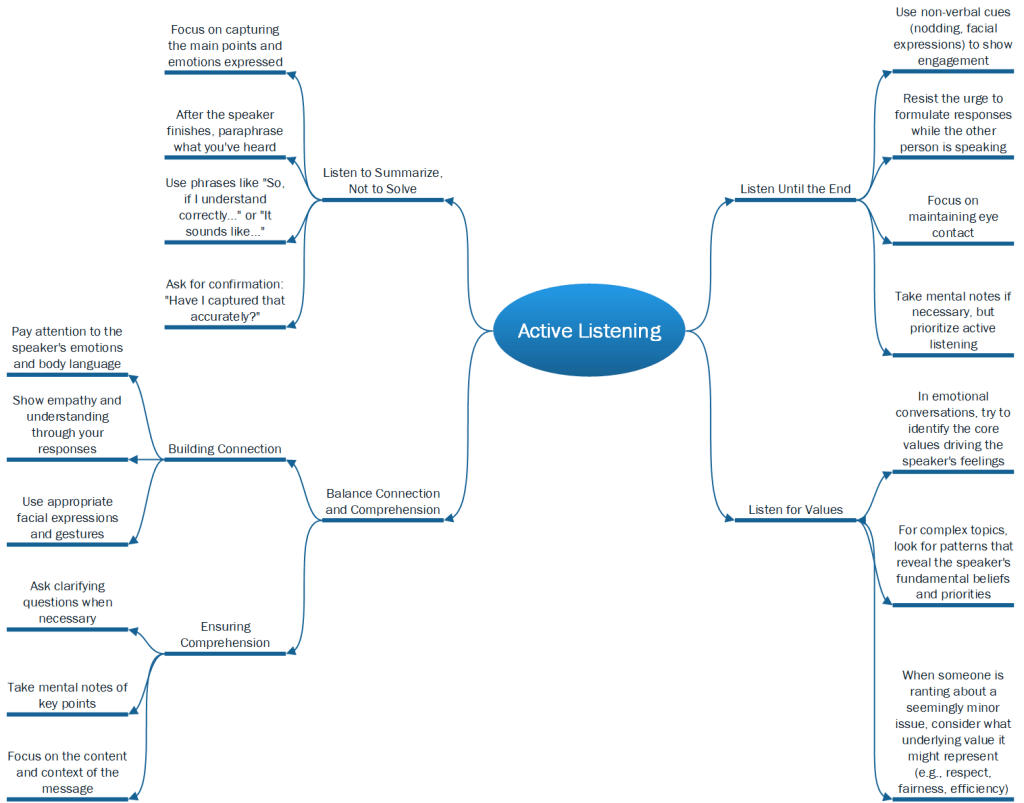
  • Focus on maintaining eye contact
  • Use non-verbal cues (nodding, facial expressions) to show engagement
  • Resist the urge to formulate responses while the other person is speaking
  • Take mental notes if necessary, but prioritize active listening

By allowing the speaker to complete their thoughts without interruption, you create an environment of trust and openness, which is essential for effective communication.

Technique 2: Listen to Summarize, Not to Solve

The Art of Understanding

When someone shares a problem or concern, our natural instinct is often to jump into problem-solving mode. However, this approach can be counterproductive, especially if the speaker is simply looking to be heard and understood.

Why Summarizing is Crucial:

  • It ensures you’ve accurately grasped the speaker’s message
  • It demonstrates that you’re fully engaged in the conversation
  • It allows the speaker to clarify any misunderstandings
  • It gives the speaker a chance to reflect on their own thoughts

Implementing This Technique:

  • Focus on capturing the main points and emotions expressed
  • After the speaker finishes, paraphrase what you’ve heard
  • Use phrases like “So, if I understand correctly…” or “It sounds like…”
  • Ask for confirmation: “Have I captured that accurately?”

By prioritizing understanding over immediate problem-solving, you create a space where the speaker feels truly heard, which can often lead to more effective resolution of issues in the long run.

Technique 3: Balance Connection and Comprehension

The Dual Focus of Effective Listening

Listening is not just about absorbing information; it’s also about building a connection with the speaker. Striking the right balance between these two aspects is crucial for meaningful communication.

Aspects to Focus On:

  1. Building Connection:
    • Pay attention to the speaker’s emotions and body language
    • Show empathy and understanding through your responses
    • Use appropriate facial expressions and gestures
  2. Ensuring Comprehension:
    • Focus on the content and context of the message
    • Ask clarifying questions when necessary
    • Take mental notes of key points

Strategies for Balancing Both:

  • Practice active empathy by putting yourself in the speaker’s shoes
  • Use reflective listening techniques to confirm understanding while showing support
  • Alternate between focusing on emotional cues and factual content

By mastering this balance, you not only gain a deeper understanding of the issue at hand but also strengthen your relationship with the speaker, fostering trust and open communication.

Technique 4: Listen for Values

Uncovering the Hidden Layers

Every conversation, whether it’s a casual chat or an emotional outpouring, offers a window into the speaker’s values and priorities. By tuning into these underlying messages, you can gain profound insights into what truly matters to the person you’re communicating with.

Why Listening for Values Matters:

  • It deepens your understanding of the speaker’s motivations
  • It helps you respond more empathetically and effectively
  • It strengthens your connection by showing genuine interest in the speaker’s worldview

How to Identify Values in Conversation:

  • Pay attention to recurring themes or concerns
  • Notice what elicits strong emotional responses
  • Listen for statements about what “should” or “ought to” be
  • Observe which topics the speaker spends the most time on

Applying This Technique:

  • When someone is ranting about a seemingly minor issue, consider what underlying value it might represent (e.g., respect, fairness, efficiency)
  • In emotional conversations, try to identify the core values driving the speaker’s feelings
  • For complex topics, look for patterns that reveal the speaker’s fundamental beliefs and priorities

By listening for values, you transform every interaction into an opportunity for deeper understanding and connection, enriching your relationships and broadening your perspective.
Conclusion

Mastering these four listening techniques – listening until the end, summarizing rather than solving, balancing connection and comprehension, and listening for values – can revolutionize your communication skills. These strategies not only enhance your ability to understand and connect with others but also contribute to your personal and professional growth.

Remember, effective listening is a skill that requires practice and patience. As you implement these techniques in your daily interactions, you’ll likely find that your conversations become more meaningful, your relationships stronger, and your understanding of others more profound. In a world where genuine connection is increasingly valuable, honing your listening skills is an investment that pays dividends in all areas of life.

So, the next time you engage in a conversation, challenge yourself to apply these techniques. You might be surprised at how much you can learn and how much deeper your connections can become when you truly listen with intention and care.

Anger and the job in difficult times

On Wednesday the United States set a devastating new record in the coronavirus pandemic: 3,124 people dead in one day. This was the first time the daily number of deaths has exceeded 3,000 but I fear it will not be the last. There are over 260k deaths in the US so far, over 1.5 million deaths worldwide. This is crippling, and it is difficult to go day-by-day with the pain of this suffering.

And yet, we need to work, support our families and communities. Get the job done. Amidst all that it is important to remember that is important to grieve and it is okay to be angry.

People grieve in diverse ways with different emotions, from anger, to depression to hopelessness, to resentment over what has been taken from them. Combined with the isolation of the pandemic, this is a recipe for poor mental health and poor coping mechanisms. And then there is a question of just how much and what sort of coping is good. Two-hundred-and-sixty thousand people are dead and there is a lot of evidence this is an underreport and a lot more people are going to die.

I hope you understand that I am angry. All day long. And it is a struggle not to bring that anger to work, not to let it twist my relationships. Yet that anger always exists.

I linked earlier this week to an article on mental health. It is particularly important to make this part of our organizations. Burnout must have a systematic fix.

What we need to give permission to, give space to, is a recognition that we are not in an okay state. And it may not be okay for a very long while, long after vaccines are widely available, and we return to the office.

It is okay to have taken a step back from obligations. I have not, for example, been writing much on this blog. It just did not work for me. Be kind to yourself and be okay with the things you must do less of. And when you are ready, go back to it.

Anger and Culture

Our organizational cultures are full of anger. What we must do is work to establish mechanisms to assure that anger is directed at issues or situations, not people. This will build psychological safety, enable good decisions and enhance our problem solving culture.

Some things we should do:

  • Acknowledge what is happening: Senior leadership needs to be working from compassion and generosity and taking real steps to address.
  • Treat toxic positivity as a bias: Toxic positivity is the assumption, either by one’s self or others, that despite a person’s emotional pain or difficult situation, they should only have a positive mindset. This is especially important as we have talent discussions, evaluate performance, and perform other managerial tasks.
  • Have systems around burnout
  • Focus on decision making quality
  • Build employee judgement feedback loops

We are not done. This winter will be very hard for many. As leaders we need to be ensuring our organizations can get through this and then leverage what we’ve learned to build a better culture.

Top 5 Posts by Views in 2019 (first half)

With June almost over a look at the five top views for 2019. Not all of these were written in 2019, but I find it interesting what folks keep ending up at my blog to read.

  1. FDA signals – no such thing as a planned deviation: Since I wrote this has been a constant source of hits, mostly driven by search engines. I always feel like I should do a follow-up, but not sure what to say beyond – don’t do planned deviations, temporary changes belong in the change control system.
  2. Empathy and Feedback as part of Quality Culture: The continued popularity of this post since I wrote it in March has driven a lot of the things I am writing lately.
  3. Effective Change Management: Change management and change control are part of my core skill set and I’m gratified that this post gets a lot of hits. I wonder if I should build it into some sort of expanded master class, but I keep feeling I already have.
  4. Review of Audit Trails: Data Integrity is so critical these days. I should write more on the subject.
  5. Risk Management is about reducing uncertainty: This post really captures a lot of the stuff I am thinking about and driving action on at work.

Thinking back to my SWOT, and the ACORN test I did at the end of 2018, I feel fairly good about the first six months. I certainly wish I found time to blog more often, but that seems doable. And like most bloggers, I still am looking for ways to increase engagement with my posts and to spark conversations.

Empathy and Feedback as part of Quality Culture

Many of us have had, or given, a talk about how we can learn from children in how to communicate, whether it is being thoughtful in our relationships or learning to adapt and be resilient, or some other point.

Zach Weinersmith, Saturday Morning Breakfast Cereal

What we are really talking about how communicating empathetically is essential, including to building a quality culture and it is a key part of change management.
People need to feel respected and have a sense of self-worth in order to be motivated, confident, innovative, and committed to their work and to appropriately engage in quality culture.

I am not going to pretend to be an expert on empathy. I think it is fair to say that is still (always) one of my key development areas. That said, I think a core skill of any quality leader is that of giving feedback.

People need to feel respected and have a sense of self-worth in order to be motivated, confident, innovative, and committed to their work.

To provide good feedback focus on doing the following:

  • Focus on facts.
  • Respect and support others. Even when people aren’t performing their best, they need to feel your support and to know that they’re valued.
  • Clarify motives. Don’t jump to conclusions. Keep others’ self-esteem in mind, and you’ll be more likely to ask, “What can you tell me about this error?” instead of, “Don’t you care about quality?”

When someone has done a good job, succeeded at a task, or made a contribution, you want to enhance that person’s self-esteem. Some ways to do that are to:

  • Acknowledge good thinking and ideas. Demonstrations of appreciation encourage people to think and contribute, and they support innovation and intellectual risk taking.
  • Recognize accomplishments. People need to hear specifically what they’ve done to contribute to the team’s or organization’s success. This encourages them to sustain or exceed expectations.
  • Express and show confidence. Voicing your trust and then calling on people to show what they can do boosts their confidence and their feelings of self-worth.
  • Be specific and sincere. When you describe in detail what people do well and why it’s effective, they know exactly what you’re recognizing.

Nothing can deflate people’s confidence faster than telling them they’re responsible for something, and then doing it yourself. Conversely, when you provide support without removing responsibility, you build people’s sense of ownership of the task or assignment as well as the confidence that they can accomplish it. When you use this Key Principle, remember to:

  • Help others think and do. Provide your support in two ways: Help others think of ideas, alternatives, and solutions, then support them so that they can execute the plan.
  • Be realistic about what you can do and keep your commitments. Remember that you don’t have to do it all, but be sure to do whatever you agree to.
  • Resist the temptation to take over—keep responsibility where it belongs.

Many quality individuals tend to be action oriented and task driven, so keeping responsibility where it belongs can take resolve, even courage. You might have to overcome the protests of a team member who is reluctant to stretch into new areas or even brave objections from a key manager about your decision to support others rather than take over.

Feedback Conversation Structure

Open

In the OPEN step you ensure that the discussion has a clear purpose and that everyone understands the importance of accomplishing it.

  • Always state purpose and importance clearly in the discussion opening.
  • If you initiate the discussion, explain what you would like to accomplish and why.
  • If someone else is leading the discussion, ask questions if necessary to pinpoint the purpose and importance.
  • Cite how accomplishing the purpose would benefit others in the discussion.
  • Ask if there are any related topics to discuss.

Clarify

There are two types of information to seek and share in this step: facts and figures and issues and concerns. Both are essential to building a complete picture of the situation.

  • Facts and figures are the basic data and background information that people need to understand the situation and make informed decisions.
  • Exploring issues and concerns provides insight into potential barriers to achieving your purpose. It also helps reveal people’s feelings about the situation, which is valid, important information to gather.

Develop

When developing ideas, it’s important to ask questions and include others in the process. Most likely, you’ll have ideas about what to do, and you should share them. However, you should put equal emphasis on seeking others’ ideas. Involving people in thinking about alternative approaches can:

  • Spark their creative energy.
  • Result in more and better ideas than you alone could generate.
  • Build commitment to turning ideas into action.

Agree

It’s important that you and the people involved agree on a plan for following through on the ideas that were developed and for supporting those who will take action. During this step:

  • Specify what will be done, who will do it, and by when.
  • Agree on any follow-up actions needed to track progress in carrying out the plan.
  • Be sure to agree on needed resources or support.

Close

This is the final chance to make sure that everyone is clear on agreements and next steps and committed to following through. Closing discussions involves a summary of actions and agreements as well as a check on the person’s or team’s commitment to carrying them out.