
A Reader Writes In
A long-time reader of this blog, Raz, recently left a comment that I think resonates with a lot of people in our industry:
“As a compliance lead with 10+ years of experience in pharma (API sites, greenfield) but lacking a technical background, what would you suggest to be the best courses / trainings for proper certificates?”
First, thank you for reading and for asking the question publicly. You’re not alone. This is one of the most common career inflection points in pharmaceutical quality and compliance — you’ve spent a decade building deep regulatory instincts, you understand what the rules require, and now you want to close the gap on the how and why behind the technical systems you oversee. That’s exactly the right impulse. Let’s talk about how to act on it.
Your Experience Is the Foundation, Not the Gap
Before diving into specific programs, a reframe is needed. Ten years navigating API manufacturing, greenfield startups, and automation compliance isn’t “lacking a technical background” — it is a technical background, just one built from the compliance and operational side rather than the engineering side. Greenfield experience in particular is rare and valuable; you’ve seen quality systems built from scratch rather than inherited. That perspective is something no certification can teach.
What certifications can do is give you a shared vocabulary with your engineering and validation counterparts, formalize knowledge you’ve likely already absorbed by osmosis, and — importantly — signal to future employers that you’ve made deliberate investments in your professional development. With that framing, here’s how to think about the landscape.
Tier 1: The Flagship Credentials
These are the certifications that carry the most weight on a resume and in hiring conversations across the pharmaceutical industry. They require significant preparation but deliver lasting career value.
ASQ Certified Pharmaceutical GMP Professional (CPGP)
This is the single most relevant certification for someone in Raz’s position. The CPGP is specifically designed for pharmaceutical professionals who work within GMP-regulated environments and covers the full lifecycle — from regulatory governance and quality systems to production operations, laboratory controls, and facility management. Unlike more general quality certifications, every question on the exam is rooted in pharmaceutical context.
The eligibility requirements are straightforward for someone with a decade of experience: five years of on-the-job experience in one or more areas of the CPGP Body of Knowledge, with at least three years in a decision-making position. No specific degree is required. The exam consists of 165 multiple-choice questions over roughly four hours and is open-book. Exam fees run approximately $450–$550 depending on ASQ membership status, and the certification is maintained with 30 continuing education units every three years.
For a compliance lead who wants to demonstrate comprehensive GMP knowledge — not just the regulatory text, but how it applies to actual manufacturing operations — this is the credential that most directly fills the gap.
ASQ Certified Quality Auditor (CQA)
The CQA is the gold standard for professionals whose work involves auditing, supplier qualification, and compliance assessment. If Raz’s role includes conducting or hosting audits (which most compliance leads at API sites do), the CQA formalizes and deepens that skill set. The exam covers auditing fundamentals, techniques, tools, and management of audit programs. It’s industry-agnostic, which is both a strength (portable across sectors) and a limitation (less pharma-specific than the CPGP).
Many professionals pursue the CPGP first for its pharmaceutical depth and then add the CQA to formalize their auditing capabilities. Together, they form a powerful combination for compliance leadership.
ASQ Certified Quality Engineer (CQE)
The CQE is the most broadly recognized ASQ certification and has been the flagship credential for quality professionals for decades. It covers statistical process control, design of experiments, quality management systems, reliability, and continuous improvement. For someone who self-identifies as lacking a technical background, this is the certification that most directly addresses that gap — it teaches the quantitative and analytical toolkit that underpins modern quality engineering.
The CQE body of knowledge directly correlates with statistical methods and tools used across pharmaceutical manufacturing. However, it’s a challenging exam. If statistics and data analysis feel like foreign territory, a preparation course (CQE Academy offers well-regarded ones) is a worthwhile investment before sitting for the exam.
Tier 2: Industry-Specific Technical Programs
These aren’t exam-based certifications in the traditional sense, but they’re recognized across the industry and deliver directly applicable technical knowledge.
ISPE Academy Certificate Programs
ISPE launched its Academy in 2025 with five certificate programs that are highly relevant to pharmaceutical compliance professionals:
| Program | Focus Area | Best For |
|---|---|---|
| GAMP® Essentials | Computerized system validation, data integrity, risk-based approaches | Automation compliance roles (directly relevant to Raz) |
| GMP Refresher | Current GMP regulations, quality systems, QA vs. QC distinction | Staying current on evolving requirements |
| Biopharmaceutical Essentials | Drug substance manufacturing, facility design, aseptic processing | Broadening beyond API into biologics |
| Good Engineering Practices | Engineering project management, compliance in project delivery | Understanding the engineering lifecycle |
| Pharmaceutical Water Systems | Water generation, storage, delivery, regulatory compliance | Utility system knowledge |
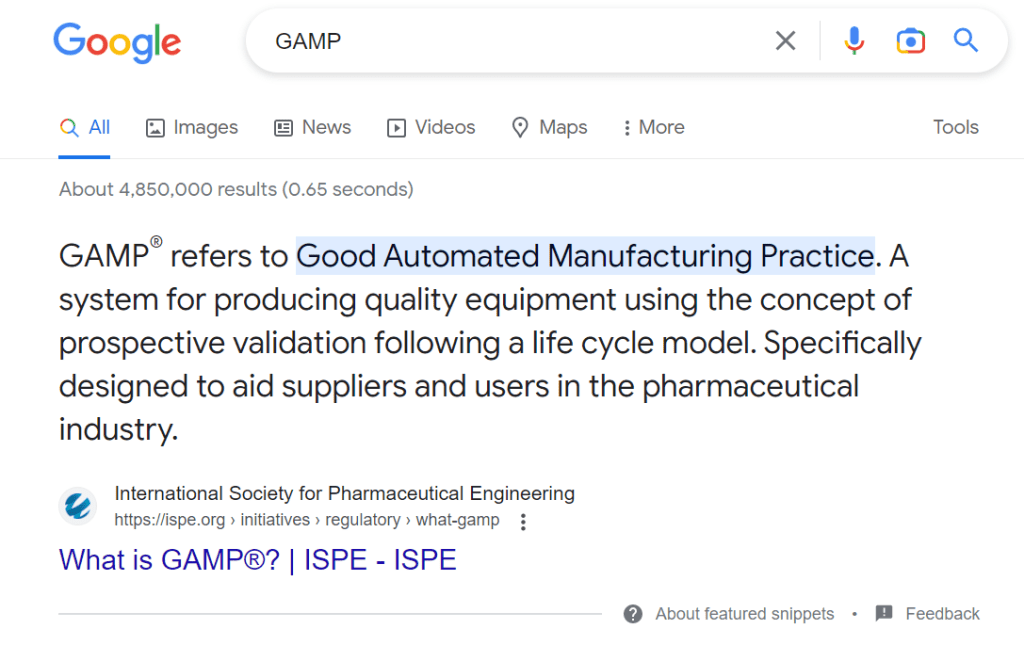
For someone in automation compliance at an API site, the GAMP® Essentials program should be the starting point — it covers risk-based validation, data integrity, and regulatory requirements aligned with the ISPE GAMP® 5 Guide (Second Edition). This is the technical language of computerized system validation, and mastering it transforms a compliance professional from someone who reviews validation documents into someone who can meaningfully challenge and improve them.
ISPE membership also provides access to Baseline Guides, technical articles, and local chapter events — resources that experienced practitioners consistently recommend as among the most valuable in the industry.
PDA Training and Research Institute
The Parenteral Drug Association’s Training and Research Institute (TRI) in Bethesda, Maryland is unique in the industry — it operates an independent manufacturing training facility with cleanrooms where professionals gain hands-on experience without patient or product risk. PDA trains over 1,000 professionals annually, including more than 300 health authority and regulator representatives.
PDA courses cover aseptic processing, process validation, environmental monitoring, quality risk management, and regulatory compliance. For building technical depth, the hands-on format is particularly valuable. Reading about aseptic technique in a guidance document is qualitatively different from gowning up and working in a simulated fill room. PDA is developing a formal TRI Certificate Program with verified digital badges, which will add credentialing to an already excellent training experience.
CfPIE Current Good Manufacturing Practices Certified Professional (GMPCP)
The Center for Professional Innovation and Education (CfPIE) holds an FDA contract to provide Quality System Regulation training to FDA professionals — which speaks to the program’s credibility. Their cGMP certification requires completion of four courses (three core, one elective) and a comprehensive examination. The curriculum covers the full spectrum of cGMP compliance from clinical development through post-approval manufacturing.
CfPIE courses tend to be taught by practitioners with deep industry experience, and they offer both on-site and public sessions. The certification is particularly well-suited for professionals who want structured, classroom-style learning delivered by people who’ve been on the manufacturing floor and in the inspection room.
ECA Academy GMP/GDP Certification Programme
For professionals with international scope or working at sites with European regulatory exposure, the ECA Academy’s certification program is the largest of its kind in Europe. It offers 15 modular certification tracks — including Certified Validation Manager, Certified Biotech Manager, and Certified Quality Assurance Manager — each requiring completion of three courses from a defined list. The modular structure allows professionals to select courses aligned with their specific responsibilities and interests.
Tier 3: Process Improvement and Methodology
Lean Six Sigma (Green Belt or Black Belt)
Lean Six Sigma is the process improvement methodology, and it’s increasingly expected for quality professionals targeting management and leadership roles. In pharmaceutical manufacturing, Green Belt projects commonly focus on cycle time reduction, deviation rate reduction, cleaning optimization, and yield improvement. More than half of Fortune 500 companies follow Lean Six Sigma frameworks, and certified professionals often see 20–25% salary increases at the Green Belt level.
That said, context matters. In GMP environments, the iterative experimentation that Lean Six Sigma encourages can run into regulatory friction — changes to validated processes require formal change control, and FDA doesn’t care about your DMAIC timeline. The real value of Six Sigma for a compliance professional isn’t the belt itself; it’s the statistical literacy and structured problem-solving mindset it develops. If your investigations and CAPAs already reflect that thinking, a certification formalizes what you’re doing. If they don’t, the training will genuinely change how you approach problems.
ASQ’s Green Belt certification is the most broadly recognized and credible option.
RAPS Regulatory Affairs Certification (RAC)
If Raz’s career trajectory points toward regulatory affairs rather than quality operations, the Regulatory Affairs Certification from RAPS is the leading credential in that space. The RAC-Drugs designation validates expertise across the regulatory lifecycle — from product development and registration to post-market compliance. The exam requires at least three years of regulatory experience (or equivalent) and covers U.S., EU, and global regulatory frameworks.
RAPS also offers certificate programs (distinct from the RAC credential) consisting of online course bundles in pharmaceutical or medical device regulatory affairs — nine courses for roughly $2,745–$3,490. These are educational certificates rather than professional credentials, but they provide structured learning paths for professionals building regulatory knowledge.
Building a Technical Vocabulary: Where to Start Without a Certification
Not everything needs a certificate attached to it. For a compliance lead wanting to build technical depth quickly, these resources deliver high impact at low cost:
- ICH Q8–Q12 Guidelines: Reading and truly understanding these documents — pharmaceutical development (Q8), quality risk management (Q9), pharmaceutical quality system (Q10), development and manufacture of drug substances (Q11), and product lifecycle management (Q12) — provides the technical vocabulary of modern pharmaceutical quality. They’re free, they’re authoritative, and they’re the foundation everything else builds on.
- FDA 483 Observation Database: Reviewing recent observations for your site type (API, biologics, sterile) is free continuing education in what goes wrong and why. Make it a weekly habit.
- ISPE Baseline Guides: These are the technical reference documents that engineers and validation professionals use daily. Understanding them closes the gap between “what the regulation says” and “how we build it”.
- GAMP® 5 Guide (Second Edition): For anyone in automation compliance, this is the foundational text. It covers risk-based validation of computerized systems and is the de facto standard for computer system validation in pharma. Understanding GAMP categories, the V-model, and risk-based testing strategies is essential.
A Recommended Path for Raz
Given 10+ years in pharma compliance at API sites with greenfield experience and a current role in automation compliance, a prioritized roadmap:
- Immediate (next 3–6 months): ISPE GAMP® Essentials certificate program — directly applicable to automation compliance work, builds the technical validation vocabulary, and connects with the ISPE professional community.
- Near-term (6–12 months): ASQ CPGP certification — the most relevant formal credential for pharmaceutical GMP professionals, formalizes a decade of accumulated knowledge, and signals comprehensive competence to employers.
- Medium-term (12–18 months): Lean Six Sigma Green Belt — adds the statistical and process improvement toolkit, strengthens investigation and CAPA capabilities, and is increasingly expected for management-track roles.
- Ongoing: ISPE or PDA membership for continuing education, access to technical resources, and professional networking. Consider PDA TRI hands-on courses for specific technical areas where deeper understanding is needed.
- If auditing becomes a larger part of the role: Add the ASQ CQA to formalize and credential auditing expertise.
The Real Advice
Certifications open doors, but they don’t replace the hard work of actually learning the material. The best compliance professionals — the ones who earn the respect of their engineering and manufacturing colleagues — are the ones who can have a conversation about why a cleanroom HVAC system is designed a certain way, not just whether the qualification documentation is complete. They can look at a deviation trend and see a process capability problem, not just a paperwork problem.
Ten years of experience at API sites and greenfield facilities has built a foundation that many credentialed professionals lack. The certifications above will give that experience structure, vocabulary, and formal recognition. Pick the ones that match where you want to go next, not just where you’ve been.
Thanks for reading, Raz. Keep asking the good questions.


 Investigations of a Dog