Clarity and Accuracy: Documentation should be clear and free from errors, ensuring that instructions are understood and followed correctly. This aligns with the concept of being precise in documentation.
Thoroughness: All relevant activities impacting quality should be recorded and controlled, indicating a need for comprehensive documentation practices.
Control and Integrity: The need for strict control over documentation to maintain integrity, accuracy, and availability throughout its lifecycle.
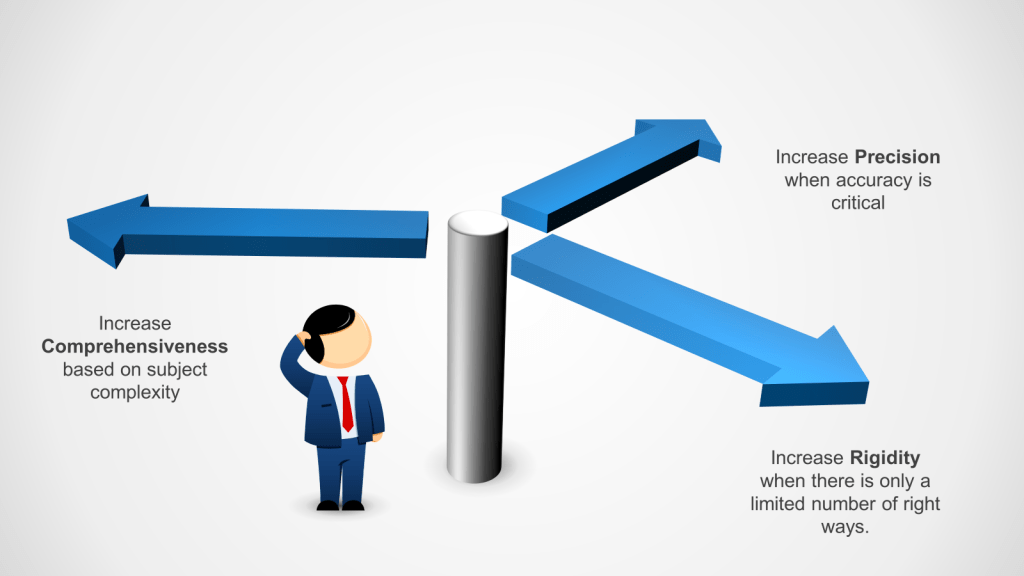
To meet these requirements we leverage three writing principles of precise, comprehensive and rigid.
Type of Instruction
Definition
Attributes
When Needed
Why
Differences
Example
Precise
Exact and accurate, leaving little room for interpretation.
– Specific – Detailed – Unambiguous
When accuracy is critical, such as in scientific experiments or programming.
Regulatory agencies require precise documentation to ensure tasks are performed consistently and correctly
Focuses on exactness and clarity, ensuring tasks are performed without deviation.
Instructions for assembling a computer, specifying exact components and steps.
Comprehensive
Complete and covering all necessary aspects of a task.
– Thorough – Inclusive – Exhaustive
When a task is complex and requires understanding of all components, such as in training manuals.
Comprehensive SOPs are crucial for ensuring all aspects of a process are covered, ensuring compliance with regulatory requirements.
Provides a full overview, ensuring no part of the task is overlooked.
Employee onboarding manual covering company policies, procedures, and culture.
Rigid
Strict and inflexible, not allowing for changes.
– Fixed – Inflexible – Consistent
When safety and compliance are paramount, such as batch records
Rigid instructions ensure compliance with strict regulatory standards.
Ensures consistency and adherence to specific protocols, minimizing risks.
Safety procedures for operating heavy machinery, with no deviations allowed.
When writing documents based on cognitive principles these three are often excellent for detailed task design but there are significant trade-offs inherent in these attributes when we codify knowledge:
The more comprehensive the instructions, the less likely that they can be absorbed, understood, and remembered by those responsible for execution – which is why it is important these instructions are followed at time of execution. Moreover, comprehensive instructions also risk can dilute the sense of responsibility felt by the person executing.
The more precise the instructions, the less they allow for customization or the exercise of employee initiative.
The more rigid the instructions, the less they will be able to evolve spontaneously as circumstances change. They require rigorous change management.
This means these tools are really good for complicated executions that must follow a specific set of steps. Ideal for equipment operations, testing, batch records. But as we shade into complex processes, which relies on domain knowledge, we start decreasing the rigidity, lowering the degree of precision, and walking a fine line on comprehensiveness.
Where organizations continue to struggle is in this understanding that it is not one size fits all. Every procedure is on a continuum and the level of comprehensiveness, precision and rigidity change as a result. Processes involving human judgement, customization for specific needs, or adaptations for changing circumstances should be written to a different standard than those involving execution of a test. It is also important to remember that a document may require high comprehensiveness, medium precision and low rigidity (for example a validation process).
Remember to use them with other tools for document writing. The goal here is to write documents that are usable to reach the necessary outcome.
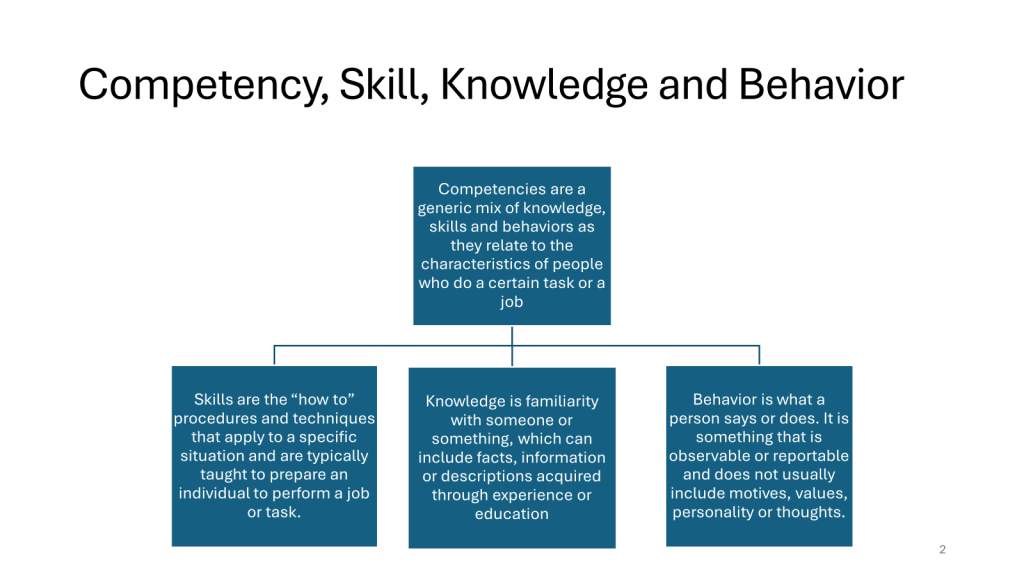
Organizational competencies are the skills, abilities, and knowledge that allow an organization to be successful in achieving its goals. They form the foundation of an organization’s culture, values, and strategy.
Organizational competencies can be broadly divided into two main categories:
Technical Competencies
Non-Technical Competencies (also called General Competencies)
Technical Competencies
Technical competencies are specific skills and knowledge required to perform particular jobs or functions within an organization. They are directly related to the core business activities and technical aspects of the work. For technical competencies:
They cover various fields of expertise relevant to the specific work carried out in the organization
They are at the heart of what the organizational employees do
They allow an organization to produce products or services efficiently and effectively
They often require ongoing training and reinforcement to stay current
Non-Technical Competencies
Non-technical competencies, also known as general competencies or soft skills, are broader skills and attributes that are important across various roles and functions. They include:
These competencies are crucial for effective interaction, collaboration, and overall organizational success.
Organizational Competencies for Validation (an example)
For an organization focusing on validation the following competencies would be particularly relevant:
Technical Competencies
Skill Area
Key Aspects
Proficiency Levels
Beginner
Intermediate
Advanced
Expert
General CQV Principles
Modern process validation and
guidance
Validation design and how to
reduce variability
Able
to review a basic protocol
Able
to review/approve Validation document deliverables.
Understands
the importance of a well-defined URS.
Able to be QEV lead in a small
project
Able to answer questions and
guide others in QEV
Participates in process
improvement
Able to review and approve
RTM/SRs
Able
to be QEV lead in a large project project
Trains
and mentors others in QEV
Leads
process improvement initiatives
Able
to provide Quality oversight on the creation of Validation Plans for complex
systems and/or projects
Sets
overall CQV strategy
Recognized
as an expert outside of JEB
Facilities
and Utilities
Oversee Facilities, HVAC and
Controlled Environments
Pharma Water and WFI
Pure Steam, Compressed Air,
Medical Gases
Understands
the principles and GMP requirements
Applies the principles,
activities, and deliverables that constitute an efficient and acceptable
approach to demonstrating facility fitness-for-use/qualification
Guide
the Design to Qualification Process for new facilities/utilities or the
expansion of existing facilities/utilities
Able
to establish best practices
Systems
and Equipment
Equipment, including Lab
equipment
Understands
the principles and GMP requirements
Principles, activities, and
deliverables that constitute an efficient and acceptable approach to
demonstrating equipment fitness-for-use/qualification
Able
to provide overall strategy for large projects
Able
to be QEV lead on complex systems and equipment.
Able
to establish best practices
Computer
Systems and Data Integrity
Computer lifecycle, including
validation
Understands
the principles and GMP requirements
Able to review CSV documents
Apply GAMP5 risk
based approach
Day-to-day quality oversight
Able
to provide overall strategy for a risk based GAMP5 approach to computer
system quality
Able
to establish best practices
Asset Lifecycle
Quality
oversight and decision making in the lifecycle asset lifecycle: Plan,
acquire, use, maintain, and dispose of assets
Can
use CMMS to look up Calibrations, Cal schedules and PM schedules
Quality
oversight of asset lifecycle decisions
Able
to provide oversight on Cal/PM frequency
Able
to assess impact to validated state for corrective WO’s.
Able
to establish asset lifecycle for new equipment classes
Establish
risk-based PM for new asset classes
verification
Establish
asset lifecycle approach
Serves
as the organization’s authority on GMP requirements related to asset
management in biotech facilities
Cleaning, Sanitization and Sterilization Validation
Evaluate
and execute cleaning practices, limit calculations, scientific rationales,
and validation documents
Manage
the challenges of multi-product facilities in the establishment of limits,
determination of validation strategies, and maintaining the validated state
Differentiate
the requirements for cleaning and sterilization validation when using manual,
semi-automatic, and automatic cleaning technologies
Review
protocols
Identify
and characterize potential residues including product, processing aids,
cleaning agents, and adventitious agents
Understand
Sterilization principles and requirements
Create,
review and approve scientifically sound rationales, validation protocols, and
reports
Manage
and remediate the pitfalls inherent in cleaning after the production of
biopharmaceutical and pharmaceutical products
Define
cleaning/sterilization validation strategy
Implements
a lifecycle approach to validation, ensuring continued process verification
Implements
a lifecycle approach to validation, ensuring continued process verification
Quality Risk Management
Apply
QRM principles according to Q9
Understands
basic risk assessment principles
Can
identify potential hazards and risks
Familiar
with risk matrices and scoring methods
Participate
in a risk assessment
Conducts
thorough risk assessments using established methodologies
Analyzes
risks quantitatively and qualitatively
Prioritizes
risks based on likelihood and impact
Determine
appropriate tools
Establish
risk-based decision-making tools
Leads
complex risk assessments across multiple areas
Develops
new risk assessment methodologies
Provides
expert guidance on risk analysis techniques
Serves
as the organization’s authority on regulatory requirements and expectations
related to quality risk management
Builds
a proactive risk culture across the organization, fostering risk awareness at
all levels
Process Validation
Demonstrating
that the manufacturing process can consistently produce a product that meets
predetermined specifications and quality attributes.
Understanding
of GMP principles and regulatory requirements
Basic
understanding of GMP principles and regulatory requirements
Can
independently write, approve and execute validation protocols for routine
processes
Ability to develop validation master plans
and protocols
Understanding
of critical process parameters (CPPs) and critical quality attributes (CQAs)
Expertise
in designing and implementing complex validation strategies
Ability
to troubleshoot and resolve validation issues
Deep
understanding of regulatory expectations and industry best practices
Leads
cross-functional validation teams for high-impact projects
Develops
innovative validation approaches for novel bioprocesses
Serves
as an organizational authority on validation matters and regulatory
interactions
Reflective learning is a powerful tool that organizations can leverage to build competency and drive continuous improvement. At its core, this approach involves actively analyzing and evaluating experiences and learning processes to enhance understanding and performance across all levels of the organization.
The process of reflective learning begins with individuals and teams taking the time to step back and critically examine their actions, decisions, and outcomes. This introspection allows them to identify what worked well, what didn’t, and why. By doing so, they can uncover valuable insights that might otherwise go unnoticed in the day-to-day rush of business activities.
One of the key benefits of reflective learning is its ability to transform tacit knowledge into explicit knowledge. Tacit knowledge is the unspoken, intuitive understanding that individuals develop through experience. By reflecting on and articulating these insights, organizations can capture and share this valuable wisdom, making it accessible to others and fostering a culture of collective learning.
To implement reflective learning effectively, organizations should create structured opportunities for reflection. This might include regular debriefing sessions after projects, dedicated time for personal reflection, or the use of learning journals. Additionally, leaders should model reflective practices and encourage open and honest discussions about both successes and failures.
It’s important to note that reflective learning is not just about looking back; it’s also about looking forward. The insights gained through reflection should be used to inform future actions and strategies. This forward-thinking approach helps organizations to be more adaptable and responsive to changing circumstances, ultimately leading to improved performance and innovation.
By embracing reflective learning as a core organizational practice, companies can create a dynamic environment where continuous learning and improvement become ingrained in the culture. This not only enhances individual and team performance but also contributes to the overall resilience and competitiveness of the organization in an ever-changing business landscape.
Implement Regular After-Action Reviews
After-action reviews (AARs) or Lessons Learned are critical to provide a structured way for teams to reflect on projects, initiatives, or events. To implement effective AARs:
Schedule them immediately after key milestones or project completions
Focus on what was planned, what actually happened, why there were differences, and what can be learned
Encourage open and honest discussion without blame
Document key insights and action items
Create a Supportive Environment for Reflection
Foster a culture that values and encourages reflection:
Provide dedicated time and space for individual and group reflection
Model reflective practices at the leadership level
Recognize and reward insights gained through reflection
By systematically implementing these practices, organizations can build a strong competency in reflective learning, leading to improved decision-making, innovation, and overall performance. Utilizing a model always helps.
Kolb’s Reflective Model
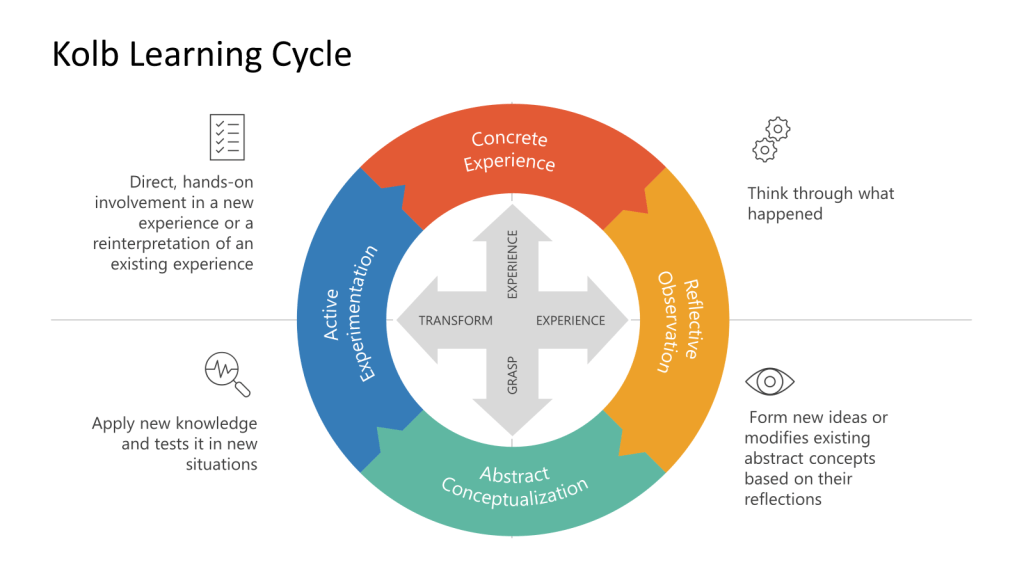
Kolb’s reflective model, also known as Kolb’s experiential learning cycle, is a widely used framework for understanding how people learn from experience. The model consists of four stages that form a continuous cycle of learning:
The Four Stages of Kolb’s Reflective Model
Concrete Experience: This is the stage where the learner actively experiences an activity or situation. It involves direct, hands-on involvement in a new experience or a reinterpretation of an existing experience.
Reflective Observation: In this stage, the learner reflects on and reviews the experience. They think about what happened, considering their feelings and the links to their existing knowledge and skills.
Abstract Conceptualization: Here, the learner forms new ideas or modifies existing abstract concepts based on their reflections. This stage involves analyzing the experience and drawing conclusions about what was learned.
Active Experimentation: In the final stage, the learner applies their new knowledge and tests it in new situations. This involves planning how to put the new learning into practice and experimenting with new approaches.
Create Opportunities for Concrete Experiences: Provide employees with hands-on learning experiences, such as job rotations, simulations, or real-world projects.
Encourage Reflection: Set up regular reflection sessions or debriefings after significant experiences. Encourage employees to keep learning journals or participate in group discussions to share their observations.
Facilitate Conceptualization: Provide resources and support for employees to analyze their experiences and form new concepts. This could involve training sessions, mentoring programs, or access to relevant literature and research.
Support Active Experimentation: Create a safe environment for employees to apply their new knowledge and skills. Encourage innovation and provide opportunities for employees to test new ideas in their work.
Integrate the Model into Learning Programs: Design training and development programs that incorporate all four stages of Kolb’s cycle, ensuring a comprehensive learning experience.
Personalize Learning: Recognize that individuals may have preferences for different stages of the cycle. Offer diverse learning opportunities to cater to various learning styles.
Measure and Iterate: Regularly assess the effectiveness of knowledge management initiatives based on Kolb’s model. Use feedback and results to continuously improve the learning process.
By incorporating Kolb’s reflective model into knowledge management practices, we can create a more holistic and effective approach to learning and development. This can lead to improved knowledge retention, better application of learning to real-world situations, and a more adaptable and skilled workforce.
– Expands on Kolb’s work – Recognizes various responses to potential learning situations
Backward Design
Grant Wiggins, Jay McTighe
1. Identify desired results 2. Determine acceptable evidence 3. Plan learning experiences and instruction
– Starts with learning outcomes – Focuses on designing effective learning experiences
Applying the Experiential Learning Model to Validation Competencies
To apply Kolb’s experiential learning model to building an organization’s competency for validation, we can structure the process as follows:
Concrete Experience
Have employees participate in actual validation activities or simulations
Provide hands-on training sessions on validation techniques and tools
Assign validation tasks to teams in real projects
Reflective Observation
Conduct debriefing sessions after validation activities
Encourage employees to keep validation journals or logs
Facilitate group discussions to share experiences and observations
Review validation results and outcomes as a team
Abstract Conceptualization
Offer formal training on validation principles, methodologies, and best practices
Encourage employees to develop validation frameworks or models based on their experiences
Analyze validation case studies from other organizations or industries
Create validation guidelines and standard operating procedures
Active Experimentation
Implement new validation approaches in upcoming projects
Encourage employees to propose and test innovative validation methods
Set up pilot programs to trial new validation tools or techniques
Assign employees to different types of validation projects to broaden their skills
To make this process continuous and effective:
Create a validation competency framework with clear learning objectives and skill levels
Develop a mentoring program where experienced team members guide less experienced colleagues
Establish regular knowledge-sharing sessions focused on validation topics
Implement a system for capturing and disseminating lessons learned from validation activities
Use technology platforms to support collaborative learning and information sharing about validation
Regularly assess and update the organization’s validation processes based on learning outcomes
Encourage cross-functional teams to work on validation projects to broaden perspectives
Partner with external experts or organizations to bring in fresh insights and best practices
Recognize and reward employees who demonstrate growth in validation competencies
Integrate validation competency development into performance reviews and career progression paths
By systematically applying Kolb’s model, we can create a robust learning environment that continuously improves our validation capabilities. This approach ensures that employees not only gain theoretical knowledge but also practical experience, leading to a more competent and adaptable workforce.
The ICH Q9 guideline on Quality Risk Management (QRM), including its revised version ICH Q9(R1), addresses the concept of uncertainty as a critical component in risk management within the pharmaceutical industry.
Uncertainty in the context of ICH Q9 refers to the lack of complete knowledge about a process and its expected or unexpected variability. This uncertainty can stem from various sources, including gaps in knowledge about pharmaceutical science, process understanding, and potential failure modes.
Key Points on Uncertainty from ICH Q9(R1)
Sources of Uncertainty:
Knowledge Gaps: Incomplete understanding of the scientific and technical aspects of processes.
Process Variability: Both expected and unexpected changes in process performance.
Failure Modes: Unidentified or poorly understood potential points of failure in processes or systems.
Managing Uncertainty:
Risk-Based Decision Making: The guideline emphasizes that decisions should be made based on the level of uncertainty, importance, and complexity of the situation. This means that more formal and structured approaches should be used when uncertainty is high.
Formality in QRM: ICH Q9(R1) introduces the concept of formality as a spectrum, suggesting that the degree of formality in risk management activities should be commensurate with the level of uncertainty. Less formal methods may be appropriate for well-understood processes, while highly structured methods are necessary for areas with high uncertainty.
The guideline acknowledges that subjectivity can impact the effectiveness of risk management. It recommends strategies to minimize subjectivity, such as using well-recognized risk assessment tools and involving cross-functional teams to provide diverse perspectives.
ICH Q9(R1) stresses the importance of continual improvement in risk management processes. This involves regularly updating risk assessments and control measures as new information becomes available, thereby reducing uncertainty over time.
Practical Implementation
In practice, managing uncertainty within the framework of ICH Q9 involves:
Conducting thorough risk assessments to identify potential hazards and their associated risks.
Applying appropriate risk control measures based on the level of uncertainty and the criticality of the process.
Documenting and reviewing risk management activities to ensure they remain relevant and effective as new information is obtained.
Conclusion
The ICH Q9 approach to uncertainty underscores the importance of a structured, knowledge-based approach to risk management in the pharmaceutical industry. By addressing uncertainty through rigorous risk assessments and appropriate control measures, organizations can enhance the reliability and safety of their processes and products, ultimately safeguarding patient health and safety.
The article “Why ‘Wisdom Work’ Is the New ‘Knowledge Work'” by Chip Conley at Harvard Business Review discusses the evolving dynamics in the workforce due to significant demographic shifts. As the workforce ages and younger individuals ascend to senior management roles, there is a unique opportunity for companies to harness the intergenerational transfer of wisdom. This transfer can significantly strengthen organizations by leveraging the experience and insights of older employees while integrating the innovative perspectives of younger workers. The article emphasizes that companies that successfully facilitate this exchange will enhance their overall workplace environment and performance.
This approach closely aligns with my thoughts around building expertise, and I found this a very thought provoking article.
Wisdom work involves leveraging the collective experience and insights of employees, leading to more informed and balanced decision-making. Wise leaders consider diverse perspectives and long-term implications, which can result in more sustainable and ethical business practices.
Intergenerational knowledge transfer fosters an environment where creativity and innovation can thrive. Younger employees bring fresh ideas and familiarity with new technologies, while older employees provide context and practical wisdom. This synergy can lead to innovative solutions and improved business processes.
Increased Employee Engagement and Satisfaction
Employees who feel their knowledge and experience are valued are more likely to be engaged and motivated. Wisdom work encourages a culture of mutual respect and continuous learning, which can enhance job satisfaction and reduce turnover rates.
Better Conflict Resolution
Wisdom work promotes the development of soft skills such as empathy, communication, and problem-solving. These skills are crucial for resolving conflicts effectively and maintaining a harmonious workplace. Employees equipped with relational wisdom can navigate interpersonal challenges more smoothly, leading to a more cohesive team environment.
Enhanced Mentorship and Leadership Development
A focus on wisdom work facilitates mentorship opportunities where experienced employees guide and support younger colleagues. This not only helps in the professional development of younger employees but also keeps older employees engaged and valued. Such mentorship can accelerate the growth of leadership skills across the organization.
Organizations that embrace wisdom work are better equipped to adapt to changes and uncertainties. The combined experience of older employees and the adaptability of younger ones create a resilient workforce capable of navigating complex challenges and seizing new opportunities.
Increased Productivity and Performance
The integration of wisdom work can lead to performance enhancements by leveraging the strengths of a diverse workforce. Employees can learn from each other, leading to improved productivity and business outcomes. The exchange of knowledge and skills across generations helps in creating a more competitive and efficient organization.
Fostering a Culture of Lifelong Learning
Wisdom work encourages a culture where learning and development are continuous processes. Employees are motivated to keep updating their skills and knowledge, which is essential for staying relevant in a rapidly changing business environment. This culture of lifelong learning can drive innovation and maintain a competitive edge.
I feel that the numerous benefits that wisdom work can bring to significantly enhance the professional setting really resonate with the concepts behind quality culture. By fostering intergenerational knowledge transfer, organizations can improve decision-making, innovation, employee engagement, conflict resolution, mentorship, adaptability, productivity, and create a culture of lifelong learning.
As I discussed in “A CoP is Collaborative Learning, not Lecture,” it is past time to stop treating professionals as college kids (it is also past time to stop teaching college kids that way, but another subject). Lectures have their place. There is undoubtedly a high need for information transfer events (but even these can be better structured), and there will always be a need for GAMP5 workshops, training courses, and webinars on a specific topic.
I’ve written in the past some ways I prefer to structure professional engagements, such as poster sessions and an unconference. I have demonstrated some ways I think we can do this better. So, let’s turn our attention to what a better GAMP5 community of practice session could look like
We aim to connect, communicate, share, collaborate, and dialogue. So, what would a six-hour event look like?
Noon to 1:00—Networking and poster session. We have a lot of introverts in this industry, so help folks connect by doing it in a structured way. Posters are excellent as they can serve as a springboard for conversation. All the presentations that started about ISPE and GAMP5, what the GAMP5 plans are for the next two years, and current regulatory trends are posters.
1:00-2:00—Think-Pair-Share: There will be three rounds of 15 minutes each, each with a different topic. Each participant will have an 11×17 piece of paper to take notes of the other person’s thoughts. Post.
2:00 to 2:30: Review thoughts, brainstorm a theme, and propose.
2:30 to 2:45: N/5 voting for top themes
2:30 to 3:30 – Mock audit, fishbowl style. Deep dive on a particular issue, audit style.
3:30 to 4:30 -Unconference-style breakouts of the themes. Each working group comes out with a hand-drawn poster (or more based on how productive the group is)
4:30 to 5:00 – Present ideas
5:00 to 6:00 – Network, discuss ideas. Add to them.
Hit the bar/restaurant.
Publish the results, and continue to work on the online forum.