As leaders a big part of our work is ensuring the know-why – fostering and sharing an understanding of work culture and values. This is a continuing, long-term co-creative process that does not happen overnight. An important part of this work is shaping and sharing stories, using the past as a shaper of the future to give meaning to events. As stories are told in the present, they become a partner in shaping the future.
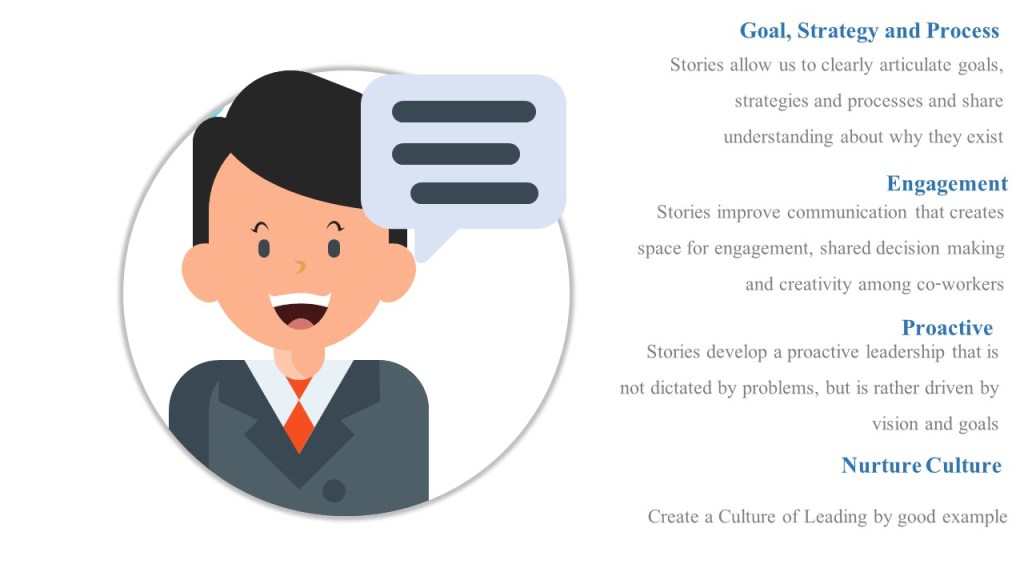
To successfully change, it is important to understand the past as well as dream for the future. Storytelling as a method and tool has real power to foster dialogue, reveal culture and create a shared vision:
Storytelling makes complex situations and phenomena accessible and provides details that can be used to build action plans for change and improvement.
Stories reveal values and principles embedded in a culture that are often hidden from the naked eye.
Stories make visible driving forces for change that are not revealed when direct questions are asked.
Stories provides a platform for understanding different perspectives. It breaks down barriers and builds bridges of trust.
Stories highlight turning points that can be used to facilitate innovation and change.
Through storytelling and dialog, we strengthen structure, identity and culture. It is how we tell our story.
Playfulness can soften difficult decisions, conversations and actions that require courage. Having the ability to bring a level of lightheartedness to even the most difficult situations can take the edge of circumstances that might otherwise scare you. Playfulness has the incredible power to disarm even the darkest of circumstances.
Play is a fundamental part of the human experience. We should never forget to bring it to our work. A playful attitude keeps your mind curious. It makes us better problem-solvers.
Play involves an enthusiastic and in-the-moment attitude. When we play, we detach from outside stressors and become completely absorbed in the activity. Play is the ultimate mindfulness.
Do not let play be the first thing that gets lost when stress overrides our lives.
Playfulness is a subtle art. It is bordered by silliness on one side and rudeness on the other side. Be careful to ensure you never are in either of those territories. Men, this is especially critical to us as our culture lets too many sexist, racist and homophobic attitudes slide as humor. Always remember that playfulness is not the same as being funny. I’m not a very funny person, I try to avoid making people laugh. what I strive to do is make people feel included in my curiosity and exploration.
Good playfulness should always connect, never divide.
Take your play seriously! But don’t take yourself too seriously. Point out your own flaws and imperfections in a humorous, confident way. Sincere self-deprecation can be powerful.
People will strive for your success when you show up with playful energy. Make the other person genuinely feel special and watch the magic happen. Playfulness is a gentle invitation for others to follow you if they want to.
Playfulness will reflect in your body language. This is very inviting, and a whole lot of what folks mean as charisma stems from this spark.
By practicing playfulness you will develop an attitude of irreverence where you are in touch with yourself and avoid negativity and drama.
So reflect and ask yourself these questions:
How can you approach life with more playfulness? What would happen if you were more playful in your daily life?
Where are you lacking playfulness?
Who is someone playful you admire? What makes them playful?
If you approached life in a more playful way, what brave decisions would you make?
How would you show up differently if you were to embrace playfulness?
Adopting a flexible but consistent approach to decision-making and giving people greater leeway creates the organizational framework for faster decision-making processes. In addition to creating the right framework, however, it is equally important for employees to have confidence in each other so that decisions are not only taken quickly but also implemented swiftly. Rather than merely seeing employees as resources, this requires management to value them as part of the community because of the competencies that they bring to the table. The underlying capability that makes this possible is a democratic leadership style.
Democratic leadership is a style where decision-making is decentralized and shared by all. This style of leadership proposes that decision-making should be shared by the leader and the group where criticisms and praises are objectively given and a feeling of responsibility is developed within the group. Leaders engage in dialogue that offers others the opportunity to use their initiative and make contributions. Once decisions are collectively taken, people are sure of what to do and how to do it with support from leaders to accomplish tasks successfully. It is the “Yes…but…and” style of leadership.
This style requires a high degree of effort in building organizational decision-making capabilities. You need to build a culture that ensures that everyone has an equal interest in an outcome and shared levels of expertise relative to decisions. But nothing provides better motivated employees.
For those keeping track on the leadership style bingo card, this requires mashing democratic and transformational leaders together (with a hefty flavoring of servant leadership). Just the democratic style is not enough, you need a few more aspects of a transformational leader to make it work.
Characteristics of a Democratic Leader
Idealized Influence means being the role model and being seen to be accountable to the culture. Part of this is doing Gemba walks as part of your standard work.
Inspirational Motivation means inspiring confidence, motivation and a sense of purpose. The leader must articulate a clear vision for the future, communicate expectations of the group and demonstrate a commitment to the goals that have been decided upon.
Through Intellectual Stimulation, the leader presents to the organization a number of challenging new ideas that are supposed to stimulate rethinking of new ways of doing things in the organization, thus seeking ideas, opinions and inputs from others to promote creativity, innovation and experimentation of new methods to replace the old ways. The leader articulates True North.
Decentralized decision-making around these new ways of doing are shared by all. Decisions are taken by both the leader and the group where criticisms and praises are objectively given and a feeling of responsibility is developed within the group, thus granting everyone the opportunity to use their initiative and make contributions. Decentralized decision-making ensures everyone empowered to take actions and are responsible for the implementation and effectiveness of these actions. This will drive adaptation and bring accountability.
Reading list
Arenas, F.J., Connelly, D.A. and Williams, M.D. (2018), Developing Your Full Range of Leadership, Air University Press, Maxwell AFB
Gastil, J. (1994), “A definition and illustration of democratic leadership”, Human Relations, Vol. 47 No. 8,pp. 953-975
Hayes, A.F. (2018), Introduction to Mediation, Moderation and Conditional Process Analysis, 2nd ed.,The Guilford Press, New York, N
Interesting perspective on adapting what makes us successful as problem solvers as we move into more senior leadership positions. Resonates very well with some of my own challenges, so I stronly recommend listening to this episode.
Take responsibility. Say, “I was wrong.” (Don’t say “mistakes were made” or “it didn’t turn out the way I had anticipated” or any other version that deflects or minimizes your personal contribution). Offer a brief explanation, but do not make excuses. Acknowledge that your error had a negative impact on others, and be willing to really listen, without defensiveness, to others’ recounting of that impact. Do not interrupt. Apologize.
Address what you need to do right now. Taking responsibility is critical, as is taking action. This is core to crisis communication, even if your mistake doesn’t constitute a major crisis. Tell others what you are doing right now to remedy the mistake, and distinguish between the parts that can be fixed, and those that can’t. Include what you are doing to address the substantive impact (money, time, processes, etc.) and well as the relational impact (feelings, reputation, trust, etc.) of having been wrong. Be open to feedback about what you’re doing. Over-communicate your plans.
Share what you will do differently next time. Being wrong is messy. Being wrong without self-reflection is irresponsible, even if you hate self-reflection. Take some time to think about what your contribution was to this situation, and identify how others contributed as well. (Try to stay away from using words like “fault” or “blame” — which tend to put people on the defensive.) Then tell those impacted by your error what you’ve learned about yourself, and what you’re going to do differently in the future. For example, you might recognize that you tend to dismiss the input of someone you don’t see eye-to-eye with, and that in the future, you’re going to actively engage her, and consider her perspective. Ask for help where you need it. And ask others to give you frequent feedback down the road on the commitments you’re making.




 Investigations of a Dog