
Be Your Authentic Self

The best quality folks I know, indeed the best of any profession I know, are those who manage to bring their authentic self to the job. This capability is core to building psychological safety and driving quality culture. And yet, too often, we teach people how to bury it or reward a degree of inauthenticity in service of some idea of “professional.” People quickly tune out, disengage, and lose trust when they sense insincerity. Being authentic allows you to connect and relate much more quickly with and bond with our fellow workers. To be an authentic quality champion, you must create a safe space to encourage people to open up and express themselves without fearing retribution. If people do not feel comfortable or safe conveying their feelings, they won’t be able to present their true, authentic selves. Trust is the key to encouraging others to express their thoughts and feelings. Without trust and authenticity, there can be no learning culture, no improvement, and little to no quality.

Be Yourself

Authenticity starts with being true to who you are. Don’t try to adopt a stereotypical quality personality or style that doesn’t feel natural to you. Instead:

  • Embrace your unique personality and style, whether that’s reserved, energetic, or straightforward
  • Be honest about your knowledge and expertise
  • Admit when you don’t know something rather than pretending

By bringing your true self to the role, you build trust and create a psychologically safe environment.

Foster Genuine Connections

By building authentic relationships with colleagues, we can enhance collaboration, boost job satisfaction, and contribute to a more fulfilling professional experience. These connections go beyond superficial interactions and involve showing a genuine interest in coworkers’ success, engaging in healthy competition, and contributing to an authentic workplace culture.

  • Strive to find time for relationship-building with and among your fellows
  • Share personal anecdotes and experiences when relevant
  • Demonstrate vulnerability by discussing your own learning journey and challenges you’ve overcome

Practice Active Listening

Active listening contributes to authenticity by encouraging open communication and transparency. When we actively listen to one another, we create a safe space for sharing ideas, concerns, and feedback without fear of judgment. This openness allows individuals to be true to their personalities and values, fostering a culture where authenticity is valued and respected. Moreover, active listening helps in recognizing the unsaid emotions and underlying messages, enabling a deeper understanding of colleagues’ experiences and perspectives.

  • Give your full attention to speakers, noting both verbal and non-verbal cues
  • Paraphrase and summarize to ensure you’ve understood correctly
  • Ask probing questions to dig deeper into folk’s thoughts and ideas

Model the Desired Culture

When a quality partner brings their authentic self to the team, they set the tone. This demonstrates the behaviors and attitudes we want to see in our culture. This is important at all levels of the quality organization, but frankly I think quality leaders may be a little to uncomfortable here. Many people get ahead in quality by being analytical, which means thse who are outside that norm are asked to act like they are to get ahead. Which frankly, can be prety disastrrious.
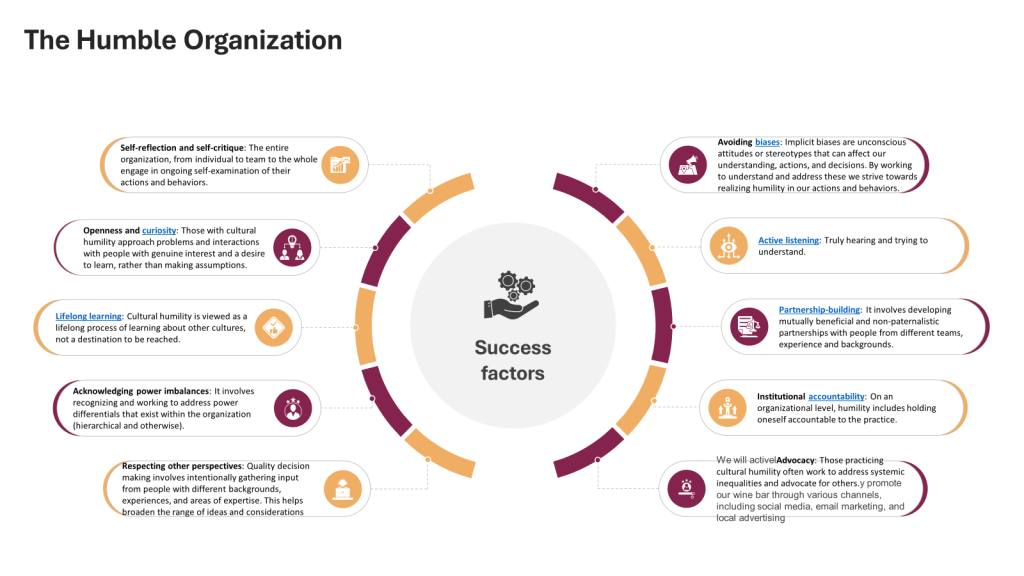
Practicing Humility as Part of a Quality Culture

Cultural humility is an important part of Quality Culture. Cultural humility is often seen as approaching interactions with an attitude of openness, asking questions to learn rather than making assumptions, being willing to admit what you don’t know, and constantly examining your own lens and biases. It’s about creating an environment where all perspectives are valued and people feel respected.

Cultural humility involves several key characteristics and behaviors:

  1. Self-reflection and self-critique: The entire organization, from individual to team to the whole engage in ongoing self-examination of their actions and behaviors.
  2. Openness and curiosity: Those with cultural humility approach problems and interactions with people with genuine interest and a desire to learn, rather than making assumptions.
  3. Lifelong learning: Cultural humility is viewed as a lifelong process of learning about other cultures, not a destination to be reached.
  4. Acknowledging power imbalances: It involves recognizing and working to address power differentials that exist within the organization (hierarchical and otherwise).
  5. Respecting other perspectives: Quality decision making involves intentionally gathering input from people with different backgrounds, experiences, and areas of expertise. This helps broaden the range of ideas and considerations
  6. Avoiding biases: Implicit biases are unconscious attitudes or stereotypes that can affect our understanding, actions, and decisions. By working to understand and address these we strive towards realizing humility in our actions and behaviors.
  7. Active listening: Truly hearing and trying to understand.
  8. Partnership-building: It involves developing mutually beneficial and non-paternalistic partnerships with people from different teams, experience and backgrounds.
  9. Institutional accountability: On an organizational level, humility includes holding oneself accountable to the practice.
  10. Advocacy: Those practicing cultural humility often work to address systemic inequalities and advocate for others.

Leadership Behaviors

Humble leaders exhibit the following behaviors:

  1. Admitting limitations and mistakes
  2. Appreciating others’ strengths and contributions
  3. Being open to new ideas and feedback
  4. Listening before speaking
  5. Encouraging employees to keep trying and viewing mistakes as learning opportunities
  6. Taking responsibility for employees’ mistakes
  7. Modeling openness and fallibility
  8. Maintaining a collective focus

Cultural Attributes

A work culture with humble leadership is characterized by:

  1. Openness to new ideas and continuous learning
  2. Appreciation for diverse perspectives and contributions
  3. Reduced fear of taking interpersonal risks
  4. High-quality interpersonal relationships
  5. Collective humility within teams
  6. Trust between leaders and team members
  7. Inclusivity and reduced power differentials
  8. Emphasis on growth and development rather than blame

Employee Perceptions and Behaviors

In a humble environment, employees are more likely to:

  1. Feel safe expressing themselves and taking risks
  2. Believe in their ability to contribute constructively
  3. Engage in voice behaviors and share ideas
  4. Show themselves freely without fear of adverse consequences
  5. Imitate leaders in showing their own shortcomings and appreciating others
  6. Perceive making mistakes as acceptable
  7. Experience increased job satisfaction and reduced turnover intentions

Organizational Practices

To cultivate humility and psychological safety, organizations can:

  1. Develop policies and practices that promote diversity, equity, and inclusion
  2. Create an inclusive climate for errors and mutual assistance
  3. Implement leadership development programs focused on humble behaviors
  4. Encourage open dialogue and social relationships in teams
  5. Foster an error management climate that doesn’t punish mistakes but learns from them

Wisdom Work and the Learning Culture

The article “Why ‘Wisdom Work’ Is the New ‘Knowledge Work'” by Chip Conley at Harvard Business Review discusses the evolving dynamics in the workforce due to significant demographic shifts. As the workforce ages and younger individuals ascend to senior management roles, there is a unique opportunity for companies to harness the intergenerational transfer of wisdom. This transfer can significantly strengthen organizations by leveraging the experience and insights of older employees while integrating the innovative perspectives of younger workers. The article emphasizes that companies that successfully facilitate this exchange will enhance their overall workplace environment and performance.

This approach closely aligns with my thoughts around building expertise, and I found this a very thought provoking article.

Benefits of Wisdom Work in a Professional Setting

Enhanced Decision-Making

Wisdom work involves leveraging the collective experience and insights of employees, leading to more informed and balanced decision-making. Wise leaders consider diverse perspectives and long-term implications, which can result in more sustainable and ethical business practices.

Improved Innovation

Intergenerational knowledge transfer fosters an environment where creativity and innovation can thrive. Younger employees bring fresh ideas and familiarity with new technologies, while older employees provide context and practical wisdom. This synergy can lead to innovative solutions and improved business processes.

Increased Employee Engagement and Satisfaction

Employees who feel their knowledge and experience are valued are more likely to be engaged and motivated. Wisdom work encourages a culture of mutual respect and continuous learning, which can enhance job satisfaction and reduce turnover rates.

Better Conflict Resolution

Wisdom work promotes the development of soft skills such as empathy, communication, and problem-solving. These skills are crucial for resolving conflicts effectively and maintaining a harmonious workplace. Employees equipped with relational wisdom can navigate interpersonal challenges more smoothly, leading to a more cohesive team environment.

Enhanced Mentorship and Leadership Development

A focus on wisdom work facilitates mentorship opportunities where experienced employees guide and support younger colleagues. This not only helps in the professional development of younger employees but also keeps older employees engaged and valued. Such mentorship can accelerate the growth of leadership skills across the organization.

Adaptability and Resilience

Organizations that embrace wisdom work are better equipped to adapt to changes and uncertainties. The combined experience of older employees and the adaptability of younger ones create a resilient workforce capable of navigating complex challenges and seizing new opportunities.

Increased Productivity and Performance

The integration of wisdom work can lead to performance enhancements by leveraging the strengths of a diverse workforce. Employees can learn from each other, leading to improved productivity and business outcomes. The exchange of knowledge and skills across generations helps in creating a more competitive and efficient organization.

Fostering a Culture of Lifelong Learning

Wisdom work encourages a culture where learning and development are continuous processes. Employees are motivated to keep updating their skills and knowledge, which is essential for staying relevant in a rapidly changing business environment. This culture of lifelong learning can drive innovation and maintain a competitive edge.

I feel that the numerous benefits that wisdom work can bring to significantly enhance the professional setting really resonate with the concepts behind quality culture. By fostering intergenerational knowledge transfer, organizations can improve decision-making, innovation, employee engagement, conflict resolution, mentorship, adaptability, productivity, and create a culture of lifelong learning.

Some Recent Psychological Safety Articles from HBR

When a Team Member Speaks Up — and It Doesn’t Go Well” by Megan Reitz
 and Amy C. Edmondson addresses the critical issue of speaking up in organizations and the potential negative outcomes that can occur. Great stuff, well worth the read, and particularly relevant to the themes of a just, conducive, and quality culture where open communication and diverse perspectives are core values.

“Research: “New Hires’ Psychological Safety Erodes Quickly” by Amy C. Edmondson, Derrick P. Bransby, and Michaela J. Kerrissey confirms what I’ve long suspected about a deadly trough in psychological safety. I’ve certainly felt it myself. Going to be thinking about this for a long while.

Navigating the New Era of Quality Management

One of the topics I’m passionate about is exploring the changing landscape of quality management and the challenges we face. The solutions that worked in the past decade won’t be as effective in our current era, marked by post-globalization, capital rationalization, spatial dispersion, shrinking workforces, and an increasing reliance on automation. This transformation calls for a new perspective on quality management, as traditional instincts and strategies may no longer be sufficient. The nature of opportunity and risk has fundamentally changed, and in order to thrive, we need to adapt our approach.

The New Rules of Engagement

In this era of volatility, several key trends are reshaping the business environment:

  • Post-Globalization: The shift towards localized operations and supply chains.
  • Capital Rationalization: More stringent allocation of financial resources. This is a huge trend in biotech.
  • Spatial Dispersion: Decentralized workforces and operations.
  • Shrinking Workforces: Reduced human resources due to demographic changes.
  • Dependence on Automation: Increased reliance on technologies like AI, ML, and RPA.

We need to reevaluate how we approach quality management in light of these trends.

Prediction: Anticipating the Future

In a volatile environment, it is crucial to predict and anticipate disruptions. Quality management must shift from being reactive to proactive. This involves:

  • Advanced Analytics: Utilizing data analytics to anticipate quality issues before they emerge. This necessitates a strong data foundation and the capability to analyze both structured and unstructured data.
  • Scenario Planning: Developing multiple scenarios to anticipate potential disruptions and their impacts on quality aids in making well-informed strategic decisions and preparing for various contingencies.

Adaptability: Embracing Change

Adaptability is crucial in a constantly changing world. Quality management systems need to be flexible and responsive to new challenges.

  • Agile Methodologies: Implementing agile practices to allow for quick adjustments to processes and workflows, fostering a culture of experimentation, and learning from failures.
  • Virtualization of Work: Adapting quality processes to support remote and hybrid work environments involves re-evaluating governance models and ensuring that quality standards are maintained regardless of the location of work.

Resilience: Building Robust Systems

Resilience ensures that organizations can withstand and recover from disruptions. This capability is built on strong foundations:

  • Robust Systems: Developing systems that can operate effectively under stress. This includes ensuring that automated processes are reliable and that there are contingencies for system failures.
  • Organizational Culture: Fostering a culture that values resilience and continuous improvement ensures that employees are prepared to handle disruptions and contribute to the organization’s long-term success.

Implementing the New Quality Paradigm

To effectively implement these principles, organizations should consider the following steps:

  1. Assess the Current State: Conduct a comprehensive assessment of existing quality processes, identifying areas for improvement and potential vulnerabilities.
  2. Set Clear Objectives: Establish clear, measurable objectives that align with the principles of prediction, adaptability, and resilience.
  3. Develop a Phased Approach: Implement changes gradually, with clear milestones and measurable outcomes to ensure smooth transitions.
  4. Engage Stakeholders: Involve all relevant stakeholders in the transformation process to ensure alignment and buy-in.
  5. Monitor Progress: Continuously monitor progress against predefined objectives and make adjustments as necessary to stay on track.
  6. Invest in Training: Provide employees with the necessary training and development opportunities to adapt to new technologies and processes.

Conclusion

It is important to change our mindset and strategy. Embracing the principles of prediction, adaptability, and resilience can help organizations navigate the complexities of a volatile environment and position themselves for long-term success. Going forward, it is essential to stay vigilant, flexible, and proactive in our approach to quality management. We must ensure that we not only meet but exceed stakeholder expectations in this rapidly changing world.
