Quality Management as Deontological Ethics

I think every quality professional should, somewhere between individual contributor and manager, have to do a deep study into philosophy.

Studying philosophy offers several important benefits for the modern professional, enhancing both personal development and professional capabilities. Here are some reasons why philosophy is valuable in today’s professional quality leader:

  1. Critical Thinking and Problem-Solving: Philosophy teaches individuals to think clearly, carefully, and logically about a wide range of topics. This skill is crucial for analyzing complex problems, making informed decisions, and developing innovative solutions in any professional field.
  2. Communication Skills: Engaging with philosophical texts and discussions enhances one’s ability to read closely, write clearly, and articulate thoughts effectively. These communication skills are essential for conveying ideas persuasively and collaborating with others in a professional setting.
  3. Ethical Reasoning: Philosophy provides a framework for addressing ethical questions and dilemmas. Understanding ethical principles helps professionals navigate moral challenges and make decisions that align with their values and societal norms. Ethical reasoning provides a framework for making decisions that are fair and just to all parties involved, ensuring that the organization’s actions align with its values and ethical standards
  4. Cultural Awareness and Adaptability: Studying philosophy fosters cultural awareness and sensitivity, enabling professionals to work effectively in diverse environments. This awareness is particularly valuable in globalized industries where understanding different perspectives and cultural contexts is crucial.
  5. Leadership and Strategic Thinking: Philosophy encourages big-picture thinking and strategic planning. Leaders who study philosophy are better equipped to anticipate future challenges, understand complex systems, and inspire others with a vision that goes beyond immediate concerns.
  6. Career Versatility: Philosophy graduates pursue careers in various fields, including technology, business, law, government, and journalism. The skills acquired through studying philosophy are transferable and valued across multiple industries, providing a strong foundation for diverse career paths.

I’m certainly not an expert, but I do believe my professional life has benefited from philosophical study. I tend to be drawn to deontological ethics, a branch of moral philosophy that emphasizes the importance of rules, duties, and obligations in determining the morality of actions, rather than focusing on the consequences of those actions.

I can apply deontological ethics to the philosophy of quality management, particularly in the work of one of my favorite thinkers, W. Edwards Deming, which resonates with the principles of duty, rules, and respect for individuals. Here are some of the integrations I draw from:

  1. Duty and Moral Rules: Deontological ethics emphasizes adherence to moral rules and duties. In quality management, this can translate to a commitment to ethical standards and practices that prioritize quality and integrity over short-term gains. Deming’s emphasis on building quality into the product from the start (rather than relying on inspection) aligns with a deontological focus on doing what is right as a matter of principle.
  2. Respect for Individuals: Deontological ethics stresses the importance of treating individuals with respect and dignity. Deming’s philosophy includes driving out fear and fostering an environment where employees can take pride in their work without fear of retribution. This reflects a deontological commitment to respecting the autonomy and rights of workers. Bocheński’s distinction between the nature of authority based on knowledge (epistemic) and authority based on power or obligation (deontic) is a fundamental read for understanding quality culture. 
  3. Leadership and Responsibility: Deming’s points on leadership—such as instituting leadership that helps people and systems perform better—can be seen through a deontological lens as a duty to lead ethically and responsibly. This involves creating systems that support ethical behavior and quality improvement as a core value.
  4. Systemic Integrity: Deming’s approach to quality management, which includes breaking down barriers between departments and fostering collaboration, can be aligned with deontological ethics by emphasizing the duty to maintain systemic integrity and fairness. This involves ensuring that all parts of an organization work together ethically to achieve common goals.
  5. Commitment to Continuous Improvement: While utilitarian approaches might focus on outcomes, a deontological perspective in quality management would emphasize the duty to continuously improve processes and systems as a moral obligation, regardless of immediate outcomes. This aligns with Deming’s focus on constant improvement and education.

By integrating deontological ethics into quality management, I feel we can create a framework that not only seeks to improve quality and efficiency but also adheres to ethical principles that respect and empower individuals within the system.

A Reading List

  • The Right and the Good by W.D. Ross: This classic work introduces Ross’s theory of prima facie duties, which is central to his deontological framework.
  • The View from Nowhere by Thomas Nagel: This book explores the tension between subjective and objective perspectives, which is relevant to understanding ethical duties and objectivity in decision-making.
  • On Human Nature by Roger Scruton: Scruton discusses human nature and ethics, providing insights into moral duties and the philosophical underpinnings of ethical behavior.
  • Intention by G.E.M. Anscombe: This influential work examines the philosophy of action and intention, contributing to discussions on moral responsibility and ethics.
  • Postures of the Mind by Annette Baier: Baier’s essays explore trust, ethics, and the moral psychology underlying ethical relationships.
  • What is Authority? by Józef Maria Bocheński: This book delves into the concept of authority, distinguishing between deontic and epistemic authority and is hugely influential.
Aging in the Workforce – or Why All Those Years Matter

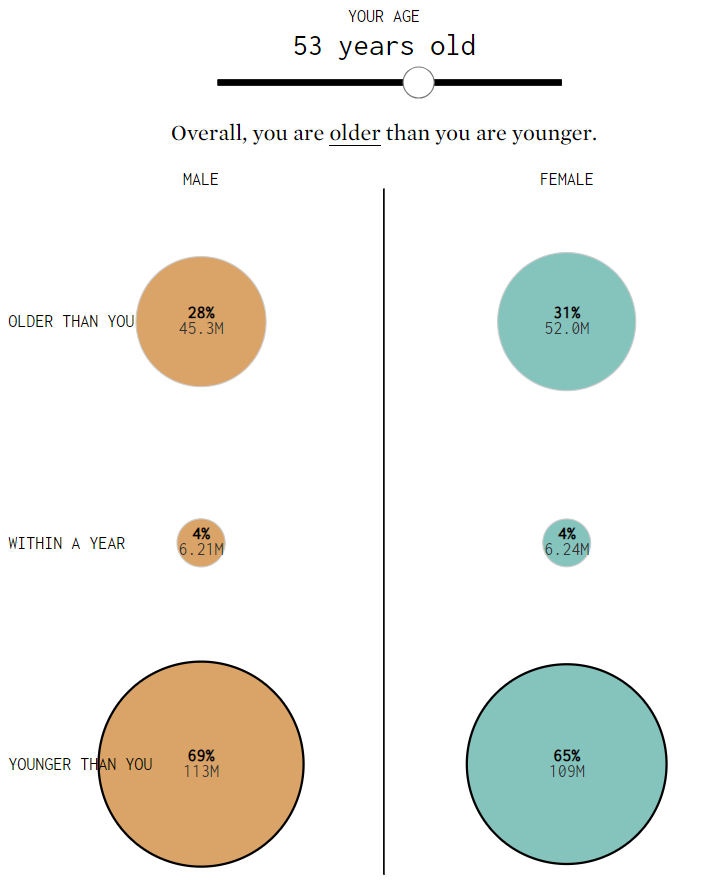
Source: https://flowingdata.com/2024/06/18/older-or-younger-than-the-population/

Wow, I’m older than a lot of people. When did that happen? (Shout out to my small cohort of fellow Gen-Xers!) So, in a bit of reflection, I want to discuss why I think aging in the quality profession is so critical.

The quality profession is an experience-heavy field. While formal education can provide some necessary theoretical knowledge, the practical skills required for the quality profession can only be mastered through extensive hands-on experience, practical application of skills, and the ability to adapt to real-world challenges.

Key characteristics

  1. Direct Experience: Students participate in activities that require them to apply what they have learned in a practical setting. An old adage is that you must do a job for three years before understanding it. However, you must keep going through the iterations since quality comprises multiple jobs. For example, my progress from deviation reviewer to eQMS implementation, to computer systems quality, to risk champion, to quality engineering, to change management process owner, to computer system implementor, to technology implementor, to validation quality, to operational excellence, to quality systems leader, to validation leader (and I am leaving a lot out). Layering and layering real experience again and again.
  2. Reflection: Reflection is a critical component of experiential learning. Most people don’t do that enough. The quality profession requires us to think about our experiences, analyze what we have learned, and consider how it applies to our work. Audits and inspections are interesting tools that can drive reflection when approached correctly.
  3. Active Participation: Quality professionals must be active agents in their learning process. They take initiative, make decisions, and are responsible for the outcomes of their actions. This active engagement helps to deepen their learning and develop critical thinking skills.
  4. Community Engagement: I joke about being able to tell what company some spent their formative years in. And that is not a good thing. Quality professionals need to seek out collaboration with the wider community members, often through professional organizations.
  5. Integration of Knowledge and Practice: Experiential fields bridge the gap between theoretical knowledge and practical application. Quality professionals must integrate what they have studied with real-world experiences, enhancing their understanding and retention of the material. And then do it again.

The quality profession is a dynamic and interactive learning environment emphasizing learning by doing, reflecting, and applying knowledge in real-world contexts.

Quality Control as a Top 10 Skill

The World Economic Forum (WEF) has developed a Global Skills Taxonomy that provides a framework for aligning around a universal language for skills. It synthesizes and builds on existing taxonomies by integrating definitions and categorizations of skills that are of growing relevance in a fast-changing labor market 1

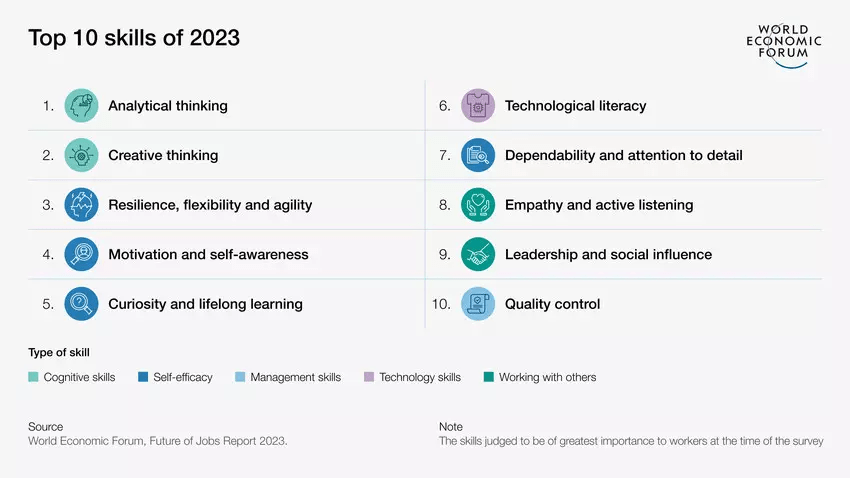
According to the World Economic Forum’s Future of Jobs Report 2023quality control is one of the top 10 core skills listed in the Global Skills Taxonomy. In the WEF taxonomy, Quality control refers to the process of verifying that a product or service meets specified standards or requirements. It appears to bundle both quality control and quality assurance into this definition.

Quality Control was not listed in the top 10 in the 2020 report. Throughout you find reference to a skill set called “Quality control and safety awareness”, so we can assume this is a refinement in the reporting. In any case, this is an interesting development that I wish the WEF’s material provided more detail on, especially as the 2021 Skills Taxonomy doesn’t include an entry for Quality Control.

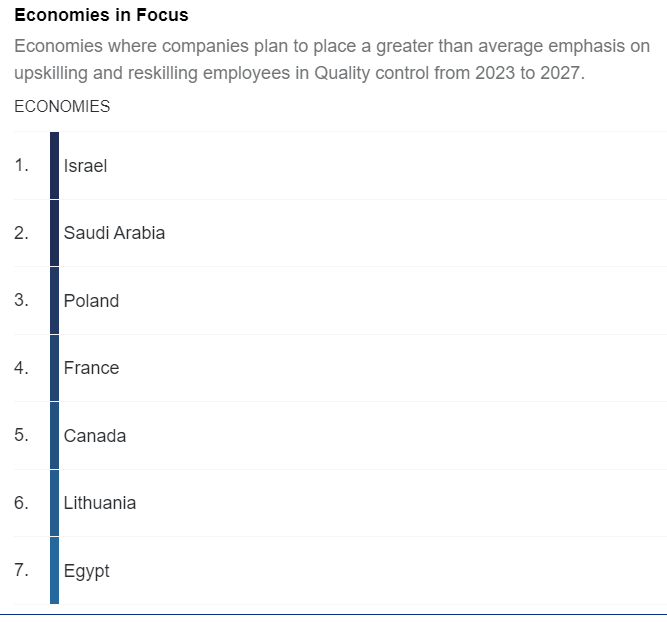
You need to go to the Data Explorer for Quality Control to see valuable information. Including this nice chart on the 7 top countries emphasizing quality control.

What facinates me most here is how it is not developing countries, there are some economic power houses here.

The industry categories of importance are interesting. Some industries I consider strong on quality rank below the mean and ohers above the mean. Others, Information and technology services I am looking at you, rate well below the mean on importance and it explains a lot of what is wrong with the world.

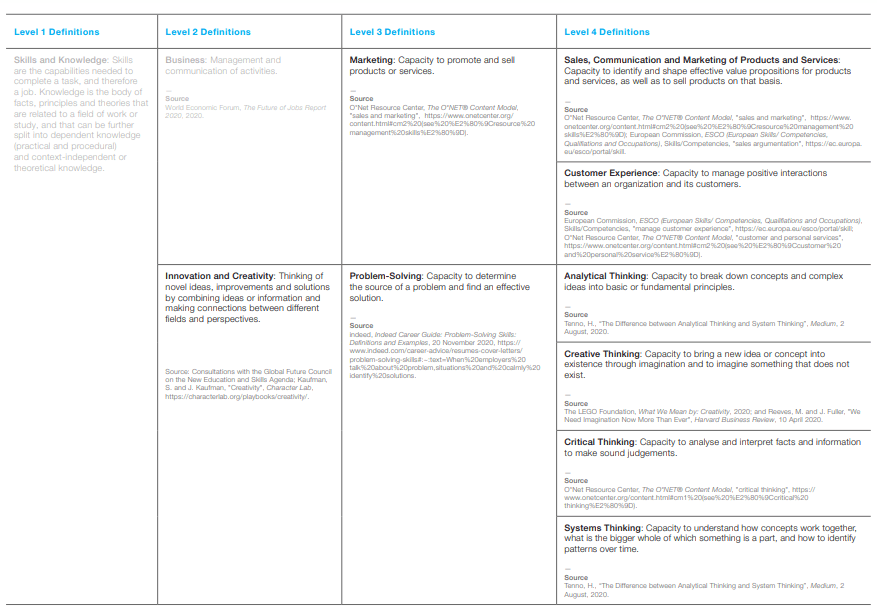
It would be nice to see the taxonomic entry. I’m fascinated by this one on Problem-Solving, which contains the first 2 in the top 10.

Interesting read that creates a lot of questions for me. But France and Canada, feel free to hit me up since it seems you are skill building.

And to help the WEF out, here is a nice way to break down what Quality is all about.

AI and Quality Profession Work

AI and its capabilities are big in the news right now, and inevitably folks start asking “What will this mean for my profession.”

The pharmaceutical GxP world is inherently slow to adopt new technologies. How many of my CxOs are still using 1990s technology? All of them. However, AI/ML has been showing up in more and more places so it is good to examine the potential to the Quality profession

It may seem counter-intuitive but the first place AI-powered software is making a difference is in improving the speed, accuracy, and efficiency of document review. From the eTMF to lab results to all the forms still used on the manufacturing floor, AI is already reviewing at a rate much faster than humans (and more reliably). Expect to see these options grow and become more part of offerings, such as your eTMF.

Trending is another place where AI/ML software is more capable than humans. Basically, anything that involves analysis will eventually be done by AI software, and will be done by software. We’re already seeing more and more automation be built into COTS and we will continue to see this trend grow.

So what won’t AI take the place of in the Quality Profession. Our real value is to strategize, understand causation, be creative, empathize and use common sense.

There’s a long way to go before AI can even do the things above. Have you asked one to write a policy on use of AI in GxP? Said policy would result in no AI ever being used in the GxPs.

Here is an example of a GxP policy for the use of AI to write SAS scripts, provided by an AI:

GxP Policy for Use of AI to Write SAS Scripts

  1. Purpose: The purpose of this policy is to provide guidance on the use of AI to write SAS scripts in compliance with GxP regulations.
  2. Scope: This policy applies to all AI systems and applications used to write SAS scripts for the analysis of data subject to GxP regulations.
  3. Responsibilities: It is the responsibility of all employees to comply with this policy and to report any non-compliance to the appropriate management.
  4. Compliance with GxP Regulations: All AI systems and applications used to write SAS scripts must be designed, developed, validated, and maintained in compliance with applicable GxP regulations.
  5. Data Integrity: All data used by AI systems to write SAS scripts must be accurate, complete, consistent, and attributable. Data must be protected against unauthorized access or modification.
  6. Validation: All AI systems used to write SAS scripts must be validated to ensure that they produce accurate and reliable scripts.
  7. Change Control: Any changes to AI systems used to write SAS scripts must be documented and approved through a formal change control process.
  8. Training: All employees involved in the use of AI systems to write SAS scripts must receive appropriate training on their use and on this policy.
  9. Audits and Inspections: All AI systems used to write SAS scripts are subject to internal and external audits and inspections to ensure compliance with this policy and with applicable GxP regulations.
  10. Continuous Improvement: This policy will be reviewed regularly and updated as necessary to ensure its continued effectiveness.

Awesome. I’ll circulate this beauty for approval right away.

Deming Unrealized

W. Edwards Deming’s substantive influence upon management thinking and practice is evidenced by the number of organizations that have worked to implement his key points, the abundance of books and papers related to his ideas, and the impact of his ideas on the practice of business today.  While I’m not a fan of the term Quality Guru, it is hard to miss his impact.

Deming’s main concepts can be summarized as:

Visionary Leadership: The ability of management to establish, practice, and lead a long-term vision for the organization, driven by changing customer requirements, as opposed to an internal management control role.
Internal and External Cooperation: The propensity of the organization to engage in non-competitive activities internally among employees and externally with respect to suppliers.
Learning: The organizational capability to recognize and nurture the development of its skills, abilities, and knowledge base.
Process Management: The set of methodological and behavioral practices emphasizing the management of process, or means of actions, rather than results.
Continuous Improvement: The propensity of the organization to pursue incremental and innovative improvements to processes, products, and services.
Employee Involvement: The degree to which employees of an organization feel that the organization continually satisfies their needs.
Customer Satisfaction: The degree to which an organization’s customers continually perceive that their needs are being met by the organization’s products and services.
Summarizing the System of Profound Knowledge

Almost thirty years after the publication of The New Economics for Industry, Government, Education and we are still striving to realize these. They are still as aspirational and, for many organizations, out of reach today as they were in the eighties. We can argue that a lot of the concepts that swirl around Quality 4.0 is just trying out new technologies to see if we meet those objectives.

We can, and should, discuss the particulars of the System of Profound Knowledge. For me, it makes an excellent departure point for what we should be striving for. By looking to the past we can discover…

  • Strengths that define us
  • Weaknesses that frustrate us
  • Causes that energize us
  • Relationships that inspire us.