PQS Efficiency – Is Efficiency Good?

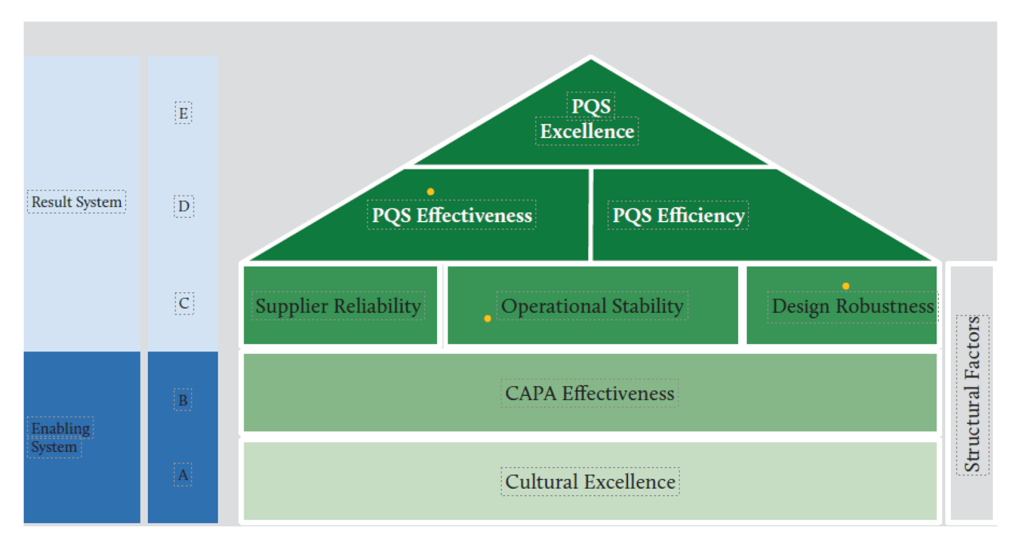
I do love a house metaphor or visualization, almost as I like a good tree, and this visualization of the house of quality is one I often return to. I want to turn to the question of efficiency, as it is often one I hear stressed by many leaders, and frankly I think the use can get a little off-kilter.

We can define efficiency as the “productivity of a process and the utilization of resources.” The St Gallen reports commissioned by the FDA as part of the quality metrics initiative finds that efficiency and effectiveness in pharmaceutical quality systems are positively correlated, though the relationship is not as strong as some may expect.

The study analyzed data from over 60 pharmaceutical manufacturing plants found a slight positive correlation between measures of quality system effectiveness and efficiency. This indicates that plants with more effective quality systems also tend to be more efficient in their operations. However, effectiveness only explained about 4% of the variation in efficiency scores, suggesting other factors play a major role as well.

To dig deeper, the researchers separated plants into four groups based on their levels of quality effectiveness and efficiency. The top performing group excelled in both areas, while the lowest group struggled with both. Interestingly, there were also groups that performed well in one area but not the other. This reveals that effectiveness and efficiency, while related, are distinct capabilities that must be built separately.

What really set apart the top performers was their higher implementation of operational excellence practices across areas like total productive maintenance, quality management, and just-in-time production. They also tended to have more empowered employees and a stronger culture of continuous improvement. This suggests that building these foundational capabilities is key to achieving both quality and efficiency.

The research provides evidence that quality and efficiency can be mutually reinforcing when the right systems and culture are in place. However, it also shows this is not automatic – companies must be intentional about developing both in tandem. Those that focus solely on efficiency without building quality maturity may struggle to sustain performance in the long run. The most successful manufacturers find ways to make quality a driver of operational excellence, not a constraint on it.

Dangers of an Excessive Focus on Efficiency

An excessive focus on efficiency in organizations can further lead to several unintended negative consequences:

Reduced Resilience and Flexibility

Prioritizing efficiency often involves streamlining processes, reducing redundancies, and optimizing resource allocation. While this can boost short-term productivity, it can also make organizations less resilient to unexpected disruptions.

Stifled Innovation and Creativity

Efficiency-driven environments tend to emphasize standardization and predictability, which can hinder innovation. When resources are tightly controlled and risk-aversion is high, there’s little room for experimentation and creative problem-solving. This can leave companies vulnerable to being outpaced by more innovative competitors.

Employee Burnout and Disengagement

Pushing for ever-increasing efficiency can lead to work environments where employees are constantly pressured to do more with less. This approach can increase stress levels, leading to burnout, reduced morale, and ultimately, lower overall productivity. Overworked employees may struggle with work-life balance and experience health issues, potentially resulting in higher turnover rates.

Compromised Quality

There’s often a delicate balance between efficiency and quality. In the pursuit of faster and cheaper ways of doing things, organizations may inadvertently compromise on product or service quality. Over time, this can erode brand reputation and customer loyalty.

Short-term Focus at the Expense of Long-term Success

An overemphasis on efficiency can lead to a myopic focus on short-term gains while neglecting long-term strategic objectives. This can result in missed opportunities for sustainable growth and innovation.

Resource Dilution and Competing Priorities

When organizations try to be efficient across too many initiatives simultaneously, it can lead to resource dilution. This often results in many projects being worked on, but few being completed effectively or on time. Competing priorities can also lead to different departments working at cross-purposes, potentially canceling out each other’s efforts.

Loss of Human Connection and Engagement

Prioritizing task efficiency over human connection can have significant negative impacts on workplace culture and employee engagement. A lack of connection in the workplace can chip away at healthy mindsets and organizational culture.

Reduced Adaptability to Change

Highly efficient systems are often optimized for specific conditions. When those conditions change, such systems may struggle to adapt. This can leave organizations vulnerable in rapidly changing business environments.

To mitigate these risks, organizations should strive for a balance between efficiency and other important factors such as resilience, innovation, and employee well-being. This may involve maintaining some redundancies, allowing for periods of “productive inefficiency,” and fostering a culture that values both productivity and human factors.

Quality and Efficiency

Building efficiency from quality, often referred to as “Good Quality – Good Business”, is best tackled by:

  1. Reduced waste and rework: By focusing on quality, companies can reduce defects, errors, and the need for rework. This directly improves efficiency by reducing wasted time, materials, and labor.
  2. Improved processes: Quality initiatives often involve analyzing and optimizing processes. These improvements can lead to more streamlined operations and better resource utilization.
  3. Enhanced reliability: High-quality products and processes tend to be more reliable. This reliability can reduce downtime, maintenance costs, and other inefficiencies.
  4. Cultural excellence: Organizations with a higher levels of cultural excellence, including employee engagement and continuous improvement mindsets supports both quality and efficiency improvements.

The important thing to remember is efficiency that does not help the worker, that does not build resilience, is not efficiency at all.

Trusting the Journey: When Uncertainty is a Feature

I spend a lot of time discussing uncertainty and how to address it in our quality system and within our organization. However, we often find ourselves at a crossroads, faced with uncertainty and the unknown in our careers – certainly, the last few years have been hard in biotech. My current approach has been to reframe this uncertainty not as an obstacle but as a feature of my journey—something it might have taken me 54 years to learn. I am striving to embrace the concept of “trusting the process” personally and as a quality practitioner so I can navigate life’s twists and turns with greater ease and purpose. As we go into the New Year, here are my current approaches.

The Power of Small Steps

If you are like me, it is easy to get lost in the day-to-day pressures of work. There is always a new issue, a new course correction. It is easy to focus on the overwhelming big picture to our next best steps and forget that the journey counts. My QA problem-solving self often wants to focus on problem-solving and forgets that we must strike a balance between action and acceptance, recognizing that while we can’t control every outcome, we can control our response to each situation. I am working to maintain agency in the present moment while surrendering to the unfolding path ahead.

Embracing Uncertainty as a Catalyst for Growth

Uncertainty, often viewed as a source of anxiety, can actually be a powerful catalyst for growth and innovation. By reframing uncertainty as a feature, we can open ourselves up to new possibilities and unexpected opportunities. This mindset shift encourages us to:

  1. Remain curious and open-minded
  2. Adapt more readily to changing circumstances
  3. Cultivate resilience in the face of challenges

The Art of Experimentation

One practical way to embrace uncertainty is through the practice of running small experiments. These controlled tests allow us to:

  • Gather quick feedback
  • Minimize risk
  • Foster creativity and innovation

We create a culture of continuous learning and improvement by incorporating regular experimentation into our personal and professional lives. This approach is particularly valuable when balancing the demands of serving an organization while pursuing personal growth.

Balancing Service and Growth

The challenge of running small experiments while fulfilling organizational responsibilities is common. Here are some strategies to help strike that balance:

  1. Integrate experiments into daily work: Look for opportunities to test new ideas or approaches within your existing projects and responsibilities.
  2. Time-box your experiments: Set aside specific, limited time periods for experimentation to ensure it doesn’t interfere with core duties.
  3. Communicate with stakeholders: Share your experimental approach, highlighting how it can benefit.
  4. Learn from successes and failures: Treat every experiment as a learning opportunity, regardless of the outcome.
  5. Start small and scale up: Begin with low-risk, high-potential experiments and gradually expand based on results and buy-in.

Cultivating Trust in the Process

Trusting the journey is not about blind faith or passivity. Instead, it’s about developing a deep relationship with your wisdom and decision-making process. This trust is built over time through:

  • Consistent self-reflection
  • Recognizing patterns in your choices and their outcomes
  • Staying connected to your core values and goals
  • Celebrating small wins and learning from setbacks

As you cultivate this trust, you’ll find yourself better equipped to navigate uncertainty confidently and gracefully.

Embracing the Journey

Trusting the journey can feel counterintuitive in a world that often demands certainty and immediate results. However, by embracing uncertainty as a feature of our growth process, we open ourselves to a richer, more fulfilling experience. Through small experiments, mindful action, and a willingness to surrender to the unknown, we can create a life and career that is both purposeful and adaptable.

Remember, the journey itself is where true growth and discovery happen. By trusting the process and focusing on our next best steps, we can navigate the complexities of life with greater ease and authenticity. So, take that first step, run that small experiment, and trust that the journey will unfold in ways you may never have imagined.

This is my New Year’s plan: to continue to apply to my personal space the skills and mindsets that have made my career so fruitful.

What is Ahead for US Pharma?

It has been a wild ride this past week. I know my family and I have been on an emotional rollercoaster, and I bet many of you are feeling the same way. One question that keeps popping up in our household (and probably yours too) is: “What does this mean for my job, and should I be freaking out?”

Short-term outlook: Keep calm and carry on

First things first, take a deep breath. In the immediate future, it’s unlikely that we’ll see any massive shifts in pharma world. Most of us can probably continue our daily grind without too much disruption. So, for now, it’s business as usual, folks! Unfortunately that business has been pretty tough the last two years.

Long-term forecast: Cloudy with a chance of uncertainty

Now, here’s where things get a bit murky. The long-term outlook? Well, it’s like trying to predict the weather a year from now – pretty darn tricky. What we do know is that this situation has cranked up the uncertainty dial, and let’s face it, uncertainty in the pharmaceutical world is very unwelcome.

We already have a hefty dose of uncertainty due to the 2024 Supreme Court decisions, which are slowly starting to have impact but the boundaries are really unknown. Add to that an incoming administration with a noted dislike (and a set of vendettas) against the HHS and FDA, and government employees. And on top of that we have the wild card of Robert F. Kennedy Jr. being able to “go wild on health” – whatever that ends up meaning but my fear is nothing good.

But I also need to be pragmatic, and as a quality individual involved in risk management and managing uncertainty, I need to start evaluating impacts. Here are the things I am looking at.

On-Shoring

On-Shoring has been a growing conversation for years. We are an incredibly global industry and have been hard hit by a variety of supply disruptions:

  1. Global Pandemic: COVID-19 threw a massive wrench into our well-oiled supply chain machine.
  2. Geopolitical Tensions: The ongoing trade tiffs between major economies have kept us on our toes.
  3. Natural Disasters: Mother Nature hasn’t exactly been playing nice lately.
  4. Labor Shortages: Finding skilled workers has become a bit like searching for a needle in a haystack.

Add to this cocktail the ongoing GMP issues with sites in key manufacturing countries like India and China, and you’ve got a recipe for some serious supply chain headache,

Add to that we have a whole lot of talk of tariffs. The incoming Trump administration is practically drooling to raise tariffs which will have some serious implications:

  • Market Access Issues: Suddenly, selling your products in certain countries becomes a whole lot trickier.
  • Higher Costs: Tariffs often mean higher prices for imported goods.
  • Retaliation Risks: When one country imposes tariffs, others tend to follow suit.

The Critical Component Conundrum

Here’s where things get scary. We are seeing an increase in both price and availability issues for critical raw materials and components. And it is not just about overseas suppliers – even our domestic suppliers are feeling the heat. Remember the great plastics shortage that hit our Single-Use System (SUS) component suppliers? That is potentially just the tip of the iceberg.

The Ripple Effect

Now, let’s connect the dots:

  1. Supply Chain Vulnerability: Our global supply chains are showing their weak spots.
  2. Critical Item Shortages: There’s a growing concern about shortages of essential items.
  3. Price Hikes: As supplies tighten and tariffs kick in, prices are heading north.
  4. Market Access Challenges: A potential trade war could make it tough to serve international markets from the U.S. And remember, we are a very global industry.

Risk Management Approach

  1. Diversify Supply Sources: Don’t put all your eggs in one basket (or country).
  2. Build Resilience: Create buffer stocks of critical components.
  3. Explore On-Shoring Options: Look into bringing some production closer to home.
  4. Stay Flexible: Be ready to pivot your strategy as the global situation evolves.
  5. Plan for multi-country impact: Evaluate what happens when other countries start retaliating and it becomes difficult to get clinical or commercial supply into a country.

Regulatory Changes

Here are my fears where RFK Jr can really do damage. He may push for less stringent approval processes for certain drugs or treatments he favors, potentially allowing more alternative or “natural” products to enter the market. Conversely, he could impose stricter regulations on vaccines and other pharmaceutical products he views skeptically (which is all of them).

There may be efforts to roll back regulatory controls that currently protect public health, potentially allowing unproven treatments to reach consumers more easily. All of this uncertainty is going to be difficult and will impact company’s ability to raise funds. Which will impact the job market. And it has been a bad couple of years for layoffs.

PDCA and OODA

PDCA (and it’s variants) are a pretty tried and true model for process improvement. In the PDCA model a plan is structured in four steps: P (plan) D (do) C (check) A (act). The intention is create a structured cycle that allows the process to flow in accordance with the objectives to be achieved (P), execute what was planned (D), check whether the objectives were achieved with emphasis on the verification of what went right and what went wrong (C) and identify factors of success or failure to feed a new process of planning (A).

Conceptually, the organization will be a fast turning wheel of endlessly learning from mistakes and seeking to maximize processes in order to remain forever in pursuit of strategic objectives, endlessly searching for the maximum efficiency and effectiveness of the system.

The OODA Loop

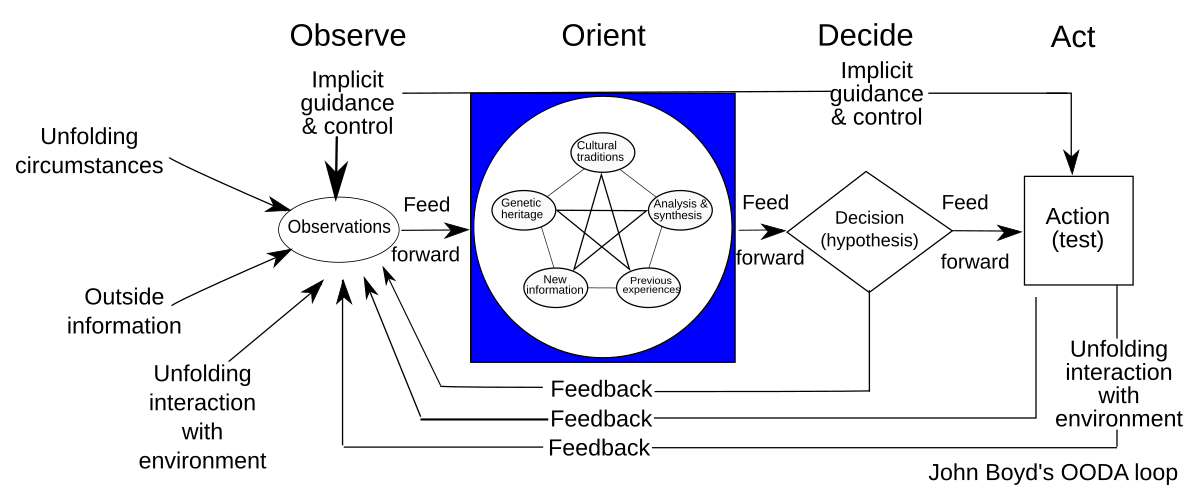
The OODA loop or cycle was designed by John R. Boyd and consists of a cycle of four phases:
Observe, Orient, Decide and Act (OODA).

  • Observe: Based on implicit guidance and control, observations are made regarding unfolding circumstances, outside information, and dynamic interaction with the environment (including the result of prior actions).
  • Orient: Observations from the prior stage are deconstructed into separate component
    pieces; then synthesized and analyzed in several contexts such as cultural traditions, genetic
    heritage, and previous experiences; and then combined together for the purposes of
    analysis and synthesis to inform the next phase.
  • Decide: In this phase, hypotheses are evaluated, and a decision is made.
  • Act: Based on the decision from the prior stage, action is taken to achieve a desired effect
    or result

While similar to the PDCA improvement of a known system making it more effective, efficient or effective (depending on the effect to be expected), the OODA strives to model a framework for situational awareness.

Boyd’s concentration on the specific set of circumstances relevant to military situations had for years meant the OODA loop has not received a lot of wide spread interest. I’ve been seeing a lot of recent adaptations of the OODA loop try to expand to address the needs of operating in volatile, uncertain, complex and ambiguous (VUCA) situations. I especially like seeing it as part of resilience and business continuity.

Enhanced Decision-Making Speed and Agility

    The OODA loop enables organizations to make faster, more informed decisions in rapidly changing environments. By continuously cycling through the observe-orient-decide-act process, organizations can respond more quickly to market crises, threats, and emerging opportunities.

    Improved Situational Awareness

      The observation and orientation phases help organizations maintain a comprehensive understanding of their operating environment. This enhanced situational awareness allows us to identify trends, threats, and opportunities more effectively.

      Better Adaptability to Change

        The iterative nature of the OODA loop promotes continuous learning and adaptation. This fosters a culture of flexibility and responsiveness, enabling organizations to adjust their strategies and operations as circumstances evolve.

        Enhanced Crisis Management

          In high-pressure situations or crises, the OODA loop provides a structured approach for rapid, effective decision-making. This can be invaluable for managing unexpected challenges or emergencies.

          Improved Team Coordination and Communication

            The OODA process encourages clear communication and coordination among team members as they move through each phase. This can lead to better team cohesion and more effective execution of strategies.

            Data-Driven Culture

              The OODA loop emphasizes the importance of observation and orientation based on current data. This promotes a data-driven culture where decisions are made based on real-time information rather than outdated assumptions.

              Continuous Improvement

                The cyclical nature of the OODA loop supports ongoing refinement of processes and strategies. Each iteration provides feedback that can be used to improve future observations, orientations, decisions, and actions.

                Complementary Perspectives

                PDCA is typically used for long-term, systematic improvement projects, while OODA is better suited for rapid decision-making in dynamic environments. Using both allows organizations to address both strategic and tactical needs.

                Integration Points

                1. Observation and Planning
                  • OODA’s “Observe” step can feed into PDCA’s “Plan” phase by providing real-time situational awareness.
                  • PDCA’s structured planning can enhance OODA’s orientation process.
                2. Execution
                  • PDCA’s “Do” phase can incorporate OODA loops for quick adjustments during implementation.
                  • OODA’s “Act” step can trigger a new PDCA cycle for more comprehensive improvements.
                3. Evaluation
                  • PDCA’s “Check” phase can use OODA’s observation techniques for more thorough assessment.
                  • OODA’s rapid decision-making can inform PDCA’s “Act” phase for faster course corrections.

                Navigating the New Era of Quality Management

                One of the topics I’m passionate about is exploring the changing landscape of quality management and the challenges we face. The solutions that worked in the past decade won’t be as effective in our current era, marked by post-globalization, capital rationalization, spatial dispersion, shrinking workforces, and an increasing reliance on automation. This transformation calls for a new perspective on quality management, as traditional instincts and strategies may no longer be sufficient. The nature of opportunity and risk has fundamentally changed, and in order to thrive, we need to adapt our approach.

                The New Rules of Engagement

                In this era of volatility, several key trends are reshaping the business environment:

                • Post-Globalization: The shift towards localized operations and supply chains.
                • Capital Rationalization: More stringent allocation of financial resources. This is a huge trend in biotech.
                • Spatial Dispersion: Decentralized workforces and operations.
                • Shrinking Workforces: Reduced human resources due to demographic changes.
                • Dependence on Automation: Increased reliance on technologies like AI, ML, and RPA.

                We need to reevaluate how we approach quality management in light of these trends.

                Prediction: Anticipating the Future

                In a volatile environment, it is crucial to predict and anticipate disruptions. Quality management must shift from being reactive to proactive. This involves:

                • Advanced Analytics: Utilizing data analytics to anticipate quality issues before they emerge. This necessitates a strong data foundation and the capability to analyze both structured and unstructured data.
                • Scenario Planning: Developing multiple scenarios to anticipate potential disruptions and their impacts on quality aids in making well-informed strategic decisions and preparing for various contingencies.

                Adaptability: Embracing Change

                Adaptability is crucial in a constantly changing world. Quality management systems need to be flexible and responsive to new challenges.

                • Agile Methodologies: Implementing agile practices to allow for quick adjustments to processes and workflows, fostering a culture of experimentation, and learning from failures.
                • Virtualization of Work: Adapting quality processes to support remote and hybrid work environments involves re-evaluating governance models and ensuring that quality standards are maintained regardless of the location of work.

                Resilience: Building Robust Systems

                Resilience ensures that organizations can withstand and recover from disruptions. This capability is built on strong foundations:

                • Robust Systems: Developing systems that can operate effectively under stress. This includes ensuring that automated processes are reliable and that there are contingencies for system failures.
                • Organizational Culture: Fostering a culture that values resilience and continuous improvement ensures that employees are prepared to handle disruptions and contribute to the organization’s long-term success.

                Implementing the New Quality Paradigm

                To effectively implement these principles, organizations should consider the following steps:

                1. Assess the Current State: Conduct a comprehensive assessment of existing quality processes, identifying areas for improvement and potential vulnerabilities.
                2. Set Clear Objectives: Establish clear, measurable objectives that align with the principles of prediction, adaptability, and resilience.
                3. Develop a Phased Approach: Implement changes gradually, with clear milestones and measurable outcomes to ensure smooth transitions.
                4. Engage Stakeholders: Involve all relevant stakeholders in the transformation process to ensure alignment and buy-in.
                5. Monitor Progress: Continuously monitor progress against predefined objectives and make adjustments as necessary to stay on track.
                6. Invest in Training: Provide employees with the necessary training and development opportunities to adapt to new technologies and processes.

                Conclusion

                It is important to change our mindset and strategy. Embracing the principles of prediction, adaptability, and resilience can help organizations navigate the complexities of a volatile environment and position themselves for long-term success. Going forward, it is essential to stay vigilant, flexible, and proactive in our approach to quality management. We must ensure that we not only meet but exceed stakeholder expectations in this rapidly changing world.