Finding Rhythm in Quality Risk Management: Moving Beyond Control to Adaptive Excellence

The pharmaceutical industry has long operated under what Michael Hudson aptly describes in his recent Forbes article as “symphonic control, “carefully orchestrated strategies executed with rigid precision, where quality units can function like conductors trying to control every note. But as Hudson observes, when our meticulously crafted risk assessments collide with chaotic reality, what emerges is often discordant. The time has come for quality risk management to embrace what I am going to call “rhythmic excellence,” a jazz-inspired approach that maintains rigorous standards while enabling adaptive performance in our increasingly BANI (Brittle, Anxious, Non-linear, and Incomprehensible) regulatory and manufacturing environment.

And since I love a good metaphor, I bring you:

Rhythmic Quality Risk Management

Recent research by Amy Edmondson and colleagues at Harvard Business School provides compelling evidence for rhythmic approaches to complex work. After studying more than 160 innovation teams, they found that performance suffered when teams mixed reflective activities (like risk assessments and control strategy development) with exploratory activities (like hazard identification and opportunity analysis) in the same time period. The highest-performing teams established rhythms that alternated between exploration and reflection, creating distinct beats for different quality activities.

This finding resonates deeply with the challenges we face in pharmaceutical quality risk management. Too often, our risk assessment meetings become frantic affairs where hazard identification, risk analysis, control strategy development, and regulatory communication all happen simultaneously. Teams push through these sessions exhausted and unsatisfied, delivering risk assessments they aren’t proud of—what Hudson describes as “cognitive whiplash”.

From Symphonic Control to Jazz-Based Quality Leadership

The traditional approach to pharmaceutical quality risk management mirrors what Hudson calls symphonic leadership—attempting to impose top-down structure as if more constraint and direction are what teams need to work with confidence. We create detailed risk assessment procedures, prescriptive FMEA templates, and rigid review schedules, then wonder why our teams struggle to adapt when new hazards emerge or when manufacturing conditions change unexpectedly.

Karl Weick’s work on organizational sensemaking reveals why this approach undermines our quality objectives: complex manufacturing environments require “mindful organizing” and the ability to notice subtle changes and respond fluidly. Setting a quality rhythm and letting go of excessive control provides support without constraint, giving teams the freedom to explore emerging risks, experiment with novel control strategies, and make sense of the quality challenges they face.

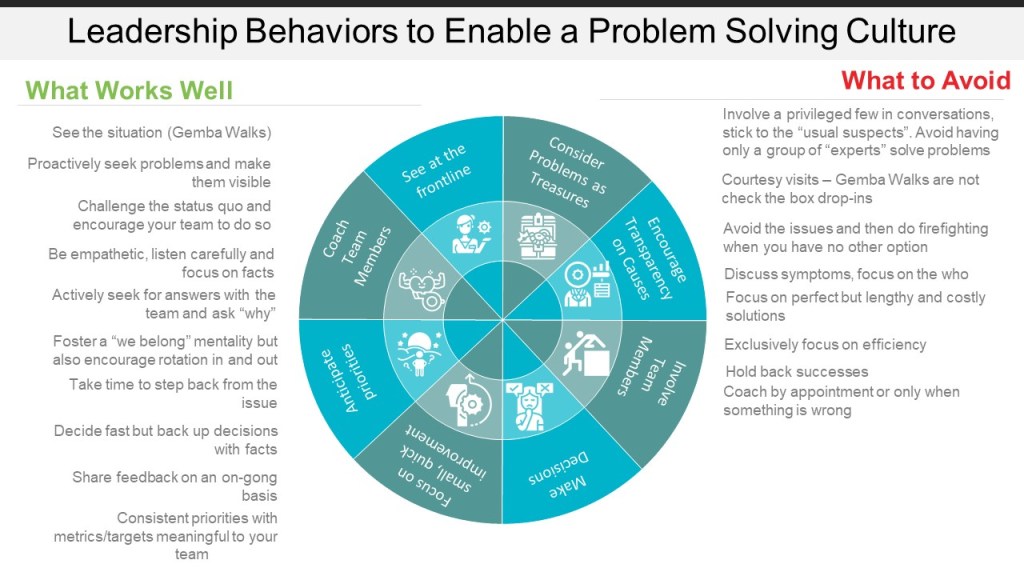
This represents a fundamental shift in how we conceptualize quality risk management leadership. Instead of being the conductor trying to orchestrate every risk assessment note, quality leaders should function as the rhythm section—establishing predictable beats that keep everyone synchronized while allowing individual expertise to flourish.

The Quality Rhythm Framework: Four Essential Beats

Drawing from Hudson’s research-backed insights and integrating them with ICH Q9(R1) requirements, I envision a Quality Rhythm Framework built on four essential beats:

Beat 1: Find Your Risk Cadence

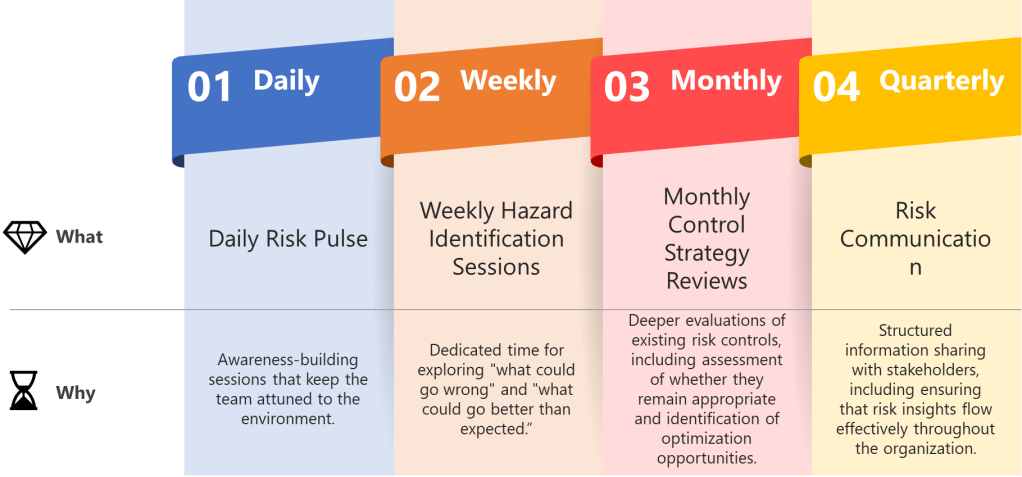
Establish predictable rhythms that create temporal anchors for your quality team while maintaining ICH Q9 compliance. Weekly hazard identification sessions, daily deviation assessments, monthly control strategy reviews, and quarterly risk communication cycles aren’t just meetings—they’re the beats that keep everyone synchronized while allowing individual risk management expression.

The ICH Q9(R1) revision’s emphasis on proportional formality aligns perfectly with this rhythmic approach. High-risk processes require more frequent beats, while lower-risk areas can operate with extended rhythms. The key is consistency within each risk category, creating what Weick calls “structured flexibility”—the ability to respond creatively within clear boundaries.

Consider implementing these quality-specific rhythmic structures:

  • Daily Risk Pulse: Brief stand-ups focused on emerging quality signals—not comprehensive risk assessments, but awareness-building sessions that keep the team attuned to the manufacturing environment.
  • Weekly Hazard Identification Sessions: Dedicated time for exploring “what could go wrong” and, following ISO 31000 principles, “what could go better than expected.” These sessions should alternate between different product lines or process areas to maintain focus.
  • Monthly Control Strategy Reviews: Deeper evaluations of existing risk controls, including assessment of whether they remain appropriate and identification of optimization opportunities.
  • Quarterly Risk Communication Cycles: Structured information sharing with stakeholders, including regulatory bodies when appropriate, ensuring that risk insights flow effectively throughout the organization.
Beat 2: Pause for Quality Breaths

Hudson emphasizes that jazz musicians know silence is as important as sound, and quality risk management desperately needs structured pauses. Build quality breaths into your organizational rhythm—moments for reflection, integration, and recovery from the intense focus required for effective risk assessment.

Research by performance expert Jim Loehr demonstrates that sustainable excellence requires oscillation, not relentless execution. In quality contexts, this means creating space between intensive risk assessment activities and implementation of control strategies. These pauses allow teams to process complex risk information, integrate diverse perspectives, and avoid the decision fatigue that leads to poor risk judgments.

Practical quality breaths include:

  • Post-Assessment Integration Time: Following comprehensive risk assessments, build in periods where team members can reflect on findings, consult additional resources, and refine their thinking before finalizing control strategies.
  • Cross-Functional Synthesis Sessions: Regular meetings where different functions (Quality, Operations, Regulatory, Technical) come together not to make decisions, but to share perspectives and build collective understanding of quality risks.
  • Knowledge Capture Moments: Structured time for documenting lessons learned, updating risk models based on new experience, and creating institutional memory that enhances future risk assessments.

Beat 3: Encourage Quality Experimentation

Within your rhythmic structure, create psychological safety and confidence that team members can explore novel risk identification approaches without fear of hitting “wrong notes.” When learning and reflection are part of a predictable beat, trust grows and experimentation becomes part of the quality flow.

The ICH Q9(R1) revision’s focus on managing subjectivity in risk assessments creates opportunities for experimental approaches. Instead of viewing subjectivity as a problem to eliminate, we can experiment with structured methods for harnessing diverse perspectives while maintaining analytical rigor.

Hudson’s research shows that predictable rhythm facilitates innovation—when people are comfortable with the rhythm, they’re free to experiment with the melody. In quality risk management, this means establishing consistent frameworks that enable creative hazard identification and innovative control strategy development.

Experimental approaches might include:

  • Success Mode and Benefits Analysis (SMBA): As I’ve discussed previously, complement traditional FMEA with systematic identification of positive potential outcomes. Experiment with different SMBA formats and approaches to find what works best for specific process areas.
  • Cross-Industry Risk Insights: Dedicate portions of risk assessment sessions to exploring how other industries handle similar quality challenges. These experiments in perspective-taking can reveal blind spots in traditional pharmaceutical approaches.
  • Scenario-Based Risk Planning: Experiment with “what if” exercises that go beyond traditional failure modes to explore complex, interdependent risk situations that might emerge in dynamic manufacturing environments.

Beat 4: Enable Quality Solos

Just as jazz musicians trade solos while the ensemble provides support, look for opportunities for individual quality team members to drive specific risk management initiatives. This distributed leadership approach builds capability while maintaining collective coherence around quality objectives.

Hudson’s framework emphasizes that adaptive leaders don’t try to be conductors but create conditions for others to lead. In quality risk management, this means identifying team members with specific expertise or interest areas and empowering them to lead risk assessments in those domains.

Quality leadership solos might include:

  • Process Expert Risk Leadership: Assign experienced operators or engineers to lead risk assessments for processes they know intimately, with quality professionals providing methodological support.
  • Cross-Functional Risk Coordination: Empower individuals to coordinate risk management across organizational boundaries, taking ownership for ensuring all relevant perspectives are incorporated.
  • Innovation Risk Championship: Designate team members to lead risk assessments for new technologies or novel approaches, building expertise in emerging quality challenges.

The Rhythmic Advantage: Three Quality Transformation Benefits

Mastering these rhythmic approaches to quality risk management provide three advantages that mirror Hudson’s leadership research:

Fluid Quality Structure

A jazz ensemble can improvise because musicians share a rhythm. Similarly, quality rhythms keep teams functioning together while offering freedom to adapt to emerging risks, changing regulatory requirements, or novel manufacturing challenges. Management researchers call this “structured flexibility”—exactly what ICH Q9(R1) envisions when it emphasizes proportional formality.

When quality teams operate with shared rhythms, they can respond more effectively to unexpected events. A contamination incident doesn’t require completely reinventing risk assessment approaches—teams can accelerate their established rhythms, bringing familiar frameworks to bear on novel challenges while maintaining analytical rigor.

Sustainable Quality Energy

Quality risk management is inherently demanding work that requires sustained attention to complex, interconnected risks. Traditional approaches often lead to burnout as teams struggle with relentless pressure to identify every possible hazard and implement perfect controls. Rhythmic approaches prevent this exhaustion by regulating pace and integrating recovery.

More importantly, rhythmic quality management aligns teams around purpose and vision rather than merely compliance deadlines. This enables what performance researchers call “sustainable high performance”—quality excellence that endures rather than depletes organizational energy.

When quality professionals find rhythm in their risk management work, they develop what Mihaly Csikszentmihalyi identified as “flow state,” moments when attention is fully focused and performance feels effortless. These states are crucial for the deep thinking required for effective hazard identification and the creative problem-solving needed for innovative control strategies.

Enhanced Quality Trust and Innovation

The paradox Hudson identifies, that some constraint enables creativity, applies directly to quality risk management. Predictable rhythms don’t stifle innovation; they provide the stable foundation from which teams can explore novel approaches to quality challenges.

When quality teams know they have regular, structured opportunities for risk exploration, they’re more willing to raise difficult questions, challenge assumptions, and propose unconventional solutions. The rhythm creates psychological safety for intellectual risk-taking within the controlled environment of systematic risk assessment.

This enhanced innovation capability is particularly crucial as pharmaceutical manufacturing becomes increasingly complex, with continuous manufacturing, advanced process controls, and novel drug modalities creating quality challenges that traditional risk management approaches weren’t designed to address.

Integrating Rhythmic Principles with ICH Q9(R1) Compliance

The beauty of rhythmic quality risk management lies in its fundamental compatibility with ICH Q9(R1) requirements. The revision’s emphasis on scientific knowledge, proportional formality, and risk-based decision-making aligns perfectly with rhythmic approaches that create structured flexibility for quality teams.

Rhythmic Risk Assessment Enhancement

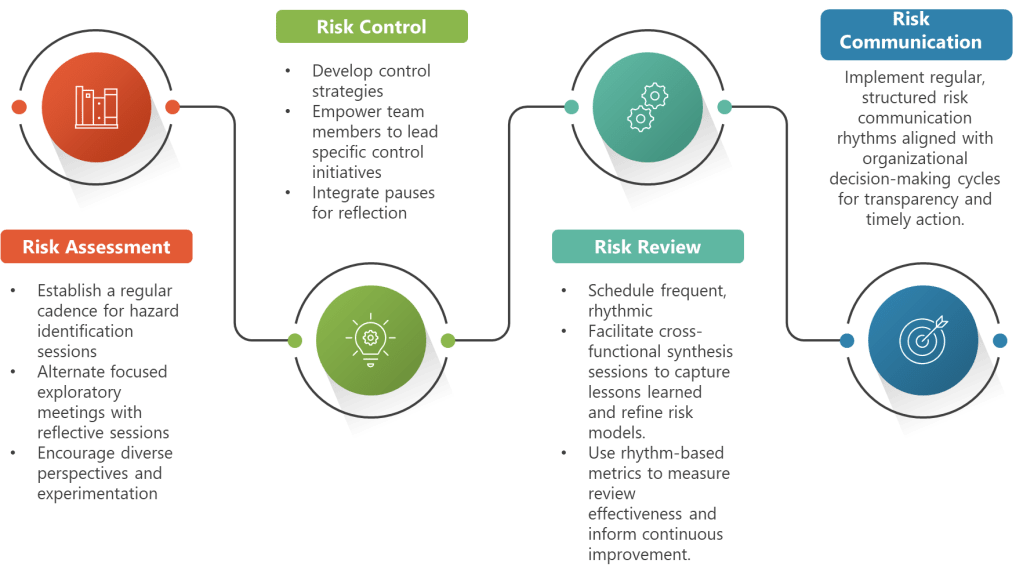
ICH Q9 requires systematic hazard identification, risk analysis, and risk evaluation. Rhythmic approaches enhance these activities by establishing regular, focused sessions for each component rather than trying to accomplish everything in marathon meetings.

During dedicated hazard identification beats, teams can employ diverse techniques—traditional brainstorming, structured what-if analysis, cross-industry benchmarking, and the Success Mode and Benefits Analysis I’ve advocated. The rhythm ensures these activities receive appropriate attention while preventing the cognitive overload that reduces identification effectiveness.

Risk analysis benefits from rhythmic separation between data gathering and interpretation activities. Teams can establish rhythms for collecting process data, manufacturing experience, and regulatory intelligence, followed by separate beats for analyzing this information and developing risk models.

Rhythmic Risk Control Development

The ICH Q9(R1) emphasis on risk-based decision-making aligns perfectly with rhythmic approaches to control strategy development. Instead of rushing from risk assessment to control implementation, rhythmic approaches create space for thoughtful strategy development that considers multiple options and their implications.

Rhythmic control development might include beats for:

  • Control Strategy Ideation: Creative sessions focused on generating potential control approaches without immediate evaluation of feasibility or cost.
  • Implementation Planning: Separate sessions for detailed planning of selected control strategies, including resource requirements, timeline development, and change management considerations.
  • Effectiveness Assessment: Regular rhythms for evaluating implemented controls, gathering performance data, and identifying optimization opportunities.

Rhythmic Risk Communication

ICH Q9’s communication requirements benefit significantly from rhythmic approaches. Instead of ad hoc communication when problems arise, establish regular rhythms for sharing risk insights, control strategy updates, and lessons learned.

Quality communication rhythms should align with organizational decision-making cycles, ensuring that risk insights reach stakeholders when they’re most useful for decision-making. This might include monthly updates to senior leadership, quarterly reports to regulatory affairs, and annual comprehensive risk reviews for long-term strategic planning.
Practical Implementation: Building Your Quality Rhythm

Implementing rhythmic quality risk management requires systematic integration rather than wholesale replacement of existing approaches. Start by evaluating your current risk management processes to identify natural rhythm points and opportunities for enhancement.

Phase 1: Rhythm Assessment and Planning

Map your existing quality risk management activities against rhythmic principles. Identify where teams experience the cognitive whiplash Hudson describes—trying to accomplish too many different types of thinking in single sessions. Look for opportunities to separate exploration from analysis, strategy development from implementation planning, and individual reflection from group decision-making.

Establish criteria for quality rhythm frequency based on risk significance, process complexity, and organizational capacity. High-risk processes might require daily pulse checks and weekly deep dives, while lower-risk areas might operate effectively with monthly assessment rhythms.

Train quality teams on rhythmic principles and their application to risk management. Help them understand how rhythm enhances rather than constrains their analytical capabilities, providing structure that enables deeper thinking and more creative problem-solving.

Phase 2: Pilot Program Development

Select pilot areas where rhythmic approaches are most likely to demonstrate clear benefits. New product development projects, technology implementation initiatives, or process improvement activities often provide ideal testing grounds because their inherent uncertainty creates natural opportunities for both risk management and opportunity identification.

Design pilot programs to test specific rhythmic principles:

  • Rhythm Separation: Compare traditional comprehensive risk assessment meetings with rhythmic approaches that separate hazard identification, risk analysis, and control strategy development into distinct sessions.
  • Quality Breathing: Experiment with structured pauses between intensive risk assessment activities and measure their impact on decision quality and team satisfaction.
  • Distributed Leadership: Identify opportunities for team members to lead specific aspects of risk management and evaluate the impact on engagement and expertise development.

Phase 3: Organizational Integration

Based on pilot results, develop systematic approaches for scaling rhythmic quality risk management across the organization. This requires integration with existing quality systems, regulatory processes, and organizational governance structures.

Consider how rhythmic approaches will interact with regulatory inspection activities, change control processes, and continuous improvement initiatives. Ensure that rhythmic flexibility doesn’t compromise documentation requirements or audit trail integrity.

Establish metrics for evaluating rhythmic quality risk management effectiveness, including both traditional risk management indicators (incident rates, control effectiveness, regulatory compliance) and rhythm-specific measures (team engagement, innovation frequency, decision speed).

Phase 4: Continuous Enhancement and Cultural Integration

Like all aspects of quality risk management, rhythmic approaches require continuous improvement based on experience and changing needs. Regular assessment of rhythm effectiveness helps refine approaches over time and ensures sustained benefits.

The ultimate goal is cultural integration—making rhythmic thinking a natural part of how quality professionals approach risk management challenges. This requires consistent leadership modeling, recognition of rhythmic successes, and integration of rhythmic principles into performance expectations and career development.

Measuring Rhythmic Quality Success

Traditional quality metrics focus primarily on negative outcome prevention: deviation rates, batch failures, regulatory findings, and compliance scores. While these remain important, rhythmic quality risk management requires expanded measurement approaches that capture both defensive effectiveness and adaptive capability.

Enhanced metrics should include:

  • Rhythm Consistency Indicators: Frequency of established quality rhythms, participation rates in rhythmic activities, and adherence to planned cadences.
  • Innovation and Adaptation Measures: Number of novel risk identification approaches tested, implementation rate of creative control strategies, and frequency of process improvements emerging from risk management activities.
  • Team Engagement and Development: Participation in quality leadership opportunities, cross-functional collaboration frequency, and professional development within risk management capabilities.
  • Decision Quality Indicators: Time from risk identification to control implementation, stakeholder satisfaction with risk communication, and long-term effectiveness of implemented controls.

Regulatory Considerations: Communicating Rhythmic Value

Regulatory agencies are increasingly interested in risk-based approaches that demonstrate genuine process understanding and continuous improvement capabilities. Rhythmic quality risk management strengthens regulatory relationships by showing sophisticated thinking about process optimization and quality enhancement within established frameworks.

When communicating with regulatory agencies, emphasize how rhythmic approaches improve process understanding, enhance control strategy development, and support continuous improvement objectives. Show how structured flexibility leads to better patient protection through more responsive and adaptive quality systems.

Focus regulatory communications on how enhanced risk understanding leads to better quality outcomes rather than on operational efficiency benefits that might appear secondary to regulatory objectives. Demonstrate how rhythmic approaches maintain analytical rigor while enabling more effective responses to emerging quality challenges.

The Future of Quality Risk Management: Beyond Rhythm to Resonance

As we master rhythmic approaches to quality risk management, the next evolution involves what I call “quality resonance”—the phenomenon that occurs when individual quality rhythms align and amplify each other across organizational boundaries. Just as musical instruments can create resonance that produces sounds more powerful than any individual instrument, quality organizations can achieve resonant states where risk management effectiveness transcends the sum of individual contributions.

Resonant quality organizations share several characteristics:

  • Synchronized Rhythm Networks: Quality rhythms in different departments, processes, and product lines align to create organization-wide patterns of risk awareness and response capability.
  • Harmonic Risk Communication: Information flows between quality functions create harmonics that amplify important signals while filtering noise, enabling more effective decision-making at all organizational levels.
  • Emergent Quality Intelligence: The interaction of multiple rhythmic quality processes generates insights and capabilities that wouldn’t be possible through individual efforts alone.

Building toward quality resonance requires sustained commitment to rhythmic principles, continuous refinement of quality cadences, and patient development of organizational capability. The payoff, however, is transformational: quality risk management that not only prevents problems but actively creates value through enhanced understanding, improved processes, and strengthened competitive position.

Finding Your Quality Beat

Uncertainty is inevitable in pharmaceutical manufacturing, regulatory environments, and global supply chains. As Hudson emphasizes, the choice is whether to exhaust ourselves trying to conduct every quality note or to lay down rhythms that enable entire teams to create something extraordinary together.

Tomorrow morning, when you walk into that risk assessment meeting, you’ll face this choice in real time. Will you pick up the conductor’s baton, trying to control every analytical voice? Or will you sit at the back of the stage and create the beat on which your quality team can find its flow?

The research is clear: rhythmic approaches to complex work create better outcomes, higher engagement, and more sustainable performance. The ICH Q9(R1) framework provides the flexibility needed to implement rhythmic quality risk management while maintaining regulatory compliance. The tools and techniques exist to transform quality risk management from a defensive necessity into an adaptive capability that drives innovation and competitive advantage.

The question isn’t whether rhythmic quality risk management will emerge—it’s whether your organization will lead this transformation or struggle to catch up. The teams that master quality rhythm first will be best positioned to thrive in our increasingly BANI pharmaceutical world, turning uncertainty into opportunity while maintaining the rigorous standards our patients deserve.

Start with one beat. Find one aspect of your current quality risk management where you can separate exploration from analysis, create space for reflection, or enable someone to lead. Feel the difference that rhythm makes. Then gradually expand, building the quality jazz ensemble that our complex manufacturing world demands.

The rhythm section is waiting. It’s time to find your quality beat.
Cognitive Foundations of Risk Management Excellence

The Hidden Architecture of Risk Assessment Failure

Peter Baker‘s blunt assessment, “We allowed all these players into the market who never should have been there in the first place, ” hits at something we all recognize but rarely talk about openly. Here’s the uncomfortable truth: even seasoned quality professionals with decades of experience and proven methodologies can miss critical risks that seem obvious in hindsight. Recognizing this truth is not about competence or dedication. It is about acknowledging that our expertise, no matter how extensive, operates within cognitive frameworks that can create blind spots. The real opportunity lies in understanding how these mental patterns shape our decisions and building knowledge systems that help us see what we might otherwise miss. When we’re honest about these limitations, we can strengthen our approaches and create more robust quality systems.

The framework of risk management, designed to help avoid the monsters of bad decision-making, can all too often fail us. Luckily, the Pharmaceutical Inspection Co-operation Scheme (PIC/S) guidance document PI 038-2 “Assessment of Quality Risk Management Implementation” identifies three critical observations that reveal systematic vulnerabilities in risk management practice: unjustified assumptions, incomplete identification of risks or inadequate information, and lack of relevant experience with inappropriate use of risk assessment tools. These observations represent something more profound than procedural failures—they expose cognitive and knowledge management vulnerabilities that can undermine even the most well-intentioned quality systems..

Understanding these vulnerabilities through the lens of cognitive behavioral science and knowledge management principles provides a pathway to more robust and resilient quality systems. Instead of viewing these failures as isolated incidents or individual shortcomings, we should recognize them as predictable patterns that emerge from systematic limitations in how humans process information and organizations manage knowledge. This recognition opens the door to designing quality systems that work with, rather than against, these cognitive realities

The Framework Foundation of Risk Management Excellence

Risk management operates fundamentally as a framework rather than a rigid methodology, providing the structural architecture that enables systematic approaches to identifying, assessing, and controlling uncertainties that could impact pharmaceutical quality objectives. This distinction proves crucial for understanding how cognitive biases manifest within risk management systems and how excellence-driven quality systems can effectively address them.

A framework establishes the high-level structure, principles, and processes for managing risks systematically while allowing flexibility in execution and adaptation to specific organizational contexts. The framework defines structural components like governance and culture, strategy and objective-setting, and performance monitoring that establish the scaffolding for risk management without prescribing inflexible procedures.

Within this framework structure, organizations deploy specific methodological elements as tools for executing particular risk management tasks. These methodologies include techniques such as Failure Mode and Effects Analysis (FMEA), brainstorming sessions, SWOT analysis, and risk surveys for identification activities, while assessment methodologies encompass qualitative and quantitative approaches including statistical models and scenario analysis. The critical insight is that frameworks provide the systematic architecture that counters cognitive biases, while methodologies are specific techniques deployed within this structure.

This framework approach directly addresses the three PIC/S observations by establishing systematic requirements that counter natural cognitive tendencies. Standardized framework processes force systematic consideration of risk factors rather than allowing teams to rely on intuitive pattern recognition that might be influenced by availability bias or anchoring on familiar scenarios. Documented decision rationales required by framework approaches make assumptions explicit and subject to challenge, preventing the perpetuation of unjustified beliefs that may have become embedded in organizational practices.

The governance components inherent in risk management frameworks address the expertise and knowledge management challenges identified in PIC/S guidance by establishing clear roles, responsibilities, and requirements for appropriate expertise involvement in risk assessment activities. Rather than leaving expertise requirements to chance or individual judgment, frameworks systematically define when specialized knowledge is required and how it should be accessed and validated.

ICH Q9’s approach to Quality Risk Management in pharmaceuticals demonstrates this framework principle through its emphasis on scientific knowledge and proportionate formality. The guideline establishes framework requirements that risk assessments be “based on scientific knowledge and linked to patient protection” while allowing methodological flexibility in how these requirements are met. This framework approach provides systematic protection against the cognitive biases that lead to unjustified assumptions while supporting the knowledge management processes necessary for complete risk identification and appropriate tool application.

The continuous improvement cycles embedded in mature risk management frameworks provide ongoing validation of cognitive bias mitigation effectiveness through operational performance data. These systematic feedback loops enable organizations to identify when initial assumptions prove incorrect or when changing conditions alter risk profiles, supporting the adaptive learning required for sustained excellence in pharmaceutical risk management.

The Systematic Nature of Risk Assessment Failure

Unjustified Assumptions: When Experience Becomes Liability

The first PIC/S observation—unjustified assumptions—represents perhaps the most insidious failure mode in pharmaceutical risk management. These are decisions made without sufficient scientific evidence or rational basis, often arising from what appears to be strength: extensive experience with familiar processes. The irony is that the very expertise we rely upon can become a source of systematic error when it leads to unfounded confidence in our understanding.

This phenomenon manifests most clearly in what cognitive scientists call anchoring bias—the tendency to rely too heavily on the first piece of information encountered when making decisions. In pharmaceutical risk assessments, this might appear as teams anchoring on historical performance data without adequately considering how process changes, equipment aging, or supply chain modifications might alter risk profiles. The assumption becomes: “This process has worked safely for five years, so the risk profile remains unchanged.”

Confirmation bias compounds this issue by causing assessors to seek information that confirms their existing beliefs while ignoring contradictory evidence. Teams may unconsciously filter available data to support predetermined conclusions about process reliability or control effectiveness. This creates a self-reinforcing cycle where assumptions become accepted facts, protected from challenge by selective attention to supporting evidence.

The knowledge management dimension of this failure is equally significant. Organizations often lack systematic approaches to capturing and validating the assumptions embedded in institutional knowledge. Tacit knowledge—the experiential, intuitive understanding that experts develop over time—becomes problematic when it remains unexamined and unchallenged. Without explicit processes to surface and test these assumptions, they become invisible constraints on risk assessment effectiveness.

Incomplete Risk Identification: The Boundaries of Awareness

The second observation—incomplete identification of risks or inadequate information—reflects systematic failures in the scope and depth of risk assessment activities. This represents more than simple oversight; it demonstrates how cognitive limitations and organizational boundaries constrain our ability to identify potential hazards comprehensively.

Availability bias plays a central role in this failure mode. Risk assessment teams naturally focus on hazards that are easily recalled or recently experienced, leading to overemphasis on dramatic but unlikely events while underestimating more probable but less memorable risks. A team might spend considerable time analyzing the risk of catastrophic equipment failure while overlooking the cumulative impact of gradual process drift or material variability.

The knowledge management implications are profound. Organizations often struggle with knowledge that exists in isolated pockets of expertise. Critical information about process behaviors, failure modes, or control limitations may be trapped within specific functional areas or individual experts. Without systematic mechanisms to aggregate and synthesize distributed knowledge, risk assessments operate on fundamentally incomplete information.

Groupthink and organizational boundaries further constrain risk identification. When risk assessment teams are composed of individuals from similar backgrounds or organizational levels, they may share common blind spots that prevent recognition of certain hazard categories. The pressure to reach consensus can suppress dissenting views that might identify overlooked risks.

Inappropriate Tool Application: When Methodology Becomes Mythology

The third observation—lack of relevant experience with process assessment and inappropriate use of risk assessment tools—reveals how methodological sophistication can mask fundamental misunderstanding. This failure mode is particularly dangerous because it generates false confidence in risk assessment conclusions while obscuring the limitations of the analysis.

Overconfidence bias drives teams to believe they have more expertise than they actually possess, leading to misapplication of complex risk assessment methodologies. A team might apply Failure Mode and Effects Analysis (FMEA) to a novel process without adequate understanding of either the methodology’s limitations or the process’s unique characteristics. The resulting analysis appears scientifically rigorous while providing misleading conclusions about risk levels and control effectiveness.

This connects directly to knowledge management failures in expertise distribution and access. Organizations may lack systematic approaches to identifying when specialized knowledge is required for risk assessments and ensuring that appropriate expertise is available when needed. The result is risk assessments conducted by well-intentioned teams who lack the specific knowledge required for accurate analysis.

The problem is compounded when organizations rely heavily on external consultants or standardized methodologies without developing internal capabilities for critical evaluation. While external expertise can be valuable, sole reliance on these resources may result in inappropriate conclusions or a lack of ownership of the assessment, as the PIC/S guidance explicitly warns.

The Role of Negative Reasoning in Risk Assessment

The research on causal reasoning versus negative reasoning from Energy Safety Canada provides additional insight into systematic failures in pharmaceutical risk assessments. Traditional root cause analysis often focuses on what did not happen rather than what actually occurred—identifying “counterfactuals” such as “operators not following procedures” or “personnel not stopping work when they should have.”

This approach, termed “negative reasoning,” is fundamentally flawed because what was not happening cannot create the outcomes we experienced. These counterfactuals “exist only in retrospection and never actually influenced events,” yet they dominate many investigation conclusions. In risk assessment contexts, this manifests as teams focusing on the absence of desired behaviors or controls rather than understanding the positive factors that actually influence system performance.

The shift toward causal reasoning requires understanding what actually occurred and what factors positively influenced the outcomes observed.

Knowledge-Enabled Decision Making

The intersection of cognitive science and knowledge management reveals how organizations can design systems that support better risk assessment decisions. Knowledge-enabled decision making requires structures that make relevant information accessible at the point of decision while supporting the cognitive processes necessary for accurate analysis.

This involves several key elements:

Structured knowledge capture that explicitly identifies assumptions, limitations, and context for recorded information. Rather than simply documenting conclusions, organizations must capture the reasoning process and evidence base that supports risk assessment decisions.

Knowledge validation systems that systematically test assumptions embedded in organizational knowledge. This includes processes for challenging accepted wisdom and updating mental models when new evidence emerges.

Expertise networks that connect decision-makers with relevant specialized knowledge when required. Rather than relying on generalist teams for all risk assessments, organizations need systematic approaches to accessing specialized expertise when process complexity or novelty demands it.

Decision support systems that prompt systematic consideration of potential biases and alternative explanations.

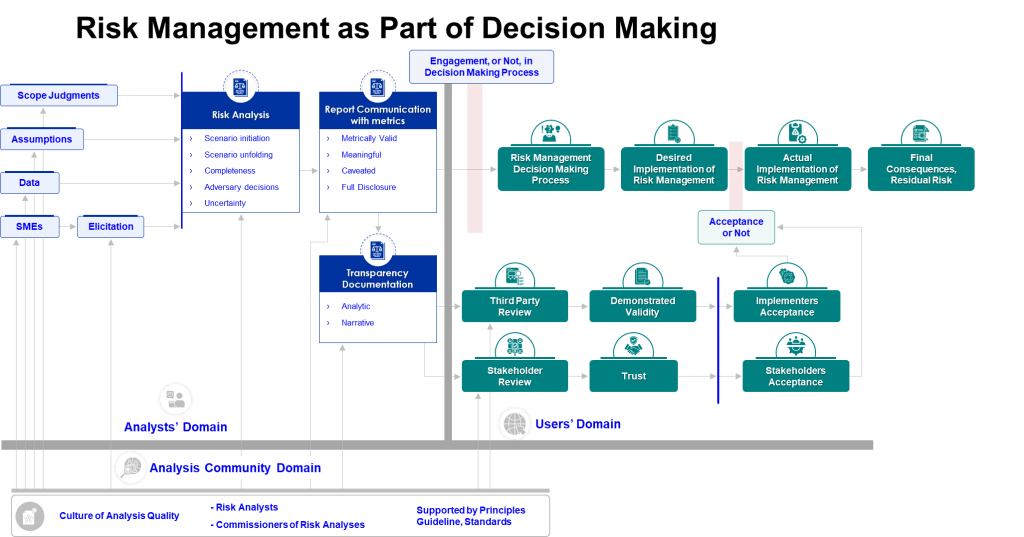
Alt Text for Risk Management Decision-Making Process Diagram
Main Title: Risk Management as Part of Decision Making

Overall Layout: The diagram is organized into three horizontal sections - Analysts' Domain (top), Analysis Community Domain (middle), and Users' Domain (bottom), with various interconnected process boxes and workflow arrows.

Left Side Input Elements:

Scope Judgments (top)

Assumptions

Data

SMEs (Subject Matter Experts)

Elicitation (connecting SMEs to the main process flow)

Central Process Flow (Analysts' Domain):
Two main blue boxes containing:

Risk Analysis - includes bullet points for Scenario initiation, Scenario unfolding, Completeness, Adversary decisions, and Uncertainty

Report Communication with metrics - includes Metrically Valid, Meaningful, Caveated, and Full Disclosure

Transparency Documentation - includes Analytic and Narrative components

Decision-Making Process Flow (Users' Domain):
A series of connected teal/green boxes showing:

Risk Management Decision Making Process

Desired Implementation of Risk Management

Actual Implementation of Risk Management

Final Consequences, Residual Risk

Secondary Process Elements:

Third Party Review → Demonstrated Validity

Stakeholder Review → Trust

Implementers Acceptance and Stakeholders Acceptance (shown in parallel)

Key Decision Points:

"Engagement, or Not, in Decision Making Process" (shown in light blue box at top)

"Acceptance or Not" (shown in gray box in middle section)

Visual Design Elements:

Uses blue boxes for analytical processes

Uses teal/green boxes for decision-making and implementation processes

Shows workflow with directional arrows connecting all elements

Includes small icons next to major process boxes

Divides content into clearly labeled domain sections at bottom

The diagram illustrates the complete flow from initial risk analysis through stakeholder engagement to final implementation and residual risk outcomes, emphasizing the interconnected nature of analytical work and decision-making processes.

Excellence and Elegance: Designing Quality Systems for Cognitive Reality

Structured Decision-Making Processes

Excellence in pharmaceutical quality systems requires moving beyond hoping that individuals will overcome cognitive limitations through awareness alone. Instead, organizations must design structured decision-making processes that systematically counter known biases while supporting comprehensive risk identification and analysis.

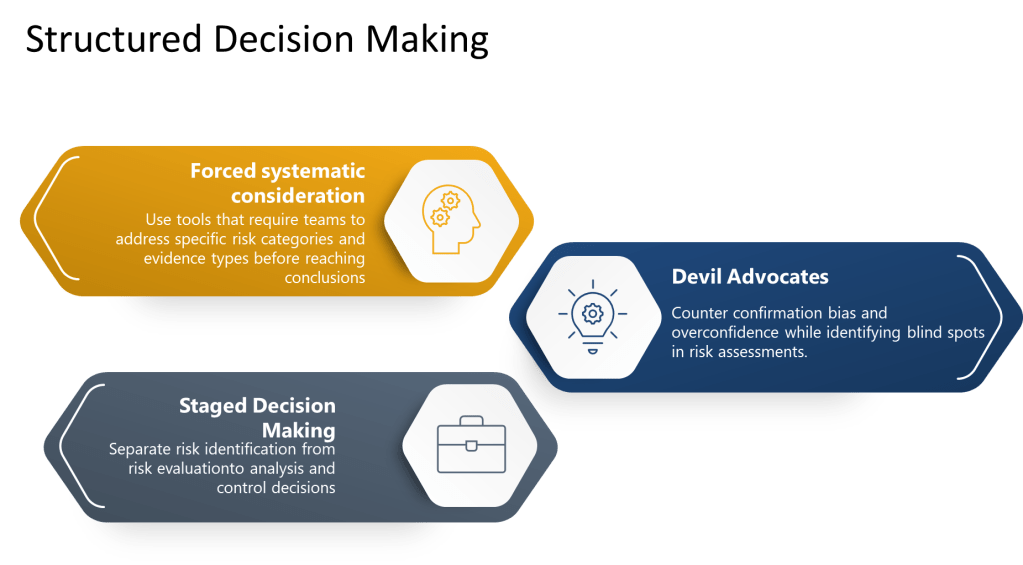
Forced systematic consideration involves using checklists, templates, and protocols that require teams to address specific risk categories and evidence types before reaching conclusions. Rather than relying on free-form discussion that may be influenced by availability bias or groupthink, these tools ensure comprehensive coverage of relevant factors.

Devil’s advocate processes systematically introduce alternative perspectives and challenge preferred conclusions. By assigning specific individuals to argue against prevailing views or identify overlooked risks, organizations can counter confirmation bias and overconfidence while identifying blind spots in risk assessments.

Staged decision-making separates risk identification from risk evaluation, preventing premature closure and ensuring adequate time for comprehensive hazard identification before moving to analysis and control decisions.

Structured Decision Making infographic showing three interconnected hexagonal components. At the top left, an orange hexagon labeled 'Forced systematic consideration' with a head and gears icon, describing 'Use tools that require teams to address specific risk categories and evidence types before reaching conclusions.' At the top right, a dark blue hexagon labeled 'Devil Advocates' with a lightbulb and compass icon, describing 'Counter confirmation bias and overconfidence while identifying blind spots in risk assessments.' At the bottom, a gray hexagon labeled 'Staged Decision Making' with a briefcase icon, describing 'Separate risk identification from risk evaluation to analysis and control decisions.' The three hexagons are connected by curved arrows indicating a cyclical process.

Multi-Perspective Analysis and Diverse Assessment Teams

Cognitive diversity in risk assessment teams provides natural protection against individual and group biases. This goes beyond simple functional representation to include differences in experience, training, organizational level, and thinking styles that can identify risks and solutions that homogeneous teams might miss.

Cross-functional integration ensures that risk assessments benefit from different perspectives on process performance, control effectiveness, and potential failure modes. Manufacturing, quality assurance, regulatory affairs, and technical development professionals each bring different knowledge bases and mental models that can reveal different aspects of risk.

External perspectives through consultants, subject matter experts from other sites, or industry benchmarking can provide additional protection against organizational blind spots. However, as the PIC/S guidance emphasizes, these external resources should facilitate and advise rather than replace internal ownership and accountability.

Rotating team membership for ongoing risk assessment activities prevents the development of group biases and ensures fresh perspectives on familiar processes. This also supports knowledge transfer and prevents critical risk assessment capabilities from becoming concentrated in specific individuals.

Evidence-Based Analysis Requirements

Scientific justification for all risk assessment conclusions requires teams to base their analysis on objective, verifiable data rather than assumptions or intuitive judgments. This includes collecting comprehensive information about process performance, material characteristics, equipment reliability, and environmental factors before drawing conclusions about risk levels.

Assumption documentation makes implicit beliefs explicit and subject to challenge. Any assumptions made during risk assessment must be clearly identified, justified with available evidence, and flagged for future validation. This transparency helps identify areas where additional data collection may be needed and prevents assumptions from becoming accepted facts over time.

Evidence quality assessment evaluates the strength and reliability of information used to support risk assessment conclusions. This includes understanding limitations, uncertainties, and potential sources of bias in the data itself.

Structured uncertainty analysis explicitly addresses areas where knowledge is incomplete or confidence is low. Rather than treating uncertainty as a weakness to be minimized, mature quality systems acknowledge uncertainty and design controls that remain effective despite incomplete information.

Continuous Monitoring and Reassessment Systems

Performance validation provides ongoing verification of risk assessment accuracy through operational performance data. The PIC/S guidance emphasizes that risk assessments should be “periodically reviewed for currency and effectiveness” with systems to track how well predicted risks align with actual experience.

Assumption testing uses operational data to validate or refute assumptions embedded in risk assessments. When monitoring reveals discrepancies between predicted and actual performance, this triggers systematic review of the original assessment to identify potential sources of bias or incomplete analysis.

Feedback loops ensure that lessons learned from risk assessment performance are incorporated into future assessments. This includes both successful risk predictions and instances where significant risks were initially overlooked.

Adaptive learning systems use accumulated experience to improve risk assessment methodologies and training programs. Organizations can track patterns in assessment effectiveness to identify systematic biases or knowledge gaps that require attention.

Knowledge Management as the Foundation of Cognitive Excellence

The Critical Challenge of Tacit Knowledge Capture

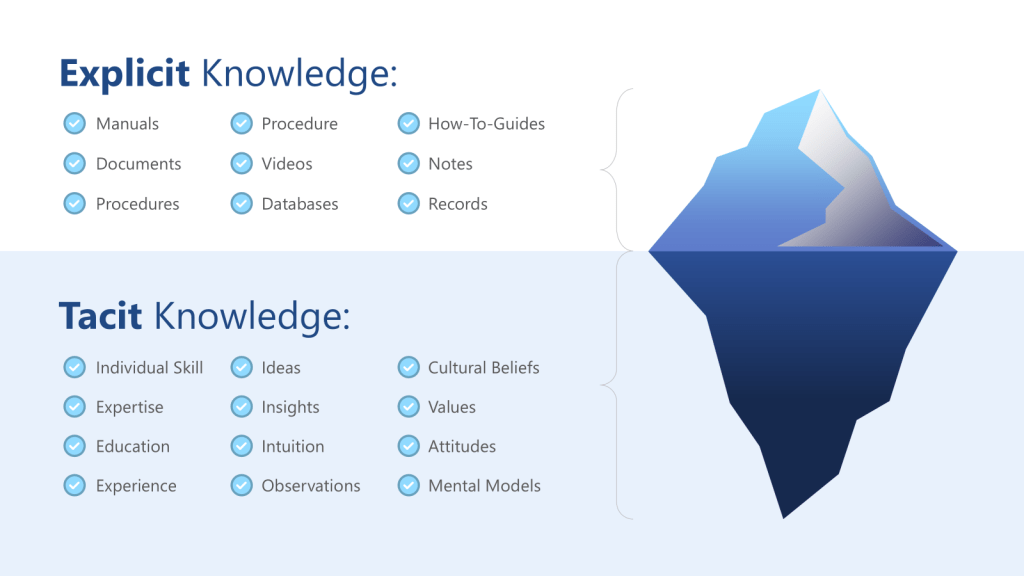
ICH Q10’s definition of knowledge management as “a systematic approach to acquiring, analysing, storing and disseminating information related to products, manufacturing processes and components” provides the regulatory framework, but the cognitive dimensions of knowledge management are equally critical. The distinction between tacit knowledge (experiential, intuitive understanding) and explicit knowledge (documented procedures and data) becomes crucial when designing systems to support effective risk assessment.

Infographic depicting the knowledge iceberg model used in knowledge management. The small visible portion above water labeled 'Explicit Knowledge' contains documented, codified information like manuals, procedures, and databases. The large hidden portion below water labeled 'Tacit Knowledge' represents uncodified knowledge including individual skills, expertise, cultural beliefs, and mental models that are difficult to transfer or document.

Tacit knowledge capture represents one of the most significant challenges in pharmaceutical quality systems. The experienced process engineer who can “feel” when a process is running correctly possesses invaluable knowledge, but this knowledge remains vulnerable to loss through retirements, organizational changes, or simply the passage of time. More critically, tacit knowledge often contains embedded assumptions that may become outdated as processes, materials, or environmental conditions change.

Structured knowledge elicitation processes systematically capture not just what experts know, but how they know it—the cues, patterns, and reasoning processes that guide their decision-making. This involves techniques such as cognitive interviewing, scenario-based discussions, and systematic documentation of decision rationales that make implicit knowledge explicit and subject to validation.

Knowledge validation and updating cycles ensure that captured knowledge remains current and accurate. This is particularly important for tacit knowledge, which may be based on historical conditions that no longer apply. Systematic processes for testing and updating knowledge prevent the accumulation of outdated assumptions that can compromise risk assessment effectiveness.

Expertise Distribution and Access

Knowledge networks provide systematic approaches to connecting decision-makers with relevant expertise when complex risk assessments require specialized knowledge. Rather than assuming that generalist teams can address all risk assessment challenges, mature organizations develop capabilities to identify when specialized expertise is required and ensure it is accessible when needed.

Expertise mapping creates systematic inventories of knowledge and capabilities distributed throughout the organization. This includes not just formal qualifications and roles, but understanding of specific process knowledge, problem-solving experience, and decision-making capabilities that may be relevant to risk assessment activities.

Dynamic expertise allocation ensures that appropriate knowledge is available for specific risk assessment challenges. This might involve bringing in experts from other sites for novel process assessments, engaging specialists for complex technical evaluations, or providing access to external expertise when internal capabilities are insufficient.

Knowledge accessibility systems make relevant information available at the point of decision-making through searchable databases, expert recommendation systems, and structured repositories that support rapid access to historical decisions, lessons learned, and validated approaches.

Knowledge Quality and Validation

Systematic assumption identification makes embedded beliefs explicit and subject to validation. Knowledge management systems must capture not just conclusions and procedures, but the assumptions and reasoning that support them. This enables systematic testing and updating when new evidence emerges.

Evidence-based knowledge validation uses operational performance data, scientific literature, and systematic observation to test the accuracy and currency of organizational knowledge. This includes both confirming successful applications and identifying instances where accepted knowledge may be incomplete or outdated.

Knowledge audit processes systematically evaluate the quality, completeness, and accessibility of knowledge required for effective risk assessment. This includes identifying knowledge gaps that may compromise assessment effectiveness and developing plans to address critical deficiencies.

Continuous knowledge improvement integrates lessons learned from risk assessment performance into organizational knowledge bases. When assessments prove accurate or identify overlooked risks, these experiences become part of organizational learning that improves future performance.

Integration with Risk Assessment Processes

Knowledge-enabled risk assessment systematically integrates relevant organizational knowledge into risk evaluation processes. This includes access to historical performance data, previous risk assessments for similar situations, lessons learned from comparable processes, and validated assumptions about process behaviors and control effectiveness.

Decision support integration provides risk assessment teams with structured access to relevant knowledge at each stage of the assessment process. This might include automated recommendations for relevant expertise, access to similar historical assessments, or prompts to consider specific knowledge domains that may be relevant.

Knowledge visualization and analytics help teams identify patterns, relationships, and insights that might not be apparent from individual data sources. This includes trend analysis, correlation identification, and systematic approaches to integrating information from multiple sources.

Real-time knowledge validation uses ongoing operational performance to continuously test and refine knowledge used in risk assessments. Rather than treating knowledge as static, these systems enable dynamic updating based on accumulating evidence and changing conditions.

A Maturity Model for Cognitive Excellence in Risk Management

Level 1: Reactive – The Bias-Blind Organization

Organizations at the reactive level operate with ad hoc risk assessments that rely heavily on individual judgment with minimal recognition of cognitive bias effects. Risk assessments are typically performed by whoever is available rather than teams with appropriate expertise, and conclusions are based primarily on immediate experience or intuitive responses.

Knowledge management characteristics at this level include isolated expertise with no systematic capture or sharing mechanisms. Critical knowledge exists primarily as tacit knowledge held by specific individuals, creating vulnerabilities when personnel changes occur. Documentation is minimal and typically focused on conclusions rather than reasoning processes or supporting evidence.

Cognitive bias manifestations are pervasive but unrecognized. Teams routinely fall prey to anchoring, confirmation bias, and availability bias without awareness of these influences on their conclusions. Unjustified assumptions are common and remain unchallenged because there are no systematic processes to identify or test them.

Decision-making processes lack structure and repeatability. Risk assessments may produce different conclusions when performed by different teams or at different times, even when addressing identical situations. There are no systematic approaches to ensuring comprehensive risk identification or validating assessment conclusions.

Typical challenges include recurring problems despite seemingly adequate risk assessments, inconsistent risk assessment quality across different teams or situations, and limited ability to learn from assessment experience. Organizations at this level often experience surprise failures where significant risks were not identified during formal risk assessment processes.

Level 2: Awareness – Recognizing the Problem

Organizations advancing to the awareness level demonstrate basic recognition of cognitive bias risks with inconsistent application of structured methods. There is growing understanding that human judgment limitations can affect risk assessment quality, but systematic approaches to addressing these limitations are incomplete or irregularly applied.

Knowledge management progress includes beginning attempts at knowledge documentation and expert identification. Organizations start to recognize the value of capturing expertise and may implement basic documentation requirements or expert directories. However, these efforts are often fragmented and lack systematic integration with risk assessment processes.

Cognitive bias recognition becomes more systematic, with training programs that help personnel understand common bias types and their potential effects on decision-making. However, awareness does not consistently translate into behavior change, and bias mitigation techniques are applied inconsistently across different assessment situations.

Decision-making improvements include basic templates or checklists that promote more systematic consideration of risk factors. However, these tools may be applied mechanically without deep understanding of their purpose or integration with broader quality system objectives.

Emerging capabilities include better documentation of assessment rationales, more systematic involvement of diverse perspectives in some assessments, and beginning recognition of the need for external expertise in complex situations. However, these practices are not yet embedded consistently throughout the organization.

Level 3: Systematic – Building Structured Defenses

Level 3 organizations implement standardized risk assessment protocols with built-in bias checks and documented decision rationales. There is systematic recognition that cognitive limitations require structured countermeasures, and processes are designed to promote more reliable decision-making.

Knowledge management formalization includes formal knowledge management processes including expert networks and structured knowledge capture. Organizations develop systematic approaches to identifying, documenting, and sharing expertise relevant to risk assessment activities. Knowledge is increasingly treated as a strategic asset requiring active management.

Bias mitigation integration embeds cognitive bias awareness and countermeasures into standard risk assessment procedures. This includes systematic use of devil’s advocate processes, structured approaches to challenging assumptions, and requirements for evidence-based justification of conclusions.

Structured decision processes ensure consistent application of comprehensive risk assessment methodologies with clear requirements for documentation, evidence, and review. Teams follow standardized approaches that promote systematic consideration of relevant risk factors while providing flexibility for situation-specific analysis.

Quality characteristics include more consistent risk assessment performance across different teams and situations, systematic documentation that enables effective review and learning, and better integration of risk assessment activities with broader quality system objectives.

Level 4: Integrated – Cultural Transformation

Level 4 organizations achieve cross-functional teams, systematic training, and continuous improvement processes with bias mitigation embedded in quality culture. Cognitive excellence becomes an organizational capability rather than a set of procedures, supported by culture, training, and systematic reinforcement.

Knowledge management integration fully integrates knowledge management with risk assessment processes and supports these with technology platforms. Knowledge flows seamlessly between different organizational functions and activities, with systematic approaches to maintaining currency and relevance of organizational knowledge assets.

Cultural integration creates organizational environments where systematic, evidence-based decision-making is expected and rewarded. Personnel at all levels understand the importance of cognitive rigor and actively support systematic approaches to risk assessment and decision-making.

Systematic training and development builds organizational capabilities in both technical risk assessment methodologies and cognitive skills required for effective application. Training programs address not just what tools to use, but how to think systematically about complex risk assessment challenges.

Continuous improvement mechanisms systematically analyze risk assessment performance to identify opportunities for enhancement and implement improvements in methodologies, training, and support systems.

Level 5: Optimizing – Predictive Intelligence

Organizations at the optimizing level implement predictive analytics, real-time bias detection, and adaptive systems that learn from assessment performance. These organizations leverage advanced technologies and systematic approaches to achieve exceptional performance in risk assessment and management.

Predictive capabilities enable organizations to anticipate potential risks and bias patterns before they manifest in assessment failures. This includes systematic monitoring of assessment performance, early warning systems for potential cognitive failures, and proactive adjustment of assessment approaches based on accumulated experience.

Adaptive learning systems continuously improve organizational capabilities based on performance feedback and changing conditions. These systems can identify emerging patterns in risk assessment challenges and automatically adjust methodologies, training programs, and support systems to maintain effectiveness.

Industry leadership characteristics include contributing to industry knowledge and best practices, serving as benchmarks for other organizations, and driving innovation in risk assessment methodologies and cognitive excellence approaches.

Implementation Strategies: Building Cognitive Excellence

Training and Development Programs

Cognitive bias awareness training must go beyond simple awareness to build practical skills in bias recognition and mitigation. Effective programs use case studies from pharmaceutical manufacturing to illustrate how biases can lead to serious consequences and provide hands-on practice with bias recognition and countermeasure application.

Critical thinking skill development builds capabilities in systematic analysis, evidence evaluation, and structured problem-solving. These programs help personnel recognize when situations require careful analysis rather than intuitive responses and provide tools for engaging systematic thinking processes.

Risk assessment methodology training combines technical instruction in formal risk assessment tools with cognitive skills required for effective application. This includes understanding when different methodologies are appropriate, how to adapt tools for specific situations, and how to recognize and address limitations in chosen approaches.

Knowledge management skills help personnel contribute effectively to organizational knowledge capture, validation, and sharing activities. This includes skills in documenting decision rationales, participating in knowledge networks, and using knowledge management systems effectively.

Technology Integration

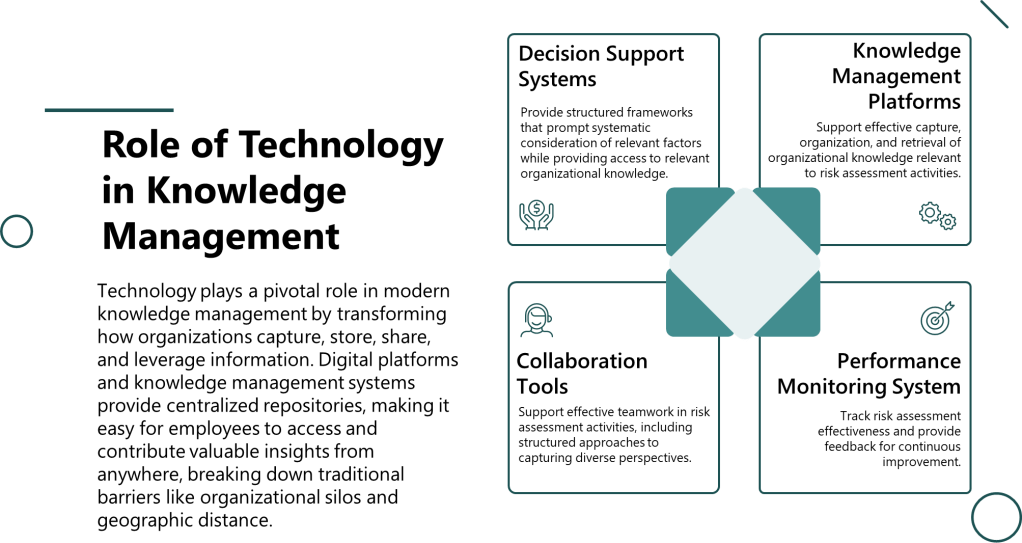
Decision support systems provide structured frameworks that prompt systematic consideration of relevant factors while providing access to relevant organizational knowledge. These systems help teams engage appropriate cognitive processes while avoiding common bias traps.

Knowledge management platforms support effective capture, organization, and retrieval of organizational knowledge relevant to risk assessment activities. Advanced systems can provide intelligent recommendations for relevant expertise, historical assessments, and validated approaches based on assessment context.

Performance monitoring systems track risk assessment effectiveness and provide feedback for continuous improvement. These systems can identify patterns in assessment performance that suggest systematic biases or knowledge gaps requiring attention.

Collaboration tools support effective teamwork in risk assessment activities, including structured approaches to capturing diverse perspectives and managing group decision-making processes to avoid groupthink and other collective biases.

Technology plays a pivotal role in modern knowledge management by transforming how organizations capture, store, share, and leverage information. Digital platforms and knowledge management systems provide centralized repositories, making it easy for employees to access and contribute valuable insights from anywhere, breaking down traditional barriers like organizational silos and geographic distance.

Organizational Culture Development

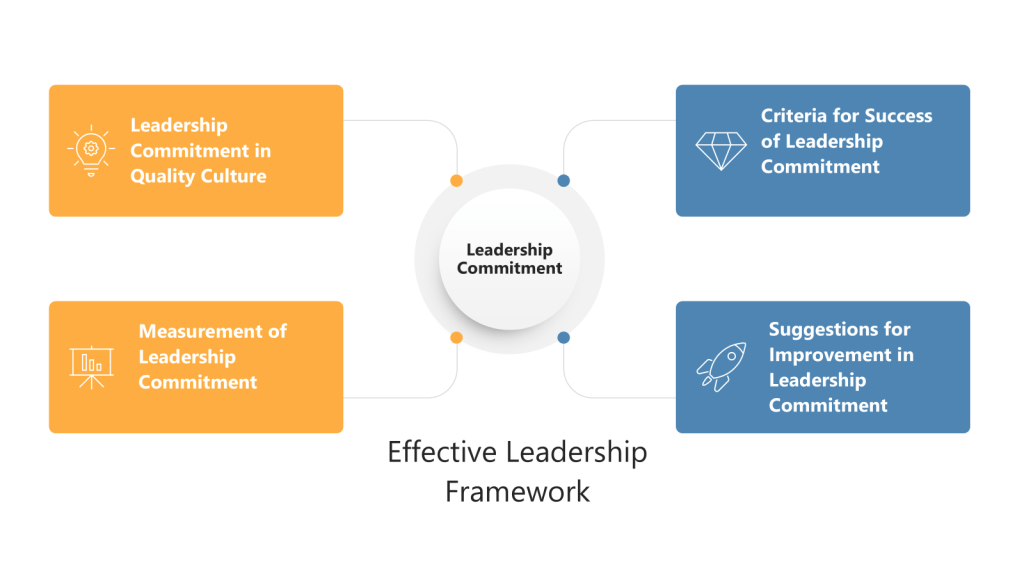
Leadership commitment demonstrates visible support for systematic, evidence-based approaches to risk assessment. This includes providing adequate time and resources for thorough analysis, recognizing effective risk assessment performance, and holding personnel accountable for systematic approaches to decision-making.

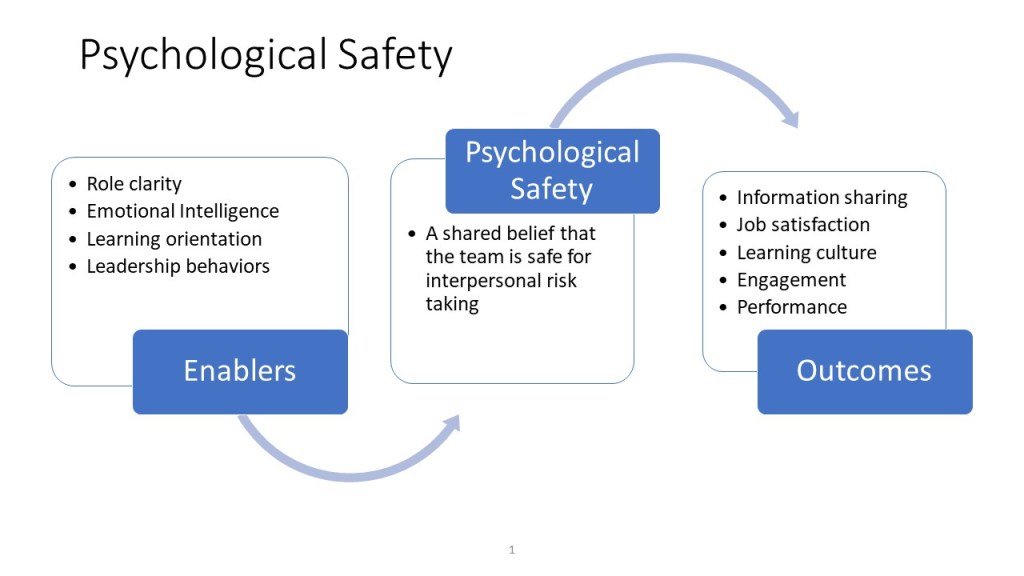
Psychological safety creates environments where personnel feel comfortable challenging assumptions, raising concerns about potential risks, and admitting uncertainty or knowledge limitations. This requires organizational cultures that treat questioning and systematic analysis as valuable contributions rather than obstacles to efficiency.

Learning orientation emphasizes continuous improvement in risk assessment capabilities rather than simply achieving compliance with requirements. Organizations with strong learning cultures systematically analyze assessment performance to identify improvement opportunities and implement enhancements in methodologies and capabilities.

Knowledge sharing cultures actively promote the capture and dissemination of expertise relevant to risk assessment activities. This includes recognition systems that reward knowledge sharing, systematic approaches to capturing lessons learned, and integration of knowledge management activities with performance evaluation and career development.

Conducting a Knowledge Audit for Risk Assessment

Organizations beginning this journey should start with a systematic knowledge audit that identifies potential vulnerabilities in expertise availability and access. This audit should address several key areas:

Expertise mapping to identify knowledge holders, their specific capabilities, and potential vulnerabilities from personnel changes or workload concentration. This includes both formal expertise documented in job descriptions and informal knowledge that may be critical for effective risk assessment.

Knowledge accessibility assessment to evaluate how effectively relevant knowledge can be accessed when needed for risk assessment activities. This includes both formal systems such as databases and informal networks that provide access to specialized expertise.

Knowledge quality evaluation to assess the currency, accuracy, and completeness of knowledge used to support risk assessment decisions. This includes identifying areas where assumptions may be outdated or where knowledge gaps may compromise assessment effectiveness.

Cognitive bias vulnerability assessment to identify situations where systematic biases are most likely to affect risk assessment conclusions. This includes analyzing past assessment performance to identify patterns that suggest bias effects and evaluating current processes for bias mitigation effectiveness.

Designing Bias-Resistant Risk Assessment Processes

Structured assessment protocols should incorporate specific checkpoints and requirements designed to counter known cognitive biases. This includes mandatory consideration of alternative explanations, requirements for external validation of conclusions, and systematic approaches to challenging preferred solutions.

Team composition guidelines should ensure appropriate cognitive diversity while maintaining technical competence. This includes balancing experience levels, functional backgrounds, and thinking styles to maximize the likelihood of identifying diverse perspectives on risk assessment challenges.

Evidence requirements should specify the types and quality of information required to support different types of risk assessment conclusions. This includes guidelines for evaluating evidence quality, addressing uncertainty, and documenting limitations in available information.

Review and validation processes should provide systematic quality checks on risk assessment conclusions while identifying potential bias effects. This includes independent review requirements, structured approaches to challenging conclusions, and systematic tracking of assessment performance over time.

Building Knowledge-Enabled Decision Making

Integration strategies should systematically connect knowledge management activities with risk assessment processes. This includes providing risk assessment teams with structured access to relevant organizational knowledge and ensuring that assessment conclusions contribute to organizational learning.

Technology selection should prioritize systems that enhance rather than replace human judgment while providing effective support for systematic decision-making processes. This includes careful evaluation of user interface design, integration with existing workflows, and alignment with organizational culture and capabilities.

Performance measurement should track both risk assessment effectiveness and knowledge management performance to ensure that both systems contribute effectively to organizational objectives. This includes metrics for knowledge quality, accessibility, and utilization as well as traditional risk assessment performance indicators.

Continuous improvement processes should systematically analyze performance in both risk assessment and knowledge management to identify enhancement opportunities and implement improvements in methodologies, training, and support systems.

Excellence Through Systematic Cognitive Development

The journey toward cognitive excellence in pharmaceutical risk management requires fundamental recognition that human cognitive limitations are not weaknesses to be overcome through training alone, but systematic realities that must be addressed through thoughtful system design. The PIC/S observations of unjustified assumptions, incomplete risk identification, and inappropriate tool application represent predictable patterns that emerge when sophisticated professionals operate without systematic support for cognitive excellence.

Excellence in this context means designing quality systems that work with human cognitive capabilities rather than against them. This requires integrating knowledge management principles with cognitive science insights to create environments where systematic, evidence-based decision-making becomes natural and sustainable. It means moving beyond hope that awareness will overcome bias toward systematic implementation of structures, processes, and cultures that promote cognitive rigor.

Elegance lies in recognizing that the most sophisticated risk assessment methodologies are only as effective as the cognitive processes that apply them. True elegance in quality system design comes from seamlessly integrating technical excellence with cognitive support, creating systems where the right decisions emerge naturally from the intersection of human expertise and systematic process.

Organizations that successfully implement these approaches will develop competitive advantages that extend far beyond regulatory compliance. They will build capabilities in systematic decision-making that improve performance across all aspects of pharmaceutical quality management. They will create resilient systems that can adapt to changing conditions while maintaining consistent effectiveness. Most importantly, they will develop cultures of excellence that attract and retain exceptional talent while continuously improving their capabilities.

The framework presented here provides a roadmap for this transformation, but each organization must adapt these principles to their specific context, culture, and capabilities. The maturity model offers a path for progressive development that builds capabilities systematically while delivering value at each stage of the journey.

As we face increasingly complex pharmaceutical manufacturing challenges and evolving regulatory expectations, the organizations that invest in systematic cognitive excellence will be best positioned to protect patient safety while achieving operational excellence. The choice is not whether to address these cognitive foundations of quality management, but how quickly and effectively we can build the capabilities required for sustained success in an increasingly demanding environment.

The cognitive foundations of pharmaceutical quality excellence represent both opportunity and imperative. The opportunity lies in developing systematic capabilities that transform good intentions into consistent results. The imperative comes from recognizing that patient safety depends not just on our technical knowledge and regulatory compliance, but on our ability to think clearly and systematically about complex risks in an uncertain world.

Reflective Questions for Implementation

How might you assess your organization’s current vulnerability to the three PIC/S observations in your risk management practices? What patterns in past risk assessment performance might indicate systematic cognitive biases affecting your decision-making processes?

Where does critical knowledge for risk assessment currently reside in your organization, and how accessible is it when decisions must be made? What knowledge audit approach would be most valuable for identifying vulnerabilities in your current risk management capabilities?

Which level of the cognitive bias mitigation maturity model best describes your organization’s current state, and what specific capabilities would be required to advance to the next level? How might you begin building these capabilities while maintaining current operational effectiveness?

What systematic changes in training, process design, and cultural expectations would be required to embed cognitive excellence into your quality culture? How would you measure progress in building these capabilities and demonstrate their value to organizational leadership?

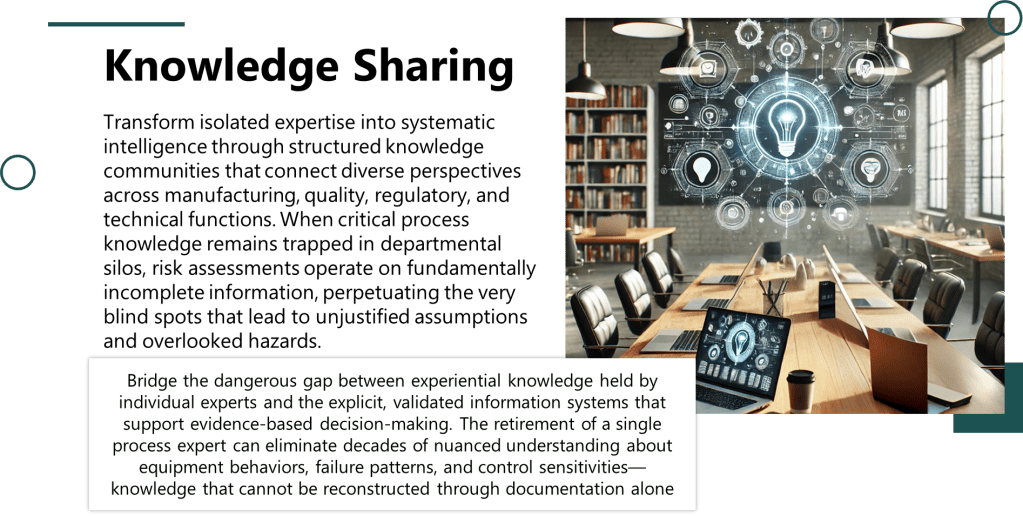
Transform isolated expertise into systematic intelligence through structured knowledge communities that connect diverse perspectives across manufacturing, quality, regulatory, and technical functions. When critical process knowledge remains trapped in departmental silos, risk assessments operate on fundamentally incomplete information, perpetuating the very blind spots that lead to unjustified assumptions and overlooked hazards.

Bridge the dangerous gap between experiential knowledge held by individual experts and the explicit, validated information systems that support evidence-based decision-making. The retirement of a single process expert can eliminate decades of nuanced understanding about equipment behaviors, failure patterns, and control sensitivities—knowledge that cannot be reconstructed through documentation alone

The Hidden Pitfalls of Naïve Realism in Problem Solving, Risk Management, and Decision Making

Naïve realism—the unconscious belief that our perception of reality is objective and universally shared—acts as a silent saboteur in professional and personal decision-making. While this mindset fuels confidence, it also blinds us to alternative perspectives, amplifies cognitive biases, and undermines collaborative problem-solving. This blog post explores how this psychological trap distorts critical processes and offers actionable strategies to counteract its influence, drawing parallels to frameworks like the Pareto Principle and insights from risk management research.

Problem Solving: When Certainty Breeds Blind Spots

Naïve realism convinces us that our interpretation of a problem is the only logical one, leading to overconfidence in solutions that align with preexisting beliefs. For instance, teams often dismiss contradictory evidence in favor of data that confirms their assumptions. A startup scaling a flawed product because early adopters praised it—while ignoring churn data—exemplifies this trap. The Pareto Principle’s “vital few” heuristic can exacerbate this bias by oversimplifying complex issues. Organizations might prioritize frequent but low-impact problems, neglecting rare yet catastrophic risks, such as cybersecurity vulnerabilities masked by daily operational hiccups.

Functional fixedness, another byproduct of naïve realism, stifles innovation by assuming resources can only be used conventionally. To mitigate this pitfall, teams should actively challenge assumptions through adversarial brainstorming, asking questions like “Why will this solution fail?” Involving cross-functional teams or external consultants can also disrupt echo chambers, injecting fresh perspectives into problem-solving processes.

Risk Management: The Illusion of Objectivity

Risk assessments are inherently subjective, yet naïve realism convinces decision-makers that their evaluations are purely data-driven. Overreliance on historical data, such as prioritizing minor customer complaints over emerging threats, mirrors the Pareto Principle’s “static and historical bias” pitfall.

Reactive devaluation further complicates risk management. Organizations can counteract these biases by appropriately leveraging risk management to drive subjectivity out while better accounting for uncertainty. Simulating worst-case scenarios, such as sudden supplier price hikes or regulatory shifts, also surfaces blind spots that static models overlook.

Decision Making: The Myth of the Rational Actor

Even in data-driven cultures, subjectivity stealthily shapes choices. Leaders often overestimate alignment within teams, mistaking silence for agreement. Individuals frequently insist their assessments are objective despite clear evidence of self-enhancement bias. This false consensus erodes trust and stifles dissent with the assumption that future preferences will mirror current ones.

Organizations must normalize dissent through anonymous voting or “red team” exercises to dismantle these myths, including having designated critics scrutinize plans. Adopting probabilistic thinking, where outcomes are assigned likelihoods instead of binary predictions, reduces overconfidence.

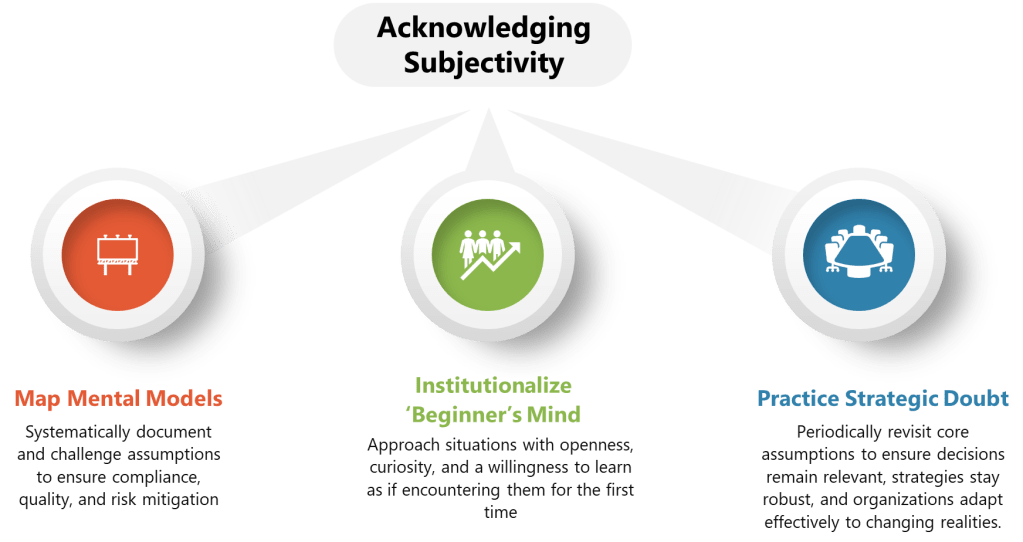
Acknowledging Subjectivity: Three Practical Steps

1. Map Mental Models

Mapping mental models involves systematically documenting and challenging assumptions to ensure compliance, quality, and risk mitigation. For example, during risk assessments or deviation investigations, teams should explicitly outline their assumptions about processes, equipment, and personnel. Statements such as “We assume the equipment calibration schedule is sufficient to prevent deviations” or “We assume operator training is adequate to avoid errors” can be identified and critically evaluated.

Foster a culture of continuous improvement and accountability by stress-testing assumptions against real-world data—such as audit findings, CAPA (Corrective and Preventive Actions) trends, or process performance metrics—to reveal gaps that might otherwise go unnoticed. For instance, a team might discover that while calibration schedules meet basic requirements, they fail to account for unexpected environmental variables that impact equipment accuracy.

By integrating assumption mapping into routine GMP activities like risk assessments, change control reviews, and deviation investigations, organizations can ensure their decision-making processes are robust and grounded in evidence rather than subjective beliefs. This practice enhances compliance and strengthens the foundation for proactive quality management.

2. Institutionalize ‘Beginner’s Mind’

A beginner’s mindset is about approaching situations with openness, curiosity, and a willingness to learn as if encountering them for the first time. This mindset challenges the assumptions and biases that often limit creativity and problem-solving. In team environments, fostering a beginner’s mindset can unlock fresh perspectives, drive innovation, and create a culture of continuous improvement. However, building this mindset in teams requires intentional strategies and ongoing reinforcement to ensure it is actively utilized.

What is a Beginner’s Mindset?

At its core, a beginner’s mindset involves setting aside preconceived notions and viewing problems or opportunities with fresh eyes. Unlike experts who may rely on established knowledge or routines, individuals with a beginner’s mindset embrace uncertainty and ask fundamental questions such as “Why do we do it this way?” or “What if we tried something completely different?” This perspective allows teams to challenge the status quo, uncover hidden opportunities, and explore innovative solutions that might be overlooked.

For example, adopting this mindset in the workplace might mean questioning long-standing processes that no longer serve their purpose or rethinking how resources are allocated to align with evolving goals. By removing the constraints of “we’ve always done it this way,” teams can approach challenges with curiosity and creativity.

How to Build a Beginner’s Mindset in Teams

Fostering a beginner’s mindset within teams requires deliberate actions from leadership to create an environment where curiosity thrives. Here are some key steps to build this mindset:

  1. Model Curiosity and Openness
    Leaders play a critical role in setting the tone for their teams. By modeling curiosity—asking questions, admitting gaps in knowledge, and showing enthusiasm for learning—leaders demonstrate that it is safe and encouraged to approach work with an open mind. For instance, during meetings or problem-solving sessions, leaders can ask questions like “What haven’t we considered yet?” or “What would we do if we started from scratch?” This signals to team members that exploring new ideas is valued over rigid adherence to past practices.
  2. Encourage Questioning Assumptions
    Teams should be encouraged to question their assumptions regularly. Structured exercises such as “assumption audits” can help identify ingrained beliefs that may no longer hold true. By challenging assumptions, teams open themselves up to new insights and possibilities.
  3. Create Psychological Safety
    A beginner’s mindset flourishes in environments where team members feel safe taking risks and sharing ideas without fear of judgment or failure. Leaders can foster psychological safety by emphasizing that mistakes are learning opportunities rather than failures. For example, during project reviews, instead of focusing solely on what went wrong, leaders can ask, “What did we learn from this experience?” This shifts the focus from blame to growth and encourages experimentation.
  4. Rotate Roles and Responsibilities
    Rotating team members across roles or projects is an effective way to cultivate fresh perspectives. When individuals step into unfamiliar areas of responsibility, they are less likely to rely on habitual thinking and more likely to approach tasks with curiosity and openness. For instance, rotating quality assurance personnel into production oversight roles can reveal inefficiencies or risks that might have been overlooked due to overfamiliarity within silos.
  5. Provide Opportunities for Learning
    Continuous learning is essential for maintaining a beginner’s mindset. Organizations should invest in training programs, workshops, or cross-functional collaborations that expose teams to new ideas and approaches. For example, inviting external speakers or consultants to share insights from other industries can inspire innovative thinking within teams by introducing them to unfamiliar concepts or methodologies.
  6. Use Structured Exercises for Fresh Thinking
    Design Thinking exercises or brainstorming techniques like “reverse brainstorming” (where participants imagine how to create the worst possible outcome) can help teams break free from conventional thinking patterns. These activities force participants to look at problems from unconventional angles and generate novel solutions.

Ensuring Teams Utilize a Beginner’s Mindset

Building a beginner’s mindset is only half the battle; ensuring it is consistently applied requires ongoing reinforcement:

  • Integrate into Processes: Embed beginner’s mindset practices into regular workflows such as project kickoffs, risk assessments, or strategy sessions. For example, make it standard practice to start meetings by revisiting assumptions or brainstorming alternative approaches before diving into execution plans.
  • Reward Curiosity: Recognize and reward behaviors that reflect a beginner’s mindset—such as asking insightful questions, proposing innovative ideas, or experimenting with new approaches—even if they don’t immediately lead to success.
  • Track Progress: Use metrics like the number of new ideas generated during brainstorming sessions or the diversity of perspectives incorporated into decision-making processes to measure how well teams utilize a beginner’s mindset.
  • Reflect Regularly: Encourage teams to reflect on using the beginner’s mindset through retrospectives or debriefs after significant projects and events. Questions like “How did our openness to new ideas impact our results?” or “What could we do differently next time?” help reinforce the importance of maintaining this perspective.

Organizations can ensure their teams consistently leverage the power of a beginner’s mindset by cultivating curiosity, creating psychological safety, and embedding practices that challenge conventional thinking into daily operations. This drives innovation and fosters adaptability and resilience in an ever-changing business landscape.

3. Revisit Assumptions by Practicing Strategic Doubt

Assumptions are the foundation of decision-making, strategy development, and problem-solving. They represent beliefs or premises we take for granted, often without explicit evidence. While assumptions are necessary to move forward in uncertain environments, they are not static. Over time, new information, shifting circumstances, or emerging trends can render them outdated or inaccurate. Periodically revisiting core assumptions is essential to ensure decisions remain relevant, strategies stay robust, and organizations adapt effectively to changing realities.

Why Revisiting Assumptions Matters

Assumptions often shape the trajectory of decisions and strategies. When left unchecked, they can lead to flawed projections, misallocated resources, and missed opportunities. For example, Kodak’s assumption that film photography would dominate forever led to its downfall in the face of digital innovation. Similarly, many organizations assume their customers’ preferences or market conditions will remain stable, only to find themselves blindsided by disruptive changes. Revisiting assumptions allows teams to challenge these foundational beliefs and recalibrate their approach based on current realities.

Moreover, assumptions are frequently made with incomplete knowledge or limited data. As new evidence emerges, whether through research, technological advancements, or operational feedback, testing these assumptions against reality is critical. This process ensures that decisions are informed by the best available information rather than outdated or erroneous beliefs.

How to Periodically Revisit Core Assumptions

Revisiting assumptions requires a structured approach integrating critical thinking, data analysis, and collaborative reflection.

1. Document Assumptions from the Start

The first step is identifying and articulating assumptions explicitly during the planning stages of any project or strategy. For instance, a team launching a new product might document assumptions about market size, customer preferences, competitive dynamics, and regulatory conditions. By making these assumptions visible and tangible, teams create a baseline for future evaluation.

2. Establish Regular Review Cycles

Revisiting assumptions should be institutionalized as part of organizational processes rather than a one-off exercise. Build assumption audits into the quality management process. During these sessions, teams critically evaluate whether their assumptions still hold true in light of recent data or developments. This ensures that decision-making remains agile and responsive to change.

3. Use Feedback Loops

Feedback loops provide real-world insights into whether assumptions align with reality. Organizations can integrate mechanisms such as surveys, operational metrics, and trend analyses into their workflows to continuously test assumptions.

4. Test Assumptions Systematically

Not all assumptions carry equal weight; some are more critical than others. Teams can prioritize testing based on three parameters: severity (impact if the assumption is wrong), probability (likelihood of being inaccurate), and cost of resolution (resources required to validate or adjust). 

5. Encourage Collaborative Reflection

Revisiting assumptions is most effective when diverse perspectives are involved. Bringing together cross-functional teams—including leaders, subject matter experts, and customer-facing roles—ensures that blind spots are uncovered and alternative viewpoints are considered. Collaborative workshops or strategy recalibration sessions can facilitate this process by encouraging open dialogue about what has changed since the last review.

6. Challenge Assumptions with Data

Assumptions should always be validated against evidence rather than intuition alone. Teams can leverage predictive analytics tools to assess whether their assumptions align with emerging trends or patterns. 

How Organizations Can Ensure Assumptions Are Utilized Effectively

To ensure revisited assumptions translate into actionable insights, organizations must integrate them into decision-making processes:

Monitor Continuously: Establish systems for continuously monitoring critical assumptions through dashboards or regular reporting mechanisms. This allows leadership to identify invalidated assumptions promptly and course-correct before significant risks materialize.

Update Strategies and Goals: Adjust goals and objectives based on revised assumptions to maintain alignment with current realities. 

Refine KPIs: Key Performance Indicators (KPIs) should evolve alongside updated assumptions to reflect shifting priorities and external conditions. Metrics that once seemed relevant may need adjustment as new data emerges.

Embed Assumption Testing into Culture: Encourage teams to view assumption testing as an ongoing practice rather than a reactive measure. Leaders can model this behavior by openly questioning their own decisions and inviting critique from others.

From Certainty to Curious Inquiry

Naïve realism isn’t a personal failing but a universal cognitive shortcut. By recognizing its influence—whether in misapplying the Pareto Principle or dismissing dissent—we can reframe conflicts as opportunities for discovery. The goal isn’t to eliminate subjectivity but to harness it, transforming blind spots into lenses for sharper, more inclusive decision-making.

The path to clarity lies not in rigid certainty but in relentless curiosity.

Building a Safe Space for Reflection: Leveraging Psychological Safety Towards a Quality Culture

Creating a safe space for reflection is crucial for fostering innovation, problem-solving, and continuous improvement. This environment is deeply rooted in psychological safety and a quality culture, where employees feel empowered to express themselves freely, share ideas, and challenge existing norms without fear of judgment or reprisal.

Understanding Psychological Safety

Psychological safety refers to a shared belief among team members that they are safe to take risks, share their thoughts, and learn from their mistakes without fear of negative consequences. This concept is foundational to building a culture where individuals feel valued, included, and motivated to contribute their unique perspectives. It is the bedrock upon which effective collaboration, creativity, and problem-solving are built. In environments where psychological safety is prioritized, employees are more likely to engage in open dialogue, admit mistakes, and explore new ideas, leading to enhanced innovation and productivity.

The Role of Leadership in Fostering Psychological Safety

Effective leadership plays a pivotal role in establishing and maintaining a culture of psychological safety. Leaders must set the tone by modeling vulnerability, encouraging open communication, and demonstrating empathy towards their team members. They should establish clear expectations of respect and inclusivity, ensuring that diverse perspectives are welcomed and valued. By doing so, leaders create an environment where employees feel comfortable sharing their thoughts and ideas, which is essential for driving innovation and solving complex problems.

In the past post on Psychological Safety, Reflexivity, and Problem Solving, I explored how psychological safety enables individuals to behave authentically and express themselves candidly, which is crucial for effective problem-solving and reflexivity in organizations. This authenticity allows teams to tackle challenges more effectively by leveraging diverse viewpoints and experiences.

Building a Quality Culture

A quality culture is deeply intertwined with psychological safety. It emphasizes continuous improvement, learning from mistakes, and a commitment to excellence. In such a culture, employees are encouraged to reflect on their processes, identify areas for improvement, and implement changes that enhance overall performance. This reflective practice is facilitated by psychological safety, as it allows individuals to share insights and ideas without fear of criticism, thereby fostering a collaborative and adaptive environment.

Strategies for Creating a Safe Space for Reflection

Creating a safe space for reflection involves several strategic steps:

Establishing Open Communication Channels

Organizations should implement transparent and constructive communication channels that allow employees to express their thoughts, concerns, and ideas without fear of negative consequences. This can be achieved through regular team meetings, anonymous feedback systems, or open forums where employees feel comfortable sharing their perspectives. Active listening and empathy are crucial in these interactions, as they reinforce the sense of safety and encourage further participation.

Implementing Psychological Safety Training

Providing comprehensive training on psychological safety is essential for building awareness and equipping employees with the skills needed to navigate complex interactions and support their colleagues. These programs should emphasize the importance of trust, vulnerability, and inclusivity, and offer practical strategies for fostering a psychologically safe environment. By educating employees on these principles, organizations can ensure that psychological safety becomes an integral part of their culture.

Encouraging Active Participation and Feedback

Encouraging active participation involves creating opportunities for employees to engage in collaborative discussions and provide feedback. This can be facilitated through workshops, brainstorming sessions, or project meetings where diverse perspectives are sought and valued. Feedback loops should be open and constructive, allowing employees to learn from their experiences and grow professionally.

Measuring Psychological Safety

Measuring psychological safety is critical for understanding its impact on organizational culture and identifying areas for improvement. This can be achieved through surveys, behavioral indicators, and engagement scores. Surveys should include questions that assess employees’ perceptions of safety, trust, and openness within their teams. Behavioral indicators, such as the frequency of idea sharing and openness in feedback loops, can also provide valuable insights into the level of psychological safety within an organization.

In our previous discussions on on this blog, I have emphasized the importance of a culture that supports open dialogue and continuous improvement. A few examples include:

  1. Communication Loops and Silos: A Barrier to Effective Decision Making in Complex Industries: This post highlights the challenges of communication loops and silos in industries like aviation and biotechnology. It emphasizes the need for open dialogue to bridge these gaps and improve decision-making processes.
  2. Change Strategies for Accelerating Change: This post discusses strategies such as promoting cross-functional training, fostering informal interactions, and implementing feedback loops. These strategies are crucial for creating a culture that supports open dialogue and continuous improvement.
  3. Reducing Subjectivity in Quality Risk Management: Aligning with ICH Q9(R1): This post focuses on reducing subjectivity through structured approaches and data-driven decision-making. It underscores the importance of a culture that encourages open communication to ensure that decisions are based on comprehensive data rather than personal biases.

These examples illustrate the importance of fostering a culture that supports open dialogue and continuous improvement in complex industries.

Overcoming Challenges

Despite the benefits of psychological safety, several challenges may arise when attempting to implement it within an organization. Fear and resistance to change are common obstacles, particularly in hierarchical structures where speaking up can be perceived as risky. To overcome these challenges, organizations should identify influential champions who can model psychological safety behaviors and inspire others to do the same. Regular assessments and feedback sessions can also help identify areas where psychological safety is lacking, allowing for targeted interventions.

Sustaining Psychological Safety

Sustaining a culture of psychological safety requires ongoing effort and commitment. Organizations must regularly assess the effectiveness of their psychological safety initiatives and refine their strategies based on feedback and performance data. This involves ensuring that leadership behaviors consistently reinforce psychological safety principles and that training programs are scaled to reach all levels of the organization.

Conclusion

Building a safe space for reflection within an organization is a multifaceted process that relies heavily on psychological safety and a quality culture. By fostering an environment where employees feel valued, included, and empowered to share their ideas, organizations can unlock their full potential and drive innovation. Psychological safety is not a static state but a continuous journey that requires leadership commitment, effective communication, and ongoing evaluation. As we continue to navigate the complexities of modern organizational challenges, prioritizing psychological safety will remain essential for creating a workplace where employees thrive and contribute meaningfully.

By embracing psychological safety and fostering a quality culture, organizations can create a safe space for reflection that drives innovation, enhances collaboration, and promotes continuous improvement. This approach not only benefits the organization but also contributes to the well-being and growth of its employees, ultimately leading to a more resilient and adaptive workforce.

Communication Loops and Silos: A Barrier to Effective Decision Making in Complex Industries

In complex industries such as aviation and biotechnology, effective communication is crucial for ensuring safety, quality, and efficiency. However, the presence of communication loops and silos can significantly hinder these efforts. The concept of the “Tower of Babel” problem, as explored in the aviation sector by Follet, Lasa, and Mieusset in HS36, highlights how different professional groups develop their own languages and operate within isolated loops, leading to misunderstandings and disconnections. This article has really got me thinking about similar issues in my own industry.

The Tower of Babel Problem: A Thought-Provoking Perspective

The HS36 article provides a thought-provoking perspective on the “Tower of Babel” problem, where each aviation professional feels in control of their work but operates within their own loop. This phenomenon is reminiscent of the biblical story where a common language becomes fragmented, causing confusion and separation among people. In modern industries, this translates into different groups using their own jargon and working in isolation, making it difficult for them to understand each other’s perspectives and challenges.

For instance, in aviation, air traffic controllers (ATCOs), pilots, and managers each have their own “loop,” believing they are in control of their work. However, when these loops are disconnected, it can lead to miscommunication, especially when each group uses different terminology and operates under different assumptions about how work should be done (work-as-prescribed vs. work-as-done). This issue is equally pertinent in the biotech industry, where scientists, quality assurance teams, and regulatory affairs specialists often work in silos, which can impede the development and approval of new products.

Tower of Babel by Joos de Momper, Old Masters Museum

Impact on Decision Making

Decision making in biotech is heavily influenced by Good Practice (GxP) guidelines, which emphasize quality, safety, and compliance – and I often find that the aviation industry, as a fellow highly regulated industry, is a great place to draw perspective.

When communication loops are disconnected, decisions may not fully consider all relevant perspectives. For example, in GMP (Good Manufacturing Practice) environments, quality control teams might focus on compliance with regulatory standards, while research and development teams prioritize innovation and efficiency. If these groups do not effectively communicate, decisions might overlook critical aspects, such as the practicality of implementing new manufacturing processes or the impact on product quality.

Furthermore, ICH Q9(R1) guideline emphasizes the importance of reducing subjectivity in Quality Risk Management (QRM) processes. Subjectivity can arise from personal opinions, biases, or inconsistent interpretations of risks by stakeholders, impacting every stage of QRM. To combat this, organizations must adopt structured approaches that prioritize scientific knowledge and data-driven decision-making. Effective knowledge management is crucial in this context, as it involves systematically capturing, organizing, and applying internal and external knowledge to inform QRM activities.

Academic Research on Communication Loops

Research in organizational behavior and communication highlights the importance of bridging these silos. Studies have shown that informal interactions and social events can significantly improve relationships and understanding among different professional groups (Katz & Fodor, 1963). In the biotech industry, fostering a culture of open communication can help ensure that GxP decisions are well-rounded and effective.

Moreover, the concept of “work-as-done” versus “work-as-prescribed” is relevant in biotech as well. Operators may adapt procedures to fit practical realities, which can lead to discrepancies between intended and actual practices. This gap can be bridged by encouraging feedback and continuous improvement processes, ensuring that decisions reflect both regulatory compliance and operational feasibility.

Case Studies and Examples

  1. Aviation Example: The HS36 article provides a compelling example of how disconnected loops can hinder effective decision making in aviation. For instance, when a standardized phraseology was introduced, frontline operators felt that this change did not account for their operational needs, leading to resistance and potential safety issues. This illustrates how disconnected loops can hinder effective decision making.
  2. Product Development: In the development of a new biopharmaceutical, different teams might have varying priorities. If the quality assurance team focuses solely on regulatory compliance without fully understanding the manufacturing challenges faced by production teams, this could lead to delays or quality issues. By fostering cross-functional communication, these teams can align their efforts to ensure both compliance and operational efficiency.
  3. ICH Q9(R1) Example: The revised ICH Q9(R1) guideline emphasizes the need to manage and minimize subjectivity in QRM. For instance, in assessing the risk of a new manufacturing process, a structured approach using historical data and scientific evidence can help reduce subjective biases. This ensures that decisions are based on comprehensive data rather than personal opinions.
  4. Technology Deployment: . A recent FDA Warning Letter to Sanofi highlighted the importance of timely technological upgrades to equipment and facility infrastructure. This emphasizes that staying current with technological advancements is essential for maintaining regulatory compliance and ensuring product quality. However the individual loops of decision making amongst the development teams, operations and quality can lead to major mis-steps.

Strategies for Improvement

To overcome the challenges posed by communication loops and silos, organizations can implement several strategies:

  • Promote Cross-Functional Training: Encourage professionals to explore other roles and challenges within their organization. This can help build empathy and understanding across different departments.
  • Foster Informal Interactions: Organize social events and informal meetings where professionals from different backgrounds can share experiences and perspectives. This can help bridge gaps between silos and improve overall communication.
  • Define Core Knowledge: Establish a minimum level of core knowledge that all stakeholders should possess. This can help ensure that everyone has a basic understanding of each other’s roles and challenges.
  • Implement Feedback Loops: Encourage continuous feedback and improvement processes. This allows organizations to adapt procedures to better reflect both regulatory requirements and operational realities.
  • Leverage Knowledge Management: Implement robust knowledge management systems to reduce subjectivity in decision-making processes. This involves capturing, organizing, and applying internal and external knowledge to inform QRM activities.

Combating Subjectivity in Decision Making

In addition to bridging communication loops, reducing subjectivity in decision making is crucial for ensuring quality and safety. The revised ICH Q9(R1) guideline provides several strategies for this:

  • Structured Approaches: Use structured risk assessment tools and methodologies to minimize personal biases and ensure that decisions are based on scientific evidence.
  • Data-Driven Decision Making: Prioritize data-driven decision making by leveraging historical data and real-time information to assess risks and opportunities.
  • Cognitive Bias Awareness: Train stakeholders to recognize and mitigate cognitive biases that can influence risk assessments and decision-making processes.

Conclusion

In complex industries effective communication is essential for ensuring safety, quality, and efficiency. The presence of communication loops and silos can lead to misunderstandings and poor decision making. By promoting cross-functional understanding, fostering informal interactions, and implementing feedback mechanisms, organizations can bridge these gaps and improve overall performance. Additionally, reducing subjectivity in decision making through structured approaches and data-driven decision making is critical for ensuring compliance with GxP guidelines and maintaining product quality. As industries continue to evolve, addressing these communication challenges will be crucial for achieving success in an increasingly interconnected world.


References:

  • Follet, S., Lasa, S., & Mieusset, L. (n.d.). The Tower of Babel Problem in Aviation. In HindSight Magazine, HS36. Retrieved from https://skybrary.aero/sites/default/files/bookshelf/hs36/HS36-Full-Magazine-Hi-Res-Screen-v3.pdf
  • Katz, D., & Fodor, J. (1963). The Structure of a Semantic Theory. Language, 39(2), 170–210.
  • Dekker, S. W. A. (2014). The Field Guide to Understanding Human Error. Ashgate Publishing.
  • Shorrock, S. (2023). Editorial. Who are we to judge? From work-as-done to work-as-judged. HindSight, 35, Just Culture…Revisited. Brussels: EUROCONTROL.