Utilizing the Nadler-Tushman Model for Culture of Quality Initiatives

The Nadler-Tushman Congruence model is a diagnostic tool developed by organizational theorists David A. Nadler and Michael L. Tushman in the early 1980s. It analyzes and identifies the root causes of performance issues within an organization and can be a helpful model for diagnosing and improving a culture of quality.

Nadler-Tushman Congruence Framework

The Nadler-Tushman Congruence model is based on several assumptions that are common to modern organizational diagnostic models:

  • Organizations are open social systems within a larger environment.
  • Organizations are dynamic entities (i.e., change is possible and occurs).
  • Organizational behavior occurs at the individual, group, and systems level.
  • Interactions occur between the individual, group, and systems levels of organizational behavior

The model is based on the premise that an organization can achieve high performance when four key elements – work, people, structure, and culture – are aligned or congruent with each other. These elements are defined as:

Work

This refers to the core tasks and activities that the organization performs to achieve its goals. It includes the processes, workflows, and the skills/knowledge required to carry out the work effectively.

People

This element focuses on the individuals within the organization, their skills, knowledge, personalities, work styles, and how well they fit with the work requirements.

Structure

This encompasses the formal aspects of the organization, such as its hierarchy, reporting lines, policies, procedures, and systems that govern how work gets done.

Culture

This includes the shared values, beliefs, behaviors, and norms that shape how people interact and work together within the organization. The basic premise is that when these four elements are well-aligned and congruent, the organization operates smoothly and performs at a high level. However, a misalignment or incongruence among these elements can lead to friction, inefficiencies, and poor organizational performance.

Use

The Nadler-Tushman Congruence model can be effectively used for root cause analysis of organizational performance issues by following these steps:

  1. Identify the symptoms or performance gaps within the organization, such as low productivity, high employee turnover, quality issues, etc.
  2. Analyze the four key elements of the model – work, people, structure, and culture – to understand their current state within the organization.
  3. Assess the level of congruence or alignment among these four elements by examining their interactions in pairs:
  • Work and people: Do employees have the right skills/knowledge for the work? Is the work meaningful to them?
  • Work and structure: Does the organizational structure support efficient work processes?
  • Structure and people: Does the structure enable or hinder employee engagement/motivation?
  • People and culture: Are employee values/behaviors aligned with the organizational culture?
  • Culture and work: Does the culture facilitate or impede effective work practices?
  • Structure and culture: Is there harmony or conflict between the structure and cultural norms?
  1. Identify areas of incongruence or misalignment among these elements that could be the root causes of the performance issues. For example, a misalignment between people’s skills and work requirements or between an innovative culture and a rigid hierarchical structure.
  2. Conduct a root cause analysis by further investigating the specific reasons behind the identified incongruences using techniques like fishbone diagrams or Why-Why analysis.
  3. Develop an action plan to address the root causes by realigning the incongruent elements. This may involve changes to work processes, training programs, organizational policies, cultural initiatives, etc.

The key strength of the Nadler-Tushman model is its ability to provide a comprehensive framework for diagnosing performance problems by examining the interactions among the critical organizational elements. This systemic approach helps uncover root causes that may be overlooked in a siloed analysis of individual elements.

Peer Checking

Peer checking is a technique where two individuals work together to prevent errors before and during a specific action or task. Here are the key points about peer checking:

  • It involves a performer (the person doing the task) and a peer checker (someone familiar with the task who observes the performer).
  • The purpose is to prevent errors by the performer by having a second set of eyes verify the correct action is being taken.
  • The performer and peer checker first agree on the intended action and component. Then, the performer performs the action while the peer observes to confirm it was done correctly.
  • It augments self-checking by the performer but does not replace self-checking. Both individuals self-check in parallel.
  • The peer checker provides a fresh perspective that is not trapped in the performer’s task mindset, allowing them to potentially identify hazards or consequences the performer may miss.
  • It is recommended for critical, irreversible steps or error-likely situations where an extra verification can prevent mistakes.
  • Peer checking should be used judiciously and not mandated for all actions, as overuse can make it become a mechanical process that loses effectiveness.
  • It can also be used to evaluate potential fatigue or stress in a co-worker before starting a task.

Personally, I think we overcheck, and the whole process loses effectiveness. A big part of automation and computerized systems like an MES is removing the need for peer checking. But frankly, I’m pretty sure it will never go away.

Peer-Checking is the Check/Witness

The Means Justify the Ends

A central premise of the Quality mindset is that the means justify the ends and that how we work produces a better result.

At its core, a Quality mindset values the journey as much as the destination. It’s an understanding that the path taken to achieve results is integral to the quality of those results. This mindset shifts the focus from merely meeting targets to how those targets are met, emphasizing continuous improvement, attention to detail, and a commitment to excellence at every step of the process.

The Means Define the Culture

One of the most profound impacts of adopting a Quality mindset is on organizational culture. When a company prioritizes the means as much as the ends, it fosters a culture of integrity, responsibility, and continuous learning. Employees are encouraged to take ownership of their work, innovate, and find better ways to achieve objectives. This enhances the quality of work and boosts morale and engagement among team members.

Process Improvement as a Habit

Incorporating a Quality mindset means viewing process improvement as not a one-time initiative but an ongoing habit. It’s about making small, continuous adjustments that cumulatively lead to significant improvements.

Building Resilience through Quality

Another critical aspect of the Quality mindset is its role in building organizational resilience. Companies can create flexible and robust processes that withstand external pressures and disruptions by concentrating on the means. This resilience is crucial in today’s fast-paced and ever-changing business environment, where adaptability and agility are key to survival and success.

The Role of Leadership

Leadership plays a pivotal role in cultivating a Quality mindset within an organization. Leaders must set the tone by demonstrating a commitment to quality in their actions and decisions. They should encourage open communication, foster a culture of feedback and learning, and recognize and reward quality improvements. By leading by example, leaders can inspire their teams to adopt a Quality mindset and contribute to a culture of excellence.

Conclusion

Adopting a Quality mindset is a strategic choice that can lead to superior outcomes for organizations. By focusing on the means—how work is done—companies can improve processes, foster a positive culture, build resilience, and ultimately achieve higher-quality results. Embedding this mindset into the fabric of the company’s operations requires a commitment from all levels of the organization, especially leadership. In the end, a Quality mindset is not just about achieving better results; it’s about building a better organization.

Self-Checking in Work-As-Done

Self-checking is one of the most effective tools we can teach and use. Rooted in the four aspects of risk-based thinking (anticipate, monitor, respond, and learn), it refers to the procedures and checks that employees perform as part of their routine tasks to ensure the quality and accuracy of their work. This practice is often implemented in industries where precision is critical, and errors can lead to significant consequences. For instance, in manufacturing or engineering, workers might perform self-checks to verify that their work meets the required specifications before moving on to the next production stage.

A proactive approach enhances the reliability, safety, and quality of various systems and practices by allowing for immediate detection and correction of errors, thereby preventing potential failures or flaws from escalating into more significant issues.

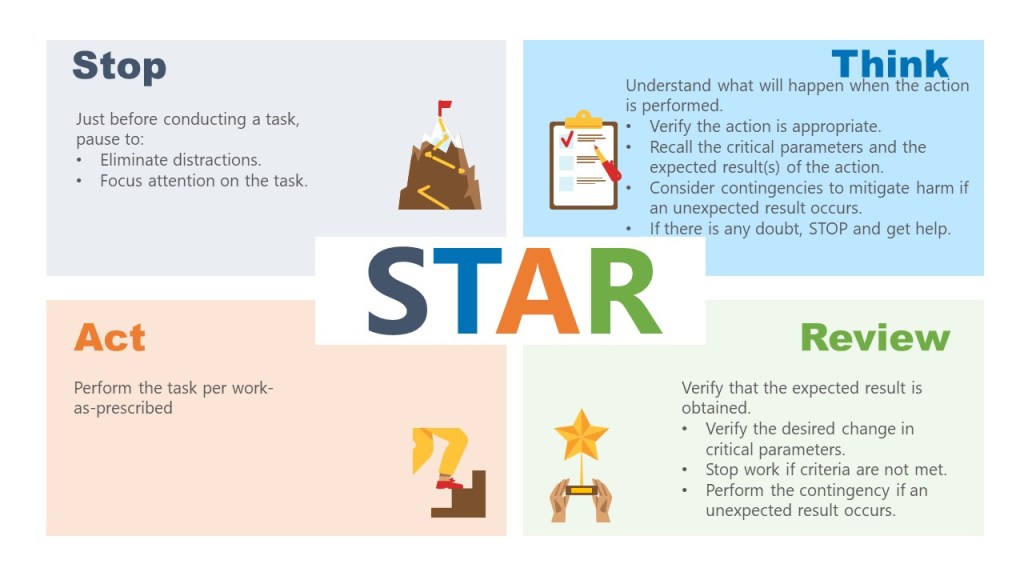
The memory aid STAR (stop, think, act, review) helps the user recall the thoughts and actions associated with self-checking.

  1. Stop – Just before conducting a task, pause to:
    • Eliminate distractions.
    • Focus attention on the task.
  2. Think – Understand what will happen when the action is performed.
    • Verify the action is appropriate.
    • Recall the critical parameters and the action’s expected result(s).
    • Consider contingencies to mitigate harm if an unexpected result occurs.
    • If there is any doubt, STOP and get help.
  3. Act – Perform the task per work-as-prescribed
  4. Review – Verify that the expected result is obtained.
    • Verify the desired change in critical parameters.
    • Stop work if criteria are not met.
    • Perform the contingency if an unexpected result occurs.

Risk Based Thinking

Risk-based thinking is a crucial component of modern quality management systems and consists of four key aspects: anticipate, monitor, respond, and learn. Each aspect ensures an organization can effectively manage and mitigate risks, enhancing overall performance and reliability.

Anticipate

Anticipating risks involves proactively identifying and analyzing potential risks that could impact the organization’s operations or objectives. This step is about foreseeing problems before they occur and planning how to address them. It requires a thorough understanding of the organization’s processes, the external and internal factors that could affect these processes, and the potential consequences of various risks. By anticipating risks, organizations can prepare more effectively and prevent many issues from occurring.

Monitor

Monitoring involves continuously observing and tracking the operational environment to detect risk indicators early. This ongoing process helps catch deviations from expected outcomes or standards, which could indicate the emergence of a risk. Effective monitoring relies on establishing metrics that help to quickly and accurately identify when things are starting to veer off course. This real-time data collection is crucial for enabling timely responses to potential threats.

Respond

Responding to risks is about taking appropriate actions to manage or mitigate identified risks based on their severity and potential impact. This step involves implementing the planned risk responses that were developed during the anticipation phase. The effectiveness of these responses often depends on the speed and decisiveness of the actions taken. Responses can include adjusting processes, reallocating resources, or activating contingency plans. The goal is to minimize the organization’s and its stakeholders’ negative impact.

Learn

Learning from the management of risks is a critical component that closes the loop of risk-based thinking. This aspect involves analyzing the outcomes of risk responses and understanding what worked well and what did not. Learning from these experiences is essential for continuous improvement. It helps organizations refine risk management processes, improve response strategies, and better prepare for future risks. This iterative learning process ensures that risk management efforts are increasingly effective over time.

The four aspects of risk-based thinking—anticipate, monitor, respond, and learn—form a continuous cycle that helps organizations manage uncertainties proactively. This approach protects the organization from potential downsides and enables it to seize opportunities that arise from a well-understood risk landscape. Organizations can enhance their resilience and adaptability by embedding these practices into everyday operations.

Implementing Risk-Based Thinking

1. Understand the Concept of Risk-Based Thinking

Risk-based thinking involves a proactive approach to identifying, analyzing, and addressing risks. This mindset should be ingrained in the organization’s culture and used as a basis for decision-making.

2. Identify Risks and Opportunities

Identify potential risks and opportunities. This can be achieved through various methods such as SWOT analysis, brainstorming sessions, and process mapping. It’s crucial to involve people at all levels of the organization since they can provide diverse perspectives on potential risks and opportunities.

3. Analyze and Prioritize Risks

Once risks and opportunities are identified, they should be analyzed to understand their potential impact and likelihood. This analysis will help prioritize which risks need immediate attention and which opportunities should be pursued.

4. Plan and Implement Responses

After prioritizing, develop strategies to address these risks and opportunities. Plans should include preventive measures for risks and proactive steps to seize opportunities. Integrating these plans into the organization’s overall strategy and daily operations is important to ensure they are effective.

5. Monitor and Review

Implementing risk-based thinking is not a one-time activity but an ongoing process. Regular monitoring and reviewing of risks, opportunities, and the effectiveness of responses are crucial. This can be done through regular audits, performance evaluations, and feedback mechanisms. Adjustments should be made based on these reviews to improve the risk management process.

6. Learn and Improve

Organizations should learn from their experiences in managing risks and opportunities. This involves analyzing what worked well and what didn’t and using this information to improve future risk management efforts. Continuous improvement should be a key goal, aligning with the Plan-Do-Check-Act (PDCA) cycle.

7. Documentation and Compliance

Maintaining proper documentation is essential for tracking and managing risk-based thinking activities. Documents such as risk registers, action plans, and review reports should be updated and readily available.

8. Training and Culture

Training and cultural adaptation are necessary to implement risk-based thinking effectively. All employees should be trained on the principles of risk-based thinking and how to apply them in their roles. Creating a culture encouraging open communication about risks and supporting risk-taking within defined limits is also vital.