Regulatory agencies have continually continued to make it clear that when a Contract Manufacturing Organization (CMO) or Contract Research Organization (CRO) experiences a deviation, the sponsor/Marketing Authorization Holder (MAH) has several key responsibilities:
Review the deviation: The sponsor must thoroughly review the deviation to ensure it was appropriately defined and investigated. This review is crucial as the sponsor cannot delegate their responsibility to ensure the drug product is safe, effective, and conforms to specifications and regulatory commitments.
Assess product impact: The sponsor should ensure that the CMO has properly assessed the impact of the deviation on the product. This includes evaluating whether the deviation affected material quality, safety, or efficacy.
Verify appropriate material control: It’s the sponsor’s responsibility to ensure the CMO has appropriately controlled the affected material and extended this control to any other potentially affected materials.
Make disposition decisions: Ultimately, the sponsor is responsible for deciding whether the product should be released, reprocessed, or rejected. This decision is especially critical if the deviation affected material in clinical trials.
Oversee corrective and preventive actions: The sponsor should understand how the CMO’s corrective and preventive action (CAPA) system operates and ensure appropriate measures are taken to prevent recurrence of the deviation.
Maintain oversight: While the quality agreement defines the CMO’s responsibilities, the sponsor retains 100% oversight, including executed batch record review, change control, and deviation review and approval.
Risk-based approach: For major or critical deviations, sponsors should employ a risk-based approach to assess the severity and potential impact.
To simplify the deviation notification process with a Contract Organization (CxO), sponsors and can implement several strategies:
Clear Communication and Documentation
Establish a Well-Defined Quality Agreement: Create a comprehensive quality agreement that clearly outlines the deviation notification process, including timelines, classification criteria, and reporting requirements.
Implement Standardized Templates: Develop and provide standardized templates for deviation reporting to ensure consistency and completeness of information.
Set Clear Notification Timelines: Agree on specific timelines for different deviation categories. For example, critical and major deviations should be reported within one business day.
Risk-Based Approach
Adopt a Quality Risk Management (QRM) Mindset: Approach the partnership with a focus on risk management, ensuring that both parties understand the potential impact of deviations on product quality and patient safety.
Calibrate Risk Classification: Align the deviation classification system between the sponsor and CxO to avoid discrepancies in severity assessment.
Streamlined Processes
Utilize Electronic Quality Management Systems: Implement digital tools to facilitate real-time reporting and tracking of deviations, improving efficiency and transparency. Yes, the sponsor should be taking a risk based approach to tracking deviations in their eQMS that captures the important sponsor/MAH decision making.
Define Clear Roles and Responsibilities: Clearly delineate who is responsible for each step of the deviation management process, from identification to reporting and investigation.
Training and Support
Provide Comprehensive Training: Ensure that CxO staff are well-trained on the sponsor’s quality expectations, deviation reporting procedures, and the use of any specific tools or systems.
Offer Ongoing Support: Establish a dedicated point of contact or support team to assist the CxO with questions or issues related to deviation reporting.
Regular Review and Improvement
Conduct Periodic Reviews: Schedule regular meetings to review the deviation notification process, discuss any challenges, and identify areas for improvement.
Encourage Open Dialogue: Foster an environment where the CMO feels comfortable reporting issues promptly without fear of punitive action.
I strongly believe that a CxO needs to implement these strategies (do not put it only on the MAH’s shoulders) as part of their client onboarding and management process to create a more efficient and effective deviation notification process. This approach not only simplifies the process but also ensures that critical quality information is communicated promptly and accurately, ultimately contributing to better product quality and regulatory compliance. Add some value and don’t make the sponsor beg for information.
Classification of change controls within change management is a common and widely accepted best practice. It stems from the requirement that change proposals as assessed from a risk perspective, where:
the level of rigor, effort and documentation is commensurate with the level of risk,
the risk assessments adequately evaluate the potential risks and benefits of changes to product quality, safety and efficacy, and
those risk assessments consider the potential risks and benefits to other products, processes and systems.
Classification for GMP/GDP changes itself is not a requirement, it is a guidance, best found in the PIC/S Recommendation “How to Evaluate and Demonstrate the Effectiveness of a Pharmaceutical Quality System in relation to Risk-based Change Management” (PI 054-1) which states in section 5.2 “Change Management procedures often require a risk-based classification (e.g. critical, major, minor) to be assigned to proposed changes as well as an impact assessment to be performed. The latter routinely determines the potential impacts of the proposed change on various items, such as product quality, documentation, cleaning, maintenance, regulatory compliance, etc. In some cases, especially for simple and minor/low risk changes, an impact assessment is sufficient to document the risk-based rationale for a change without the use of more formal risk assessment tools or approaches.”
The PIC/S tells us that these categories drive the amount of rigor a change control requires, which is a great reason to have them. We spend time creating and confirming our categories, and then we only need to perform more rigorous risk assessments on the big changes.
How should we build this risk-based classification system? There are four criteria that drive this:
Potential regulatory impact
Potential impact on the qualified and validated state
Potential impact on the ability to disposition and ship product
Complexity
I tend to use only two categories, defined like this:
Major has Significant Impact: Changes that have a considerable potential impact on the process, product quality, safety, or regulatory status.
Minor has Limited Impact: Changes that have minimal or no significant impact on the process, product quality, safety, or regulatory status.
For regulatory impact, it really is as easy as dividing things into the four categories. “Do, Report, and Do and Record are minors. “Do and Tell” are majors, and “Tell and Do are either majors or critical based on how you slice it.
When considering potential validation impact you’ll leverage your process risk assessments and your validated state to determine what is in that bucket. This is why I like a document like an operational control strategy because this tells me exactly what impacts my validated state and I can just it to form this category.
The potential impact on the ability to disposition and ship the product has me looking at what can impact the ability to release and get the product out the door, which is an important aspect of what we do. Remember, a shortage of products is a quality issue.
Complexity looks at how many processes and systems are impacted and how many functions and areas are involved. The more complex, the more formal risk assessment is required. For example, you might use groupings like this:
Low level of complexity
Requires actions from the change owner and the system owner’s department(s) only
Impacts 1 system
<10 document revisions (approximate)
<2 potential training audiences (approximate)
Higher complexity:
Requires actions from more than change owner and system owner
Impacts more than one system
>10 document revisions
>2 potential training audiences (approximate)
The where of making the classification also makes a difference. I recommend up front, agreed to by the change owner and quality and it then drives everything. Doing it just before approval really just decides who gets to approve the change control and whether it goes to CCRB or not.
These classifications can be loose guidelines; for example, a table that looks at the first three categories and then by complexity. Your rating depends on whichever Impact or Complexity is higher.
Impact of Change (regulatory, validation, product)
Complexity of Change
Minor
No risk to patient as assessed by SISPQ, product, or validated equipment or process AND No regulatory impact.
Limited impact to only one system/functional area AND Has defined process for implementation of change. (e.g. all action items are per defined procedures)
Major
Potential impact to patient or product SISPQ or validated equipment or process or compliance
Impacts multiple systems / functional areas OR Has defined process for implementation of change
Critical
High likelihood of impact to patient, product SISPQ or validated equipment or process or compliance
Impacts multiple systems / functional areas OR Implementation activities are not pre-defined or governed by formal internal system
Or we could try for something much more specific. The advantage of specific is any change owner can start making the determination. Something like this:
Change Category
Change Description
Manufacturing Processes
In-process labeling
Changes to Process Control and Operating Parameters (tightening/shifting) within current batch record (does not impact established conditions)
The addition of in-process or final product samples
Changes to sample volume for in-process or finished product samples
Addition of new ancillary equipment (e.g. no product contact, does not control process steps) to the process
Analytical Methods
Changes to the qualification of a critical reagent (i.e., in-house produced assay standards and controls)
Use of an additional new instrument of the identical model and vendor
Change in compendial method to comply with formal updates to compendia, provided it does not involve the widening of system suitability or acceptance criteria
Equipment/instruments calibration, maintenance, and cleaning
Changes to software or validated analytical spreadsheets that do not impact the current validated state of the method
Movement of instruments from one location to another in the same room/lab
Initial validation of analytical spreadsheets for use in calculation of data and results defined by a specific analytical method, provided it does not replace a worksheet in an SOP (if so, this change may be reportable)
Changes to non-critical equipment or materials that allow “or equivalent” in current method, provided method re-validation is not required
Drug Substance or Drug Product Specifications/ Limits
Changes to the sampling plan involving changes to the number of extra samples or amount of sample provided to QC or CMO as appropriate.
Changes to the storage and/or shipping conditions of samples (except for stability vials)
Raw Materials/Com ponents
Compendial Specification Changes to meet Compendial updates
Non-product contact filters
Vendor increase or decrease in the number of items per shipping container, or the size of the shipping or outer container
Changes to the vendor Certificate of Analysis (format change only)
Changes in recommended expiration date and/or storage conditions of raw material
Finished Goods
Catalog Number changes to components
Creation of label at contract manufacturing site for existing presentation (assuming ‘No’ other change to already approved label)
Changing position of pharmacode on leaflet
Computer
When there is no validation impact
Facility, Utilities, Systems and Equipment (including Automation)
Equipment/instrument maintenance
Decommissioning of equipment not classified as critical equipment
Computer programming that affects non-production equipment
Alarms (i.e., notification system for out of tolerances)
Cleaning and Sanitization of Manufacturing facilities and non-product Contact equipment
Upgrade of Application Software or operating system
Alarm set point changes
Creating user groups and modifying user group privileges
Tuning parameter, adjustment to the gain, reset and rate of a PID controller
Phase or sequence change that does not affect the function and performance
Modifying a phase prompt or message (technical change)
Addition of a graphic, adding or changing a non-static device to a graphic (technical change)
Addition or changing to an interlock/permissive trigger
Changes to alarm paging/notification functionality
Spend the time on your classification structure. You will use it to:
Determine level of risk assessment (major yes, minor no)
Determine approvals (minors can be as simple as change owner and quality)
Does this change require a CCRB? Only send majors.
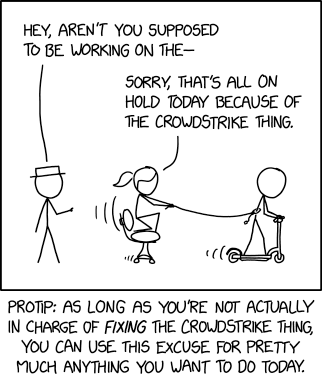
This is not an unexpected accident. It has happened before on a smaller scale. We’ve seen companies like Crowdstrike under-resource their system controls that should prevent this. There is probably a strong case for regulation here. Maybe the EU will do something.
While my flight was only delayed an hour, there were sure to be a lot of grumpy and angry-looking people at Sea-Tac and Logan. I really think if we didn’t have a dysfunctional Congress, we would have seen a real change in how the airline industry is regulated by now.
It is common for numerous meetings to go unrecorded, leading to the risk of losing valuable ideas that are dismissed. This can hinder the group’s ability to achieve its full potential, as revisiting past ideas has the potential to enhance overall performance. Forgetting is a significant barrier to generating innovative ideas; however, engaging in discussions about previous ideas can result in fresh insights. Fortunately, with the aid of chat windows, electronic whiteboards, and other virtual collaboration tools, it is possible to preserve past discussions effectively. This allows for easy access to previously overlooked ideas and facilitates thorough reviews, ultimately contributing to improved collaboration and innovation.
An idea vault is a tool or system that stores, organizes, and manages ideas for future use. This concept can be applied in various contexts, such as personal creativity, business innovation, and project management. Here’s a comprehensive guide on how to use an idea vault effectively:
Organizing Your Ideas
Ideas need to be curated to be of value:
Categorization: Group similar ideas together. Categories can be based on themes, projects, or types of ideas (e.g., story ideas, business concepts, marketing strategies).
Tagging: Use tags to make searching for specific ideas easier. Tags can include keywords, project names, or stages of development.
Prioritization: Rank your ideas based on their potential impact or urgency. This helps in focusing on the most promising ideas first.
Documentation: Provide enough detail for each idea so that you can understand and develop it later. This may include notes, sketches, diagrams, or links to related resources.
Using Your Idea Vault
With your ideas organized, you can now use your vault to enhance your creative and productive processes:
Idea Generation: Review your vault regularly to spark new ideas or find inspiration for current projects. Combining or modifying existing ideas can lead to innovative solutions.
Project Planning: Pull relevant ideas from your vault to create a solid foundation when starting a new project. This ensures that no good idea goes to waste.
Problem Solving: If you encounter a roadblock, your idea vault can provide alternative approaches or solutions you might not have considered initially.
Collaboration: Share your idea vault with team members or collaborators to gather feedback and build on each other’s ideas.
Maintenance and Updates
An idea vault is best used as a living document, which requires regular maintenance:
Regular Updates: Add new ideas as they come to you and update existing ones with new insights or developments.
Review and Cull: Periodically review your vault to remove outdated or irrelevant ideas. This keeps your vault focused and manageable.
Track Usage: Mark ideas that have been used or developed to avoid duplication and to keep track of your creative journey.
Blending Ideas
To make your ideas more interesting or unique, consider blending two or more concepts together. This can lead to unexpected and innovative outcomes. For example, combining elements from different genres or industries can result in novel solutions or creative projects.
By following these steps, you can effectively use an idea vault to capture, organize, and utilize your ideas, ensuring you and your team’s creative potential is fully realized.
Maturity models offer significant benefits to organizations by providing a structured framework for benchmarking and assessment. Organizations can clearly understand their strengths and weaknesses by evaluating their current performance and maturity level in specific areas or processes. This assessment helps identify areas for improvement and sets a baseline for measuring progress over time. Benchmarking against industry standards or best practices also allows organizations to see how they compare to their peers, fostering a competitive edge.
One of the primary advantages of maturity models is their role in fostering a culture of continuous improvement. They provide a roadmap for growth and development, encouraging organizations to strive for higher maturity levels. This continuous improvement mindset helps organizations stay agile and adaptable in a rapidly changing business environment. By setting clear goals and milestones, maturity models guide organizations in systematically addressing deficiencies and enhancing their capabilities.
Standardization and consistency are also key benefits of maturity models. They help establish standardized practices across teams and departments, ensuring that processes are executed with the same level of quality and precision. This standardization reduces variability and errors, leading to more reliable and predictable outcomes. Maturity models create a common language and framework for communication, fostering collaboration and alignment toward shared organizational goals.
The use of maturity models significantly enhances efficiency and effectiveness. Organizations can increase productivity and use their resources by identifying areas for streamlining operations and optimizing workflows. This leads to reduced errors, minimized rework, and improved process efficiency. The focus on continuous improvement also means that organizations are constantly seeking ways to refine and enhance their operations, leading to sustained gains in efficiency.
Maturity models play a crucial role in risk reduction and compliance. They assist organizations in identifying potential risks and implementing measures to mitigate them, ensuring compliance with relevant regulations and standards. This proactive approach to risk management helps organizations avoid costly penalties and reputational damage. Moreover, maturity models improve strategic planning and decision-making by providing a data-backed foundation for setting priorities and making informed choices.
Finally, maturity models improve communication and transparency within organizations. Providing a common communication framework increases transparency and builds trust among employees. This improved communication fosters a sense of shared purpose and collaboration, essential for achieving organizational goals. Overall, maturity models serve as valuable tools for driving continuous improvement, enhancing efficiency, and fostering a culture of excellence within organizations.
Business Process Maturity Model (BPMM)
A structured framework used to assess and improve the maturity of an organization’s business processes, it provides a systematic methodology to evaluate the effectiveness, efficiency, and adaptability of processes within an organization, guiding continuous improvement efforts.
Key Characteristics of BPMM
Assessment and Classification: BPMM helps organizations understand their current process maturity level and identify areas for improvement. It classifies processes into different maturity levels, each representing a progressive improvement in process management.
Guiding Principles: The model emphasizes a process-centric approach focusing on continuous improvement. Key principles include aligning improvements with business goals, standardization, measurement, stakeholder involvement, documentation, training, technology enablement, and governance.
Incremental Levels
BPMM typically consists of five levels, each building on the previous one:
Initial: Processes are ad hoc and chaotic, with little control or consistency.
Managed: Basic processes are established and documented, but results may vary.
Standardized: Processes are well-documented, standardized, and consistently executed across the organization.
Predictable: Processes are quantitatively measured and controlled, with data-driven decision-making.
Optimizing: Continuous process improvement is ingrained in the organization’s culture, focusing on innovation and optimization.
Benefits of BPMM
Improved Process Efficiency: By standardizing and optimizing processes, organizations can achieve higher efficiency and consistency, leading to better resource utilization and reduced errors.
Enhanced Customer Satisfaction: Mature processes lead to higher product and service quality, which improves customer satisfaction.
Better Change Management: Higher process maturity increases an organization’s ability to navigate change and realize project benefits.
Readiness for Technology Deployment: BPMM helps ensure organizational readiness for new technology implementations, reducing the risk of failure.
Usage and Implementation
Assessment: Organizations can conduct BPMM assessments internally or with the help of external appraisers. These assessments involve reviewing process documentation, interviewing employees, and analyzing process outputs to determine maturity levels.
Roadmap for Improvement: Organizations can develop a roadmap for progressing to higher maturity levels based on the assessment results. This roadmap includes specific actions to address identified deficiencies and improve process capabilities.
Continuous monitoring and regular evaluations are crucial to ensure that processes remain effective and improvements are sustained over time.
A BPMM Example: Validation Program based on ASTM E2500
To apply the Business Process Maturity Model (BPMM) to a validation program aligned with ASTM E2500, we need to evaluate the program’s maturity across the five levels of BPMM while incorporating the key principles of ASTM E2500. Here’s how this application might look:
Level 1: Initial
At this level, the validation program is ad hoc and lacks standardization:
Validation activities are performed inconsistently across different projects or departments.
There’s limited understanding of ASTM E2500 principles.
Risk assessment and scientific rationale for validation activities are not systematically applied.
Documentation is inconsistent and often incomplete.
Level 2: Managed
The validation program shows some structure but lacks organization-wide consistency:
Basic validation processes are established but may not fully align with ASTM E2500 guidelines.
Some risk assessment tools are used, but not consistently across all projects.
Subject Matter Experts (SMEs) are involved, but their roles are unclear.
There’s increased awareness of the need for scientific justification in validation activities.
Level 3: Standardized
The validation program is well-defined and consistently implemented:
Validation processes are standardized across the organization and align with ASTM E2500 principles.
Risk-based approaches are consistently used to determine the scope and extent of validation activities.
SMEs are systematically involved in the design review and verification processes.
The concept of “verification” replaces traditional IQ/OQ/PQ, focusing on critical aspects that impact product quality and patient safety.
Quality risk management tools (e.g., impact assessments, risk management) are routinely used to identify critical quality attributes and process parameters.
Level 4: Predictable
The validation program is quantitatively managed and controlled:
Key Performance Indicators (KPIs) for validation activities are established and regularly monitored.
Data-driven decision-making is used to continually improve the efficiency and effectiveness of validation processes.
Advanced risk management techniques are employed to predict and mitigate potential issues before they occur.
There’s a strong focus on leveraging supplier documentation and expertise to streamline validation efforts.
Engineering procedures for quality activities (e.g., vendor technical assessments and installation verification) are formalized and consistently applied.
Level 5: Optimizing
The validation program is characterized by continuous improvement and innovation:
There’s a culture of continuous improvement in validation processes, aligned with the latest industry best practices and regulatory expectations.
Innovation in validation approaches is encouraged, always maintaining alignment with ASTM E2500 principles.
The organization actively contributes to developing industry standards and best practices in validation.
Validation activities are seamless integrated with other quality management systems, supporting a holistic approach to product quality and patient safety.
Advanced technologies (e.g., artificial intelligence, machine learning) may be leveraged to enhance risk assessment and validation strategies.
Key Considerations for Implementation
Risk-Based Approach: At higher maturity levels, the validation program should fully embrace the risk-based approach advocated by ASTM E2500, focusing efforts on aspects critical to product quality and patient safety.
Scientific Rationale: As maturity increases, there should be a stronger emphasis on scientific understanding and justification for validation activities, moving away from a checklist-based approach.
SME Involvement: Higher maturity levels should see increased and earlier involvement of SMEs in the validation process, from equipment selection to verification.
Supplier Integration: More mature programs will leverage supplier expertise and documentation effectively, reducing redundant testing and improving efficiency.
Continuous Improvement: At the highest maturity level, the validation program should have mechanisms in place for continuous evaluation and improvement of processes, always aligned with ASTM E2500 principles and the latest regulatory expectations.
Process and Enterprise Maturity Model (PEMM),
The Process and Enterprise Maturity Model (PEMM), developed by Dr. Michael Hammer, is a comprehensive framework designed to help organizations assess and improve their process maturity. It is a corporate roadmap and benchmarking tool for companies aiming to become process-centric enterprises.
Key Components of PEMM
PEMM is structured around two main dimensions: Process Enablers and Organizational Capabilities. Each dimension is evaluated on a scale to determine the maturity level.
Process Enablers
These elements directly impact the performance and effectiveness of individual processes. They include:
Design: The structure and documentation of the process.
Performers: The individuals or teams executing the process.
Owner: The person responsible for the process.
Infrastructure: The tools, systems, and resources supporting the process.
Metrics: The measurements used to evaluate process performance.
Organizational Capabilities
These capabilities create an environment that supports and sustains high-performance processes. They include:
Leadership: The commitment and support from top management.
Culture: The organizational values and behaviors that promote process excellence.
Expertise: The skills and knowledge required to manage and improve processes.
Governance: The mechanisms to oversee and guide process management activities.
Maturity Levels
Both Process Enablers and Organizational Capabilities are assessed on a scale from P0 to P4 (for processes) and E0 to E4 (for enterprise capabilities):
P0/E0: Non-existent or ad hoc processes and capabilities.
P1/E1: Basic, but inconsistent and poorly documented.
P2/E2: Defined and documented, but not fully integrated.
P3/E3: Managed and measured, with consistent performance.
P4/E4: Optimized and continuously improved.
Benefits of PEMM
Self-Assessment: PEMM is designed to be simple enough for organizations to conduct their own assessments without needing external consultants.
Empirical Evidence: It encourages the collection of data to support process improvements rather than relying on intuition.
Engagement: Involves all levels of the organization in the process journey, turning employees into advocates for change.
Roadmap for Improvement: Provides a clear path for organizations to follow in their process improvement efforts.
Application of PEMM
PEMM can be applied to any type of process within an organization, whether customer-facing or internal, core or support, transactional or knowledge-intensive. It helps organizations:
Assess Current Maturity: Identify the current state of process and enterprise capabilities.
Benchmark: Compare against industry standards and best practices.
Identify Improvements: Pinpoint areas that need enhancement.
Track Progress: Monitor the implementation and effectiveness of process improvements.
A PEMM Example: Validation Program based on ASTM E2500
To apply the Process and Enterprise Maturity Model (PEMM) to an ASTM E2500 validation program, we can evaluate the program’s maturity across the five process enablers and four enterprise capabilities defined in PEMM. Here’s how this application might look:
Process Enablers
Design:
P-1: Basic ASTM E2500 approach implemented, but not consistently across all projects
P-2: ASTM E2500 principles applied consistently, with clear definition of requirements, specifications, and verification activities
P-3: Risk-based approach fully integrated into design process, with SME involvement from the start
P-4: Continuous improvement of ASTM E2500 implementation based on lessons learned and industry best practices
Performers:
P-1: Some staff trained on ASTM E2500 principles
P-2: All relevant staff trained and understand their roles in the ASTM E2500 process
P-3: Staff proactively apply risk-based thinking and scientific rationale in validation activities
P-4: Staff contribute to improving the ASTM E2500 process and mentor others
E-3: Leadership drives cultural change to fully embrace risk-based validation approach
E-4: Leadership promotes ASTM E2500 principles beyond the organization, influencing industry standards
Culture:
E-1: Some recognition of the importance of risk-based validation
E-2: Culture of quality and risk-awareness developing across the organization
E-3: Strong culture of scientific thinking and continuous improvement in validation activities
E-4: Innovation in validation approaches encouraged and rewarded
Expertise:
E-1: Basic understanding of ASTM E2500 principles among key staff
E-2: Dedicated team of ASTM E2500 experts established
E-3: Deep expertise in risk-based validation approaches across multiple departments
E-4: Organization recognized as thought leader in ASTM E2500 implementation
Governance:
E-1: Basic governance structure for validation activities in place
E-2: Clear governance model aligning ASTM E2500 with overall quality management system
E-3: Cross-functional governance ensuring consistent application of ASTM E2500 principles
E-4: Governance model that adapts to changing regulatory landscape and emerging best practices
To use this PEMM assessment:
Evaluate your validation program against each enabler and capability, determining the current maturity level (P-1 to P-4 for process enablers, E-1 to E-4 for enterprise capabilities).
Identify areas for improvement based on gaps between current and desired maturity levels.
Develop action plans to address these gaps, focusing on moving to the next maturity level for each enabler and capability.
Regularly reassess the program to track progress and adjust improvement efforts as needed.
Comparison Table
Aspect
BPMM
PEMM
Creator
Object Management Group (OMG)
Dr. Michael Hammer
Purpose
Assess and improve business process maturity
Roadmap and benchmarking for process-centricity
Structure
Five levels: Initial, Managed, Standardized, Predictable, Optimizing
Two components: Process Enablers (P0-P4), Organizational Capabilities (E0-E4)
Enterprise systems, business process improvement, benchmarking
Process reengineering, organizational engagement, benchmarking
In summary, while both BPMM and PEMM aim to improve business processes, BPMM is more structured and detailed, often requiring external appraisers, and focuses on incremental process improvement across organizational boundaries. In contrast, PEMM is designed for simplicity and self-assessment, emphasizing the role of process enablers and organizational capabilities to foster a supportive environment for process improvement. Both have advantages, and keeping both in mind while developing processes is key.


 Investigations of a Dog