Dealing with Naysayers

Every process improvement, every experiment, requires us to persuade others. There is a diversity of ideas, of needs, of requirements from stakeholders. I’ve written before about practicing “Yes..But…And“. Sometimes you just find people who are in naysayer category and you should have strategies for dealing with them. Try these:

  • Have you acknowledged the individual and their concerns? Sometimes the person simply wants to acknowledged. Although the naysayer’s actions can be frustrating because they are delaying the process of implementing, it can be worth it – and save time in the long run – to meet with the individual and listen to their concerns and thoughts.
  • What is the person not saying? Do they feel threatened or excluded?
  • As the individual how they would handle the challenge your idea seeks to solve. When you listen to them, you may find you have a kernel of common agreement upon which to build. Listen to their arguments against your idea – that could help you as you sell your idea to stakehoders and build an army of volunteers.
  • Does your idea potentially affect the naysayer’s area? Could it be a matter of a turf war? Can you gain insights by seeing things from their perspective – for example how would you feel if someone offered a similar idea that affected your team?
  • Does the person have someone whom they respect and will listen to? Can you discuss your idea with that individual and ask them to speak with the naysayer?
  • Are there other allies whom you can persuade and whom you can gain as allies to counter the naysayer? You may have to accept that the naysayer won’t come around to your idea.
  • Reach out to the naysayer for casual conversation to try to establish a collegial bond and build a better relationship for the long term.
Photo by elifskies on Pexels.com

Practice Exuberance

Love what you do. Love the practice of quality. Your enthusiasm will take you a long way. If you don’t love the work you do, well…. maybe get a different job, or if you are like me, learn to exude exuberance.

Your enthusiasm is the secret sauce of quality success. It is the launching pad to get folks to listen, learn, participate and strive for changes. You should inspire hope, energy, and excitement about the future.

Please don’t confuse enthusiasm with entertainment. Enthusiasm is a passion for what you do, commitment to whom you do it form, and confidence in how you do it.

I am passionate about quality and building systems. And yes, some days I have more enthusiasm than others. We all have days like that. So have a few ways to help:

  • Look for ways to do something out of the ordinary
  • Examine the parts of my work I enjoy the least and then look for opportunities to fix them.
  • Keep a smile file.
  • Try something new regularly
Photo by Monstera on Pexels.com

Biotech Employees in Short Supply, a rant

The Boston Globe reported this past weekend “In the region’s booming biotech industry, workers are in short supply“, which is both good news and bad for me.

Good news is that my career prospects are always good.

Bad news is that I am hiring and building teams within quality.

also affect the quality of work as key positions become harder to fill and lower-level workers jump from company to company in search of a better compensation package.

For compensation package, read total cash. Sure there can be a difference on how good other benefits can be, but they all kind of get blurred together and I don’t think I noticed any difference between benefits packages until I went to a small startup, and I definitely knew what I was getting into there. The article later goes on to say some biotech is starting to offer some of the benefits seen in more computer-driven fields, but maybe folks should pay attention to how that is usually a trad to entice people into longer hours.

Notice the emphasis on lower level workers. Read that for “We don’t really offer good development programs and the only way to get promoted in this title-obsessed field is go to another company.”

According to the latest report from industry association MassBio, nearly 85,000 people work in the state’s life sciences sector, up 55 percent from 2008.

And sometimes you feel like you know all 85k, and have worked with most of them.

“You can’t walk two blocks around Kendall Square without receiving a job offer,” said Jeanne Gray, chief people officer at Relay Therapeutics in Cambridge, only half-kiddingly. “I get the sense that a lot of candidates know the market is hot.”

And she only made it 2 blocks because of the pandemic. Seriously, this joke has existed for over a decade.

About 16.5 percent of life sciences employees in Massachusetts voluntarily quit their jobs last year

Wouldn’t you if you keep getting better offers, often unsolicited from other companies and your current company gave you a measly 2-4% raise? Companies want folks to stay, start giving real raises commensurate with the market increase. As a manager, looking someone in the eyes (or vaguely at their eyes because we are both on camera) and telling the best the company can do is a 3% raise is pretty damn problematic. Especially if the employee knows how to read a SEC filing (if your company is public make sure you read these at every update).

There’s also a sense that employees are easily swayed by “title inflation,” a phenomenon that occurs when people climb the corporate ladder faster by bouncing around.

This is a problem in a field where title is everything. Where people where their MDs and PhDs as holy vestments. Where title is tied to autonomy and with ability to influence. This is a complex systematic problem, and few companies are even thinking of how to fix it, and probably can’t because the problem starts at the C-suite. No the problem starts with the regulators. See it’s complex, it starts in a lot of places.

I’m doing my little experiment here, I went to a company started by two incredibly earnest guys who had just graduated from Brown. Is everything perfect? Never is. But the experiment itself is fascinating to participate in.

the talent pool has not matured enough to fill key areas from the C-suite and clinical development, all the way through to the commercial launch of products.

Yes, expertise matters. However, we prize years-in-seat more than we should sometimes, and we do not spend enough time building talent. And let’s be honest, that leads to a lot of director levels who do not know how to actually do the thing they are supposed to do beyond the last time they did it.

This is definitely a ranty post.

Work-As-Instructed

As part of his model for Proxies for Work-as-Done, Steven Shorrock covers Work-as-Instructed. I think the entire series is salient to the work of building a quality organization, so please spend the time to read the entire series. You’ll definitely see inspiration in many of the themes I’ve been discussing.

Work-as-Instructed in training and personnel qualification, topics near and dear to my own heart.

Steven provides a few attributes for Work-as-Instructed, three of which fidelity, completeness, and granularity are constant concerns for me.

The Epistemic Interactions of Knowledge Management

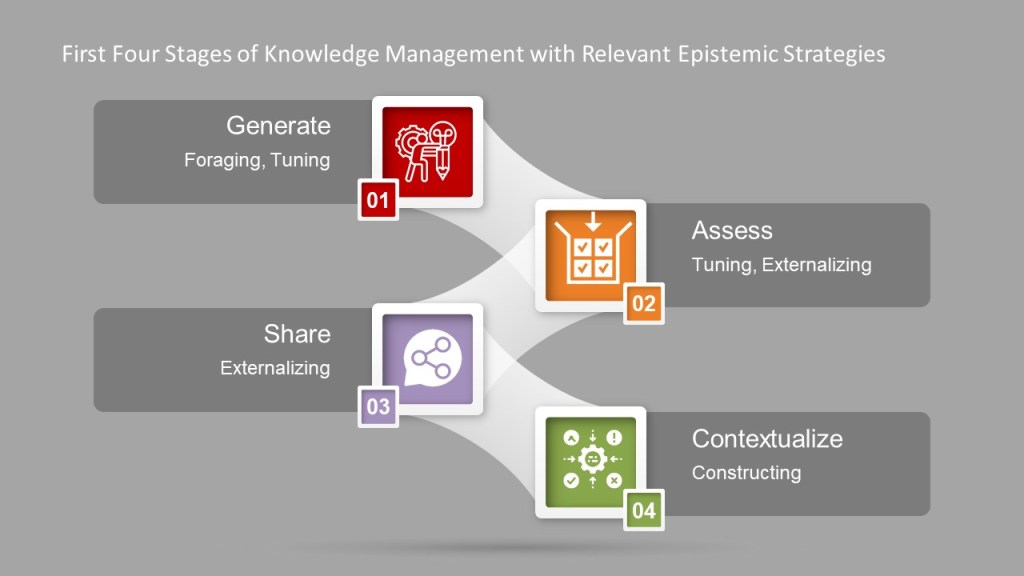
The first four phases of knowledge management are all about identifying and creating meaning and then making that meaning usable. Knowledge management is a set of epistemic actions, creating knowledge through interaction. This interaction is a way of creating a partnership between what happens in the head with everything in the world – Work-as-Imagined and Work-as-Done.

There are really four themes to a set of epistemic actions:

  • Foraging: Locating resources that will lead to understanding
  • Tuning: Adjusting resources to align with desired understanding
  • Externalizing: Moving resources out of the head and into the world
  • Constructing: Forming new knowledge structures in the world

These epistemic actions are all about moving from Work-as-Imagined through Work-as-Prescribed to enable Work-as-Done.

Knowledge Management is really about the embodiment of information, knowledge, and even wisdom through these epistemic actions to apply change upon the world.

Four Themes Mapped to Firts 4 Phases of Knowledge Management

Theme

Epistemic Interaction

Means

Foraging

Locating resources that will lead to understanding

Searching


Searching happens when you need information and believe it exists somewhere.

Searching depends on how we articulate or information needs.

Probing


“Tell me more.” Probing happens when the information you have isn’t quite enough. You are probing when you take the next step, move to the next level, and obtain more salient specifics. Probing is about drilling down and saying “show, explain, and reveal more about this.”

We can probe to reveal new patterns, structures and relationships. It brings to light new information that helps us to reconsider what we already know.

Animating


Animating is when we initiate and control motion in an information source. It includes learning-by-doing.

Collecting

Collecting is how we gather foraged information and tuck it away for future use.

Tuning

Adjusting resources to align with desired understanding

Collecting


Cloning


Cloning lets us take information from one situation and use it in another.

Cutting


Cutting is the way we say “this matters”, that “I need this part, but not the rest.”

Filtering

Filtering reduces complexity by reducing clutter to expose salient details.

Externalizing

Moving resources out of the head and into the world

Annotating


Annotating is how we add context to information. How we adapt and modify the information to the needed context.

Linking

Connecting bits of information together. Forming conceptual maps.

Generating

Introducing new knowledge into the world.

Chunking

Grouping idenpendent yet related information together.

Constructing

Forming new knowledge structures in the world

Chunking


Composing

Producing a new, separate structure from the information that has its own meaning and purpose.

Fragmenting

Taking information and breaking it apart into usable components.

Rearranging

The art of creating meaningful order.

Repicturing

Changing the way the information is represented to create understanding.