In the 14 years since permission-less blockchains were created absolutely no one has come up with a single useful thing to do with the technology. The majority of blockchain activity is just about maintaining the blockchain — not about buying or selling things or actually doing anything that has any value to society.
The massive amounts of energy and ewaste is a requirement, maybe even a feature, to the wasteful endeavor of blockchain. Given how that energy waste is a requirement to ensure ‘security’ (for what it is) there’s really no way to fix the problem. And why bother since the whole thing is a tulip-bubble anyways. It exists for speculation.
Blockchain has not offered one feasible solution, and cannot offer a single one, to issues of data integrity or anti-counterfeiting. It isn’t what the technology is designed to do. All it is designed to do is spend a lot of money to drive a speculative bubble,
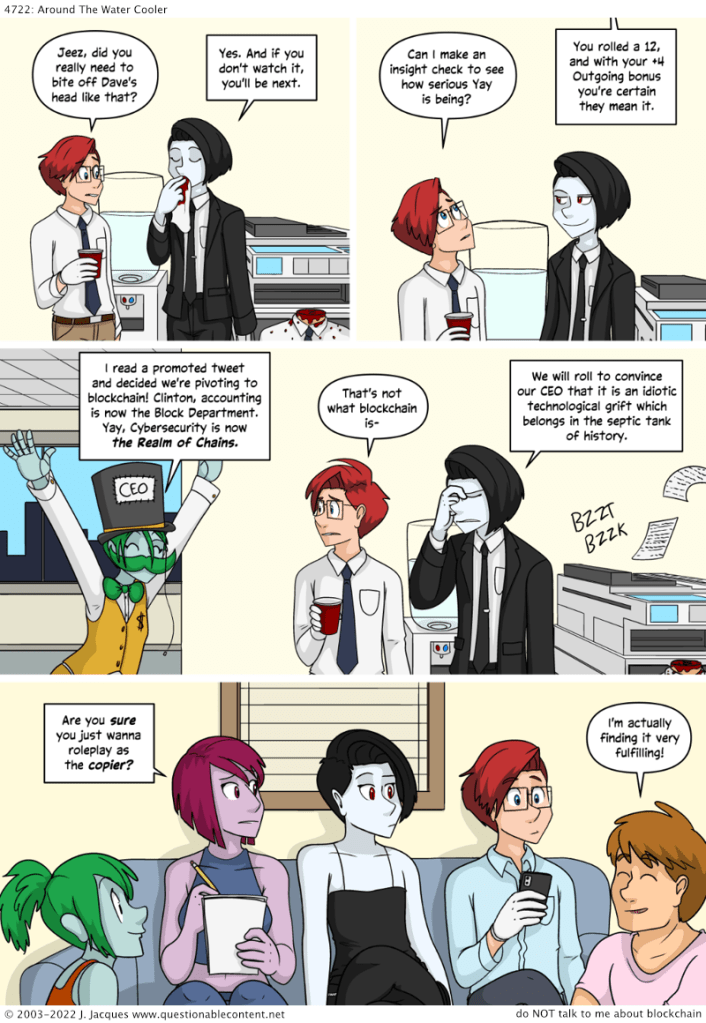
I leave you with a comic, which succinctly summarizes how I feel everytime blockchain comes up in a professional context.
As a pharmaceutical GXP professional with one foot in the GXP Quality camp and another in the organizational change management camp, I have a few pet peeves. And one of my biggest is whenever someone uses a phrase like “Change management may be known by different terminologies (e.g., change control, change requests, change orders).” That’s a reductionist statement that can really lead to a lot of confusion in an organization.
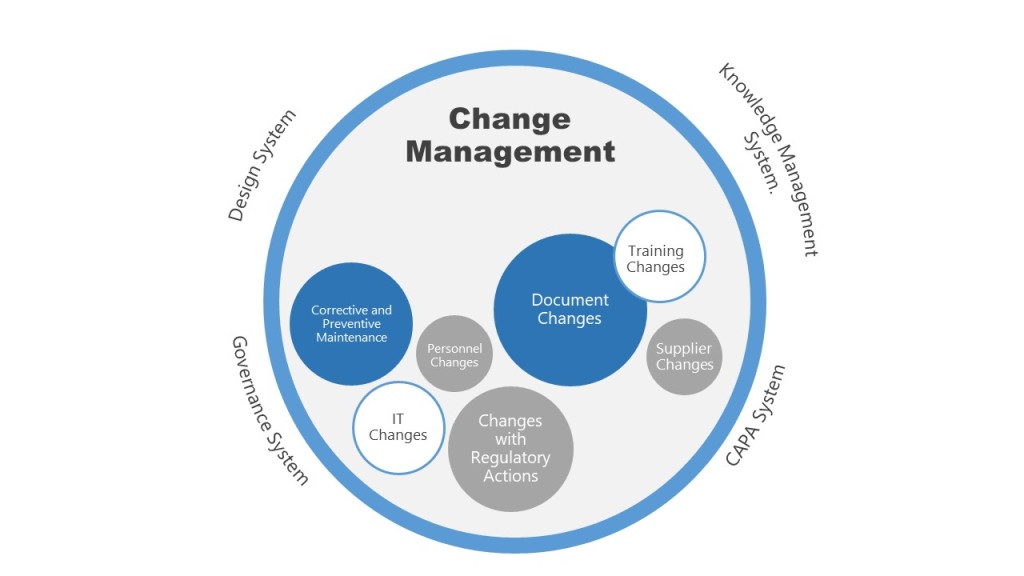
Change management is the how of change – assess, handle and release. Change control is the what, the execution steps. Change management is a big picture system that looks systematically at people, technology, process, and organization. Change control is the set of mechanisms for controlling the introduction of that change to the organization.
A lot of different systems and processes have change control elements. As many of these processes are supported with specific technologies, it can be very important to think about how they fit together like a puzzle.
This puzzle is usually made up of core requirements. Based on how much the change impacts them decides the rigor of the change control process.
Take for example a pharmaceutical manufacturing site. It is fairly typical to have one process for maintenance, another for IT, another for documents, etc. And then you have a change control system for things that impact established conditions, including validated state and regulatory submissions. Maybe you work at some technological utopia with a single system that manages all changes with all the deliverables, but at most places, you are trying to balance efficiency with effectiveness, and have a real need to avoid unnecessary duplication.
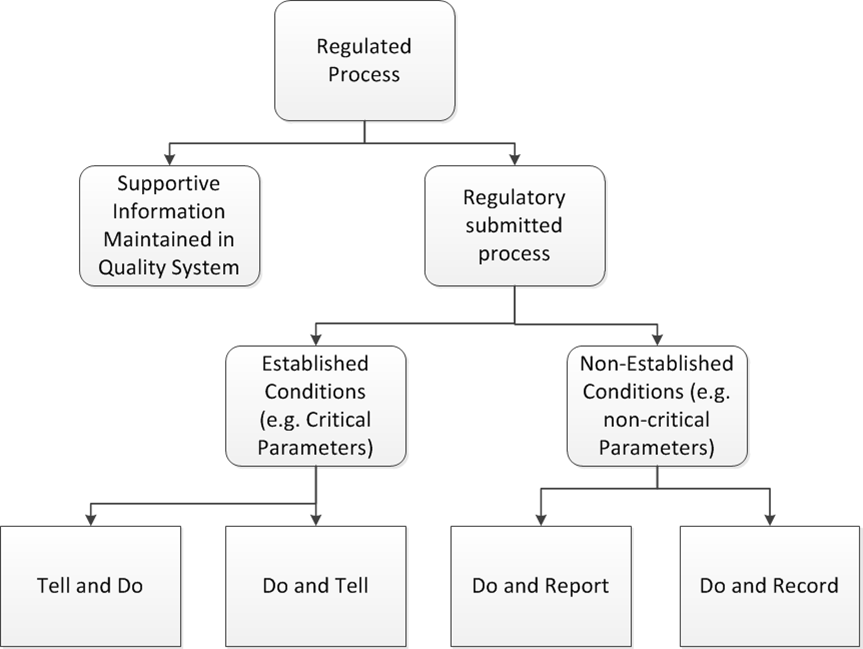
ICH Q12 helps by giving a nice breakdown of the major families of changes.
This helps somewhat, but for the average user it is not very specific. We need to translate it. First, we establish that only one system will be used for regulatory impact (“Tell and Do”, “Do and Tell” “Do and Report” and some of “Do and Record”), then we put the major activities that go into it. This breakdown might look like:
We are utilizing a few major criteria:
Impact of regulated state
Impact of validated state
Risk level of change
Scale of change to the organization
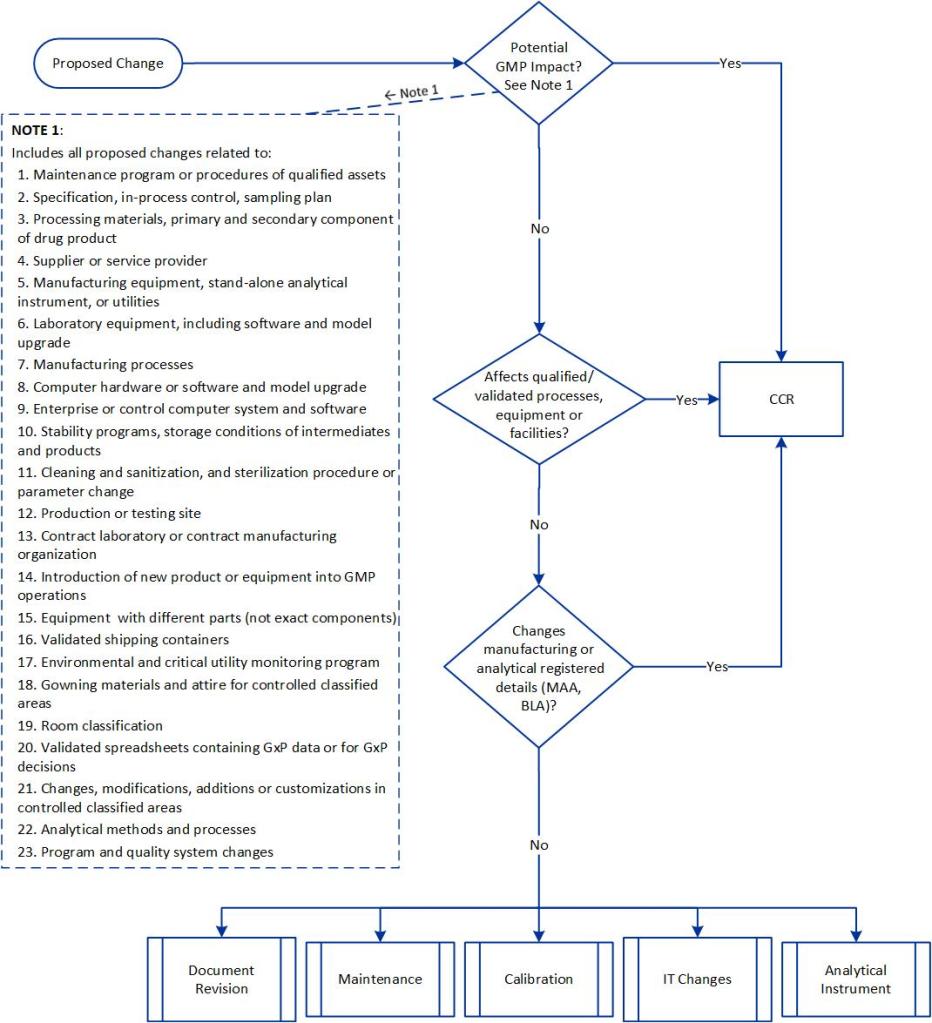
Using these criteria we can even drill down further, for example:
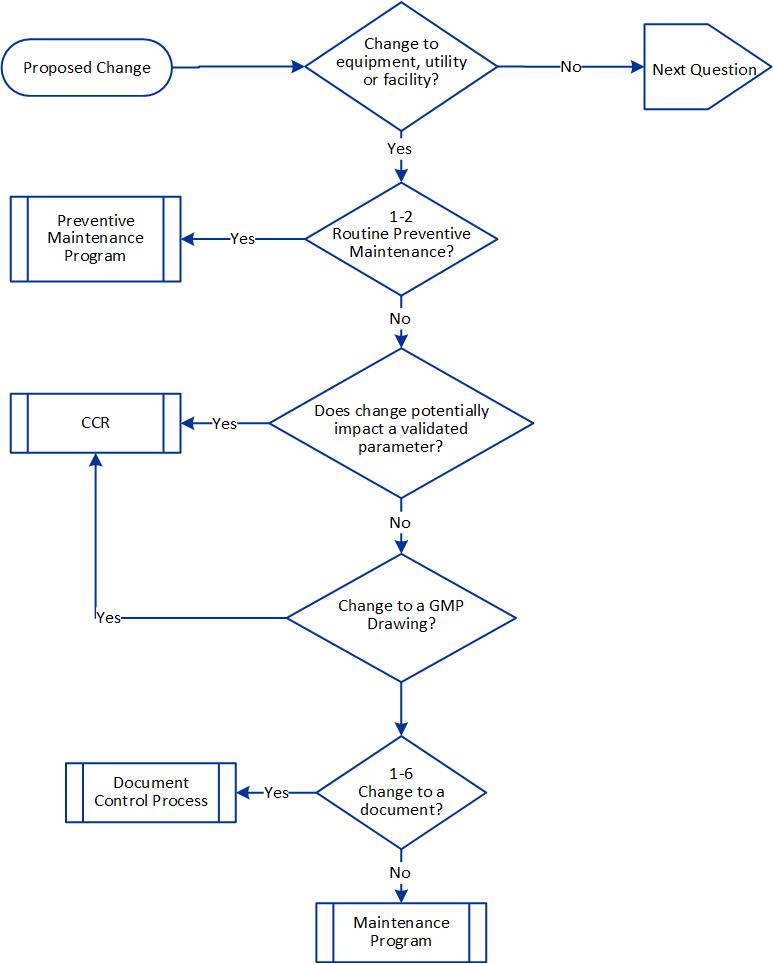
FEU Changes as a flowchart
It is usually a good idea to go down to an even deeper level to help the end-user.
Requires CCR
Does Not Require CCR
Any change that impacts the integrity of
controlled classified areas, including all room and equipment surfaces
Changes that do not impact
integrity of controlled classified areas by meeting the following criteria:
·Does not change airflow
·Does not impact structural integrity and maintains a smooth
cleanable surface
·Does not change means of ingress/egress
·Does not impact current sampling sites from the Environmental
Monitoring Program
·Materials used are resistant to cleaning agents used in the area
as defined in the building specifications
·Materials are included in disinfectant effectiveness study
Any change that impacts air balancing
Work that is part of routine or
preventive maintenance or calibration
Changes to equipment or replacements with a functional
equivalent or different component
Changes to equipment with an
exact component
Changes to facility floor layout
Instrument calibration including
adjustments to field instrumentation
Changes to equipment operating and control
parameters
Removal/storage of portable
equipment
Changes to equipment, material and personnel ingress,
egress and flow procedures
Replacement of system instrument
hardware with exact components (hardware)
Changes to room classifications
Engineering studies that do not
change the validated state or change anything requiring a CCR per this
procedure
Changes that impact the environmental
integrity of a room
Alarm set point changes that
return to the previous qualified/validated state
Replacement and/or decommissioning of equipment,
utilities or facilities
Remediation work (such as
mechanical polishing, weld repairs, electro-polishing, filling of pits,
de-rouging and chemical cleaning with already approved material)
Alarm set point or classification changes
Addition, modification or
deletion to Potable Water, Plant Steam, Chilled Water, Cogeneration System,
or pre-treatment reverse-osmosis
Changes in intended use of a room or area
Modification to piping tied to
Potable Water, Plant Steam, Chilled Water, Cogeneration System, or
pre-treatment reverse-osmosis
Changes to Preventive Maintenance that
includes:
·Decreasing
frequency of preventive maintenance (i.e. making less frequent)
·Change
in intent of a preventive maintenance task
·Adding
or removing tasks
Changes to Preventive Maintenance
that include:
·Increasing frequency of preventative maintenance (i.e. making
more frequent)
·Administrative changes
·Adding clarity to a task (e.g. changing instructions on how to
execute a task without altering the intent of the task)
·Reordering task(s) without changing intent of the task(s)
·Changes of tools needed to execute a task; room dedicated tools
must remain in the designated area
·Changes to quantity of materials
Changes that decrease the calibration
frequency (i.e. make less frequent) for GMP Critical equipment (e.g. directly
related to operational control of the product)
·Changes that increase calibration frequency (i.e. make more
frequent) for GMP Non-Critical equipment (e.g. indirectly related to
operational control of the product)
Tuning parameter, adjustment to the gain,
reset and rate of a PID controller
New or replacement analytical
equipment or instruments identified as Category A or Category B-Calibration
Only with an exact component
Changes to the calibration frequency of GMP
critical equipment (e.g. directly related to operational control of the
product)
Changes to manufacturing report
properties
Changes to the Environmental Monitoring
Program, including addition, deletion or change to a sample location
Changes to alarm
paging/notification recipients
Changes to the program for disinfection of a
facility or equipment exterior
Creating/modifying individual
user accounts
Change of materials of construction or class
of polymeric materials (e.g. elastomers, tubing, gaskets and diaphragms)
Add an instrument to the
calibration system during pre-commissioning
Changes to hardware or infrastructure
associated with a validated system, equipment or utility
Changes to requalification
frequency that do not change the intended use or validated state of the
equipment or utility
Upgrade of application software or operating
system for validated systems, equipment or utility
Corrective changes to an SOP to
align it to the validated state
Changes to an SOP to align it to the
validated state with impact to one or more regulatory filings
A corrective change to alarm set
points to align with the validated state
Creating user groups and/or modifying user
group privileges as part of a larger process change associated with validated
systems, equipment, or utilities
Addition of a new calibration
standard to be used with a new type of instrument at the Alachua site
Creating user groups and/or modifying user
group privileges associated with validated systems, equipment, or utilities
Changes to alarm paging/notification
recipients
Addition of a new calibration standard to be
used with a new type of instrument at the Cambridge and Lexington sites
Modifying a phase prompt or message
associated with validated systems, equipment, or utilities
Addition / change of a graphic associated
with validated systems, equipment, or utilities
Addition or changing an interlock/permissive
trigger
Addition/removal of I/O of validated systems
Changes to the Environmental Monitoring
Program, including addition, deletion or change to a sample location
Changes to alarm paging/notification
functionality
Historical data collection configuration
Change of equipment and spare parts storage
site, including transfers between facilities and transfers to a contracted
third party
All of this is change management. We utilize multiple change control mechanisms to manage the change.
Also, don’t forget that change controls can nest. For example a change to the EQMS has IT changes, document changes, training changes, and probably more.
McKinsey paid $600 million as a result of its illegal activities around the sales of opioid drugs. Frankly, I’m amazed that the company has not gone the way of Arthur Anderson, a fate that is well deserved.
Yet the company still exists and continues to do creepy stuff, for example, take a look at Cory Doctorow’s article on their kids’ program.
Hiring McKinsey is basically like hiring the Tony Soprano Consulting Company.
Does training in your organization seem like death by PowerPoint? Is learning viewed as something an expert dumps in the lap of the learner.? However, that’s not what learning is – lectures and one-way delivery end up resulting in very little learning.
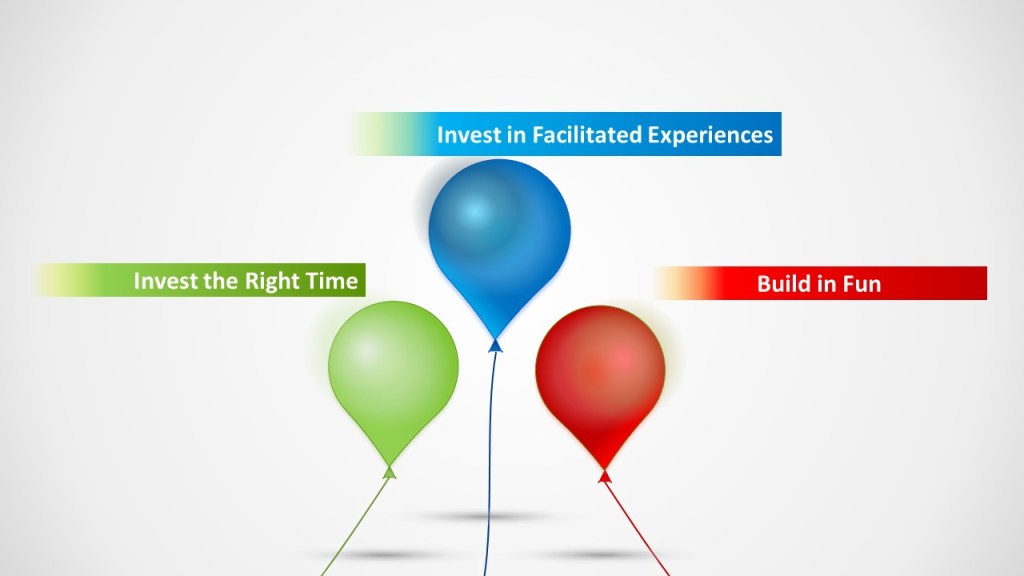
For deeper meaning to occur, invest in professionally facilitated experiences that enable staff to form mental models they remember. Get people thinking before and after the training to ensure that the mental model stays fresh in the mind.
Culture of Cutting Time
Avoid the desire for training in shorter and shorter chunks. The demands of the workplace are increasingly complex and stressful, so any time out of the office is a serious cost. The paradox is that by shortening the training, we don’t give the time for structured learning, which sabotages the investment when the training program could be substantially improved by adding the time to allow the learning to be consolidated.
We know that learning takes place when people have fun, stress is low, and the environment encourages discovery. Make training cheerful and open rather than dull and quiet. Encourage lots of informal learning opportunities. Give more control to the learner to shape their experience. Have fun!