Build Key Risk Indicators

We perform risk assessments; execute risk mitigations; and we end up with four types of inherent risks (parenthesis is opportunities) in our risk register:

  1. Mitigated (or enhanced)
  2. Avoided (or exploited)
  3. Transferred (or shared)
  4. Accepted

We’ve built a set of risk response plans to ensure we are continuing to treat these risks. And now we need to monitor the effectiveness of our risk plan and to ensure that the risks are behaving in the manner anticipated during risk treatment.

The living risk assessment is designed to conduct reassessment of risks after treatment and continuously throughout the life cycle. However, not all systems and risks need to be reassessed continually, and the organization should prioritize which systems should be reassessed based on a schedule.

Identify indicators that inform the organization about the status of the risk without having to conduct a full risk assessment every time. The trending status of these indicators can act as a flag for investigations, which may result in complete risk assessments.

This risk indicator is then a metric that indicates the state of the level of risk. It is important to note that not all indicators show the exact level of risk exposure, instead providing a trend of drivers, causes or intermediary effects of risk.

The most important risks can be categorized as key risks and the indicators for these key risks are known as key risk indicators (KRIs) which can be defined as: A metric that provides a leading or lagging indicator of the current state of risk exposure on key objectives. KRIs can be used to continually assess current and predict potential risk exposures.

These KRIs need to have a strong relationship with the key performance indicators of the organization.

KRIs are monitored through Quality Management Review.

A good rule of thumb is as you identify the key performance indicators to assess the performance of a specific process, product, system or function you then identify the risks and the KRIs for that objective.

Strive to have leading indicators that measure the elements that influences the risk performance. Lagging indicators will measure they actual performance of the risk controls.

These KRIs qualitatively or quantitatively present the risk exposure by having a strong relationship qirh the risk, its intermediate output or its drivers.

Let’s think in terms of a pharmaceutical supply chain. We’ve done our risk assessments and end up with a top level view like this:
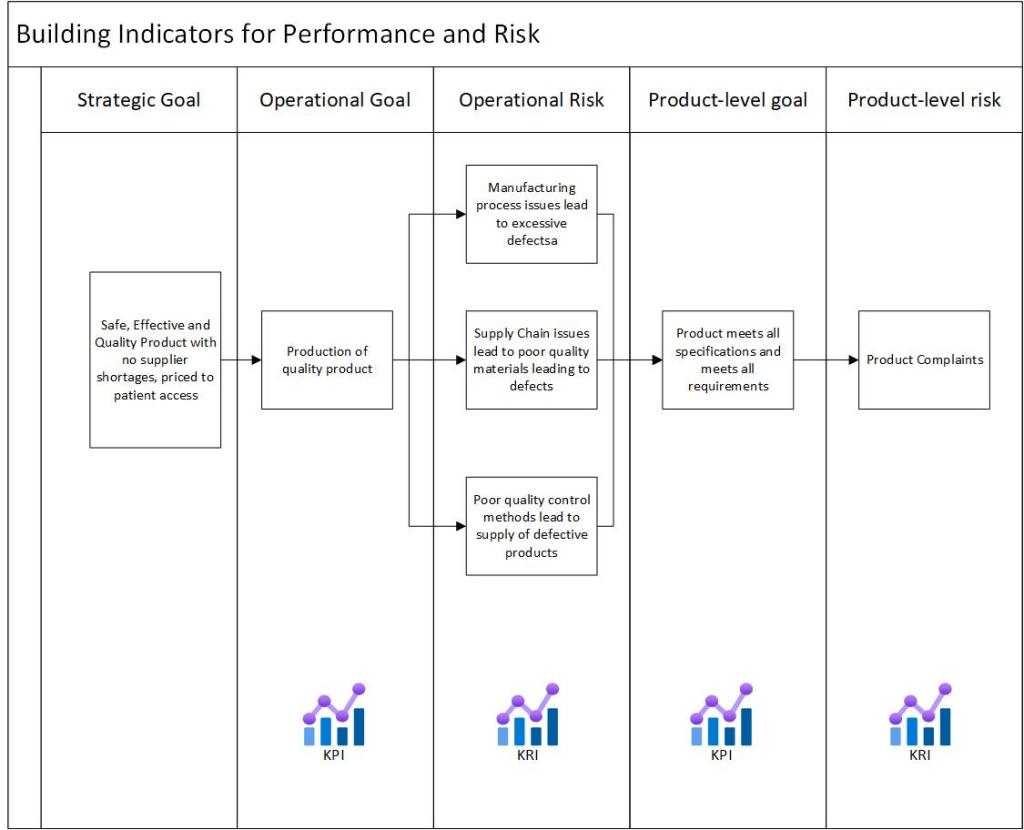
For the risk column we should have some good probabilities and impacts and mitigations in place. We can then chose some KRIs to monitor, such as

  1. Nonconformance rate
  2. Supplier score card
  3. Lab error rate
  4. Product Complaints

As we develop, our KRIs can get more specific and focused. A good KRI is:

  • Quantifiable
  • Measurable (accurately and precisely) 
  • Can be validated (have a high level of confidence) 
  • Relevant (measuring the right thing associated with decisions) 

In developing a KRI to serve as a leading indicator for potential future occurrences of a risk, it can be helpful to think through the chain of events that led to the event so that management can uncover the ultimate driver (i.e., root cause(s)) of the risk event. When KRIs for root cause events and intermediate events are monitored, we are in an enviable position to identify early mitigation strategies that can begin to reduce or eliminate the impact associated with an emerging risk event.

These KRIs will help us monitor and quantify our risk exposure. They help our organizations compare business objectives and strategy to actual performance to isolate changes, measure the effectiveness of processes or projects, and demonstrate changes in the frequency or impact of a specific risk event.

Effective KRIs can provide value to the organization in a variety of ways. Potential value may be derived from each of the following contributions:

  • Risk Appetite – KRIs require the determination of appropriate thresholds for action at different levels within the organization. By mapping KRI measures to identified risk appetite and tolerance levels, KRIs can be a useful tool for better articulating the risk appetite that best represents the organizational mindset.
  • Risk and Opportunity Identification – KRIs can be designed to alert management to trends that may adversely affect the achievement of organizational objectives or may indicate the presence of new opportunities.
  • Risk Treatment – KRIs can initiate action to mitigate developing risks by serving as triggering mechanisms. KRIs can serve as controls by defining limits to certain actions.
Dealing with Emotional Ambivalence

Wordcloud for Ambivalence

Ambivalence, the A in VUCA, is a concept that quality professionals struggle with. We often call it “navigating the gray” or something similar. It is a skill we need to grow into, and definitely an area that should be central to your development program.

There is a great article in Harvard Business Review on “Embracing the Power of Ambivalence” that I strongly recommend folks read. This article focuses on emotional ambivalence, the feeling of being “torn” and discusses the return to the office. I’m not focusing on that topic (though like everyone I have strong opinions), instead I think the practices described there are great to think about as we develop a culture of quality.

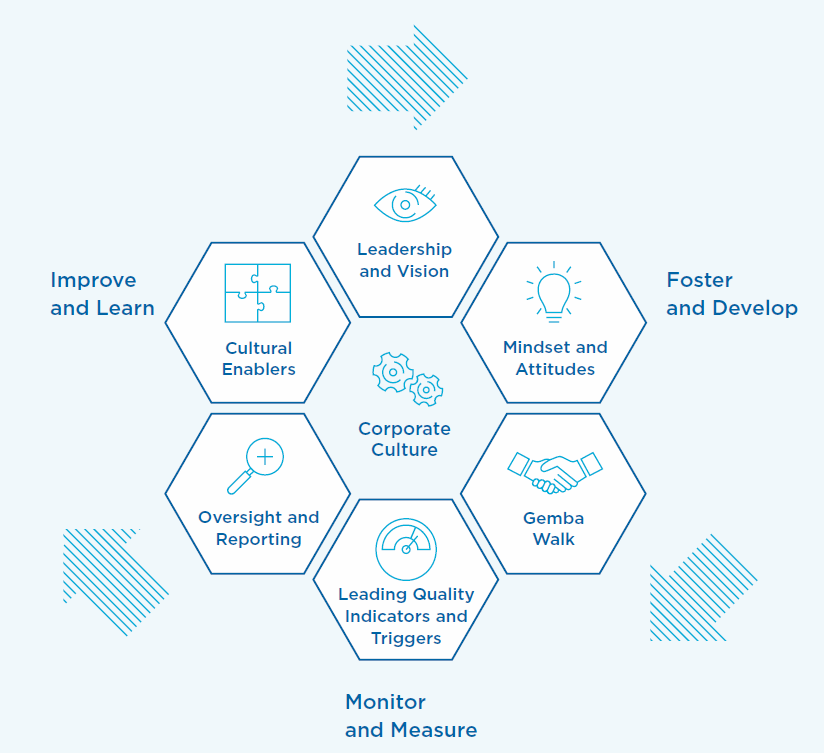
ISPE’s cultural excellence model

The Risk Register

Every organization should ask themselves seven questions about the health of their risk management program.

  1. Do you have a risk management plan?
  2. Have you identified and captured your risks in a risk register?
  3. How have you evaluated and prioritized your risks?
  4. Have you engaged the appropriate stakeholders in the risk identification and evaluation processes?
  5. What about risk owners? Does each risk have a risk owner?
  6. Have the risk owners developed risk response plans for the highest risks?
  7. Are you facilitating a review of your risks periodically, resulting in updates to the risk register and effective risk responses?

At the heart of this program sits the Risk Register, which brings together information about risks to inform those exposed to risks and those who have responsibility for their management. A risk register is used to record and track information about individual risks and how they are being controlled. It can be used to communicate information about risks to stakeholders and highlight particularly important risks. While it can be used at any level of the organization where there are a large number of risks, controls and treatments that need to be tracked, a risk register really shines as a central component of a quality management review. The risk register includes:

  • List of risks, failure modes or hazards and expected outcomes
  • A statement about the probability of consequences occurring
  • Sources or causes of the risk
  • Priority or risk levels
  • What is currently being done to control the risk
  • Risk owner
  • Actual outcome, if and when available

Risks are generally listed individually as separate events but interdependencies should be flagged.

In recording information about risks, the distinction between risks (the potential effects of what might happen) and risk sources (how or why it might happen) and controls that might fail should be explicit. It can also be useful to indicate the early warning signs that an event might be about to occur.

Many risk registers also include some rating of the significance of a risk, an indication of whether a risk is considered to be acceptable or tolerable, or whether further treatment is needed and the reasons for this decision. Where a significance rating is applied to a risk based on consequences and their likelihood, this should take account of the possibility that controls will fail. A level of risk should not be allocated for the failure of a control as if it were an independent risk.

A risk register is used as the basis for tracking implementation of proposed treatments, so it should contain information about treatments and how they will be implemented, or make reference to other documents or data bases with this information. (Such information can include risk owners, actions, action owners, action business case summaries, budgets and timelines, etc.). This living document can usually roll (or even serve as) the Quality Plan.

Strengths of risk registers include the following.

  • Information about risks is brought together in a form where actions required can be identified and tracked.
  • Information about different risks is presented in a comparable format, which can be used to indicate priorities and is relatively easy to interrogate.
  • The construction of a risk register usually involves many people and raises general awareness of the need to manage risk.

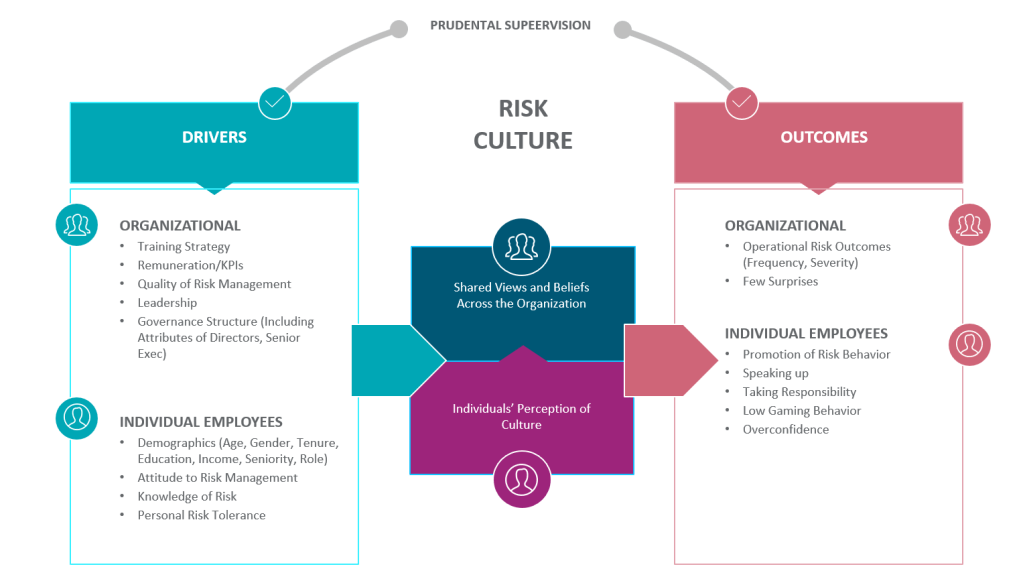
By doing this, the risk register serves as a central underpining for the organization as it builds a risk culture, driving transparency and accountability.

Building Risk Based Thinking in the Organization requires a strong governance structure


Pay attention the the following limitations:

  • Risks captured in risk registers are typically based on events, which can make it difficult to accurately characterize some forms of risk
  • The apparent ease of use can give misplaced confidence in the information because it can be difficult to describe risks consistently and sources of risk, risks, and weaknesses in controls for risk are often confused.
  • There are many different ways to describe a risk and any priority allocated will depend on the way the risk is described and the level of disaggregation of the issue.
  • Considerable effort is required to keep a risk register up to date (for example, all proposed treatments should be listed as current controls once they are implemented, new risks should be continually added and those that no longer exist removed).
  • Risks are typically captured in risk registers individually. This can make it difficult to consolidate information to develop an overall treatment program.

Artifacts, like the risk register, both demonstrate and channel culture. Invest the time in your organization’s register, and you will reap dividends towards developing a risk friendly culture.

ASQ Webinar August 4, 2021

I am speaking with the ASQ’s Human Developlement and Leadership Division on August 4th at 3 pm eastern on “Trust & Adaptability: Servant Leadership Lessons from Joining an Organization During a Pandemic” exploring from what Steven M. R. Covey wrote in Ken Blanchard and Renee’s Broadwell’s book Servant Leadership in Action that the key outcome for a servant leader is trust. Trust and servant leadership are both built on intent. The Trust built will allow your organization to be more adaptable. Adaptability builds resilience and allows innovation and transformation.

This talk will mostly focus on my continual learnings as I’ve worked, and usually struggled, to build trust during this pandemic in an environment where I’ve never met most of my co-workers.

Registration Link is https://attendee.gotowebinar.com/register/5744331842761271563

Quality, Decision Making and Putting the Human First

Quality stands in a position, sometimes uniquely in an organization, of engaging with stakeholders to understand what objectives and unique positions the organization needs to assume, and the choices that are making in order to achieve such objectives and positions.

The effectiveness of the team in making good decisions by picking the right choices depends on their ability of analyzing a problem and generating alternatives. As I discussed in my post “Design Lifecycle within PDCA – Planning” experimentation plays a critical part of the decision making process. When designing the solution we always consider:

  • Always include a “do nothing” option: Not every decision or problem demands an action. Sometimes, the best way is to do nothing.
  • How do you know what you think you know? This should be a question everyone is comfortable asking. It allows people to check assumptions and to question claims that, while convenient, are not based on any kind of data, firsthand knowledge, or research.
  • Ask tough questions Be direct and honest. Push hard to get to the core of what the options look like.
  • Have a dissenting option. It is critical to include unpopular but reasonable options. Make sure to include opinions or choices you personally don’t like, but for which good arguments can be made. This keeps you honest and gives anyone who see the pros/cons list a chance to convince you into making a better decision than the one you might have arrived at on your own.
  • Consider hybrid choices. Sometimes it’s possible to take an attribute of one choice and add it to another. Like exploratory design, there are always interesting combinations in decision making. This can explode the number of choices, which can slow things down and create more complexity than you need. Watch for the zone of indifference (options that are not perceived as making any difference or adding any value) and don’t waste time in it.
  • Include all relevant perspectives. Consider if this decision impacts more than just the area the problem is identified in. How does it impact other processes? Systems?

A struggle every organization has is how to think through problems in a truly innovative way.  Installing new processes into an old bureaucracy will only replace one form of control with another. We need to rethink the very matter of control and what it looks like within an organization. It is not about change management, on it sown change management will just shift the patterns of the past. To truly transform we need a new way of thinking. 

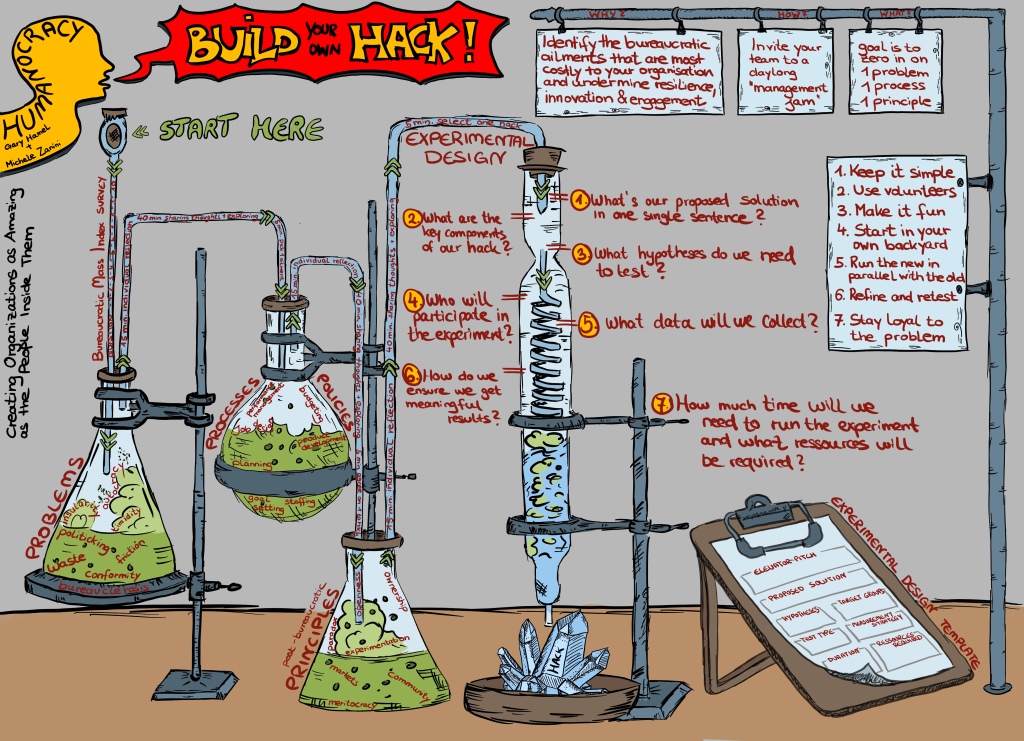
One of my favorite books on just how to do this is Humanocracy: Creating Organizations as Amazing as the People Inside Them by Gary Hamel and Michele Zanini. In this book, the authors advocate that business must become more fundamentally human first.  The idea of human ability and how to cultivate and unleash it is an underlying premise of this book.

Visualized by Rose Fastus

it’s possible to capture the benefits of bureaucracy—control, consistency, and coordination—while avoiding the penalties—inflexibility, mediocrity, and apathy.

Gary Hamel and Michele Zanini, Humanocracy, p. 15

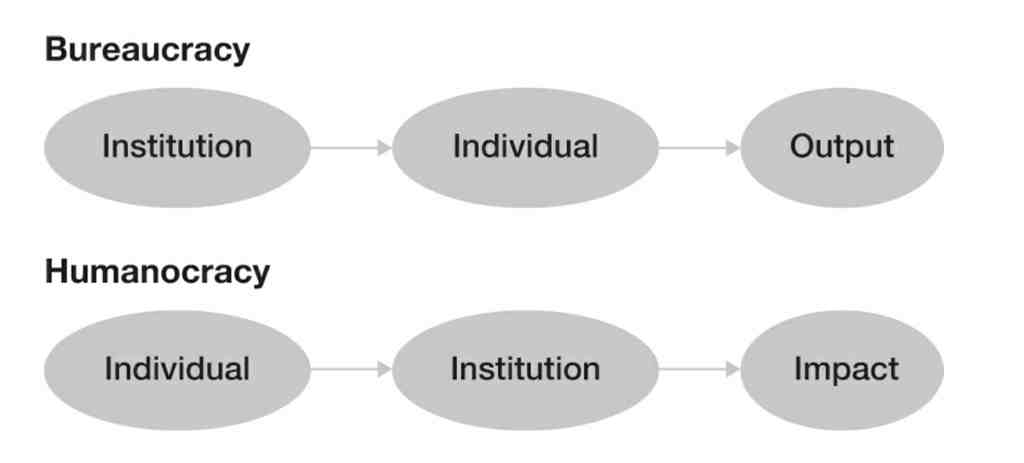
The above quote really encapsulates the heart of this book, and why I think it is such a pivotal read for my peers. This books takes the core question of a bureaurcacy is “How do we get human beings to better serve the organization?”. The issue at the heart of humanocracy becomes: “What sort of organization elicits and merits the best that human beings can give?” Seems a simple swap, but the implications are profound.

Bureaucracy versus Humanocracy. Source: Gary Hamel and Michele Zanini, Humanocracy, p. 48

I would hope you, like me, see the promise of many of the central tenets of Quality Management, not least Deming’s 8th point. The very real tendency of quality to devolve to pointless bureaucracy is something we should always be looking to combat.

Humanocracy’s central point is that by truly putting the employee first in our organizations we drive a human-centered organization that powers and thrives on innovation. Humanocracy is particularly relevant as organizations seek to be more resilient, agile, adaptive, innovative, customer centric etc. Leaders pursuing such goals seek to install systems like agile, devops, flexible teams etc.  They will fail, because people are not processes.  Resiliency, agility, efficiency, are not new programming codes for people.  These goals require more than new rules or a corporate initiative.  Agility, resilience, etc. are behaviors, attitudes, ways of thinking that can only work when you change the deep ‘systems and assumptions’ within an organization.  This book discusses those deeper changes.

Humanocracy lays out seven tips for success in experimentation. I find they align nicely with Kotter’s 8 change accelerators.

Humanocracy’s TipKotter’s Accelerator
Keep it SimpleGenerate (and celebrate) short-term wins
Use VolunteersEnlist a volunteer army
Make it FunSustain Acceleration
Start in your own backyardForm a change vision and strategic initiatives
Run the new parallel with the oldEnable action by removing barriers
Refine and RetestSustain acceleration
Stay loyal to the problemCreate a Sense of Urgency around a
Big Opportunity
Comparison to Kotter’s Eight Accelerators for Change