A central premise of the Quality mindset is that the means justify the ends and that how we work produces a better result.
At its core, a Quality mindset values the journey as much as the destination. It’s an understanding that the path taken to achieve results is integral to the quality of those results. This mindset shifts the focus from merely meeting targets to how those targets are met, emphasizing continuous improvement, attention to detail, and a commitment to excellence at every step of the process.
The Means Define the Culture
One of the most profound impacts of adopting a Quality mindset is on organizational culture. When a company prioritizes the means as much as the ends, it fosters a culture of integrity, responsibility, and continuous learning. Employees are encouraged to take ownership of their work, innovate, and find better ways to achieve objectives. This enhances the quality of work and boosts morale and engagement among team members.
Process Improvement as a Habit
Incorporating a Quality mindset means viewing process improvement as not a one-time initiative but an ongoing habit. It’s about making small, continuous adjustments that cumulatively lead to significant improvements.
Building Resilience through Quality
Another critical aspect of the Quality mindset is its role in building organizational resilience. Companies can create flexible and robust processes that withstand external pressures and disruptions by concentrating on the means. This resilience is crucial in today’s fast-paced and ever-changing business environment, where adaptability and agility are key to survival and success.
The Role of Leadership
Leadership plays a pivotal role in cultivating a Quality mindset within an organization. Leaders must set the tone by demonstrating a commitment to quality in their actions and decisions. They should encourage open communication, foster a culture of feedback and learning, and recognize and reward quality improvements. By leading by example, leaders can inspire their teams to adopt a Quality mindset and contribute to a culture of excellence.
Conclusion
Adopting a Quality mindset is a strategic choice that can lead to superior outcomes for organizations. By focusing on the means—how work is done—companies can improve processes, foster a positive culture, build resilience, and ultimately achieve higher-quality results. Embedding this mindset into the fabric of the company’s operations requires a commitment from all levels of the organization, especially leadership. In the end, a Quality mindset is not just about achieving better results; it’s about building a better organization.
Self-checking is one of the most effective tools we can teach and use. Rooted in the four aspects of risk-based thinking (anticipate, monitor, respond, and learn), it refers to the procedures and checks that employees perform as part of their routine tasks to ensure the quality and accuracy of their work. This practice is often implemented in industries where precision is critical, and errors can lead to significant consequences. For instance, in manufacturing or engineering, workers might perform self-checks to verify that their work meets the required specifications before moving on to the next production stage.
A proactive approach enhances the reliability, safety, and quality of various systems and practices by allowing for immediate detection and correction of errors, thereby preventing potential failures or flaws from escalating into more significant issues.
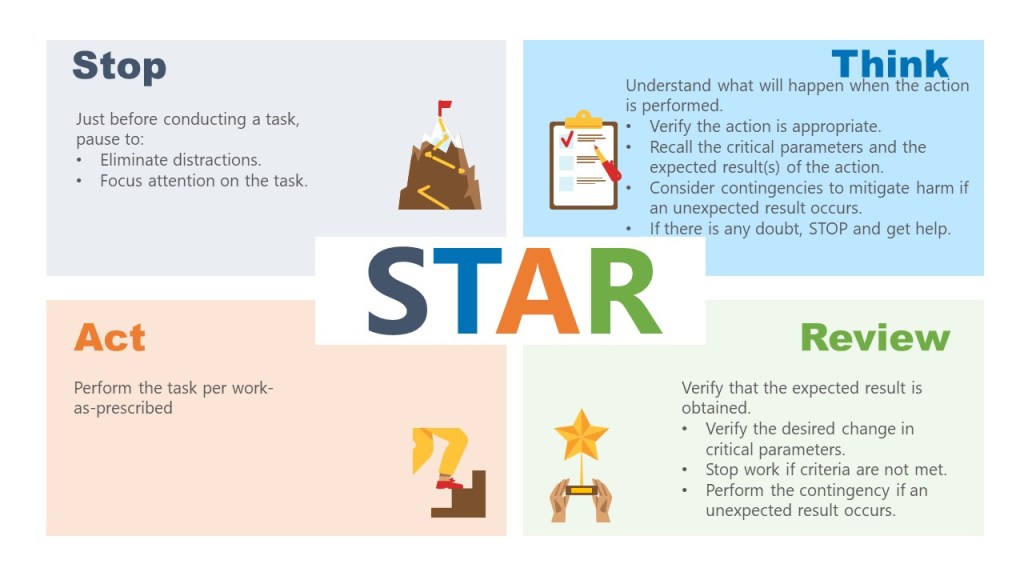
The memory aid STAR (stop, think, act, review) helps the user recall the thoughts and actions associated with self-checking.
Stop – Just before conducting a task, pause to:
Eliminate distractions.
Focus attention on the task.
Think – Understand what will happen when the action is performed.
Verify the action is appropriate.
Recall the critical parameters and the action’s expected result(s).
Consider contingencies to mitigate harm if an unexpected result occurs.
If there is any doubt, STOP and get help.
Act – Perform the task per work-as-prescribed
Review – Verify that the expected result is obtained.
Verify the desired change in critical parameters.
Stop work if criteria are not met.
Perform the contingency if an unexpected result occurs.
Risk-based thinking is a crucial component of modern quality management systems and consists of four key aspects: anticipate, monitor, respond, and learn. Each aspect ensures an organization can effectively manage and mitigate risks, enhancing overall performance and reliability.
Anticipate
Anticipating risks involves proactively identifying and analyzing potential risks that could impact the organization’s operations or objectives. This step is about foreseeing problems before they occur and planning how to address them. It requires a thorough understanding of the organization’s processes, the external and internal factors that could affect these processes, and the potential consequences of various risks. By anticipating risks, organizations can prepare more effectively and prevent many issues from occurring.
Monitor
Monitoring involves continuously observing and tracking the operational environment to detect risk indicators early. This ongoing process helps catch deviations from expected outcomes or standards, which could indicate the emergence of a risk. Effective monitoring relies on establishing metrics that help to quickly and accurately identify when things are starting to veer off course. This real-time data collection is crucial for enabling timely responses to potential threats.
Respond
Responding to risks is about taking appropriate actions to manage or mitigate identified risks based on their severity and potential impact. This step involves implementing the planned risk responses that were developed during the anticipation phase. The effectiveness of these responses often depends on the speed and decisiveness of the actions taken. Responses can include adjusting processes, reallocating resources, or activating contingency plans. The goal is to minimize the organization’s and its stakeholders’ negative impact.
Learn
Learning from the management of risks is a critical component that closes the loop of risk-based thinking. This aspect involves analyzing the outcomes of risk responses and understanding what worked well and what did not. Learning from these experiences is essential for continuous improvement. It helps organizations refine risk management processes, improve response strategies, and better prepare for future risks. This iterative learning process ensures that risk management efforts are increasingly effective over time.
The four aspects of risk-based thinking—anticipate, monitor, respond, and learn—form a continuous cycle that helps organizations manage uncertainties proactively. This approach protects the organization from potential downsides and enables it to seize opportunities that arise from a well-understood risk landscape. Organizations can enhance their resilience and adaptability by embedding these practices into everyday operations.
Implementing Risk-Based Thinking
1. Understand the Concept of Risk-Based Thinking
Risk-based thinking involves a proactive approach to identifying, analyzing, and addressing risks. This mindset should be ingrained in the organization’s culture and used as a basis for decision-making.
2. Identify Risks and Opportunities
Identify potential risks and opportunities. This can be achieved through various methods such as SWOT analysis, brainstorming sessions, and process mapping. It’s crucial to involve people at all levels of the organization since they can provide diverse perspectives on potential risks and opportunities.
3. Analyze and Prioritize Risks
Once risks and opportunities are identified, they should be analyzed to understand their potential impact and likelihood. This analysis will help prioritize which risks need immediate attention and which opportunities should be pursued.
4. Plan and Implement Responses
After prioritizing, develop strategies to address these risks and opportunities. Plans should include preventive measures for risks and proactive steps to seize opportunities. Integrating these plans into the organization’s overall strategy and daily operations is important to ensure they are effective.
5. Monitor and Review
Implementing risk-based thinking is not a one-time activity but an ongoing process. Regular monitoring and reviewing of risks, opportunities, and the effectiveness of responses are crucial. This can be done through regular audits, performance evaluations, and feedback mechanisms. Adjustments should be made based on these reviews to improve the risk management process.
6. Learn and Improve
Organizations should learn from their experiences in managing risks and opportunities. This involves analyzing what worked well and what didn’t and using this information to improve future risk management efforts. Continuous improvement should be a key goal, aligning with the Plan-Do-Check-Act (PDCA) cycle.
Training and cultural adaptation are necessary to implement risk-based thinking effectively. All employees should be trained on the principles of risk-based thinking and how to apply them in their roles. Creating a culture encouraging open communication about risks and supporting risk-taking within defined limits is also vital.
I have them, you have them, and chances are they are used in more ways than you know. The spreadsheet is a powerful tool and really ubiquitous. As such, spreadsheets are used in many ways in the GxP environment, which means they need to meet their intended use and be appropriately controlled. Spreadsheets must perform accurately and consistently, maintain data integrity, and comply with regulatory standards such as health agency guidelines and the GxPs.
That said, it can also be really easy to over-control spreadsheets. It is important to recognize that there is no one-size-fits-all approach.
It is important to build a risk-based approach from a clear definition of the scope and purpose of an individual spreadsheet. This includes identifying the intended use, the type of data a spreadsheet will handle, and the specific calculations or data manipulations it will perform.
I recommend an approach that breaks the spreadsheet down into three major categories. This should also apply to similar tools, such as Jira, Smartsheet, or what-have-you.
Spreadsheet Functionality
Level of verification
Used like typewriters or simple calculators. They are intended to produce an approved document. Signatories should make any calculations or formulas visible or explicitly describe them and verify that they are correct. The paper printout or electronic version, managed through an electronic document management system, is the GxP record.
Control with appropriate procedural governance. The final output may be retained as a record or have an appropriate checked-by-step in another document.
A low level of complexity (few or no conditional statements, smaller number of cells) and do not use Visual Basic Application programs, macros, automation, or other forms of code.
Control through the document lifecycle. Each use is a record.
A high level of complexity (many conditional statements, external calls or writing to an external database, or linked to other spreadsheets, larger number of cells), using Visual Basic Application, macros, or automation, and multiple users and departments.
Treat under a GAMP5 approach for configuration or even customization (Category 4 or 5)
Requirements by Spreadsheet complexity
For spreadsheets, the GxP risk classification and GxP functional risk assessment should be performed to include both the spreadsheet functionality and the associated infrastructure components, as applicable (e.g., network drive/storage location).
For qualification, there should be a succinct template to drive activities. This should address the following parts.
1. Scope and Purpose
The validation process begins with a clear definition of the spreadsheet’s scope and purpose. This includes identifying its intended use, the type of data it will handle, and the specific calculations or data manipulations it will perform.
2. User Requirements and Functional Specifications
Develop detailed user requirements and functional specifications by outlining what the spreadsheet must do, ensuring that it meets all user needs and regulatory requirements. This step specifies the data inputs, outputs, formulas, and any macros or other automation the spreadsheet will utilize.
3. Design Qualification
Ensure that the spreadsheet design aligns with the user requirements and functional specifications. This includes setting up the spreadsheet layout, formulas, and any macros or scripts. The design should prevent common errors such as incorrect data entry and formula misapplication.
4. Risk Assessment
Conduct a risk assessment to identify and evaluate potential risks associated with the spreadsheet. This includes assessing the impact of spreadsheet errors on the final results and determining the likelihood of such errors occurring. Mitigation strategies should be developed for identified risks.
5. Data Integrity and Security
Implement measures to ensure data integrity and security. This includes setting up access controls, using data validation features to limit data entry errors, and ensuring that data storage and handling comply with regulatory requirements.
6. Testing (IQ, OQ, PQ)
IQ tests the proper installation and configuration of the spreadsheet.
OQ ensures the spreadsheet operates as designed under specified conditions.
PQ verifies that the spreadsheet consistently produces correct outputs under real-world conditions.
Remember, all one template; don’t get into multiple documents that each regurgitate all the same stuff.
Lifecycle Approach
Spreadsheets should have appropriate procedural guidance and training.
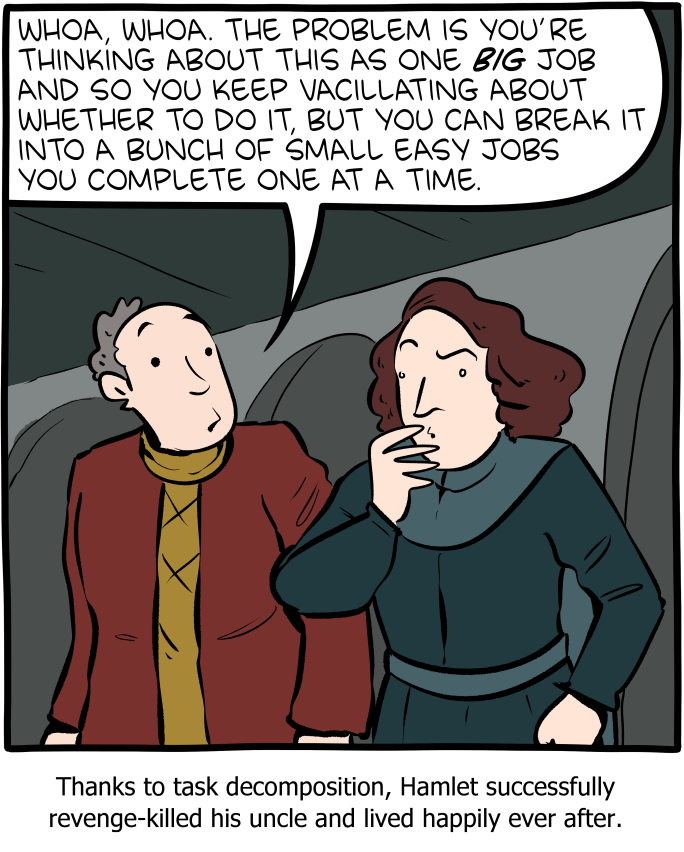
Task decomposition is a systematic approach to breaking down a complex task into smaller, more manageable components. A more detailed version of task analysis helps organize work, improve understanding, and facilitate effective execution.
Step 1: Understand the Task
The first step in task decomposition is to fully understand the task at hand. This involves defining the main objective, identifying the final deliverables, and recognizing all the requirements and constraints associated with the task.
Step 2: Break Down the Task
Once the task is clearly understood, the next step is to break it down into smaller, more manageable parts. This can be done by identifying the major components or phases of the task and then further dividing these into subtasks.
Techniques for Breaking Down Tasks:
Hierarchical Task Analysis (HTA): This involves creating a hierarchy of tasks, starting with the main task at the top and breaking it down into subtasks and further into individual actions.
Functional Decomposition: Focus on dividing the task based on different functions or processes involved.
Object-Oriented Decomposition: Used primarily in software development, where tasks are divided based on the objects or data involved.
Step 3: Sequence the Tasks
Determine the logical order in which the subtasks should be completed. This involves identifying dependencies between tasks, where some tasks must precede others.
Step 4: Assign Resources and Estimate Time
Assign the appropriate resources to each subtask, including personnel, tools, and materials. Additionally, estimate the time required to complete each subtask. This helps in scheduling and resource allocation.
Step 5: Prioritize Tasks
Not all tasks are equally important. Prioritize tasks based on their impact on the overall project, their urgency, and their dependencies.
Step 6: Monitor and Adjust
Once the decomposition and planning are in place, the execution phase begins. It’s important to monitor the progress of tasks, check adherence to timelines, and make adjustments as necessary. This might involve re-prioritizing tasks or re-allocating resources to address any bottlenecks or delays.
Step 7: Documentation and Feedback
Document the entire process and gather feedback. This documentation will serve as a valuable reference for future projects, and feedback can help in refining the decomposition process.
Task decomposition is a dynamic process that may require iterative adjustments. Used well, it is a powerful tool in the quality toolbox.




 Investigations of a Dog