
Living Risk in the Validation Lifecycle

Risk management plays a pivotal role in validation by enabling a risk-based approach to defining validation strategies, ensuring regulatory compliance, mitigating product quality and safety risks, facilitating continuous improvement, and promoting cross-functional collaboration. Integrating risk management principles into the validation lifecycle is essential for maintaining control and consistently producing high-quality products in regulated industries such as biotech and medical devices.

We will conduct various risk assessments in our process lifecycle—many ad hoc (static) and a few living (dynamic). Understanding how they fit together in a larger activity set is crucial.
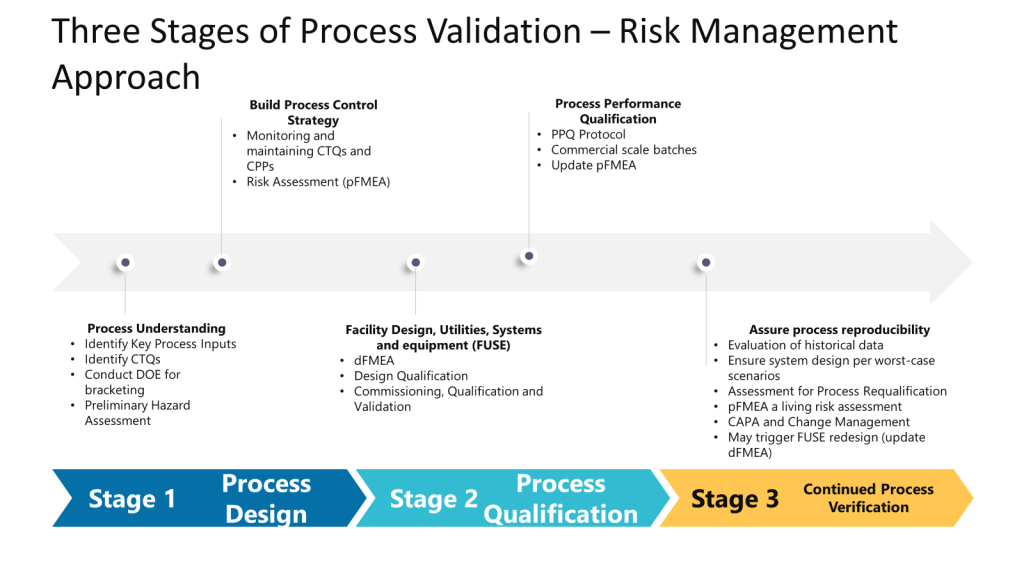
In the Facility, Utilities, Systems, and Equipment (FUSE) space, we are taking the process understanding, translating it into a design, and then performing Design Qualification (DQ) to verify that the critical aspects (CAs) and critical design elements (CDEs) necessary to control risks identified during the quality risk assessment (QRA) are present in the design. This helps mitigate risks to product quality and patient safety. To do this, we need to properly understand the process. Unfortunately, we often start with design before understanding the process and then need to go back and perform rework. Too often I see a dFMEA ignored or as an input to the pFMEA instead of working together in a full risk management cycle.

The Preliminary Hazard Analysis (PHA) supports a pFMEA, which supports a dFMEA, which supports the pFMEA (which also benefits at this stage from a HAACP). Tools fit together to provide the approach. Tools do not become the approach.

Design and Process FMEAs

DFMEA (Design Failure Mode and Effects Analysis) and PFMEA (Process Failure Mode and Effects Analysis) are both methodologies used within the broader FMEA framework to identify and mitigate potential failures. Still, they focus on different aspects of development and manufacturing.

DFMEAPFMEA
Scope and FocusPrimarily scrutinizes design to preempt flaws.Focuses on processes to ensure effectiveness, efficiency and reliability.
Stakeholder InvolvementEngages design-oriented teams like engineering, quality engineers, and reliability engineers.Involves operation-centric personnel such as manufacturing, quality control, quality operations, and process engineers.
Inputs and OutputsRelies on design requirements, product specs, and component interactions to craft a robust product.Utilizes process steps, equipment capabilities, and parameters to design a stable operational process.
Stages in lifecycleConducted early in development, concurrent with the design phase, it aids in early issue detection and minimizes design impact.Executed in production planning post-finalized design, ensuring optimized operations prior to full-scale production.
Updated WhenExecuted in production planning post-finalized design, ensuring optimized operations before full-scale production.Process changes and under annual review.
dFMEA and pFMEA

Risk Analysis in the Design Phase

The design qualification phase is especially suitable for determining risks for products and patients stemming from the equipment or machine. These risks should be identified during the design qualification and reflected by appropriate measures in the draft design so that the operator can effectively eliminate, adequately control, and monitor or observe them. To identify design defects (mechanical) or in the creation of systems (electronics) on time and to eliminate them at a low cost, it is advisable to perform the following risk analysis activities for systems, equipment, or processes:

  • Categorize the GMP criticality and identify the critical quality attributes and process parameters;
  • Categorize the requirements regarding the patient impact and product impact (for example, in the form of a trace matrix);
  • Identify critical functions and system elements (e.g., the definition of a calibration concept and preventive maintenance);
  • Investigate functions for defect recognition. This includes checking alarms and fault indications, operator error, etc. The result of this risk analysis may be the definition of further maintenance activities, a different assessment of a measurement point, or the identification of topics to include in the operating manuals or procedures.

Additional risk analyses for verifying the design may include usability studies using equipment mock-ups or preliminary production trials (engineering studies) regarding selected topics to prove the feasibility of specific design aspects (e.g., interaction between machine and materials).

Too often, we misunderstand risk assessments and start doing them at the most granular level. This approach allows us to right-size our risk assessments and holistically look at the entire lifecycle.
Challenges in Validation

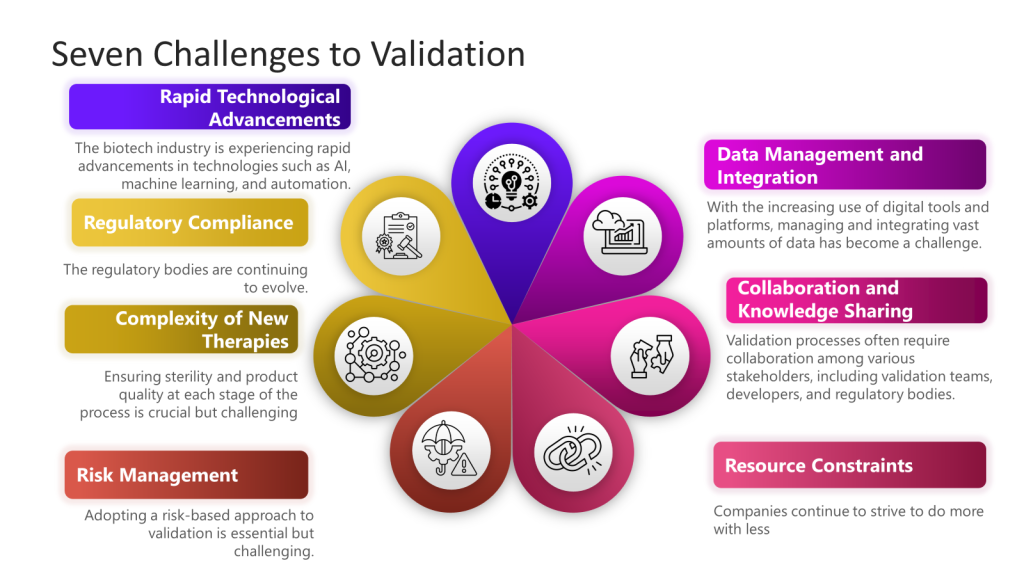
I often get asked why I moved from a broader senior role in Quality Management to a particular but deep role in Quality Engineering and Validation. There are many answers, but the biggest is that validation is poised for some exciting shifts due to navigating a complex validation landscape characterized by rapid technological advancements, evolving regulatory standards, and the development of novel therapies. Addressing these challenges requires innovation, collaboration, and a proactive approach to risk management and data integration. Topics near and dear to me.

Today’s Challenges in Biotech Validation

1. Rapid Technological Advancements

The biotech industry is experiencing rapid technological advancements such as AI, machine learning, and automation. Integrating these technologies into validation processes can be challenging due to the need for new validation frameworks and methodologies.

2. Regulatory Compliance

Maintaining compliance with evolving regulatory standards is a significant challenge. Regulatory bodies like the FDA continuously update guidelines for technological advancements.

3. Complexity of New Therapies

Developing novel therapies, such as cell and gene therapies, introduces additional complexity to the validation process. These therapies often require redesigned facilities and equipment to accommodate their sensitive and sterile nature. Ensuring sterility and product quality at each process stage is crucial but challenging.

4. Data Management and Integration

Managing and integrating vast amounts of data has become challenging with the increasing use of digital tools and platforms. Effective data management is essential for predictive modeling and risk management in validation processes. Organizations must adopt robust data analytics and machine learning tools to handle this data efficiently.

5. Collaboration and Knowledge Sharing

Validation processes often require collaboration among various stakeholders, including validation teams, developers, and regulatory bodies. Ensuring real-time communication and data sharing can be challenging but is essential for streamlining validation efforts and aligning goals.

6. Resource Constraints

Smaller biotech companies, in particular, face resource constraints regarding funding, personnel, and expertise. These constraints can hinder their ability to implement advanced validation techniques and maintain compliance with regulatory standards.

7. Risk Management

Adopting a risk-based approach to validation is essential but challenging. Companies must identify and mitigate risks throughout the product lifecycle, which requires a thorough understanding of potential risks and effective risk management strategies.

Let’s Avoid the Term Validation 4.0

Let’s avoid the 4.0 term. We are constantly evolving, and adding a current ‘buzziness’ to it does no one any favors. We are shifting from traditional, paper-heavy validation methods to a more dynamic, data-driven, and digitalized process. Yes, we are leveraging modern technologies such as automation, data analytics, artificial intelligence (AI), and the Internet of Things (IoT) to enhance validation processes’ efficiency, flexibility, and reliability. But we don’t need buzziness, we just need to give it some thought, experiment, and refine.

Quality Agreements with Cloud Providers

Having a quality agreement with a cloud provider is crucial for several reasons:

Ensure Regulatory Compliance

A quality agreement helps ensure the cloud provider’s services and processes comply with relevant regulations and guidelines, such as GxP (Good Practice) requirements from agencies like the FDA, EMA, and MHRA. It defines the roles, responsibilities, and expectations for maintaining data integrity, security, and quality standards throughout the product lifecycle.

Delineate Responsibilities

Cloud services often involve complex technology stacks and multiple subservice providers. A quality agreement clearly delineates the responsibilities of the regulated company and the cloud provider, ensuring that critical activities like change control, incident management, data governance, and security controls are properly addressed and assigned.

Establish Service Levels

The quality agreement specifies the agreed service levels, performance metrics, and key performance indicators (KPIs) that the cloud provider must meet, such as application availability, support response times, data security breach notification timelines, and system performance. This helps maintain the required quality of service.

Enable Oversight and Audits

The agreement outlines provisions for initial qualification audits, periodic audits, and inspections by the regulated company to assess the cloud provider’s compliance with the agreed terms. It also defines processes for managing audit findings and corrective actions.

Ensure Data Integrity and Security

Addressing data-related requirements, such as data ownership, privacy, protection controls, retention, archiving, and disposal processes, is critical to ensuring data integrity and security throughout the data lifecycle.

Manage Third-Party Risks

The agreement establishes guidelines for the approval process and compliance requirements when the cloud provider uses subcontractors or third-party services, mitigating associated risks.

Contents

A quality agreement between a regulated company (customer) and a Cloud (SaaS, PaaS, IaaS) provider should cover the following key elements:

Roles and Responsibilities

Clearly define the roles, responsibilities, and obligations of both parties regarding:

  • Regulatory compliance (GxP, data privacy, security, etc.)
  • Quality management system and processes
  • Change control and release management
  • Incident and deviation management
  • Data integrity, backup, and recovery
  • Performance monitoring and reporting

Service Levels and Performance Metrics

Specify the agreed service levels and key performance indicators (KPIs) for:

  • Application availability and uptime
  • Support response and resolution times
  • Data security and breach notification timelines
  • System performance and capacity

Audits and Assessments

Outline the provisions for:

  • Initial qualification audits of the SaaS provider
  • Periodic audits and inspections by the regulated company
  • Processes for managing audit findings and corrective actions

Data Management

Address data-related aspects such as:

  • Data ownership and usage rights
  • Data privacy and protection controls (as per applicable regulations)
  • Data retention, archiving, and disposal processes

Subcontracting and Third Parties

Establish guidelines for:

  • Approval process for use of subcontractors/third parties
  • Ensuring subcontractors comply with the quality agreement
  • Communication of changes impacting the regulated company

Term, Termination, and Offboarding

Specify conditions for:

  • Initial term and renewal of the quality agreement
  • Termination rights (e.g., for non-compliance, data breaches)
  • Responsibilities during offboarding and data transition

The quality agreement should be a comprehensive yet pragmatic document that ensures the cloud solution meets the regulated company’s quality and compliance requirements throughout the engagement.

Component Manufacturers Validation Requirements

I recently got asked what a medical device component manufacturer’s validation requirements are. Here is my answer.

Component manufacturers play a crucial role in the medical device industry by producing various parts and components for proper functioning and assembly. Here are some key expectations and responsibilities of component manufacturers in the medical device sector:

  1. Quality and Precision Manufacturing: Medical device components often require high precision, accuracy, and quality to ensure patient safety and device efficacy. To meet these demanding standards, component manufacturers must adhere to stringent quality control measures, utilize advanced manufacturing techniques, and maintain strict tolerances.
  2. Regulatory Compliance: The medical device industry is heavily regulated, and component manufacturers must comply with relevant regulations and standards set by governing bodies like the FDA, ISO, and others. This includes maintaining proper documentation, implementing quality management systems, and ensuring traceability of materials and processes.
  3. Material Selection and Biocompatibility: Many medical device components come into direct contact with the human body or bodily fluids. Consequently, component manufacturers must carefully select biocompatible, non-toxic, and suitable materials for the intended application. They must also ensure proper sterilization and packaging to maintain sterility.
  4. Design and Engineering Support: Some component manufacturers offer design and engineering services in addition to manufacturing to assist medical device companies in developing new components or optimizing existing ones. This collaboration helps ensure that components meet specific performance, functional, and regulatory requirements.
  5. Supply Chain Management: Component manufacturers must have robust supply chain management systems to ensure the timely delivery of components to medical device manufacturers. This includes maintaining adequate inventory levels, managing logistics, and minimizing disruptions in the supply chain.

Yes, component manufacturers in the medical device industry are expected to validate their manufacturing processes to ensure the components they produce meet specified requirements and perform as intended.

  • Regulatory bodies like the FDA require that components critical to the safety and performance of medical devices be produced through validated processes. This helps ensure that components consistently meet quality standards.
  • Component manufacturers must perform Installation Qualification (IQ), Operational Qualification (OQ), and Performance Qualification (PQ) on their manufacturing equipment and processes.
  • Validation requirements apply to finished components and raw materials, sub-components received from suppliers, and any processes involved in producing the component. Traceability of validation activities throughout the supply chain is essential.
  • The level of validation required depends on the component’s criticality and risk to the final medical device. More stringent validation is expected for higher-risk components that directly contact the patient or are essential for device safety and efficacy.
  • The component manufacturer must maintain validation documentation such as protocols, test reports, and traceability matrices and provide it to the medical device company upon request for review and auditing purposes.

Quality and a Just Culture

It is fascinating that for all the discussion around quality culture, which borrows from Safety II and other safety movements/submovements, we’ve largely avoided using the term justice, which is so prevalent in certain areas of the safety world. One can replace quality with justice and talk about many of the same things.

Both attempt to realize Deming’s Point 8—to drive out fear—which I consider Deming’s most radical proposition.

We really should see them as building blocks. A just culture enables the open reporting and analysis of errors necessary for a quality culture to identify areas for improvement. The two cultures are complementary—a robust quality program requires psychological safety fostered by a just culture. However, a quality culture has broader aims beyond responding to errors or safety lapses. We cannot have a Quality Culture without a Just Culture.

Psychological safety creates an environment where staff can speak up, enabling a just culture. A just culture defines the balanced accountability approach for responding to errors and safety events. A quality culture is a broader concept that drives improvement across the organization, relying on the foundation of a just culture.

But I really wish we used the term justice more. Promoting justice is an activity I wish we took more seriously as a profession.