Validation Planning in the Quality System

The Validation Master Plan (VMP) and Validation Plan (VP) are integral to the validation process but differ significantly in their scope, detail, and application. The VMP provides a strategic and comprehensive outline for validation activities (often capturing the whole commissioning/qualification/validation lifecycle) across an organization, ensuring compliance and coherence. The VP, derived from the VMP, focuses on specific validation projects, detailing the procedures, responsibilities, and requirements needed to achieve compliance for those specific systems or projects.

Validation Master Plan (VMP)

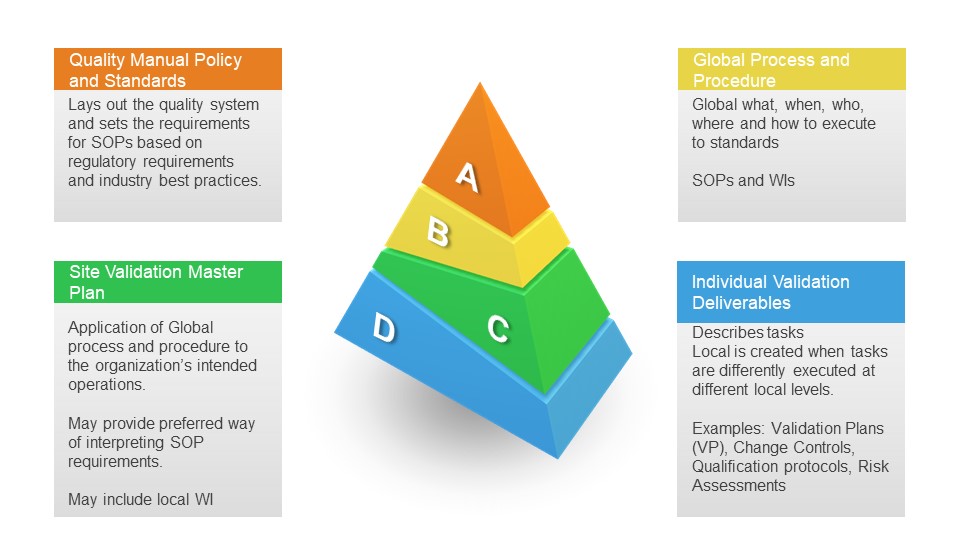
A Validation Master Plan is a high-level document that outlines the overall validation strategy for an entire site or organization. It is comprehensive and covers all aspects of validation activities across various departments and systems within the organization. The VMP is designed to ensure that all components of the validation process are appropriately planned, executed, and maintained to meet regulatory compliance requirements.

Key characteristics of a VMP include:

  • Scope and Purpose: It defines the scope and objectives of all validation activities within the organization.
  • Strategy and Approach: It outlines the validation strategy and approach, including integrating Good Manufacturing Practices (GMP).
  • Responsibilities: It details the organizational structure and responsibilities for validation activities.
  • Documentation: It references all applicable protocols, reports, and related documents.
  • Compliance and Review: It includes compliance requirements and specifies the frequency of reviews and updates to ensure the plan remains current.

A Subvalidation Master Plan (sVMP) is a deep dive into a specific area or validation, such as the analytical method lifecycle.

The purpose of a Validation Master Plan (VMP) is multifaceted, primarily serving as a comprehensive document that outlines the strategy for validation activities within an organization. It is designed to ensure that all validation processes are conducted correctly and comply with regulatory standards.

Here are the key purposes of a VMP:

  1. Documentation of Compliance Requirements: The VMP documents the organization’s compliance requirements, ensuring that all validation activities meet the necessary regulatory standards.
  2. Strategic Planning: Acts as a roadmap for validation, detailing what, how, and when validation activities will be executed. This includes the lifecycle of the manufacturing validation process and integrates Good Manufacturing Practices (GMP).
  3. Resource Planning: The VMP identifies anticipated resource needs and provides key input into scheduling project timelines, which is crucial for efficient validation execution.
  4. Control and Direction: The VMP controls and defines different parts of the production process to ensure consistency over time and directs validation strategies for instruments and systems.
  5. Risk Mitigation: The VMP helps mitigate risks associated with product manufacturing by outlining the validation approach and specific validation activities.
  6. Educational Tool: The VMP informs and educates senior management and other stakeholders about the importance of validation in terms of its impact on product quality, thereby fostering an understanding and support for validation activities.
  7. Regulatory Audit Support: It provides essential documentation regulators require during an audit, demonstrating the organization’s control over quality and compliance with GMPs.
  8. Organizational Alignment: The VMP enables stakeholders within the organization to unify around the details of the validation strategy, eliminating ambiguity and justifying validation activities internally and externally.

The Validation Master Plan is crucial for ensuring that all aspects of validation are planned, executed, and documented in accordance with regulatory requirements and organizational goals. It serves as a compliance tool and a strategic guide for managing and conducting validation activities effectively.

Validation Plan (VP)

A Validation Plan (VP) is more specific and detailed than a VMP and is typically written for a particular validation project or system. The VP focuses on the specific validation activities for individual pieces of equipment, systems, or processes and is derived from the broader directives set out in the VMP.

Key characteristics of a VP include:

  • Detailed Scope and Objectives: It describes what is to be validated, the specific tasks to be performed, and the expected outcomes.
  • Project-Specific Details: These include timelines, specific procedures, and responsibilities for the particular validation project.
  • Risk Assessments and Requirements: It details the risk assessments, quality parameters, and regulatory requirements specific to the system or project being validated.

Differences and Relationship

Level of Detail: The VMP is a high-level document that provides an overarching framework and strategy for validation activities across an organization. In contrast, a VP is a detailed, project-specific document that outlines the execution of validation activities for specific systems or projects.

Purpose and Use: The VMP sets the stage for all validation efforts within an organization and ensures consistency and compliance with industry standards. The VP, derived from the VMP, focuses on specific validation tasks and how they will be accomplished.

Scope: While the VMP covers an organization’s entire validation program, a VP is limited to a particular project or system.
Periodic Review and Updates

A Validation Master Plan (VMP) should be reviewed and updated regularly to remain current and effective. The specific frequency of these reviews can vary depending on the organization’s needs, the complexity of the systems, and regulatory requirements. However, it is generally recommended that a VMP be reviewed at least annually.

This annual review is crucial to address any changes in the manufacturing process, regulatory updates, or modifications in the validation strategy. The review process should include evaluating the progress of validation activities, assessing the impact of any changes in the process or equipment, and updating the plan to reflect new or altered validation requirements.

Additionally, the VMP should be updated whenever significant changes occur that could affect the validation status of the systems or processes described in the plan. This could include major equipment upgrades, product design changes, or regulatory standard shifts.

Validation Plans (VP) should be revised based on changes in the project’s scope. Sometimes, a VP may be opened for an extended period of time for a complex project, in which case it should be evaluated for accuracy and completeness based on the project lifecycle.

Utilizing the Nadler-Tushman Model for Culture of Quality Initiatives

The Nadler-Tushman Congruence model is a diagnostic tool developed by organizational theorists David A. Nadler and Michael L. Tushman in the early 1980s. It analyzes and identifies the root causes of performance issues within an organization and can be a helpful model for diagnosing and improving a culture of quality.

Nadler-Tushman Congruence Framework

The Nadler-Tushman Congruence model is based on several assumptions that are common to modern organizational diagnostic models:

  • Organizations are open social systems within a larger environment.
  • Organizations are dynamic entities (i.e., change is possible and occurs).
  • Organizational behavior occurs at the individual, group, and systems level.
  • Interactions occur between the individual, group, and systems levels of organizational behavior

The model is based on the premise that an organization can achieve high performance when four key elements – work, people, structure, and culture – are aligned or congruent with each other. These elements are defined as:

Work

This refers to the core tasks and activities that the organization performs to achieve its goals. It includes the processes, workflows, and the skills/knowledge required to carry out the work effectively.

People

This element focuses on the individuals within the organization, their skills, knowledge, personalities, work styles, and how well they fit with the work requirements.

Structure

This encompasses the formal aspects of the organization, such as its hierarchy, reporting lines, policies, procedures, and systems that govern how work gets done.

Culture

This includes the shared values, beliefs, behaviors, and norms that shape how people interact and work together within the organization. The basic premise is that when these four elements are well-aligned and congruent, the organization operates smoothly and performs at a high level. However, a misalignment or incongruence among these elements can lead to friction, inefficiencies, and poor organizational performance.

Use

The Nadler-Tushman Congruence model can be effectively used for root cause analysis of organizational performance issues by following these steps:

  1. Identify the symptoms or performance gaps within the organization, such as low productivity, high employee turnover, quality issues, etc.
  2. Analyze the four key elements of the model – work, people, structure, and culture – to understand their current state within the organization.
  3. Assess the level of congruence or alignment among these four elements by examining their interactions in pairs:
  • Work and people: Do employees have the right skills/knowledge for the work? Is the work meaningful to them?
  • Work and structure: Does the organizational structure support efficient work processes?
  • Structure and people: Does the structure enable or hinder employee engagement/motivation?
  • People and culture: Are employee values/behaviors aligned with the organizational culture?
  • Culture and work: Does the culture facilitate or impede effective work practices?
  • Structure and culture: Is there harmony or conflict between the structure and cultural norms?
  1. Identify areas of incongruence or misalignment among these elements that could be the root causes of the performance issues. For example, a misalignment between people’s skills and work requirements or between an innovative culture and a rigid hierarchical structure.
  2. Conduct a root cause analysis by further investigating the specific reasons behind the identified incongruences using techniques like fishbone diagrams or Why-Why analysis.
  3. Develop an action plan to address the root causes by realigning the incongruent elements. This may involve changes to work processes, training programs, organizational policies, cultural initiatives, etc.

The key strength of the Nadler-Tushman model is its ability to provide a comprehensive framework for diagnosing performance problems by examining the interactions among the critical organizational elements. This systemic approach helps uncover root causes that may be overlooked in a siloed analysis of individual elements.

Peer Checking

Peer checking is a technique where two individuals work together to prevent errors before and during a specific action or task. Here are the key points about peer checking:

  • It involves a performer (the person doing the task) and a peer checker (someone familiar with the task who observes the performer).
  • The purpose is to prevent errors by the performer by having a second set of eyes verify the correct action is being taken.
  • The performer and peer checker first agree on the intended action and component. Then, the performer performs the action while the peer observes to confirm it was done correctly.
  • It augments self-checking by the performer but does not replace self-checking. Both individuals self-check in parallel.
  • The peer checker provides a fresh perspective that is not trapped in the performer’s task mindset, allowing them to potentially identify hazards or consequences the performer may miss.
  • It is recommended for critical, irreversible steps or error-likely situations where an extra verification can prevent mistakes.
  • Peer checking should be used judiciously and not mandated for all actions, as overuse can make it become a mechanical process that loses effectiveness.
  • It can also be used to evaluate potential fatigue or stress in a co-worker before starting a task.

Personally, I think we overcheck, and the whole process loses effectiveness. A big part of automation and computerized systems like an MES is removing the need for peer checking. But frankly, I’m pretty sure it will never go away.

Peer-Checking is the Check/Witness

The Means Justify the Ends

A central premise of the Quality mindset is that the means justify the ends and that how we work produces a better result.

At its core, a Quality mindset values the journey as much as the destination. It’s an understanding that the path taken to achieve results is integral to the quality of those results. This mindset shifts the focus from merely meeting targets to how those targets are met, emphasizing continuous improvement, attention to detail, and a commitment to excellence at every step of the process.

The Means Define the Culture

One of the most profound impacts of adopting a Quality mindset is on organizational culture. When a company prioritizes the means as much as the ends, it fosters a culture of integrity, responsibility, and continuous learning. Employees are encouraged to take ownership of their work, innovate, and find better ways to achieve objectives. This enhances the quality of work and boosts morale and engagement among team members.

Process Improvement as a Habit

Incorporating a Quality mindset means viewing process improvement as not a one-time initiative but an ongoing habit. It’s about making small, continuous adjustments that cumulatively lead to significant improvements.

Building Resilience through Quality

Another critical aspect of the Quality mindset is its role in building organizational resilience. Companies can create flexible and robust processes that withstand external pressures and disruptions by concentrating on the means. This resilience is crucial in today’s fast-paced and ever-changing business environment, where adaptability and agility are key to survival and success.

The Role of Leadership

Leadership plays a pivotal role in cultivating a Quality mindset within an organization. Leaders must set the tone by demonstrating a commitment to quality in their actions and decisions. They should encourage open communication, foster a culture of feedback and learning, and recognize and reward quality improvements. By leading by example, leaders can inspire their teams to adopt a Quality mindset and contribute to a culture of excellence.

Conclusion

Adopting a Quality mindset is a strategic choice that can lead to superior outcomes for organizations. By focusing on the means—how work is done—companies can improve processes, foster a positive culture, build resilience, and ultimately achieve higher-quality results. Embedding this mindset into the fabric of the company’s operations requires a commitment from all levels of the organization, especially leadership. In the end, a Quality mindset is not just about achieving better results; it’s about building a better organization.

Self-Checking in Work-As-Done

Self-checking is one of the most effective tools we can teach and use. Rooted in the four aspects of risk-based thinking (anticipate, monitor, respond, and learn), it refers to the procedures and checks that employees perform as part of their routine tasks to ensure the quality and accuracy of their work. This practice is often implemented in industries where precision is critical, and errors can lead to significant consequences. For instance, in manufacturing or engineering, workers might perform self-checks to verify that their work meets the required specifications before moving on to the next production stage.

A proactive approach enhances the reliability, safety, and quality of various systems and practices by allowing for immediate detection and correction of errors, thereby preventing potential failures or flaws from escalating into more significant issues.

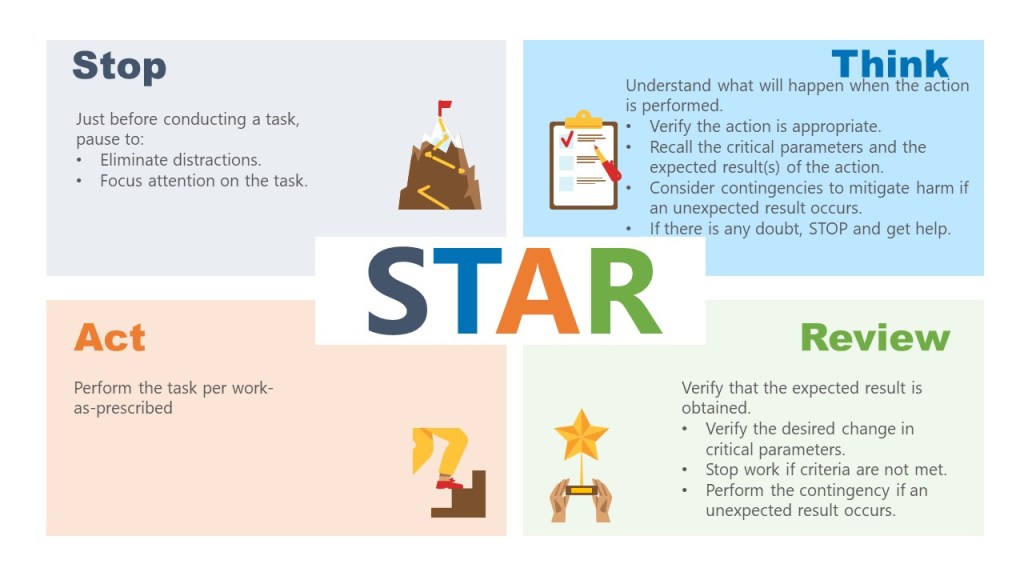
The memory aid STAR (stop, think, act, review) helps the user recall the thoughts and actions associated with self-checking.

  1. Stop – Just before conducting a task, pause to:
    • Eliminate distractions.
    • Focus attention on the task.
  2. Think – Understand what will happen when the action is performed.
    • Verify the action is appropriate.
    • Recall the critical parameters and the action’s expected result(s).
    • Consider contingencies to mitigate harm if an unexpected result occurs.
    • If there is any doubt, STOP and get help.
  3. Act – Perform the task per work-as-prescribed
  4. Review – Verify that the expected result is obtained.
    • Verify the desired change in critical parameters.
    • Stop work if criteria are not met.
    • Perform the contingency if an unexpected result occurs.